
Microwave-Activated Biomass-Derived Carbon for Smart Sensor Applications in Pollutant Detection and Drinking Water Purification
DOI:
https://doi.org/10.48048/tis.2026.12660Keywords:
Microwave activation, Biomass-derived carbon, Pollutant detection, Water purification, Smart sensorAbstract
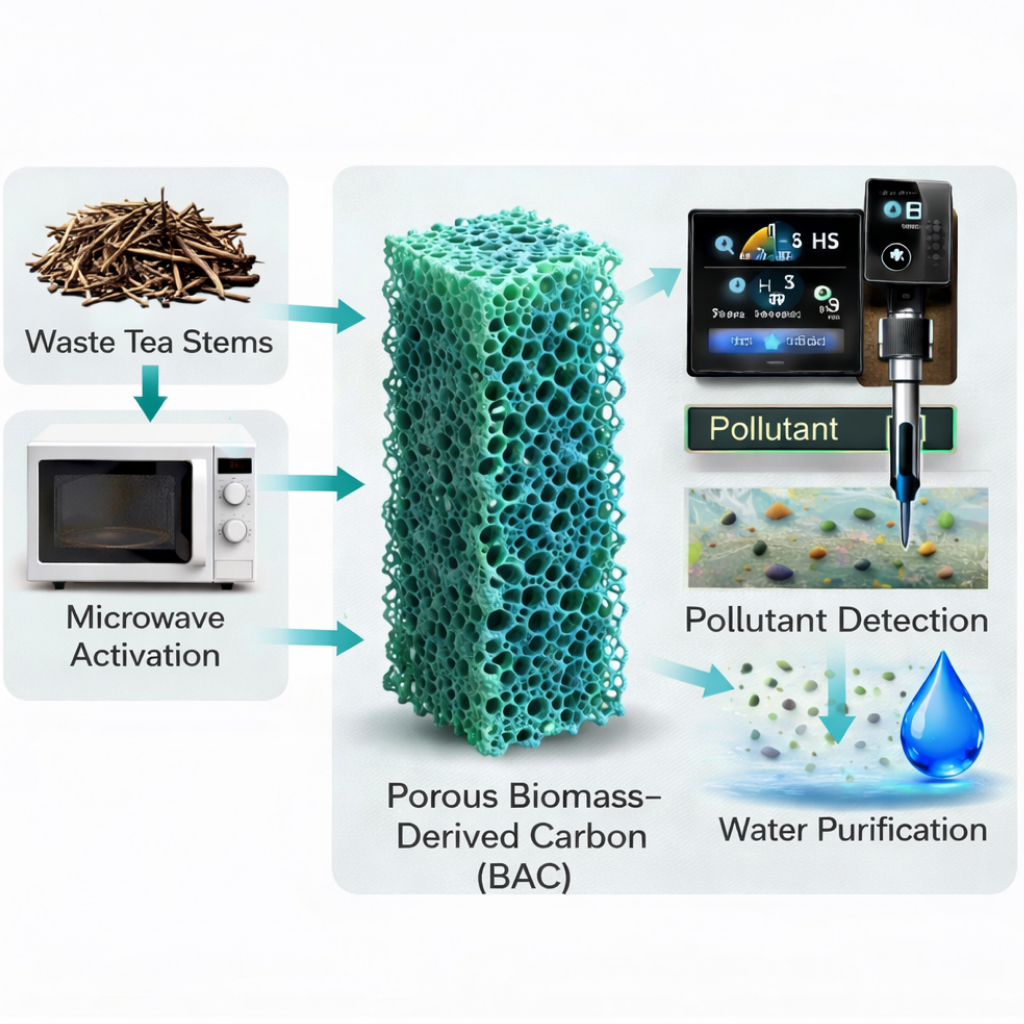
The increasing demand for sustainable materials in environmental monitoring has encouraged the use of biomass waste for the development of advanced sensor technology and water purification. This study reports the synthesis of activated carbon (AC) from tea stem biomass through activation with a microwave at 800 W for 120, 180, and 240 s. The variation in time was used to investigate the effect of activation time on structure, porosity, and electrochemical performance. X-ray diffraction confirmed a progressive transition from predominantly amorphous carbon at 120 s to a more regular graphite structure at 180 - 240 s. AC Tea Waste 180 s showed a balanced degree of crystallinity without significant structural fragmentation. SEM analysis showed that 180 s of activation resulted in a highly open and interconnected pore network, while shorter activation resulted in relatively closed pores, and longer activation caused surface cracks and particle fragmentation. Electrochemical testing in a 1 M Na₂SO₄ solution using a three-electrode configuration showed that AC activated for 180 s produced the highest specific capacitance of 735.76 F g⁻¹ at a current of 2.5 A g⁻¹, accompanied by better rate capability and lower charge transfer resistance compared to the 120- and 240- s samples. At the same activation time, the material achieved an energy density of 366.41 Ws g⁻¹ at a power density of 0.875 W g⁻¹, demonstrating a balance between energy and power for practical applications. The optimized AC exhibits a characteristic quasi-rectangular cyclic voltammetry profile of electrochemical double-layer capacitance, stable charge-discharge behavior, and favorable ion transport, confirming its suitability as a supercapacitor transducer layer. Furthermore, the high carbon purity and tailored pore structure of the 180 s sample provide strong sensitivity for pollutant detection and robust adsorption capacity for drinking water purification, demonstrating that tea stalk waste is a low-cost, renewable raw material for multifunctional smart sensors and clean water technology.
HIGHLIGHTS
- Microwave-assisted activation produced porous bio-carbon from tea stem waste.
- Optimal 180 s activation achieved 735.76 F g⁻¹ specific capacitance at 2.5 A g⁻¹.
- Enhanced pore structure and crystallinity with minimized energy consumption.
- Strong pollutant sensitivity and high adsorption capacity in water purification.
- Dual-function material enabling smart sensor and clean water integration.
GRAPHICAL ABSTRACT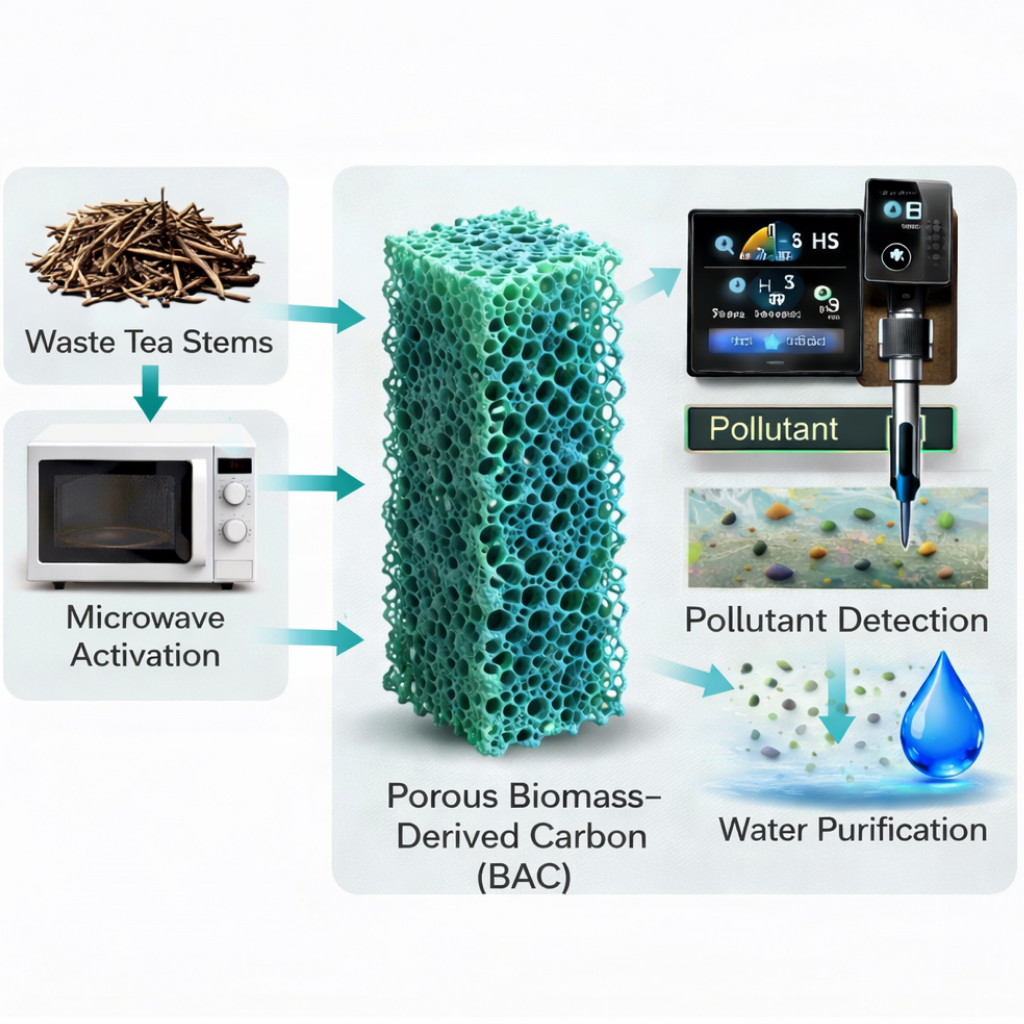
Downloads
References
LP Magagula, CM Masemola, MA Ballim, ZN Tetana, N Moloto and EC Linganiso. Lignocellulosic biomass waste-derived cellulose nanocrystals and carbon nanomaterials: A review. International Journal of Molecular Sciences 2022; 23(8), 4310.
F Vallejo, D Yánez, L Díaz-Robles, M Oyaneder, S Alejandro-Martín, R Zalakeviciute and T Romero. Valorizing biomass waste: Hydrothermal carbonization and chemical activation for activated carbon production. Biomass 2025; 5(3), 45.
MB Mosbah, L Mechi, R.Khiari and Y Moussaoui. Current State of Porous Carbon for Wastewater Treatment. Processes 2020; 8(12), 1651
A Kumar, R Aslam, C Verma and OM Rodríguez-Narváez. Activated carbon for environmental applications. In: C Verma and MA Quraishi (Eds.). Activated carbon. The Royal Society of Chemistry, London, 2023, p. 70-91.
AM Afridi, M Aktary, SS Shah, SM Sheikh, GJ Islam, MN Shaikh and MA Aziz. Advancing electrical engineering with biomass-derived carbon materials: Applications, innovations, and future directions. The Chemical Record 2024; 24(12), e202400144.
RO Gembo, S Odisitse and CK King’ondu. Transforming waste resources into efficient activated carbon for energy storage and environmental remediation: A comprehensive review. International Journal of Environmental Science and Technology 2024; 21(7), 6167-6206.
S Yarramsetti, M Girirajan, S Kalluri, S Sangaraju and PS Maram. Multifunctional activated carbon derived from novel biomass for high-performance energy storage applications: A sustainable alternative to fossil-fuel-derived carbon. Materials Chemistry and Physics 2024; 320, 129424.
P Das, V Chettri, S Ghosh and C Ghosh. Micromorphological studies of the leaf and stem of Camellia sinensis (L.) Kuntze with reference to their taxonomic significance. Microscopy Research and Technique; 86(4), 465-472.
R Crang, S Lyons-Sobaski and R Wise. Parenchyma, collenchyma, and sclerenchyma. Plant Anatomy 2018. https://doi.org/10.1007/978-3-319-77315-5_6
L Wu, D Xue, R Wen, X Jiang, L Jiao and H Chen. Production of activated carbon from tea. Recent advances in activated carbon: Synthesis, properties and applications. In: HS Min, HS Kusuma and YC Sharma (Eds.). Recent advances in activated carbon. CRC Press, Florida, 2024, p. 14.
S Ahmed, Z Ferdous and Fatema-Tuj-Zohra. Prospective application of eco-friendly banana peel reduced graphene oxide (BRGO) for aqueous Cr (VI) and acid dye adsorption: A waste utilization approach. Bioresource Technology Reports 2024; 27, 101936.
AA Ahmad, M Al-Raggad and N Shareef. Production of activated carbon derived from agricultural by-products via microwave-induced chemical activation: A review. Carbon Letters 2021; 31(5), 957-971.
X Qu, W Kang, C Lai, C Zhang and SW Hong. A simple route to produce highly efficient porous carbons recycled from tea waste for high-performance symmetric supercapacitor electrodes. Molecules 2022; 27, 791.
R Nandi, MK Jha, SK Guchhait, D Sutradhar and S Yadav. Impact of KOH activation on rice husk derived porous activated carbon for carbon capture at flue gas alike temperatures with high CO2/N2 Selectivity. ACS Omega 2023; 8(5), 4802-4812.
IG Dyachkova, DA Zolotov, AS Kumskov, IS Volchkov, VV Berestov and EV Matveev. Possibilities of the microwave method for the activation of carbon materials in comparison with the traditional thermal method. Physics-Uspekhi 2023; 66(12), 1248-1257.
W Hu, S Cheng, H Xia, L Zhang, X Jiang, Q Zhang and Q Chen. Waste phenolic resin derived activated carbon by microwave-assisted KOH activation and application to dye wastewater treatment. Green Processing and Synthesis 2019; 8(1), 408-415.
R Kasana, U Shashikumar, CM Hussain and S Chawla. Green carbon materials for sensing applications. ACS Symposium Series 2023; 1441, 163-179.
AM Pai, MM Shanbhag, T Maiyalagan, SA Alqarni and NP Shetti. Activated carbon synthesized from Arecanut catechu L. as a sustainable precursor intercalated TiO2 modified electrode for the detection of fungicide Dichlorophen. Diamond and Related Materials2023; 140(B), 110561.
I Neme, G Gonfa and C Masi. Activated carbon from biomass precursors using phosphoric acid: A review. Heliyon 2022; 8(12), e11940.
SM Yakout and G Sharaf El-Deen. Characterization of activated carbon prepared by phosphoric acid activation of olive stones. Arabian Journal of Chemistry 2016; 9, S1155-S1162.
L Nimah, SR Juliastuti and M Mahfud. Microwave-assisted synthesis, characterization, and performance assessment of lemongrass-derived activated carbon for removal of Fe and Mn from acid mine drainage. Journal of Renewable Materials 2025, 13(11), 2169-2190.
G Wang, X Duan, D Wang, X Dong and X Zhang. Polyvinylidene fluoride effects on the electrocatalytic properties of air cathodes in microbial fuel cells. Bioelectrochemistry 2018; 120, 138-144.
CVVM Gopi, AE Reddy, JS Bak, IH Cho and HJ Kim. One-pot hydrothermal synthesis of tungsten diselenide/reduced graphene oxide composite as advanced electrode materials for supercapacitors. Materials Letters 2018; 223, 57-60.
LG Schultz. Quantitative interpretation of mineralogical composition from X-ray and chemical data for the pierre shale. United States Government Printing Office, Washington DC, 1964, p. C1-C31.
C Choi, SD Seo, BK Kim and DW Kim. Enhanced lithium storage in hierarchically porous carbon derived from waste tea leaves. Scientific Reports 2016; 6(1), 39099.
MAA Mariah, K Rovina, JM Vonnie and KH Erna. Characterization of activated carbon from waste tea (Camellia sinensis) using chemical activation for removal of methylene blue and cadmium ions. South African Journal of Chemical Engineering 2023; 44, 113-122.
RK Mishra, B Singh and B Acharya. A comprehensive review on activated carbon from pyrolysis of lignocellulosic biomass: An application for energy and the environment. Carbon Resources Conversion 2024; 7(4), 100228.
AB Marahatta. XRD studies on metamorphic changes of the dissimilarly graphitized carbonaceous materials. Asian Journal of Applied Chemistry Research 2024; 15(4), 194-215.
L Lestari, S Raharjo, IN Sudiana, LO Rusman and S Manikam. Production and characterization of microwave-activated palm kernel shell (Elaeis Guineensis Jacq.) activated charcoal. Journal of World Science 2024; 3(9), 1198-1207.
E Taer, P Dewi, Sugianto, R Syech, R Taslim, Salomo, Y Susanti, A Purnama, Apriwandi, Agustino and RN Setiadi. The synthesis of carbon electrode supercapacitor from durian shell based on variations in the activation time. AIP Conference Proceedings 2018; 1927(1), 030026.
A Vakili, AA Zinatizadeh, Z Rahimi, S Zinadini, P Mohammadi, S Azizi, A Karami and M Abdulgader. The impact of activation temperature and time on the characteristics and performance of agricultural waste-based activated carbons for removing dye and residual COD from wastewater. Journal of Cleaner Production 2023; 382, 134899.
L Wu, D Xue, R Wen, X Jiang, L Jiao and H Chen. Production of activated carbon from tea. In: HS Min, HS Kusuma and YC Sharma (Eds.). Recent advances in activated carbon: synthesis, properties and applications, CRC Press, London, 2024, p. 13-26.
S Bhoyate, CK Ranaweera, C Zhang, T Morey, M Hyatt, PK Kahol, M Ghimire, SR Mishra and RK Gupta. Eco‐friendly and high performance supercapacitors for elevated temperature applications using recycled tea leaves. Global Challenges 2017; 1(8), 1700063.
H Hasanah and H Aziz. Synthesis of activated carbon from waste tea by koh activation as high performance supercapacitors electrodes. Journal of Chemical and Pharmaceutical Research 2020; 12(6), 6-12.
K Mensah-Darkwa, FO Agyemang, S Akromah, EK Arthur, F Abdallah and E Gikunoo. A comparative study on the performance of activated carbon electrodes and activated carbon/titanium dioxide nanotubes hybrid electrodes. Scientific African 2021; 12, 00786.
M Rosi, MNZ Fatmizal, DH Siburian, A Ismardi and NH Abdullah. Electrochemical properties of activated carbon electrodes for supercapacitor application: the effect of various electrolyte concentrations of Na2SO4. Jurnal Ilmiah Pendidikan Fisika Al-Biruni 2023; 12(2), 243-250.
A Apriwandi, E Taer and R. Farma. Analysis of cyclic voltammetry dan galvanostatic charge discharge electrode supercapacitor based on activated carbon from Kepok Banana Leaf (Musa balbisiana). Journal of Aceh Physics Society 2021; 10(4), 94-101.
Y Zhang, X Li, Z Li and F Yang. Evaluation of electrochemical performance of supercapacitors from equivalent circuits through cyclic voltammetry and galvanostatic charge/discharge. Journal of Energy Storage 2024; 86(A), 111122.
M Mehmandoust, G Li and N Erk. Biomass-derived carbon materials as an emerging platform for advanced electrochemical sensors: recent advances and future perspectives. Industrial & Engineering Chemistry Research 2022; 62(11), 4628-4635.
KKR Reddygunta, R Beresford, L Šiller, L Berlouis and A Ivaturi. Activated carbon utilization from corn derivatives for High-energy-density flexible supercapacitors. Energy and Fuels 2023; 37(23), 19248-19265.
Published
How to Cite
Issue
Section
License
Copyright (c) 2025 Walailak University

This work is licensed under a Creative Commons Attribution-NonCommercial-NoDerivatives 4.0 International License.





