
Controlled Thermal Oxidation of TiO2-MXene: A Scalable Annealing Strategy for High-Performance Asymmetric Supercapatteries
DOI:
https://doi.org/10.48048/tis.2026.12134Keywords:
TiO2 MXene, Controlled thermal oxidation, Annealing strategy, Asymmetric supercapattery, Faradaic performance, Energy density, Power density, Cycle stability, Scalable processAbstract
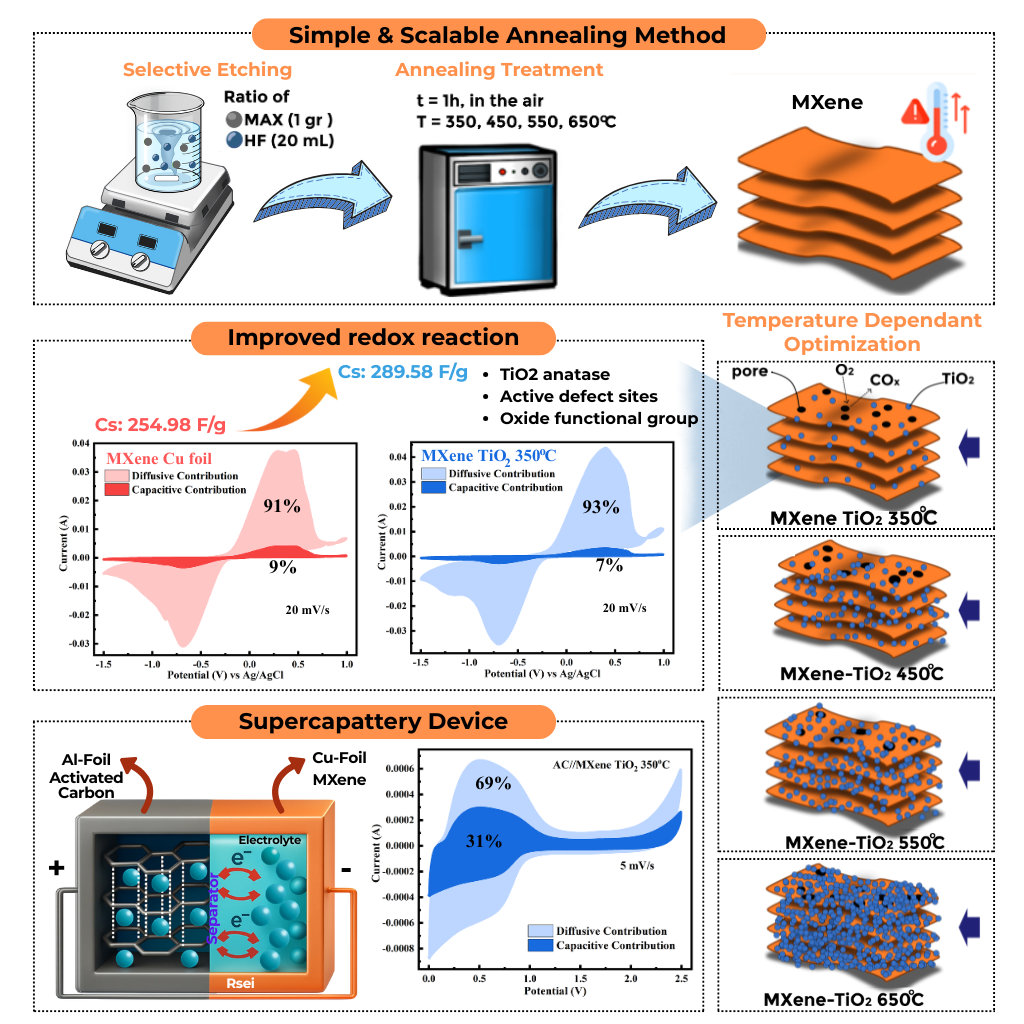
Enhancing the faradaic storage mechanism, stability, high power density, and energy density of energy storage requires further development of MXene, an oxidation-prone material, while preserving its interlayer structure and stability from restacking and excessive oxidation. This work presents a novel controlled thermal oxidation strategy, a scalable single-step annealing method to incorporate TiO2 into MXene and engineer its surface chemistry without multi-step synthesis and other chemical additions. It has been successfully established that anatase TiO2, structural defects, and oxide functional groups, which are critical for enhancing the redox reaction kinetics formed by the annealing treatment in the temperature range of 350 - 650 °C under air conditions. Among the annealed samples, TiO2-modified MXene treated at 350 °C exhibited the most promising electrochemical performance. Its effective redox reactions demonstrated a battery-type behavior, dominated by diffusion-controlled charge storage, instead of the typical capacitive behavior driven by surface area. This was owing to an optimal balance between TiO2 particle formation and the surface functional groups. Excessive oxidation at higher temperatures results in predominant TiO2 formation, blocking interlayer spacing, and reducing the specific surface area. The specific capacitance (Cs) of MXene TiO2 at 350 °C increases by up to 13% from the Cs of MXene reached 289.58 F/g at a scan rate of 20 mV/s, indicating superior electrochemical performance. Furthermore, an asymmetric supercapattery was manufactured by pairing MXene TiO2 350°C with activated carbon (AC) as a practical approach to improving the energy density without sacrificing power density or capacity retention of the device. AC//MXene TiO2 350 °C supercapattery demonstrates remarkable performance with a Cs of 49.42 F/g, energy density (ED) of 32.88 Wh/kg, and power density (PD) of 700.38 W/kg. Furthermore, it also demonstrated exceptional cycle stability (retaining 92% of its capacity after 5,000 cycles), and reduced resistance (equivalent series resistance (ESR), charge transfer resistance (Rct), and ion diffusion resistance), outperforming traditional AC-based supercapatteries. These findings highlight the novelty of controlled thermal oxidation as a simple yet effective route for engineering high-performance TiO2-MXene-based electrodes for advanced energy storage systems.
HIGHLIGHTS
- A Novel Scalable Strategy: Introduces controlled thermal oxidation in air as a simple and scalable annealing method to engineer the surface chemistry and structure of MXene strategically.
- Temperature-Dependent Optimization: Reveals that annealing temperature precisely controls the anatase TiO2 crystallization and functional group composition, with 350 °C identified as the optimal condition to balance TiO2 formation and prevent pore blockage.
- Transition to Battery-Type Behavior: Successfully transforms the Mxene’s charge storage mechanism from capacitive to dominant diffusion-controlled, battery-type behavior, enhancing faradaic activity.
- Superior MXene TiO2 Performance: MXene TiO2 350 °C single electrode enhancing the electrochemical performance by approximately ~13% (from 254.98 to 58 F/g).
- Outstanding Supercapattery Performance and Stability: AC//MXene TiO2 350 °C exhibits excellent performance (Cs 42 F/g, ED 32.88 Wh/kg, and PD 700.38 W/kg) and stability (capacity retention remains 92% after 5,000 cycles).
GRAPHICAL ABSTRACT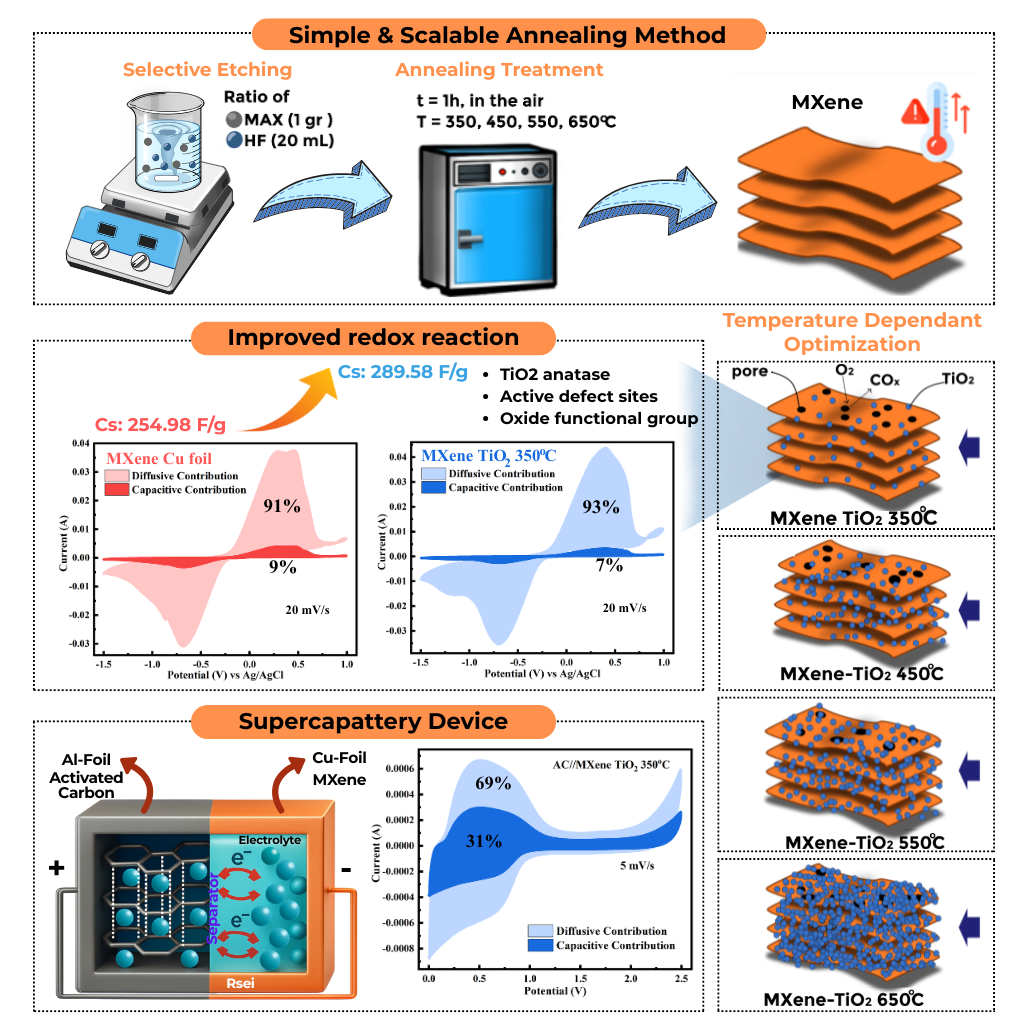
Downloads
References
S Jayakumar, PC Santhosh, MM Mohideen and AV Radhamani. A comprehensive review of metal oxides (RuO2, Co3O4, MnO2 and NiO) for supercapacitor applications and global market trends. Journal of Alloys and Compounds 2023; 976, 173170.
A Sreedhar, MR Pallavolu and JS Noh. Progress in surface and interlayer distance modulated 2D Ti3C2 MXenes for potential flexible supercapacitors: A review. Applied Materials Today 2023; 35, 101942.
D Meena, R Kumar, S Gupta, O Khan, D Gupta and M Singh. Energy storage in the 21st century: A comprehensive review on factors enhancing the next-generation supercapacitor mechanisms. Journal of Energy Storage 2023; 72, 109323.
Q Guo, P Fan, Y Zhang, L Guan, H Wang, A Croft and GZ Chen. Alkali and alkaline earth metals in liquid salts for supercapatteries. RSC Sustainability 2024; 2, 101-124
MI Rosli, FS Omar, R Awang and NM Saidi. Optimization of heating temperature on the growth of manganese sulfide nanosheets binder-free electrode for supercapattery. Ionics 2024; 30(1), 407-420.
K Karuppasamy, D Vikraman, R Bose, S Hussain, P Santhoshkumar, R Manikandan, J Jung, S Alameri, A Alfantazi and HS Kim. Unveiling the redox electrochemical kinetics of interconnected wrinkled microspheres of binary Cu2-xSe/Ni1-xSe as battery-type electrode for advanced supercapatteries. Journal of Colloid and Interface Science 2024; 654(B), 1098-1110.
Y Zhou, L Yin, S Xiang, S Yu, HM Johnson, S Wang, J Yin, J Zhao, Y Luo and PK Chu. Unleashing the potential of mxene-based flexible materials for high-performance energy storage devices. Advanced Science 2024; 11(3), 2304874.
Y Guo, Z Du, Z Cao, B Li and S Yang. MXene derivatives for energy storage and conversions. Small Methods 2023; 7(8), 2201559.
S Panda, K Deshmukh, SKK Pasha, J Theerthagiri, S Manickam and MY Choi. MXene based emerging materials for supercapacitor applications: Recent advances, challenges, and future perspectives. Coordination Chemistry Reviews 2022; 462, 214518.
S Delgado, Y Remedios-Díaz, JC Calderón, S Díaz-Coello, MC Arévalo, G García and E Pastor. Catalytic activity of 2D MXenes toward electroreduction processes: Oxygen reduction and hydrogen evolution reactions. International Journal of Hydrogen Energy 2024; 55, 1050-1061.
P Das, TK Mondal, S Bera, S Das, HL Hsu, YK Su and SK Saha. Facile in-situ growth of spore-like silica on layered MXene sheets for potential application in Supercapacitor. Electrochimica Acta 2023; 465, 142983.
WS Poh, WJ Yiang, WJ Ong, PL Show and CY Foo. Enhancing MXene-based supercapacitors: Role of synthesis and 3D architectures. Journal of Energy Chemistry 2024; 91, 1-26.
S Park, SH Choi, JM Kim, S Ji, S Kang, S Yim, S Myung, SK Kim, SS Lee and KS An. Nanoarchitectonics of MXene derived TiO2/graphene with vertical alignment for achieving the enhanced supercapacitor performance. Small 2023; 20(6), 2305311.
AB Tambe, SS Arbuj, GG Umarji, NS Jawale, SB Rane, SK Kulkarni and BB Kale. 2D layered MXene/TiO2 nano-heterostructures for photocatalytic H2 generation. Graphene and 2D Materials 2022; 7(3), 91-106.
K Xie, J Wang, K Xu, Z Wei, M Zhang and J Zhang. In-situ synthesis of fluorine-free MXene/TiO2 composite for high-performance supercapacitor. Arabian Journal of Chemistry 2024; 17(2), 105551.
T Jiang, Y Wang and GZ Chen. Electrochemistry of titanium carbide MXenes in supercapacitor. Small Methods 2023; 7(8), 2201724.
G Sahu, A Balhara, L Besra, D Nechiyil, K Sudarshan, J Prakash, SK Gupta and S Chatterjee. Defect enriched luminescent MXene-derived TiO for supercapacitors. Inorganic Chemistry Communications 2024; 170, 113462.
W Chen, J Tang, P Cheng, Y Ai, Y Xu and N Ye. 3D porous MXene (Ti3C2Tx) prepared by alkaline-induced flocculation for supercapacitor electrodes. Materials 2022; 15(3), 925.
S Kumar, S Aftab, T Singh, M Kumar, S Kumar and Y Seo. Charge storage improvement in uniformly grown TiO2 on Ti3C2Tx MXene surface. Journal of Alloys and Compounds 2023; 968, 172181.
J Hong, C Paeng, S Park, I In, H Lee, NB Velhal, TH Yun, C Jo and C Yim. Flashlight treatment for instantaneous structuring of dense MXene film into porous MXene/TiO2 nanocomposite for lithium-ion battery anodes. Chemical Engineering Journal 2024; 484, 149598.
EP Simonenko, IA Nagornov, AS Mokrushin, SV Kashevsky, YM Gorban, TL Simonenko, NP Simonenko and NT Kuznetsov. Low temperature chemoresistive oxygen sensors based on titanium-containing Ti2CTx and Ti3C2Tx MXenes. Materials 2023; 16(13), 4506.
AA Shamsabadi, H Fang, D Zhang, A Thakur, CY Chen, A Zhang, H Wang, B Anasori, M Soroush, Y Gogotsi and Z Fakhraai The evolution of MXenes conductivity and optical properties upon heating in air. Small Methods 2023; 7(10), 2300568.
Y Xu, W Lu, G Xu and TW Chou. Structural supercapacitor composites: A review. Composites Science and Technology 2021; 204, 108636.
S Banerjee, B De, P Sinha, J Cherusseri and KK Kar. Applications of supercapacitors. In: K Kar (Ed.). Handbook of nanocomposite supercapacitor materials I: Characteristics. Springer, Cham, Switzerland, 2020.
X Zhao, Z Wang, J Dong, T Huang, Q Zhang and L Zhang. Annealing modification of MXene films with mechanically strong structures and high electrochemical performance for supercapacitor applications. Journal of Power Sources 2020; 470, 228356.
NM Keppetipola, M Dissanayake, P Dissanayake, B Karunarathneb, MA Dourges, D Talagaa, L Servanta, C Olivier, T Toupance, S Uchida, K Tennakonebd, GRA Kumara and L Cojocaru. Graphite-type activated carbon from coconut shell:A natural source for eco-friendly non-volatile storage devices. RSC Advances 2021; 11, 2854-2865
BJ Choudhury, HH Muigai, P Kalita and VS Moholkar. Biomass blend derived porous carbon for aqueous supercapacitors with commercial-level mass loadings and enhanced energy density in redox-active electrolyte. Applied Surface Science 2022; 601, 154202.
S Park, SH Choi, JM Kim, S Ji, S Kang, S Yim, S Myung, SK Kim, SS Lee and KS An. Nanoarchitectonics of MXene derived TiO2/graphene with vertical alignment for achieving the enhanced supercapacitor performance. Small 2024; 20(6), 2305311.
A Raza, A Farid, A Rasheed, M Yousaf, IA Khan, KMH Mohammed and MA Ghanem. Home-made chemical vapor deposition-based synthesis of binder-free nanostructured magnesium-molybdenum-sulfide electrode materials for supercapacitor application. Journal of Physics and Chemistry of Solids 2024; 192, 112093.
S Tuntithavornwat, C Saisawang, T Ratvijitvech, A Watthanaphanit, M Hunsom and AM Kannan. Recent development of black TiO2 nanoparticles for photocatalytic H2 production: An extensive review. International Journal of Hydrogen Energy 2024; 55, 1559-1593.
X Zhang, J Miao, P Zhang, Q Zhu, M Jiang and B Xu. 3D crumbled MXene for high-performance supercapacitors. Chinese Chemical Letters 2020; 31(9), 2305-2308.
RA Soomro, P Zhang, B Fan, Y Wei and B Xu. Progression in the oxidation stability of MXenes. Nano-Micro Letters 2023; 15(1), 108.
T Parker, D Zhang, D Bugallo, K Shevchuk, M Downes, G Valurouthu, A Inman, B Chacon, T Zhang, AJ Drexel, CE Shuck, YJ Hu and Y Gogotsi. Fourier-transform infrared spectral library of MXenes. Chemistry of Materials 2024; 36(17), 8437-8446.
M Hou, B Miao, M Asad, Y Zhang, Q Chen, M Zhang, Z Bai, Y Zhao and G Liu. Efficient photocatalytic degradation of aqueous organic pollutants by using an advanced TiO2/Ti3C2/montmorillonite composites. Journal of Alloys and Compounds 2024; 976, 173362.
P Karthikeyan, K Ramkumar, K Pandi, A Fayyaz, S Meenakshi and CM Park. Effective removal of Cr(VI) and methyl orange from the aqueous environment using 2-dimensional (2D) Ti3C2Tx MXene nanosheets. Ceramics International 2021; 47(3), 3692-3698.
M AhadiParsa, A Dehghani and B Ramezanzadeh. Titanium carbide-based (Ti3C2) MXene@Zn-doped-S-polyaniline nanosheets: Toward thermo-mechanical and UV-shielding properties enhancement. Journal of the Taiwan Institute of Chemical Engineers 2024; 156, 105364.
K Gothandapani, GT Selvi, RS Jennifer, V Velmurugan, S Pandiaraj, M Muthuramamoorthy, S Pitchaimuthu, V Raghavan, ACJ Malathi, A Alodhayb and AN Grace. Ni-Ti3C2 MXene composite derived from Ni-metal organic framework for electrochemical hydrogen evolution reaction in acidic and alkaline medium. International Journal of Hydrogen Energy 2024; 52(D), 1164-1171.
T Cygan, J Wozniak, M Petrus, A Lachowski, W Pawlak, B Adamczyk-Cieślak, B Adamczyk-Cieślak, A Jastrzębska, A Rozmysłowska-Wojciechowska, T Wojciechowski, W Ziemkowska and A Olszyna. Microstructure and mechanical properties of alumina composites with addition of structurally modified 2d Ti3C2 (Mxene) phase. Materials 2021; 14(4), 829.
H Xue, Q Yan, L Chen, Y Wang, X Xie and J Sun. Ti3C2 MXene assembled with TiO2 for efficient photocatalytic mineralization of gaseous o-xylene. Applied Surface Science 2023; 608, 155136.
R Bardestani, GS Patience and S Kaliaguine. Experimental methods in chemical engineering: Specific surface area and pore size distribution measurements - BET, BJH, and DFT. The Canadian Journal of Chemical Engineering 2019; 97(11), 2781-2791.
J Yu, M Zeng, J Zhou, H Chen, G Cong, H Liu, M Ji, C Zhu and J Xu. A one-pot synthesis of nitrogen doped porous MXene/TiO2 heterogeneous film for high-performance flexible energy storage. Chemical Engineering Journal 2021; 426, 130765.
S Ghotia, A Kumar, V Sudarsan, N Dwivedi, S Singh and P Kumar. Multilayered Ti3C2Tx MXenes: A prominent materials for hydrogen storage. International Journal of Hydrogen Energy 2024; 52, 100-107.
A Numan, S Rafique, M Khalid, HA Zaharin, A Radwan, NA Mokri, OP Ching and R Walvekar. Microwave-assisted rapid MAX phase etching and delamination: A paradigm shift in MXene synthesis. Materials Chemistry and Physics 2022; 288, 126429.
JB Lee, GH Choi and PJ Yoo. Oxidized-co-crumpled multiscale porous architectures of MXene for high performance supercapacitors. Journal of Alloys and Compounds 2021; 887, 161304.
M Cao, F Wang, L Wang, W Wu, W Lv and J Zhu. Room temperature oxidation of Ti3C2 MXene for supercapacitor electrodes. Journal of The Electrochemical Society 2017; 164(14), A3933.
H Hassan, U Romman, MW Iqbal, AM Afzal, T Yaseen, MA Sunny, S Mohammad, NH Alotaibi and M Manzoor. Synergistic hybridization of Mn-MOF@rGO and Ti3C2 for high-performance supercapattery devices and hydrogen evolution reaction. Materials Chemistry and Physics 2024; 327, 129914.
G Sriram, G Hegde, K Dhanabalan, Y Kalegowda, D Mouraliraman, RS Vishwanath, M Kurkuri and TH Oh. Recent trends in hierarchical electrode materials in supercapacitor: Synthesis, electrochemical measurements, performance and their charge-storage mechanism. Journal of Energy Storage 2024; 94, 11254.
RRB Rakhi, B Ahmed, MN Hedhili, DH Anjum and HN Alshareef. Effect of Postetch annealing gas composition on the structural and electrochemical properties of Ti2CTx MXene electrodes for supercapacitor applications. Chemistry of Materials 2015; 27(15), 5314-5323.
Q Wang, Z Zhang, L Wang, Y Zhang, X Zhou and G Ma. Ultrafast fabrication of TiO2-inlaid multilayered carbon for supercapacitor. ChemistrySelect 2018; 3(38), 10811-10814.
M Ahmed, N Ahmed, H Ahmad, S Bashir, R Subramaniam and G Ali. A comparative study on exploring sputtered titanium nitride thin films for high-performance supercapacitors. Journal of Energy Storage 2025; 105, 114712.
R Ismail, NHN Azman, D Mohanadas, MN Mustafa, MAAM Abdah, V Raman, J Abdullah and Y Sulaiman. Facile ultrasonication synthesis of MXene/HKUST-1 composite as positive electrode for supercapattery. Journal of Energy Storage 2024; 94, 112461.
AH Rumman, S Mahmud, NT Mim, J Akter, A Roy, AR Nirjhar, NA Dipon, S Islam, A Gafur, AN Ahmed and K Shorowordi. Cold sintered TiO2-Ti3C2Tx MXene electrode materials. Materials Advances 2025; 6(18), 6454-6468.
H Liu, R Hu, J Qi, Y Sui, Y He, Q Meng, F Wei, Y Ren and Y Zhao. A facile method for synthesizing NiS nanoflower grown on MXene (Ti3C2Tx) as positive electrodes for ‘supercapattery’. Electrochimica Acta 2020; 353, 136526.
LA Santa-Cruz, FC Tavares, LF Loguercio, CIL Dos Santos, RA Galvão, OAL Alves, MZ Oliveira, RM Torresi and G Machado. Electrochemical impedance spectroscopy: From breakthroughs to functional utility in supercapacitors and batteries - a comprehensive assessment. Physical Chemistry Chemical Physics 2024; 26, 25748-25761
M Rizan, V Samaje, K Kumara, KN Ravindra and S Thiyagaraj. Hydrothermal synthesis of Bi2S3 nanoparticle as a prospective electrode for supercapacitor. Next Materials 2024; 2, 100081.
Published
How to Cite
Issue
Section
License
Copyright (c) 2025 Walailak University

This work is licensed under a Creative Commons Attribution-NonCommercial-NoDerivatives 4.0 International License.





