
Impact of YSZ Solid Electrolyte on the Efficiency and Photoresponse of Dye-Sensitized Solar Cells
DOI:
https://doi.org/10.48048/tis.2026.11651Keywords:
DSSC, Dye N719, TiO2 mesoporous, Solid electrolyte, Yttria-stabilized zirconiaAbstract
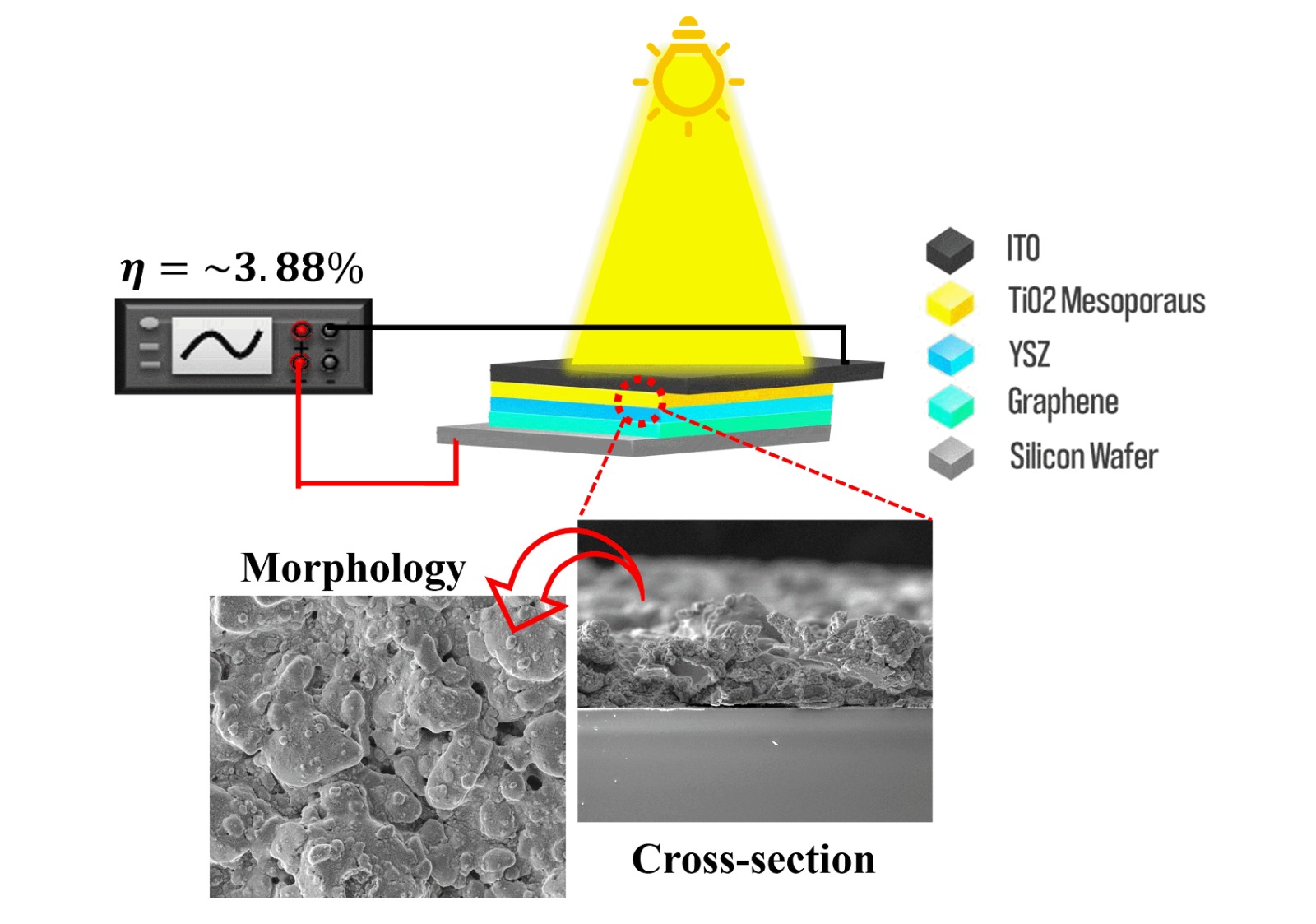
Dye-sensitized solar cells (DSSCs) are an alternative method for converting solar energy into electrical energy and have attracted significant interest due to their environmentally friendly production process, relatively low fabrication cost, and competitive efficiency. This study aims to investigate the efficiency and photoresponse of DSSCs using yttria-stabilized zirconia (YSZ) as a solid electrolyte to replace the conventional liquid electrolyte. The DSSC consists of 4 main components: A photoanode made from mesoporous TiO2, a counter electrode using carbon/graphene, the dye N719, and YSZ solid electrolyte. Mesoporous TiO2, YSZ, and graphene were deposited using screen printing, doctor blade, and knife coating methods, while the dye N719 was injected into the film. The samples were characterized using XRD, SEM, and UV-Vis spectroscopy. Based on the analysis result, with the increase of the thickness from 5 - 25 μm, the crystal size was increased from 6.37 - 6.92 nm and porosity was decreased from 63.5% - 58.0%, while the band gap increased (3.34 - 3.37 eV), respectively. The solar cell efficiency and photoresponse were measured using a solar simulator. The highest efficiency achieved was 3.88% for the YSZ thickness. Additionally, the TiO2/YSZ film demonstrated a rapid response to light exposure, making it a promising material for light sensors.
HIGHLIGHTS
- Detailed fabrication methods of DSSC-based solid electrolytes have been provided.
- Yttria stabilized zirconia (YSZ) as solid electrolytes were used in DSSC.
- The most optimum solid electrolyte thickness for DSC has been investigated.
- DSSC based on YSZ solid electrolytes showed an efficiency of 3.88%.
GRAPHICAL ABSTRACT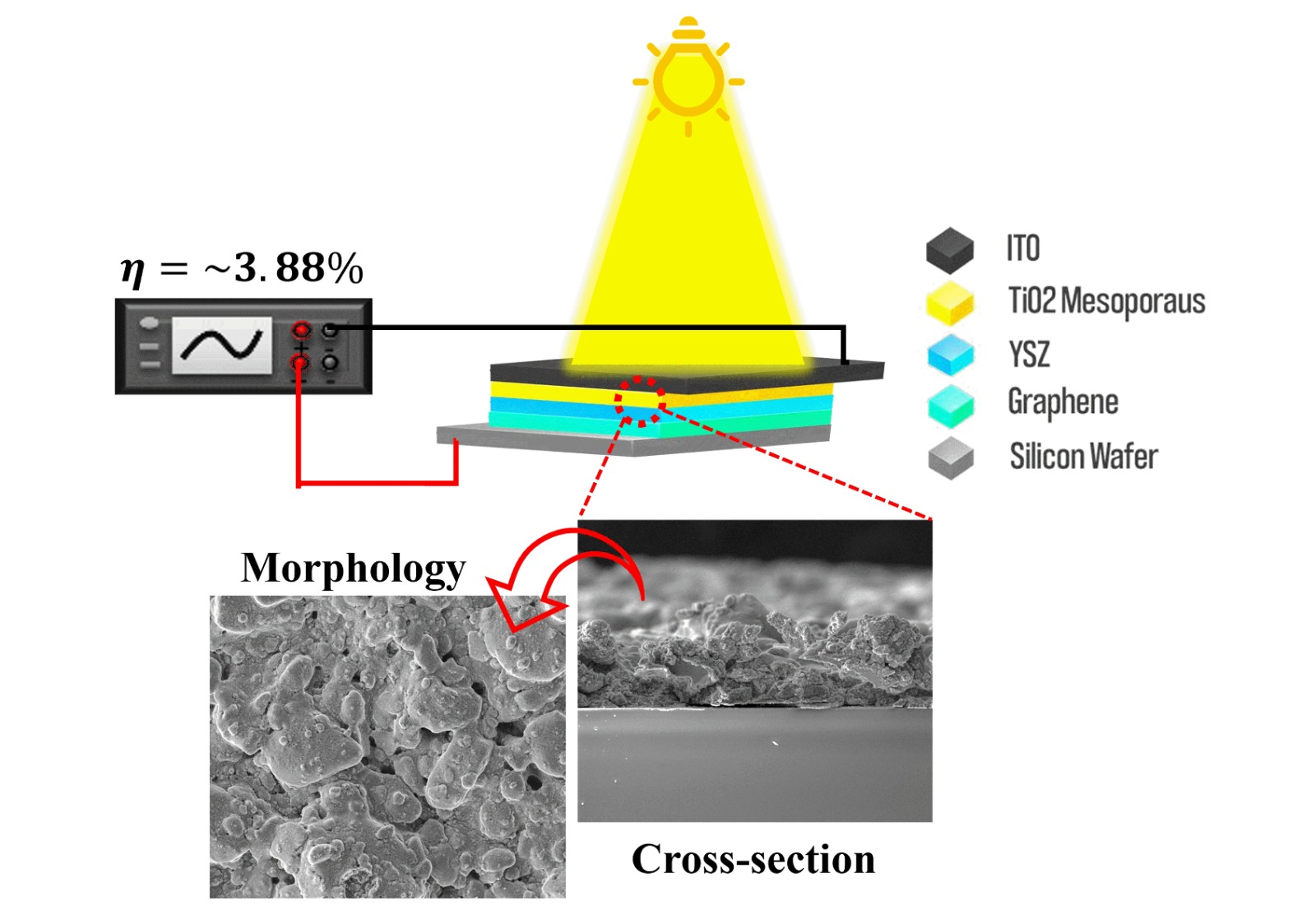
Downloads
References
MJB Kabeyi and OA Olanrewaju. Sustainable energy transition for renewable and low carbon grid electricity generation and supply. Frontiers in Energy Research 2022; 9, 743114.
A Rahman, O Farrok and MM Haque. Environmental impact of renewable energy source based electrical power plants: Solar, wind, hydroelectric, biomass, geothermal, tidal, ocean, and osmotic. Renewable and Sustainable Energy Reviews 2022; 161, 112279.
R Sasikumar, S Thirumalaisamy, B Kim and B Hwang. Dye-sensitized solar cells: Insights and research divergence towards alternatives. Renewable and Sustainable Energy Reviews 2024; 199, 114549.
NH Rased, B Vengadaesvaran, SRS Raihan and NA Rahim. Introduction to solar energy and its conversion into electrical energy by using dye-sensitized solar cells. In: SJ Dhoble, NT Kalyani, B Vengadaesvaran and AK Arof (Eds.). Energy materials. Elsevier, Amsterdam, Netherlands, 2021, p. 139-178.
G Richhariya, A Kumar, AK Shukla, KN Shukla and BC Meikap. Effect of different counter electrodes on power conversion efficiency of DSSCs. Journal of Electronic Materials 2023; 52(1), 60-71.
H Zhou, M Aftabuzzaman, Masud, SH Kang and HK Kim. Key materials and fabrication strategies for high-performance dye-sensitized solar cells: Comprehensive comparison and perspective. ACS Energy Letters 2025; 10(2), 881-895.
CY Hsu, HNK Al-Salman, ZH Mahmoud, RM Ahmed and AF Dawood. Improvement of the photoelectric dye sensitized solar cell performance using Fe/S-TiO2 nanoparticles as photoanode electrode. Scientific Reports 2024; 14(1), 4931.
V Paranthaman, KS Devi, KB Bhojanaa, V Aravindan, G Raman, RS Kumar, C Doroody, RK Rajamony and PS Krishnan. Experimental and theoretical insights into enhanced light harvesting in dye-sensitized solar cells via Au@ TiO2 core-shell and BaTiO3 nanoparticles. Journal of the Taiwan Institute of Chemical Engineers 2024; 165, 105778.
V Leela Devi, D De, P Kuchhal and RK Pachauri. Photovoltaic performance of TiO2 and ZnO nanostructures in anthocyanin dye-sensitized solar cells. Clean Energy 2024; 8(5), 144-156.
Y Yan, Y Zhang, Y Zhao, F Ding, Y Lei, Y Wang, J Zhou and W Kang. Review on TiO2 nanostructured photoanode and novel dyes for dye-sensitized solar cells application. Journal of Materials Science 2025; 60, 4975-5005.
Y Zhang, H Tao, H Wang, J Hao, Y Liu and Y Yuan. Sol-gel synthesis of magnesium doped TiO2 thin film and its application in dye sensitized solar cell. Optical Materials 2025; 158, 116446.
CP Pasigon. Performance of dye-sensitized solar cell with carrot-based dyes in deep eutectic solvent and KI/I2 electrolytes. Trends in Sciences 2025; 22(7), 10041.
BK Korir, JK Kibet and SM Ngari. A review on the current status of dye‐sensitized solar cells: Toward sustainable energy. Energy Science & Engineering 2024; 12(8), 3188-3226.
AI Rafieh, P Ekanayake, H Nakajima, AH Mahadi, M Abu, MF Don and CM Lim. Enhanced N719 dye adsorption onto Ca and La doped mesoporous TiO2 anodes for Dye-sensitized solar cells. Journal of Electronic Materials 2021; 50(10), 5788-5795.
SJ Sharma, J Prasad, SS Soni and N Sekar. The impact of anchoring groups on the efficiency of dye-sensitized solar cells: 2-cyanoacrylic acid vs. ethyl 2-cyanoacrylate. Journal of Photochemistry and Photobiology A: Chemistry 2023; 444, 114915.
T Xia, J Cao, MA Bissett, H Waring, Y Xiang, G Pinter, AV Kretinin, P Yang, Y Zhu, X Zhao, SA Hodge, T Thomson and IA Kinloch. Graphenization of graphene oxide films for strongly anisotropic thermal conduction and high electromagnetic interference shielding. Carbon 2023; 215, 118496.
VAF Samson, SB Bernadsha, JF Britto, MVA Raj and J Madhavan. Synthesis of rGO/NiFe2O4 nanocomposite as an alternative counter electrode material to fabricate Pt-free efficient dye sensitized solar cells. Diamond and Related Materials 2022; 130, 109406.
SN Tamilselvan and S Shanmugan. Towards sustainable solar cells: Unveiling the latest developments in bio-nano materials for enhanced DSSC efficiency. Clean Energy 2024; 8(3), 238-257.
ZY Yang, LJ Jin, GQ Lu, QQ Xiao, YX Zhang, L Jing, XX Zhang, YM Yan and KN Sun. Sponge‐templated preparation of high surface area graphene with ultrahigh capacitive deionization performance. Advanced Functional Materials 2014; 24(25), 3917-3925.
M Kashif, E Jafaar, SK Sahari, FW Low, ND Hoa, A Ahmad, A Abbas, Z Ngaini, M Shafa and A Qurashi. Organic sensitization of graphene oxide and reduced graphene oxide thin films for photovoltaic applications. International Journal of Energy Research 2021; 45(6), 9657-9666.
Y Zhang, B Liu, L Xu, Z Ding, R Yang and S Wang. Failure mechanism analysis and emerging strategies for enhancing the photoelectrochemical stability of photoanodes. ChemSusChem 2025; 18(2), e202401420.
DJ Brett, A Atkinson, NP Brandon and SJ Skinner. Intermediate temperature solid oxide fuel cells. Chemical Society Reviews 2008; 37(8), 1568-1578.
SPS Badwal. Zirconia-based solid electrolytes: Microstructure, stability and ionic conductivity. Solid State Ionics 1992; 52(1-3), 23-32.
Y Wang, Y Wu, Z Wang, L Chen, H Li and F Wu. Doping strategy and mechanism for oxide and sulfide solid electrolytes with high ionic conductivity. Journal of Materials Chemistry A 2022; 10(9), 4517-4532.
I Danilenko, O Gorban, A Shylo, L Akhkozov, S Gorban, G Lasko and V Mysovets. Determination of the nature of the co-doping effect on the structure, mechanical properties and ionic conductivity of SOFC electrolyte based on YSZ. Solid State Ionics 2024; 412, 116581.
AA Solovyev, NS Sochugov, SV Rabotkin, AV Shipilova, IV Ionov, AN Kovalchuk and AO Borduleva. Application of PVD methods to solid oxide fuel cells. Applied Surface Science 2014; 310, 272-277.
R Raza, Z Gao, T Singh, G Singh, S Li and B Zhu. LiAlO2-LiNaCO3 composite electrolyte for solid oxide fuel cells. Journal of Nanoscience and Nanotechnology 2011; 11(6), 5402-5407.
I Sta, M Jlassi, M Hajji, MF Boujmil, R Jerbi, M Kandyla, M Kompitsas and H Ezzaouia. Structural and optical properties of TiO2 thin films prepared by spin coating. Journal of Sol-Gel Science and Technology 2014; 72, 421-427.
C Wang, L Yin, L Zhang, Y Qi, N Lun and N Liu. Large scale synthesis and gas-sensing properties of anatase TiO2 3-dimensional hierarchical nanostructures. Langmuir 2010; 26(15), 12841-12848.
N Mufti, IK Laila, R Idiawati, A Fuad, A Hidayat and A Taufiq. The effect of growth temperature on the characteristics of ZnO Nanorods and its optical properties. Journal of Physics: Conference Series 2018; 1057(1), 012005.
N Ishizawa, Y Matsushima, M Hayashi and M Ueki. Synchrotron radiation study of yttria-stabilized zirconia, Zr0.758Y0.242 O1.879. Acta Crystallographica Section B, Structural Science 1999; 55(5), 726-735.
H Wang, RB Dinwiddie and WD Porter. Development of a thermal transport database for air plasma sprayed ZrO2-Y2O3 thermal barrier coatings. Journal of Thermal Spray Technology 2010; 19, 879-883.
Y Zhang, G Li, Y Wu, Y Luo and L Zhang. The formation of mesoporous TiO2 spheres via a facile chemical process. The Journal of Physical Chemistry B 2005; 109(12), 5478-5481.
N Mufti, F Ansar, E Latifah, M Dioktyanto, ASP Dewi, MTH Abadi, ET Sari, BH Arrosyid, A Noviyanto and A Arramel. Characterization and performance evaluation of yttria-stabilized zirconia (YSZ) thickness on ZnO nanorods-based photoelectrochemical cell. Key Engineering Materials 2023; 950, 55-62.
M Abdullah and K Khairurrijal. A simple method for determining surface porosity based on SEM images using OriginPro software. Indonesian Journal of Physics 2009; 20(2), 37-40.
ES Yuliana, ACA Nadhira, N Mufti, M Diantoro and P Puspitasari. A brief study of the carbon counter electrode for photosensor based on DSSC. E3S Web of Conferences 2024; 473, 01005.
ACA Nadhira, N Mufti, MS Aziz, ET Sari, ES Yuliana, MTH Abadi, ASP Dewi, P Puspitasari, M Diantoro and H Setiyanto. The brief study of ZnO/PEDOT: PSS counter electrode in DSSC based on solid electrolyte YSZ. Materials Science for Energy Technologies 2024; 7, 309-317.
X Tan, S Xu, X Wang, F Liu, BA Goodman, D Xiong and W Deng. Preparation and optical properties of samaria‐doped yttria‐stabilized zirconia single crystals. Journal of the American Ceramic Society 2019; 102(11), 6863-6871.
JC Sutherland and Griffin. Absorption spectrum of DNA for wavelengths greater than 300 nm. Radiation Research 1981; 86(3), 399-410.
AS Ahmed, ML Singla, S Tabassum, AH Naqvi and A Azam. Band gap narrowing and fluorescence properties of nickel doped SnO2 nanoparticles. Journal of Luminescence 2011; 131(1), 1-6.
DA Hanaor, MH Assadi, S Li, A Yu and CC Sorrell. Ab initio study of phase stability in doped TiO2. Computational Mechanics 2012; 50, 185-194.
A Maddu, R Purwati and M Kurniat. Effects of poly-ethylene glycol (PEG) template on structural and optical properties of nanocrystalline titanium dioxide (TiO2) films. Journal of Ceramic Processing Research 2016; 17(4), 360-364.
W Zhu and H Xiao. First-principles band gap criterion for impact sensitivity of energetic crystals: A review. Structural Chemistry 2010; 21, 657-665.
K Keem, H Kim, GT Kim, JS Lee, B Min, K Cho, MY Sung and S Kim. Photocurrent in ZnO nanowires grown from Au electrodes. Applied Physics Letters 2004; 84(22), 4376-4378.
Y Zhang, DJ Hellebusch, ND Bronstein, C Ko, DF Ogletree, M Salmeron and AP Alivisatos. Ultrasensitive photodetectors exploiting electrostatic trapping and percolation transport. Nature Communications 2016; 7(1), 11924.
M Takayanagi, T Tsuchiya, K Kawamura, M Minohara, K Horiba, H Kumigashira and T Higuchi. Thickness-dependent surface proton conduction in (111) oriented yttria-stabilized zirconia thin film. Solid State Ionics 2017; 311, 46-51.
N Mufti, ET Sari, MTH Abadi, ASP Dewi, M Diantoro, MS Aziz, Zulhadjri, H Setiyanto, Sunaryono and P Puspitasari. Effect of activation temperature of Yttria Stabilized Zirconia (YSZ)/ZnO nanorods thin film on photoelectrochemical cell performance. Journal of Materials Research and Technology 2022; 20, 2348-2357.
ME Yeoh, KY Chan, HY Wong, PL Low, GSH Thien, ZN Ng, HCA Murthy and R Balachandran. Hydrothermal duration effect on the self-assembled TiO2 photo-anode for DSSC application. Optical Materials 2023; 141, 113907.
A Noor, M Hamdini, S Ramadina and Y Tiandho. Dye-sensitized solar cell-based photovoltaic thermal for ethanol distillation: A narrative review. Jurnal Geliga Sains: Jurnal Pendidikan Fisika 2020; 8(2), 123-131.
Published
How to Cite
Issue
Section
License
Copyright (c) 2025 Walailak University

This work is licensed under a Creative Commons Attribution-NonCommercial-NoDerivatives 4.0 International License.





