
Papain-Enzyme Functionalized Banana Peel Carbon for High-Performance Supercapacitor Electrodes via a Green Chemistry Route
DOI:
https://doi.org/10.48048/tis.2026.11154Keywords:
Banana peel activated carbon, Papain enzyme, Green chemistry, Supercapacitor electrodeAbstract
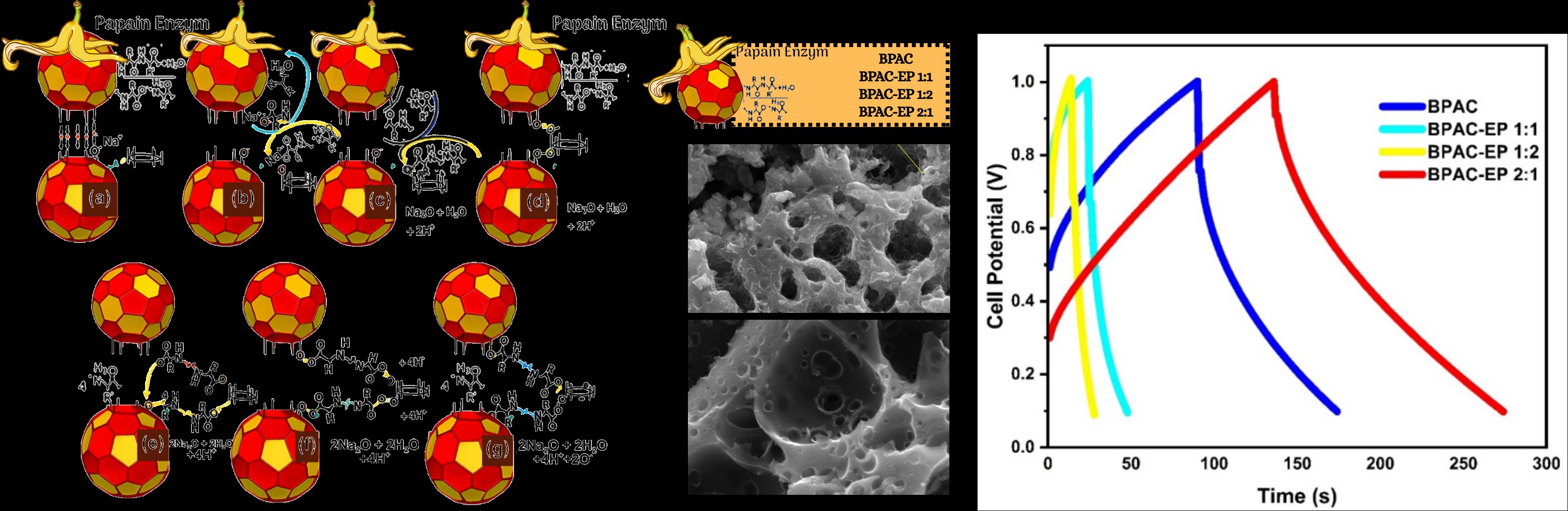
In this study, a novel and sustainable strategy is proposed for developing high-performance supercapacitor electrodes based on banana peel-derived activated carbon (BPAC) functionalized with the papain enzyme. Surface modification was carried out by covalently immobilizing papain onto BPAC at different BPAC-to-enzyme ratios (1:1, 1:2 and 2:1), followed by comprehensive electrochemical characterization using cyclic voltammetry (CV), galvanostatic charge-discharge (GCD) and electrochemical impedance spectroscopy (EIS). The BPAC-EP (2:1) electrode exhibited superior performance, achieving a specific capacitance of 67.546 F g−1 and an energy density of 146.034 Wh kg−1, with a low internal resistance (IR drop of 0.0915 V). EIS analysis confirmed a substantial decrease in charge transfer resistance (Rct) and an increase in double-layer capacitance (Cdl), indicating enhanced electrochemical kinetics. In contrast, the 1:2 composition showed a significant performance decline, with a specific capacitance of only 8 F g−1, highlighting the critical role of enzyme loading. The enhancement is attributed to the introduction of polar functional groups (–OH, –COOH, –NH2) through enzymatic treatment, which improves surface polarity and charge transport. This work demonstrates the novelty of employing enzymatic functionalization as a green chemistry route to upgrade biomass waste into efficient electrode materials for sustainable energy storage applications.
HIGHLIGHTS
- Sustainable Electrode Material: Utilizes waste banana peel activated carbon (BPAC) functionalized enzymatically (using papain) as a core material for supercapacitor electrodes, emphasizing a Green Chemistry approach.
- Enzyme Ratio Optimization: Surface functionalization was systematically studied by varying the BPAC-to-papain enzyme ratio (1:1, 1:2, 2:1), with electrochemical performance evaluated via CV, GCD and EIS.
- Optimal High Performance: The BPAC-EP (2:1) ratio demonstrated superior performance: Highest specific capacitance (67.54 F g−1), high power density (146.03 Wh kg−1), lowest internal resistance (IR drop 0.091 V), reduced charge transfer resistance (Rct) and increased double-layer capacitance (Cdl).
- Critical Enzyme Loading: Performance is highly sensitive to enzyme amount. Adding too little enzyme (BPAC 1:2 ratio) drastically reduced specific capacitance to only 8 Fg−1, highlighting the importance of optimal functionalization.
- Mechanism & Confirmation: Enhanced stability and efficiency are attributed to active polar groups (-OH, -COOH, -NH2) introduced by enzymatic modification, confirming successful functionalization and offering a sustainable path for biomass-based supercapacitors.
GRAPHICAL ABSTRACT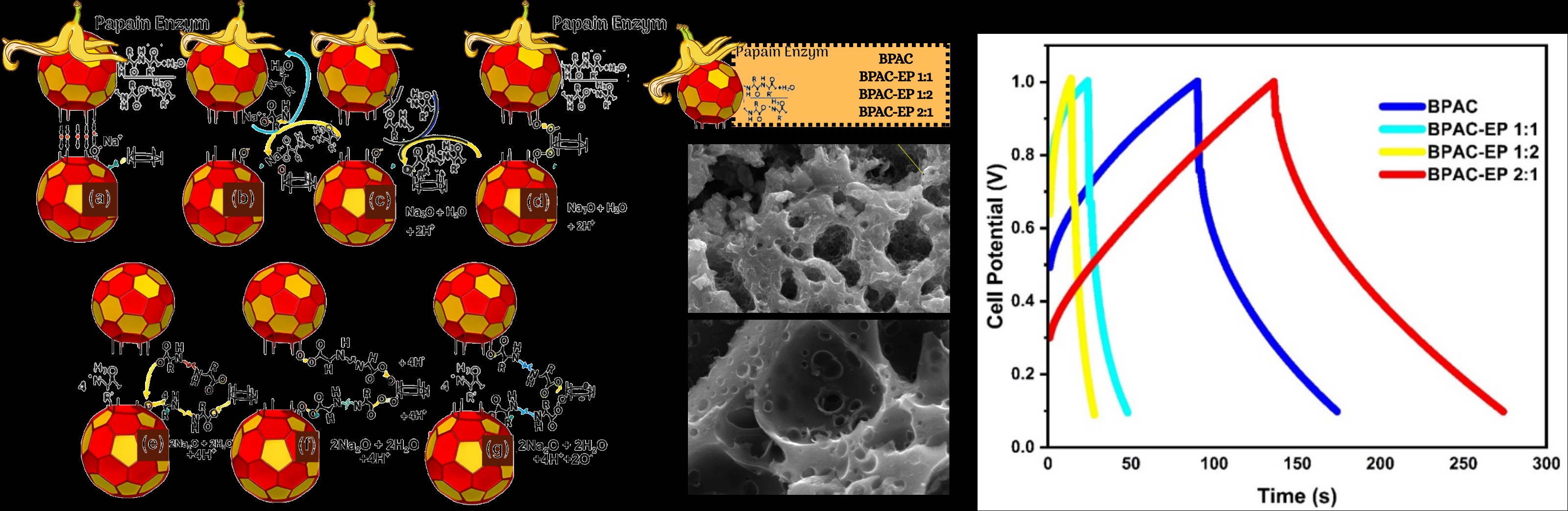
Downloads
References
Q Fan, C Song and P Fu. Advances in the improvement of the quality and efficiency of biomass-derived porous carbon: A comprehensive review on synthesis strategies and heteroatom doping effects. Journal of Cleaner Production 2024; 452, 142169.
R Chakraborty, K Vilya, M Pradhan and AK Nayak. Recent advancement of biomass-derived porous carbon based materials for energy and environmental remediation applications. Journal of Materials Chemistry A 2022; 10(13), 6965-7005.
G Ramalingam, AK Priya, L Gnanasekaran, S Rajendran and TKA Hoang. Biomass and waste derived silica, activated carbon and ammonia-based materials for energy-related applications - a review. Fuel 2024; 355, 129490.
Q Wang, H Sun, S Wu, S Pan, D Cui, D Wu, F Xu and Z Wang. Production of biomass-based carbon materials in hydrothermal media: A review of process parameters, activation treatments and practical applications. Journal of the Energy Institute 2023; 110, 101357.
Q Zou. Corn-straw-converted activated carbons with tunable porosity and N/O functionalities as high-performance supercapacitors electrode at commercial-level mass loading. Journal of Energy Storage 2023; 72(E), 108673.
H Wang, F Ruan, Q Feng, Y Liu and H Wang. Preparation of biomass-derived activated carbon from golden needle mushroom roots for supercapacitor electrodes. Materials Letters 2024; 368, 136644.
YX Gan. Activated carbon from biomass sustainable sources. Journal of Carbon Research 2021; 7(2), 39.
NE Williams, OA Oba and NP Aydinlik. Modification, production and methods of koh-activated carbon. ChemBioEng Reviews 2022; 9(2), 164-189.
L Gallego-Mena, R Campana, A Villardon, F Dorado and L Sánchez-Silva. Optimisation of hydrothermal carbonisation of olive stones for enhanced CO2 capture: Impact of zinc chloride activation. Journal of Environmental Chemical Engineering 2025; 13(4), 117321.
S Ahmed, E. Gogina, N Makisha and I Gulshin. Date palm branches-based activated carbon: Synthesis via H3PO4 activation, response surface methodology, application for phenol adsorption, kinetics and isotherm modeling. Journal of Water Process Engineering 2024; 68, 106305.
J Xiao, J Han, C Zhang, G Ling, F Kang and QH Yang. Dimensionality, function and performance of carbon materials in energy storage devices. Advanced Energy Materials 2022. https://doi.org/10.1002/aenm.202100775
G Zhang, X Liu, L Wang and H Fu. Recent advances of biomass derived carbon-based materials for efficient electrochemical energy devices. Journal of Materials Chemistry A 2022; 10(17), 9277-9307.
Y Yin, Q Liu, Y Zhao, T Chen, J Wang, L Gui and C Lu. Recent progress and future directions of biomass-derived hierarchical porous carbon: Designing, preparation and supercapacitor applications. Energy & Fuels 2023; 37(5), 3523-3554.
J Liu, Z Ding, Q Zhou, L Wei and Y Yan. 3D porous biomass derived carbon composite modified with (Ni,Co)Se particles for high-performance supercapacitors. Batteries & Supercaps 2023. https://doi.org/10.1002/batt.202300362
H Chen, Z Zhao, P Qi, G Wang, L Shi and F Yu. Sulphur-doped banana peel-derived activated carbon as electrode materials for supercapacitors. International Journal of Nanomanufacturing 2019; 15(1-2), 181-195.
V Molahalli, G Soman, VS Bhat, MS Jyothi, U Sirimahachai, S Maradur, PD Padova, N Chattham and G Hegde. Renewable Musa Sapientum derived porous nano spheres for efficient energy storage devices. Nano Express 2024; 5(3), 035006.
G Nazir, A Rehman, S Hussain, M Ikram and SJ Park. Supercapacitor performance based on nitrogen and sulfur co-doped hierarchically porous carbons: Superior rate capability and cycle stability. International Journal of Energy Research 2022; 46(11), 15602-15616.
FZ Hamadi, AO Ezzat, OH Abd-Elkader, A Benyoucef, BD Alkoudsi and L Sabantina. Synthesis and performance evaluation of supercapacitor based on banana peel–derived biochar loaded manganese dioxide with polyaniline ternary composite. International Journal of Ionics – The Science and Technology of Ionic Motion 2024; 30(8), 1-14.
M Gautam, T Patodia, V Gupta, K Sachdev and HS Kushwaha. Synthesis of high surface area activated carbon from banana peels biomass for zinc-ion hybrid super-capacitor. Journal of Energy Storage 2024; 102(A), 114088.
MG Tadesse, E Kasaw and JF Lübben. Valorization of banana peel using carbonization: Potential use in the sustainable manufacturing of flexible supercapacitors. Micromachines 2023; 14(2), 330.
AG Adeniyi, KO Iwuozor, EC Emenike, OJ Ajala, S Ogunniyi and KB Muritala. Thermochemical co-conversion of biomass-plastic waste to biochar: A review. Green Chemical Engineering 2024; 5(1), 31-49.
AI Osman, EMA El-Monaem, AM Elgarahy, CO Aniagor, M Hosny, M Farghali, E Rashad, MI Ejimofor, EA López-Maldonado, I Ihara, PS Yap, DW Rooney and AS Eltaweil. Methods to prepare biosorbents and magnetic sorbents for water treatment: A review. Environmental Chemistry Letters 2023; 21, 2337-2398.
OJ Al-sareji, RA Grmasha, M Meiczinger, RA Al-Juboori, V Somogyi and KS Hashim. A sustainable banana peel activated carbon for removing pharmaceutical pollutants from different waters: Production, characterization and application. Materials 2024; 17(5), 1032.
AG Olabi, Q Abbas, AA Makky and MA Abdelkareem. Supercapacitors as next generation energy storage devices: Properties and applications. Energy 2022; 248, 123617.
Reenu, Sonia, L Phor, A Kumar and S Chahal. Electrode materials for supercapacitors: A comprehensive review of advancements and performance. Journal of Energy Storage2024; 84(B), 110698.
S Sharma and P Chand. Supercapacitor and electrochemical techniques: A brief review. Results in Chemistry 2023; 5, 100885.
KCS Lakshmi and B Vedhanarayanan. High-Performance Supercapacitors: A Comprehensive Review on Paradigm Shift of Conventional Energy Storage Devices. Batteries 2023; 9(4), 202.
P Mehra, S Saxena and S Bhullar. A comprehensive analysis of supercapacitors and their equivalent circuit - a review. World Electric Vehicle Journal 2024; 15(8), 332.
X Li, Y Jiang, P Wang, Y Mo, W Lai, Z Li, Ru Yu, Yu Du, X Zhang and Y Chen. Effect of the oxygen functional groups of activated carbon on its electrochemical performance for supercapacitors. New Carbon Materials 2020, 35(3), 232-243.
R Mehdi, SR Naqvi, AH Khoja and R Hussain. Biomass derived activated carbon by chemical surface modification as a source of clean energy for supercapacitor application. Fuel 2023; 348, 128529.
L Zhao, Y Peng, P Dou, Y Li, T He and F Ran. Surface chemistry of electrode materials toward improving electrolyte-wettability: A method review. InfoMat 2024; 6(11), e12597.
NM Nor, NS Ridhuan and KA Razak. Progress of enzymatic and non-enzymatic electrochemical glucose biosensor based on nanomaterial-modified electrode. Biosensors 2022; 12(12), 1136.
IS Kucherenko, OO Soldatkin, DY Kucherenko, OV Soldatkina and SV Dzyadevych. Advances in nanomaterial application in enzyme-based electrochemical biosensors: A review. Nanoscale Advances 2019; 1(12), 4560-4577.
X Yang, P Qiu, J Yang, Y Fan, L Wang, W Jiang, X Cheng, Y Deng and W Luo. Mesoporous materials-based electrochemical biosensors from enzymatic to nonenzymatic. Small 2021; 17(9), e1904022.
R Carvalho, RV Silva, JD Brito and MFC Pereira. Alkali activation of bottom ash from municipal solid waste incineration: Optimization of NaOH- and Na 2SiO3-based activators. Journal of Cleaner Production 2021; 291, 125930.
P Dubey, V Shrivastav, PH Maheshwari and S Sundriyal. Recent advances in biomass derived activated carbon electrodes for hybrid electrochemical capacitor applications: Challenges and opportunities. Carbon 2020; 170, 1-29.
T Yumak, GA Yakaboylu, O Oginni, K Singh, E Ciftyurek and EM Sabolsky. Comparison of the electrochemical properties of engineered switchgrass biomass-derived activated carbon-based EDLCs. Colloids and Surfaces A: Physicochemical and Engineering Aspects 2020; 586, 124150.
C Guizani, O Sorsa, V Siipola, T Ohra-Aho, R Paalijärvi, A Pasanen, M Mäkelä, A Kalliola, M Vilkman and K Torvinen. The effects of lignin structure on the multiscale properties and electrochemical performance of activated carbons. Biomass Conversion and Biorefinery 2024; 14, 21149-21163.
S Zhang, M Zheng, Y Tang, R Zang, X Zhang, X Huang, Y Chen, Y Yamauchi, S Kaskel and H Pang. Understanding synthesis-structure-performance correlations of nanoarchitectured activated carbons for electrochemical applications and carbon capture. Advanced Functional Materials 2022; 32(40), 2204714.
J Zhang, H Yang, Z Huang, H Zhang, X Lu, J Yan, K Cen and Z Bo. Pore-structure regulation and heteroatom doping of activated carbon for supercapacitors with excellent rate performance and power density. Waste Disposal & Sustainable Energy 2023; 5(3), 417-426.
NM Keppetipola, M Dissanayake, P Dissanayake, B Karunarathne, MA Dourges, D Talaga, L Servant, C Olivier, T Toupance, S Uchida, K Tennakone, GRA Kumara and L Cojocaru. Graphite-type activated carbon from coconut shell: A natural source for eco-friendly non-volatile storage devices. RSC Advances 2021; 11(5), 2854-2865.
N Ngafwan, ING Wardana, W Wijayanti and E Siswanto. The role of NaOH and papaya latex bio-activator during production of carbon nanoparticle from rice husks. Advances in Natural Sciences: Nanoscience and Nanotechnology 2018; 9(4), 045011.
Z Guo, X Han, C Zhang, S He, K Liu, J Hu, W Yang, S Jian, S Jiang and G Duan. Activation of biomass-derived porous carbon for supercapacitors: A review. Chinese Chemical Letters 35(7), 109007.
L Wang, T Wang, R Hao and Y Wang. Synthesis and applications of biomass-derived porous carbon materials in energy utilization and environmental remediation. Chemosphere 2023; 339, 139635.
I Luthfiyah, J Utomo, M Diantoro, N Mufti, T Suprayogi, Y Yudyanto and A Aripriharta. The effect of spincoating speed on ZnONR microstructure and it’s potential of ZnONR/Aluminum foil electrodes symmetric supercapacitors. Journal of Physics: Conference Series 2020;.1595, 012001.
M Diantoro, NIM Aturroifah, I Luthfiyah, J Utomo, I Hamidah, B Yuliarto, A Rusydi, S Maensiri and W Meevasana. 3D-porous activated carbon morphological modification of Manihot esculenta tuber and Bambusa blumeana stem for high-power density supercapacitor: Biomass waste to sustainable energy. Carbon Resources Conversion 2025. https://doi.org/10.1016/j.crcon.2025.100313.
M Diantoro, Nuviya Illa Muthi Aturroifah, J Utomo, I Luthfiyah, I Hamidah, B Yuliarto, A Rusydi, W Meevesana, S Maensiri and PK Singh. Optimizing sponge-like activated carbon from Manihot esculenta tubers for high-performance supercapacitors. Arabian Journal of Chemistry 2025; 18(1), 106068.
D Veeman, MV Shree, P Sureshkumar, T Jagadeesha, L Natrayan, M Ravichandran and P Paramasivam. Sustainable development of carbon nanocomposites: Synthesis and classification for environmental remediation. Journal Nanomaterials 2021. https://doi.org/10.1155/2021/5840645
U Rasheed, QU Ain, A Ali and B Liu. One stone 2 birds: Recycling of an agri-waste to synthesize laccase-immobilized hierarchically porous magnetic biochar for efficient degradation of aflatoxin B1 in aqueous solutions and corn oil. International Journal of Biological Macromolecules 2024; 273(P1), 133115.
M Saeed, U Shahzad, MF Rabbee, R Manzar, JY Al-Humaidi, A Siddique, TA Sheikh, RH Althomali, T Qamar and MM Rahman. Potential development of porous carbon composites generated from the biomass for energy storage applications. Chemistry, an Asian Journal 2024; 19(17), e202400394.
KP Gopinath, DVN Vo, DG Prakash, AA Joseph, S Viswanathan and J Arun. Environmental applications of carbon-based materials: A review. Environmental Chemistry Letters 2020; 19, 557-582.
AK Priya, M Muruganandam and S Suresh. Bio-derived carbon-based materials for sustainable environmental remediation and wastewater treatment. Chemosphere 2024; 362, 142731.
G Bijoy, R Rajeev, L Benny, S Jose and A Varghese. Enzyme immobilization on biomass-derived carbon materials as a sustainable approach towards environmental applications. Chemosphere 2022; 307(P1), 135759.
AF Quintero-Jaime, D Cazorla-Amorós and E Morallón. Electrochemical functionalization of carbon nanomaterials and their application in immobilization of enzymes. In: GR Castro, AK Nadda, TA Nguyen, X Qi and G Yasin (Eds.). Nanomaterials for biocatalysis. Elsevier, Amsterdam, 2021, p. 67-103.
L Sun, Y Gong, D Li and C Pan. Biomass-derived porous carbon materials: Synthesis, designing and applications for supercapacitors. Green Chemistry 2022; 24(10), 3864-3894.
J Huo, J Hao, J Mu and Y Wang. Surface modification of Co3O4 nanoplates as efficient peroxidase nanozymes for biosensing application. American Chemical Society Applied Bio Materials 2021; 4(4), 3443-3452.
Sumaraj, Z Xiong, AK Sarmah and LP Padhye. Acidic surface functional groups control chemisorption of ammonium onto carbon materials in aqueous media. Science of the Total Environment 2019; 698, 134193.
J Huang, K Yuan and Y Chen. Wide voltage aqueous asymmetric supercapacitors: Advances, strategies and challenges. Advanced Functional Materials 2022. https://10.1002/adfm.202108107
Y Gao, S Zhang, X Li, L Li, L Bao, N Zhang, J Peng and X Li. Synergistically optimizing electronic structure and reducing ions transport resistance by oxygen functional groups and defects in carbon for superior sodium capture and potassium storage capability. Carbon 2021; 181, 323-334.
L Zhao and F Ran. Electrolyte-philicity of electrode materials. Chemical Communications 2023; 59(46), 6969-6986.
J Chu, J Huang, R Liu, J Liao, X Xia, Q Zhang, C Wang, M Gu, S Bai, X Shi and L Chen. Electrode interface optimization advances conversion efficiency and stability of thermoelectric devices. Nature Communications 2020; 11, 2723.
K Dujearic-Stephane, M Gupta, A Kumar, V Sharma, S Pandit, P Bocchetta and Y Kumar. The effect of modifications of activated carbon materials on the capacitive performance: Surface, microstructure and wettability. Journal of Composites Science 2021; 5(3), 66.
G Lan, J Yang, RP Ye, Y Boyjoo, J Liang, X Liu, Y Li, J Liu and K Qian. Sustainable carbon materials toward emerging applications. Small Methods 2021; 5(5), 2001250.
A Bello, N Manyala, F Barzegar, AA Khaleed, DY Momodu and JK Dangbegnon. Renewable pine cone biomass derived carbon materials for supercapacitor application. RSC Advances 2016; 6(3), 1800-1809.
Y Guo, J Qi, Y Jiang, S Yang, Z Wang and H Xu. Performance of electrical double layer capacitors with porous carbons derived from rice husk. Materials Chemistry and Physics 2003; 80(3), 704-709.
V Subramanian, C Luo, AM Stephan, KS Nahm, S Thomas and B Wei. Supercapacitors from activated carbon derived from banana fibers. Journal of Physical Chemistry C 2007; 111(20), 7527-7531.
TE Rufford, D Hulicova-Jurcakova, K Khosla, Z Zhu and GQ Lu. Microstructure and electrochemical double-layer capacitance of carbon electrodes prepared by zinc chloride activation of sugar cane bagasse. Journal of Power Sources 2010; 195(3), 912-918.
C Peng, J Lang, S Xu and X Wang. Oxygen-enriched activated carbons from pomelo peel in high energy density supercapacitors. RSC Advances 2014; 4(97), 54662-54667.
X Li, W Xing, S Zhuo, J Zhou, F Li, SZ Qiao and GQ Lu. Preparation of capacitor’s electrode from sunflower seed shell. Bioresource Technology 2011; 102(2), 1118-1123.
Y Cao, K Wang, X Wang, Z Gu, Q Fan, W Gibbons, JD Hoefelmeyer, PR Kharel and M Shrestha. Hierarchical porous activated carbon for supercapacitor derived from corn stalk core by potassium hydroxide activation. Electrochimica Acta 2016; 212, 839-847.
M Rana, K Subramani, M Sathish and UK Gautam. Soya derived heteroatom doped carbon as a promising platform for oxygen reduction, supercapacitor and CO2 capture. Carbon 2017; 114, 679-689.
M Karnan, K Subramani, PK Srividhya and M Sathish. Electrochemical studies on corncob derived activated porous carbon for supercapacitors application in aqueous and non-aqueous electrolytes. Electrochimica Acta 2017; 228, 586-596.
G Hegde, SAA Manaf, A Kumar, GAM Ali, KF Chong, Z Ngaini and KV Sharma. Biowaste sago bark based catalyst free carbon nanospheres: Waste to wealth approach. ACS Sustainable Chemistry & Engineering 2015; 3(9), 2247-2253.
GAM Ali, A Divyashree, S Supriya, KF Chong, AS Ethiraj, MV Reddy, H Algarni and G Hegde. Carbon nanospheres derived from Lablab purpureus for high performance supercapacitor electrodes: A green approach. Dalton Transactions 2017; 46(40), 14034-14044.
X Chen, J Zhang, B Zhang, S Dong, X Guo, X Mu and B Fei. A novel hierarchical porous nitrogen-doped carbon derived from bamboo shoot for high performance supercapacitor. Scientific Reports 2017; 7(1), 7362.
K Xiao, LX Ding, H Chen, S Wang, X Lu and H Wang. Nitrogen-doped porous carbon derived from residuary shaddock peel: A promising and sustainable anode for high energy density asymmetric supercapacitors. Journal of Materials Chemistry A 2016; 4(2), 372-378.
O Fasakin, JK Dangbegnon, DY Momodu, MJ Madito, KO Oyedotun, MA Eleruja and N Manyala. Synthesis and characterization of porous carbon derived from activated banana peels with hierarchical porosity for improved electrochemical performance. Electrochimica Acta 2018; 262, 187-196.
O Boujibar, A Ghosh, O Achak, T Chafik and F Ghamouss. A high energy storage supercapacitor based on nanoporous activated carbon electrode made from Argan shells with excellent ion transport in aqueous and non-aqueous electrolytes. Journal of Energy Storage 2019; 26, 100958.
W Du, Z Zhang, L Du, X Fan, Z Shen, X Ren, Y Zhao, C Wei and S Wei. Designing synthesis of porous biomass carbon from wheat straw and the functionalizing application in flexible, all-solid-state supercapacitors. Journal of Alloys and Compounds 2019; 797, 1031-1040.
JR Rajabathar, S Manoharan, JJ Vijaya, HA Al-Lohedan and P Arunachalam. Synthesis of porous carbon nanostructure formation from peel waste for low cost flexible electrode fabrication towards energy storage applications. Journal of Energy Storage 2020; 32, 101735.
E Taer, DA Yusra, A Amri, Awitdrus, R Taslim, Apriwandi, Agustino and A Putri. The synthesis of activated carbon made from banana stem fibers as the supercapacitor electrodes. Materials Today: Proceedings 2021; 44(P3), 3346-3349.
Published
How to Cite
Issue
Section
License
Copyright (c) 2025 Walailak University

This work is licensed under a Creative Commons Attribution-NonCommercial-NoDerivatives 4.0 International License.





