
Physiological and Environmental Factors Influencing Hydrogen Production by Unicellular Green Alga Monoraphidium sp. KMITL-1
DOI:
https://doi.org/10.48048/tis.2025.10645Keywords:
Hydrogen, Green algae, Nutrient deprivation, Carbon source, Hydrogenase activityAbstract
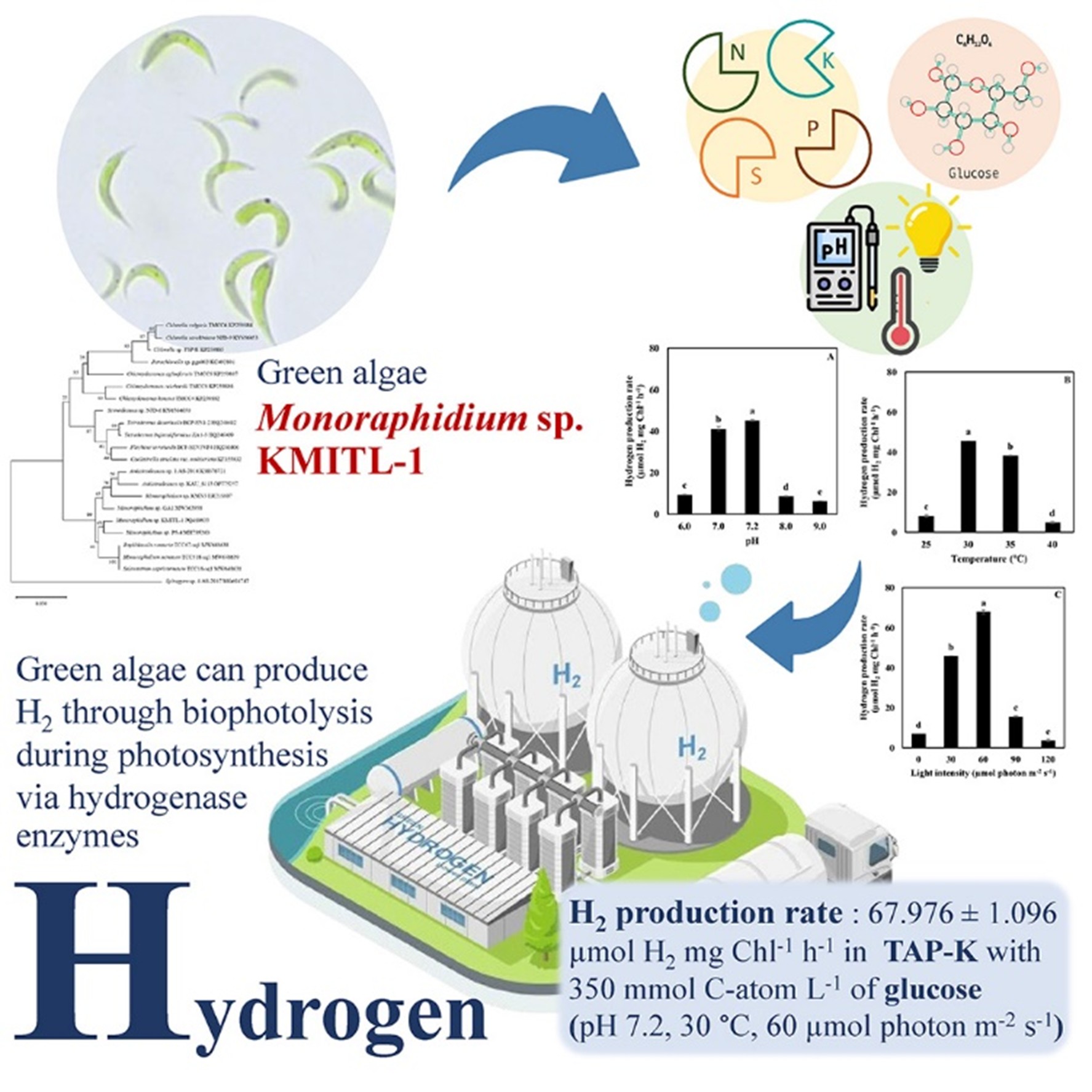
With the growing global energy demand and the urgent need to reduce carbon emissions, hydrogen (H2) has emerged as a promising clean energy carrier. Among various biological H₂ production, green algae present a sustainable and eco-friendly alternative due to their ability to produce H₂ via photobiological pathways. This study aimed to investigate H2 production by unicellular green alga Monoraphidium sp. KMITL-1, isolated from hydroponic water at the Plant Tissue Culture Laboratory, King Mongkut’s Institute of Technology Ladkrabang. The taxonomic identity of the strain, belonging to the genus Monoraphidium within the Selenastraceae family, was confirmed through morphological observation and molecular characterization using 23S plastid rRNA gene sequencing. Various physiological and environmental parameters influencing H₂ production were evaluated, including cell age, cell density, nutrient deprivation, carbon source, pH, temperature, and light intensity. A 24-hour-old culture with an OD₇₅₀ of 0.8 exhibited a significant increase in H₂ production. The optimal medium was potassium-deprived Tris-acetate-phosphate (TAP-K) supplemented with glucose at a concentration of 350 mmol C-atom L⁻¹. The ideal environmental conditions for H₂ production were pH 7.2, a temperature of 30 °C, and a light intensity of 60 µmol photons m⁻² s⁻¹. Under these optimized conditions, Monoraphidium sp. KMITL-1 achieved a maximum H₂ production rate of 67.976 ± 1.096 µmol H₂ mg Chl⁻¹ h⁻¹ and a cumulative H₂ yield of 3,190.436 ± 2.219 µmol H₂ mg Chl⁻¹ after 72 h of incubation. These results highlight the potential of Monoraphidium sp. KMITL-1 for large-scale biohydrogen production and its applicability in the development of sustainable energy technologies.
HIGHLIGHTS
- Monoraphidium sp. KMITL-1 was isolated and identified as a promising green alga for biohydrogen production.
- Potassium (K) deprivation significantly enhanced H₂ production by reducing O₂ evolution and increasing hydrogenase activity under anoxic conditions.
- Among various carbon sources, glucose supplementation yielded the highest H₂ production, with 350 mmol C-atom L⁻¹ identified as the optimal concentration.
- Maximum H₂ production was achieved under pH 7.2, 30 °C and light intensity of 60 µmol photons m⁻² s⁻¹.
GRAPHICAL ABSTRACT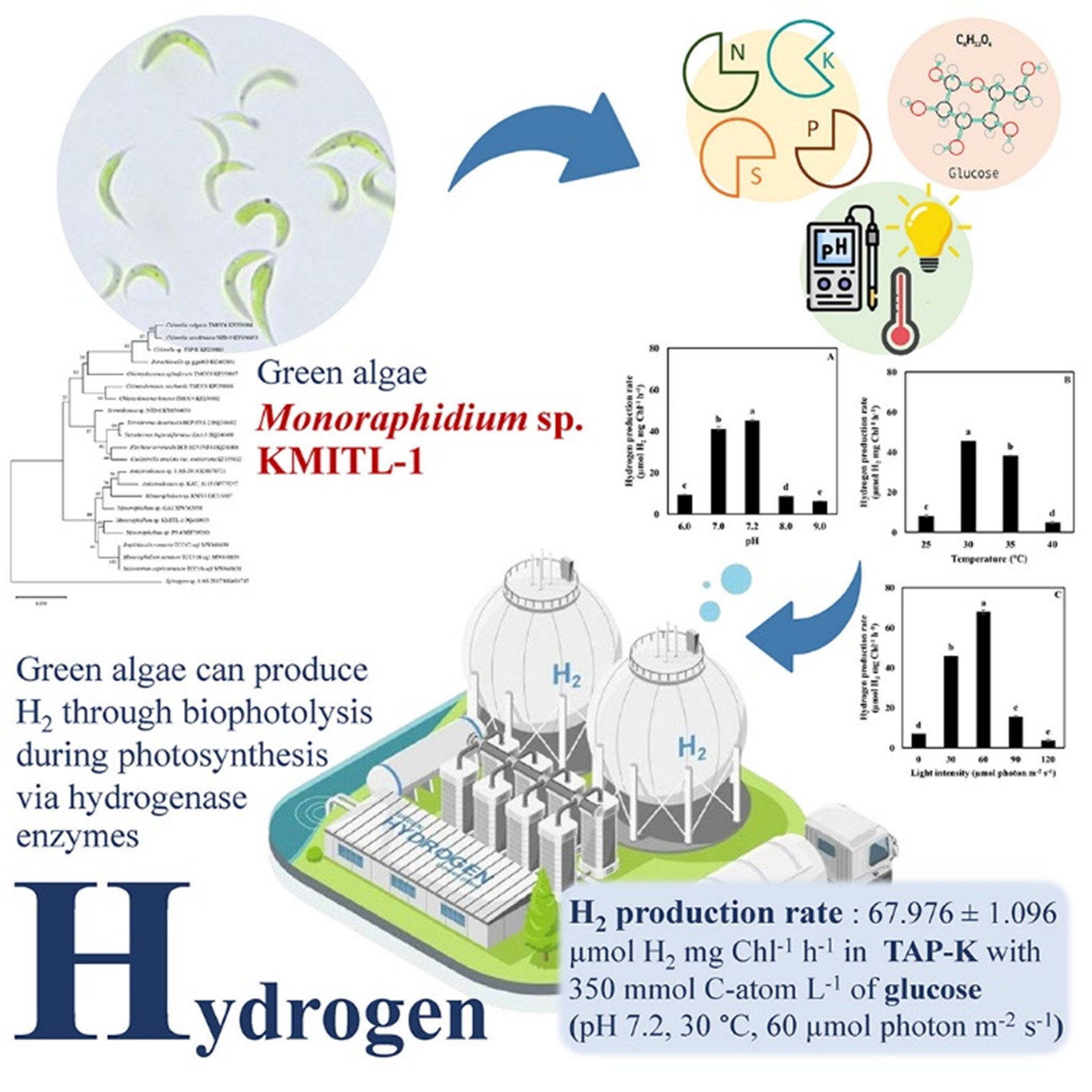
Downloads
References
CF Shih, T Zhang, J Li and C Bai. Powering the future with liquid sunshine. Joule 2018; 2(10), 1925-1949.
N Fakhimi, D Gonzalez-Ballester, E Fernándaz, A Galván and A Dubini. Algae-bacteria consortia as a strategy to enhance H2 production. Cells 2020; 9(6), 1353.
A Melis, L Zhang, M Forestier, ML Ghirardi and M Seibert. Sustained photobiological hydrogen gas production upon reversible inactivation of oxygen evolution in the green alga Chlamydomonas reinhardtii. Plant Physiology 2000; 122(1), 127-135.
M Forestier, P King, L Zhang, M Posewitz, S Schwarzer, T Happe, ML Ghirardi and M Seibert. Expression of two [Fe]-hydrogenases in Chlamydomonas reinhardtii under anaerobic conditions. European Journal of Biochemistry 2003; 270(13), 2750-2758.
HC Chen and A Melis. Localization and function of SulP, a nuclear-encoded chloroplast sulfate permease in Chlamydomonas reinhardtii. Planta 2004; 220(2), 198-210.
T Supakriangkrai and S Phunpruch. Screening and optimization of high-efficiency H2-producing Chlorella strains. Journal of Applied Biology and Biotechnology 2025; 13(3), 71-81.
P Pongpadung, J Liu, K Yokthongwattana, S Techapinyawat and N Juntawong. Screening for hydrogen-production strains of green microalgae in phosphorus or sulphur deprived medium under nitrogen limitation. ScienceAsia 2015; 41, 97-107.
K Sereetrakul and S Phunpruch. Factors affecting hydrogen production by unicellular green alga Chlamydomonas reinhardtii CC-125. Chiang Mai Journal of Science 2021; 48(4), 979-995.
N Laokua, N Rittiyan, Y Kornrawudaphikasama, R Klinsalee, Y Tonawut, N Preechaphonkul, W Raksajit, W Khetkorn, W Dejtisakdi and C Maneeruttanarungroj. Optimal conditions for maximized H2 yield from a new green algal strain Chlorella sp. KLSc61. Journal of Applied Phycology 2022; 34, 1909-1919.
C Maneeruttanarungroj and S Phunpruch. Effect of pH on biohydrogen production in green alga Tetraspora sp. CU2551. Energy Procedia 2017; 138, 1085-1092.
A Puangplub and S Phunpruch. Effect of light intensity and light pattern on hydrogen production by unicellular green alga Chlorella sp. LSD-W2. Asia-Pacific Journal of Science and Technology 2019; 24(2), APST-24.
G Torzillo, A Scoma, C Faraloni and L Giannelli. Advances in the biotechnology of hydrogen production with microalga Chlamydomonas reinhardtii. Critical Reviews in Biotechnology 2015; 35(4), 485-496.
A Dubini and ML Ghirardi. Engineering photosynthetic organisms for the production of biohydrogen. Photosynthesis Research 2015; 123(3), 241-253.
L Krienitz, I Ustinova, T Friendl and VAR Huss. Traditional generic concepts versus 18S rRNA gene phylogeny in the green algal family Selenastraceae (Chlorophyceae, Chlorophyta). Journal of Phycology 2001; 37(5), 852-865.
Q He, H Yang and C Hu. Effects of temperature and its combination with high light intensity on lipid production of Monoraphidium dybowskii Y2 from semi-arid desert areas. Bioresource Technology 2018; 265, 407-414.
SV Wychen, SM Rowland, KC Lesco, T Dong and LML Laurens. Advanced mass balance characterization and fractionation of algal biomass composition. Journal of Applied Phycology 2021; 33, 2695-2708.
X Yu, P Zhao, C He, J Li, X Tang, J Zhou and Z Huang. Isolation of a novel strain of Monoraphidium sp. and characterization of its potential application as biodiesel feedstock. Bioresource Technology 2012; 121, 256-262.
X Song, Y Zhao, B Han, T Li, P Zhao, JW Xu and X Yu. Strigolactone media jasmonic acid-induced lipid production in microalga Monoraphidium sp. QLY-1 under nitrogen deficiency conditions. Bioresource Technology 2020; 306, 123107.
C Bogan, A A-Dilaimi, A Albersmeier, J Wichmann, M Grundmann, O Rupp, KJ Lauersen, O Blifernez-Klassen, J Kalinowski, A Goesmann, JH Mussgnug and O Kruse. Reconstruction of the lipid metabolism for the microalga Monoraphidium neglectum from its genome sequence reveals characteristics suitable for biofuel production. BMC Genomics 2013; 14, 926.
M Hawrot-Paw, A Koniuszy and M Galczyńska. Suitainable production of Monoraphidium microalgae biomass as a source of bioenergy. Energies 2020; 13(22), 5975.
W Yee. Microalgae from the Selenastraceae as emerging candidates for biodiesel production: A mini review. World Journal of Microbiology and Biotechnology 2016; 32(4), 64.
D Georgiou, S Exarhopoulos, A Charisis, S Simitsis, G Papapanagiotou, C Samara, M Katsiapi, G Kountrias, S Bouras, N Katsoulas, IT Karapanagiotidis, C Chatzidoukas and EP Kalogianni. Valorization of Monoraphidium sp. microalgal biomass for human nutrition applications. Journal of Applied Phycology 2024; 36, 1293-1309.
EH Harris. The Chlamydomonas sourcebook: A comprehensive guild to biology and laboratory use. Academic Press, San Diego, 1998, p. 25-63.
AR Sherwood and GG Presting. Universal primer amplify a 23S rDNA plastid marker in eukaryotic algae and cyanobacteria. Journal of Phycology 2007; 43(3), 605-608.
SF Altschul, W Gish, W Miller, EW Myers and DJ Lipman. Basic local alignment search tool. Journal of Molecular Biology 1990; 215(3), 403-410.
MA Larkin, G Blackshields, NP Brown, R Chenna, PA McGettigan, H McWilliam, F Valentin, IM Wallace, A Wilm, R Lopez, JD Thompson, TJ Gibson and DG Higgins. Clustal W and Clustal X version 2.0. Bioinformatics 2007; 23(21), 2947-2948.
K Tamura, G Stecher and S Kumar. MEGA11: Molecular evolutionary genetics analysis version 11. Molecular Biology and Evolution 2021; 38(7), 3022-3027.
N Tinpranee, A Incharoensakdi and S Phunpruch. Hydrogen production by unicellular green alga Chlorella sp. LSD-W2 isolated from seawater in Thailand. KKU Research Journal 2016; 21(2), 256-266.
K Legnerová. The systematics and ontogenesis of the genera Ankistrodesmus Corda and Mono raphidium gen. nov. In: Studies in phycology. Academia Publishing House of the Czechosolvak Academy of Sciences, Prague, Czech Republic, 1969, p. 75-144.
Y Lin, J Ge, H Ling, Y Zhang, X Yan and W Ping. Isolation of a novel strain of Monoraphidium sp. and characterization of its potential for α-linolenic acid and biodiesel production. Bioresource Technology 2018; 267, 466-472.
GJP Ramos, CEDM Bicudo, AG Neto and CWDN Moura. Monoraphidium and Ankistrodesmus (Chlorophyceae, Chlorophyta) from Pantanal dos Marimbus, Chapada Diamantina, Bahia State, Brazil. Hoehnea 2012; 39(3), 421-434.
MR Pikoli, AF Sari, NA Solihat and AH Permana. Characteristics of tropical freshwater microalgae Micractinium conductrix, Monoraphidium sp. and Choricystis parasitica, and their potency as biodiesel feedstock. Heliyon 2019; 5, e02922.
T Sinha, D Borah, S Ravi, SN Mudliar, VS Chauhan, R Sen and J Rout. Nutrient and salinity stress induced biodiesel production from a green alga, Monoraphidium neglectum. Biocatalysis and Agricultural Biotechnology 2024; 57, 103090.
NJ Kirchner, A Hage, J Gomez, WS Grayburn and GP Holbrook. Photosynthesis, competition, and wastewater treatment characteristics of the microalga Monoraphidium sp. DeK19 at cool temperatures. Algal Research 2022; 62, 102624.
JP Kim, CD Kang, SJ Sim, MS Kim, TH Park, D Lee, D Kim, JH Kim, YK Lee and D Park. Cell age optimization for hydrogen production induced by sulfur deprivation using a green alga Chlamydomonas reinhardtii UTEX 90. Journal of Microbiology and Biotechnology 2005; 15(1), 131-135.
K Warichanan and S Phunpruch. Effect of cell density and nutrient deprivation on hydrogen production by unicellular green alga Scenedesmus sp. KMITL-OVG1. Asia-Pacific Journal of Science and Technology 2019; 24(2), 2539-6293.
A Grossman and H Takahashi. Macronutrient utilization by photosynthetic eukaryotes and the fabric of interactions. Annual Review of Plant Biology 2001; 52, 163-210.
A Papazi, AI Gjindali, E Kastanaki, K Assimakopoulos, K Stamatakis and K Kotzabasis. Potassium deficiency, a “smart” cellular switch for sustained high yield hydrogen production by the green alga Scenedesmus obliquus. International Journal of Hydrogen Energy 2014; 39, 19452-19464.
G Philipps, T Happe and A Hemschemeier. Nitrogen deprivation results in photosynthetic hydrogen production in Chlamydomonas reinhardtii. Planta 2012; 235(4), 729-745.
S Phunpruch, A Puangplub and A Incharoensakdi. Biohydrogen production by microalgae isolated from the rice paddle field in Thailand. KKU Research Journal 2016; 21(2), 236-247.
K Batyrova, A Gavrisheva, E Ivanova, J Liu and A Tsygankov. Sustainable hydrogen photoproduction by phosphorus-deprived marine green microalgae Chlorella sp. International Journal of Molecular Sciences 2015; 16(2), 2705-2716.
L Zhang, T Happe and A Melis. Biochemical and morphological characterization of sulfur-deprived and H2-producing Chlamydomonas reinhardtii (green alga). Planta 2002; 214(4), 552-561.
JZ Liu, YM Ge, JY Sun, P Chen, M Addy, SH Huo, K Li, PF Cheng and R Ruan. Exogenic glucose as an electron donor for algal hydrogenases to promote hydrogen photophoduction by Chlorella pyrenoidosa. Bioresource Technology 2019; 289, 121762.
J Zhang, D Xue, C Wang, D Fang, L Cao and C Gong. Genetic engineering for biohydrogen production from microalgae. iScience 2023; 26(8), 107255.
S Taikhao, S Junyapoon, A Incharoensakdi and S Phunpruch. Factors affecting biohydrogen production by unicellular halotolerant cyanobacterium Aphanothece halophytica. Journal of Applied Phycology 2013; 25, 575-585.
E Touloupakis, C Faraloni, AMS Benavides and G Torzillo. Recent achievements in microalgal photobiological hydrogen production. Energies 2021; 14(21), 7170.
TK Antal, GP Kukarskikh, AA Volgusheva, TE Krendeleva, E Tyystjärvi and AB Rubin. Hydrogen photoproduction by immobilized S-deprived Chlamydomonas reinhardtii: Effect of light intensity and spectrum, and initial medium pH. Algal Research 2016; 17, 38-45.
JP Kim, CD Kang, TH Park, MS Kim and SJ Sim. Enhanced hydrogen production by controlling light intensity in sulfur-deprived Chlamydomonas reinhardtii culture. International Journal of Hydrogen Energy 2006; 31, 1585-1590.
Published
How to Cite
Issue
Section
License
Copyright (c) 2025 Walailak University

This work is licensed under a Creative Commons Attribution-NonCommercial-NoDerivatives 4.0 International License.





