
Computational Analysis of TSHb Variants (Native, Mutated and Deleted) in Interaction with TSHR: Molecular Docking and Dynamic Simulations for Mechanistic Insights into Congenital Hypothyroidism
DOI:
https://doi.org/10.48048/tis.2025.10086Keywords:
Congenital hypothyroidism, TSHb, TSHR, Molecular docking, Molecular dynamic, Congenital hypothyroidism, TSHb, TSHR, Molecular docking, Molecular dynamicAbstract
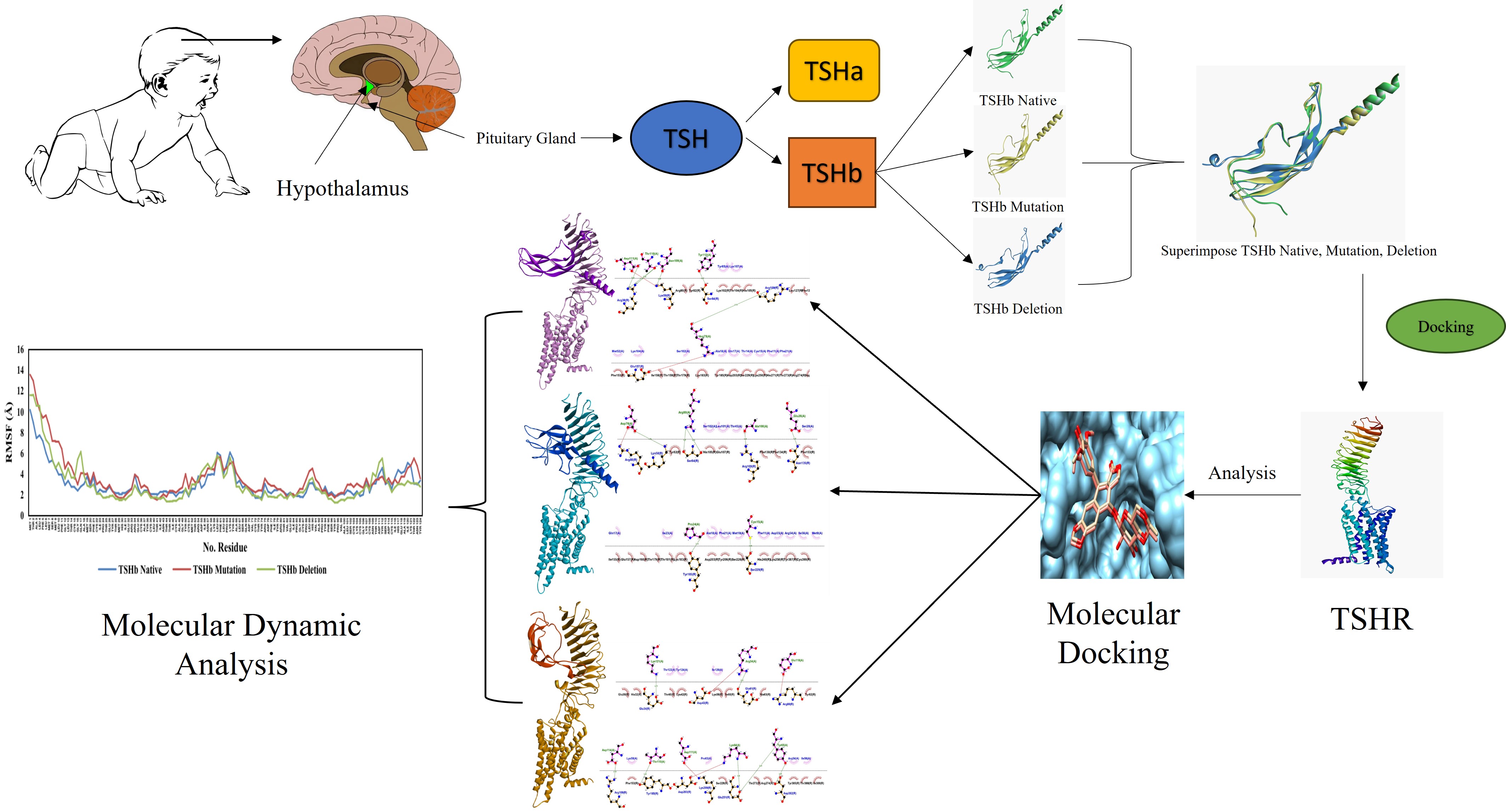
Thyroid Stimulating Hormone (TSH) is a primary protein and biomarker for the early detection of congenital hypothyroidism (CH). CH poses a serious risk for newborns as it can lead to neurological development issues, motor skill delays, and lower IQ. This study aims to computationally compare the interaction effectiveness of TSHb (native, mutation, deletion) with TSHR (Thyroid Stimulating Hormone Receptor). TSHb were constructed based on the 3D structures of fPDB proteins, specifically 7FIH_Y, 6P57_A, 6P57_B, 1HCN_B, and 1QFW_B. TSH and TSHR models were obtained from the RSCB PDB (ID: 7XW5). Molecular dynamics simulations were conducted using YASARA Dynamics. Potential energy, SASA, hydrogen bonds within the solute, hydrogen bonds between solute and solvent, RMSD, and radius of gyration analyses were obtained through the md_analyze macro. Docking and molecular dynamics simulations revealed that mutations and deletions in TSHb impact its stability, functionality, and interactions with TSHR. Furthermore, significant structural changes and reduced conformational stability were observed in the TSHb variant with a nucleotide deletion at position 114. However, this TSHb deletion variant did not alter the amino acid sequence of the active site for binding with TSHR. It is believed that this deletion variant retains sufficient affinity interaction with TSHR compared to the native TSHb.
HIGHLIGHTS
- TSHb-TSHR Interaction: Mutations and deletions affect stability and thyroid function.
- Key Mutation Insight: TSHb deletion at position 114 alters structure but retains binding.
- Molecular Dynamics: Analyzed stability via energy, SASA, hydrogen bonds, and RMSD.
- Computational Modeling: Aids precision medicine for thyroid-related disorders.
GRAPHICAL ABSTRACT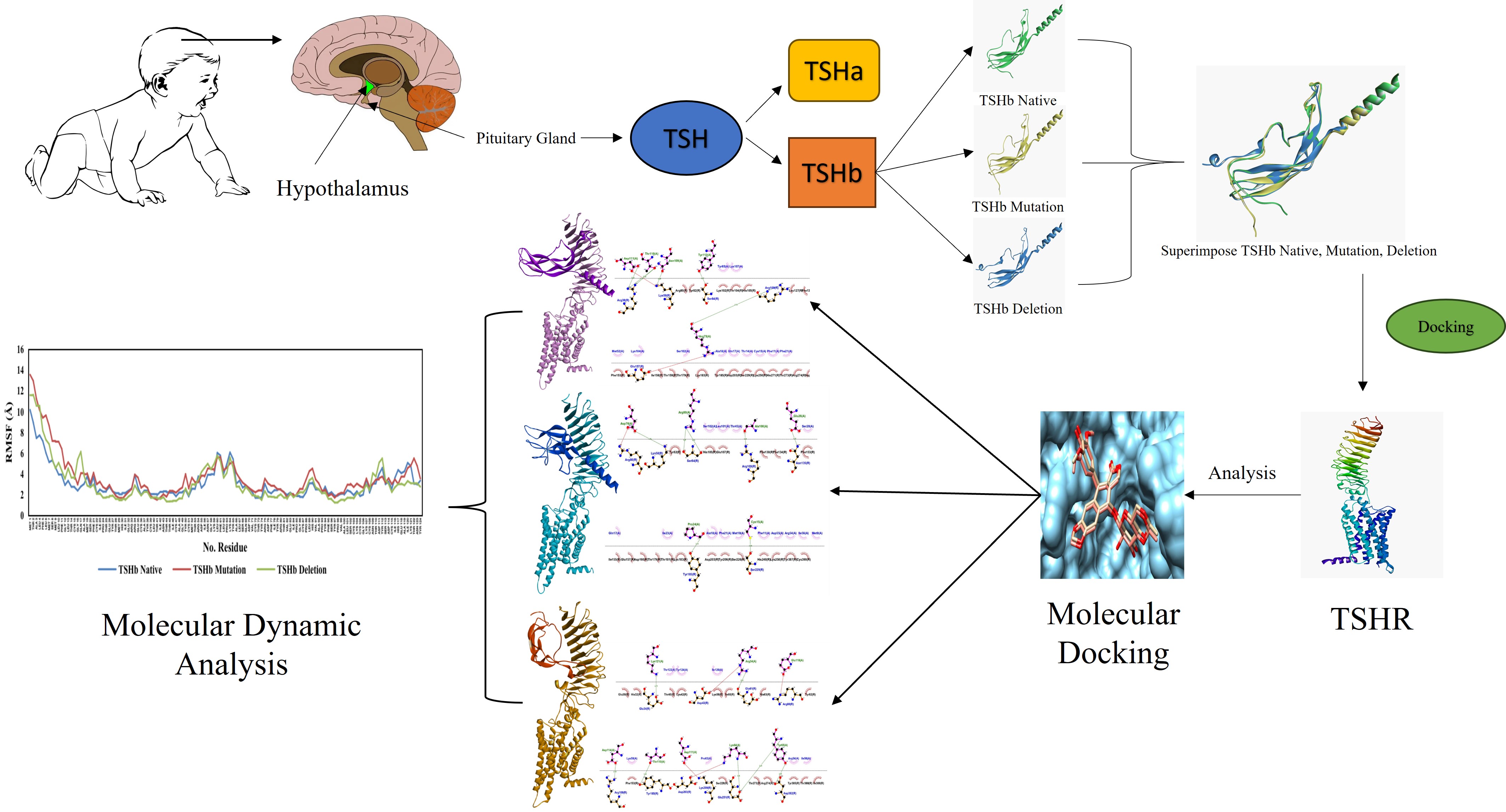
Downloads
References
H Braga, JL Duarte, L da Cruz Fernandes, IC Salles, CLO de Andrade, HE Ramos and CAD Alves. Congenital hypothyroidism as a risk factor for hearing and parents’ knowledge about its impact on hearing. Journal of Otology 2021; 16(2), 71-79.
P van Trotsenburg, A Stoupa, J Léger, T Rohrer, C Peters, L Fugazzola, A Cassio, C Heinrichs, V Beauloye, J Pohlenz, P Rodien, R Coutant, G Szinnai, P Murray, B Bartés, D Luton, M Salerno, L de Sanctis, M Vigone, …, M Polak. Congenital hypothyroidism: A 2020 - 2021 consensus guidelines update - an ENDO-European reference network initiative endorsed by the European society for pediatric endocrinology and the European society for endocrinology. Thyroid 2021; 31(3), 387-419.
L Chaker, S Razvi, IM Bensenor, F Azizi, EN Pearce and RP Peeters. Publisher correction: Hypothyroidism. Nature Reviews: Disease Primers 2022; 8(1), 39.
MC Maggio, SS Ragusa, TS Aronica, OM Granata, E Gucciardino and G Corsello. Neonatal screening for congenital hypothyroidism in an Italian Centre: A 5-years real-life retrospective study. Italian Journal of Pediatrics 2021; 47(1), 108.
R West, J Hong, JGB Derraik, D Webster, NL Heather and PL Hofman. Newborn screening TSH values less than 15 mIU/L are not associated with long-term hypothyroidism or cognitive impairment. Journal of Clinical Endocrinology and Metabolism 2020; 105(9), E3329-E3338.
E Asav. Development of a functional impedimetric immunosensor for accurate detection of thyroid-stimulating hormone. Turkish Journal of Chemistry 2021; 45(3), 819-834.
F Talebi, M Heidari, M Khatami and M Ordooei. Identification of novel missense mutations of the TSH-β subunit gene in pediatric patients with congenital central hypothyroidism. Jentashapir Journal of Cellular and Molecular Biology 2020; 11(3), 2020.
C Fu, J Luo, J Su, S Zhang, Q Yang and Y Zhang. Genetic basis of congenital central hypothyroidism in children: Expanding the mutational spectrum of POU1F1 and ATP6V0A4. International Journal of General Medicine 2023; 16, 3355-3362.
L Croce, F Beneventi, F Ripepi, I De Maggio, A Malovini, C Bellingeri, F Coperchini, M Teliti, A Spinillo and F Magri. Relationship between maternal obesity and first-trimester TSH in women with negative anti-TPO antibodies. European Thyroid Journal 2024; 13(2), e230213.
L Kalveram, G Kleinau, K Szymańska, P Scheerer, A Rivero-Müller, A Grüters-Kieslich and H Biebermann. The pathogenic TSH Β-subunit variant C105Vfs114X causes a modified signaling profile at TSHR. International Journal of Molecular Sciences 2019; 20(22), 5564.
J Furmaniak, J Sanders, J Clark, J Wilmot, P Sanders, Y Li and BR Smith. Preclinical studies on the toxicology, pharmacokinetics and safety of K1-70TM a human monoclonal autoantibody to the TSH receptor with TSH antagonist activity. Autoimmunity Highlights 2019; 10(1), 1-13.
ASP van Trotsenburg. Management of neonates born to mothers with thyroid dysfunction, and points for attention during pregnancy. Best Practice & Research Clinical Endocrinology & Metabolism 2020; 34(4), 101437.
EDL Brown, B Obeng-Gyasi, JE Hall and S Shekhar. The thyroid hormone axis and female reproduction. Multidisciplinary Digital Publishing Institute 2023; 24(12), 9815.
C Yang, Z Yang, K Tong, J Wang, W Yang, R Yu, F Jiang and Y Ji. Homology modeling and molecular docking simulation of martentoxin as a specific inhibitor of the BK channel. Annals of Translational Medicine 2022; 10(2), 71.
M Mezei, R Latif and TF Davies. Computational model of the full-length TSH receptor. Elife 2022; 11, e81415.
MAC Sousa, R Paraná and LJ de Oliveira Andrade. Phylogenetic analysis of the human thyroid-stimulating hormone. Brazilian Journal of Medicine and Human Health 2016; 4(1), 13-20.
X Xie, X Shi, H Guan, Q Guo, C Fan, W Dong, G Wang, F Li, Z Shan, L Cao and W Teng. P21-activated kinase 4 involves TSH induced papillary thyroid cancer cell proliferation. Oncotarget 2017; 8(15), 24882-24891.
O Shen, W Wu, G Du, R Liu, L Yu, H Sun, X Han, Y Jiang, W Shi, W Hu, L Song, Y Xia, S Wang and X Wang. Thyroid disruption by Di-N-Butyl Phthalate (DBP) and Mono-N-Butyl Phthalate (MBP) in Xenopus laevis. PLoS One 2011; 6(4), e19159.
P Saxena, G Charpin-El Hamri, M Folcher, H Zulewski and M Fussenegger. Synthetic gene network restoring endogenous pituitary - thyroid feedback control in experimental graves’ disease. Proceedings of the National Academy of Sciences 2016; 113(5), 1244-1249.
CR Chen, SM McLachlan and B Rapoport. Evidence that the thyroid-stimulating hormone (TSH) receptor transmembrane domain influences kinetics of TSH binding to the receptor ectodomain. Journal of Biological Chemistry 2011; 286(8), 6219-6224.
C Liu, J Miao, X Liu, Z Zhao, T Kou, J Liu, R Wang, L Li and Q Dong. HPT axis independent TSHβ splice variant regulates the synthesis of thyroid hormone in mice. Molecular Medicine Reports 2019; 49(5), 4514-4522.
J Duan, P Xu, X Luan, Y Ji, X He, N Song, Q Yuan, Y Jin, X Cheng, H Jiang, J Zheng, S Zhang, Y Jiang and HE Xu. Hormone- and antibody-mediated activation of the thyrotropin receptor. Nature 2022; 609(7928), 854-859.
Y Yan, D Zhang, P Zhou, B Li and SY Huang. HDOCK: A web server for protein-protein and protein - DNA/RNA docking based on a hybrid strategy. Nucleic Acids Research 2017; 45(W1), W365-W373.
RT Bradshaw, J Dziedzic, CK Skylaris and JW Essex. The role of electrostatics in enzymes: Do biomolecular force fields reflect protein electric fields? Journal of Chemical Information and Modeling 2020; 60(6), 3131-3144.
A Hutchinson, JF Torres and B Corry. Modelling thermodiffusion in aqueous sodium chloride solutions - which water model is best? The Journal of Chemical Physics 2022; 156(16), 164503.
T Tajima, A Nakamura, M Oguma and M Yamazaki. Recent advances in research on isolated congenital central hypothyroidism. Clinical Pediatric Endocrinology 2019; 28(3), 69-79.
N Hirahara, HM Nakamura, S Sasaki, A Matsushita, K Ohba, G Kuroda, Y Sakai, S Shinkai, H Haeno, T Nishio, S Yoshida, Y Oki and T Suda. Liganded T3 receptor Β2 inhibits the positive feedback autoregulation of the gene for GATA2, a transcription factor critical for thyrotropin production. PloS One 2020; 15(1), e0227646.
S Sraphet and B Javadi. Application of hierarchical clustering to analyze solvent-accessible surface area patterns in Amycolatopsis lipases. Biology 2022; 11(5), 652.
SK Halder, I Sultana, MN Shuvo, A Shil, MK Himel, MA Hasan and MMAK Shawan. In silico identification and analysis of potentially bioactive antiviral phytochemicals against SARS-CoV-2: A molecular docking and dynamics simulation approach. BioMed Research International 2023; 2023(1), 5469258.
ZK Bagewadi, TMY Khan, B Gangadharappa, A Kamalapurkar, SM Shamsudeen and DA Yaraguppi, Molecular dynamics and simulation analysis against superoxide dismutase (SOD) target of Micrococcus luteus with secondary metabolites from Bacillus licheniformis recognized by genome mining approach. Saudi Journal of Biological Sciences 2023; 30(9), 103753.
O Trott and AJ Olson. AutoDock Vina: Improving the speed and accuracy of docking with a new scoring function, efficient optimization, and multithreading. Journal of Computational Chemistry 2010; 31(2), 455-461.
MY Lobanov, NS Bogatyreva and OV Galzitskaya. Radius of gyration as an indicator of protein structure compactness. Molecular Biology 2008; 42(4), 623-628.
E Yamamoto, T Akimoto, A Mitsutake and R Metzler. Universal relation between instantaneous diffusivity and radius of gyration of proteins in aqueous solution. Physical Review Letters 2021; 126(12), 128101.
HY Zhang, FY Wu, XS Li, PH Tu, CX Zhang, RM Yang, RJ Cui, CY Wu, Y Fang, L Yang, HD Song and SX Zhao. TSHR variant screening and phenotype analysis in 367 Chinese patients with congenital hypothyroidism. Annals of Laboratory Medicine 2024; 44(4), 343-353.
R Latif, RB Realubit, C Karan, M Mezei and TF Davies. TSH receptor signaling abrogation by a novel small molecule. Frontiers in Endocrinology 2016; 7, 130.
R Majumdar, R Railkar and RR Dighe. The antibodies against the computationally designed mimic of the glycoprotein hormone receptor transmembrane domain provide insights into receptor activation and suppress the constitutively activated receptor mutants. Journal of Biological Chemistry 2012; 287(41), 34514-34532.
Published
How to Cite
Issue
Section
License
Copyright (c) 2025 Walailak University

This work is licensed under a Creative Commons Attribution-NonCommercial-NoDerivatives 4.0 International License.





