
Prevalence and Characterization of Plant-Parasitic Nematodes Existing in RD41 Rice Fields in Pathum Thani Province, Thailand, with Emphasis on Hirschmanniella mucronata and Meloidogyne graminicola
DOI:
https://doi.org/10.48048/tis.2025.8952Keywords:
Nematode identification, Paddy fields, Plant-parasitic nematodes, RD41 rice cultivarAbstract
Plant parasitic nematodes (PPNs) are one of the most destructive pests affecting rice growth worldwide. In this study, populations of PPNs associated with RD41 rice fields in Pathum Thani Province, Thailand, were surveyed and the dominant PPNs found in the fields were identified using a combination of morphological and molecular traits. A total of 105 soil or root samples were taken from 21 paddy fields in 7 districts of Pathum Thani, and nematode extraction was processed in a laboratory. In all sampled rice fields, 6 nematode genera, namely Hirschmanniella sp., Meloidogyne sp., Pratylenchus sp., Tylenchorhynchus sp., Helicotylenchus sp., and Tylenchus sp., were extracted. Of these 6 nematode genera, Hirschmanniella sp. was the most prevalent in both soil and root samples (66.7 - 100 % occurrence observed), followed by Meloidogyne sp., which was found in only 4 districts of the province (0.2 to 8.7 % occurrence observed). The species of these predominant PPNs were morphologically and molecularly characterized. The identification results remained consistent across morphological features and molecular techniques, confirming the presence of Hirschmanniella mucronata and Meloidogyne graminicola in the studied rice fields. The results of this study provide useful baseline data of the occurrence of PPNs in Thailand's rice fields. The incidence of some PPNs found in this study is likely to become a significant factor limiting rice production yields if they are not better managed.
HIGHLIGHTS
- Plant-parasitic nematode (PPN) populations in RD41 rice fields located in Pathum Thani province, Thailand were examined
- Six PPN genera were extracted from soil and root samples
- The predominant PPNs were characterized using morphological and molecular traits
- The main PPNs were identified as mucronata and M. graminicola
- This study provides useful baseline data of PPNs found in Thailand's rice fields
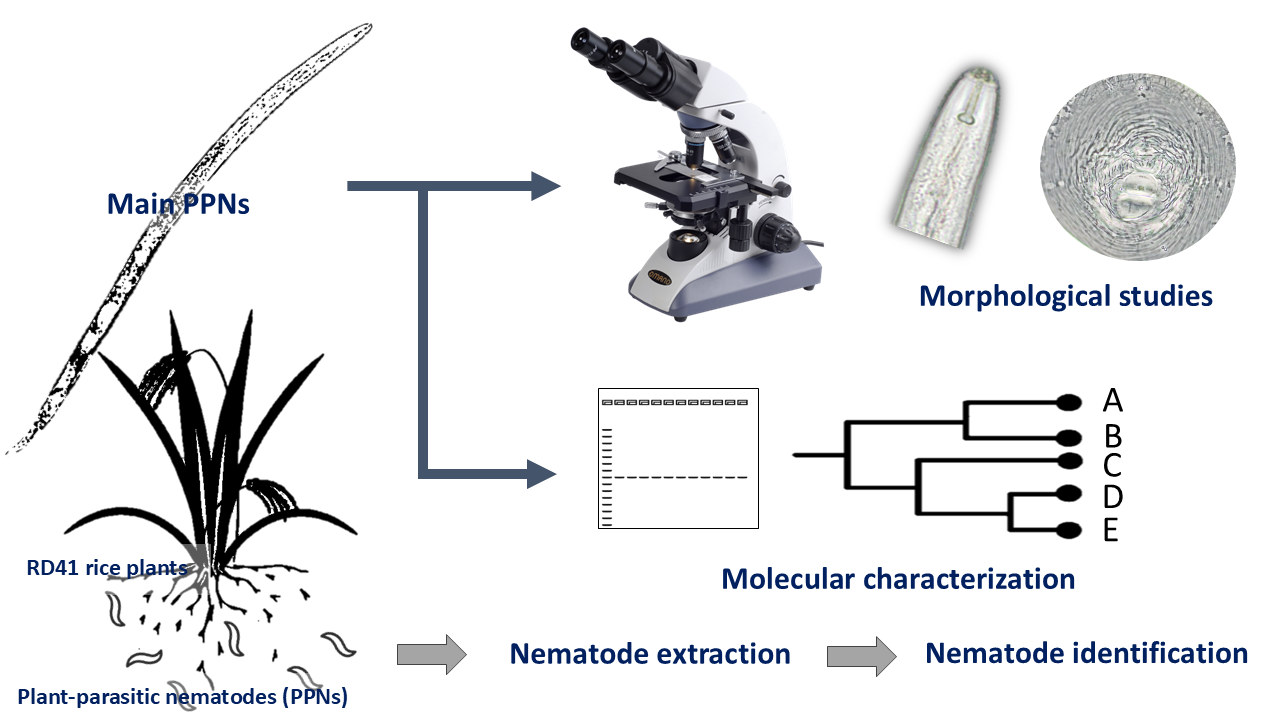
GRAPHICAL ABSTRACT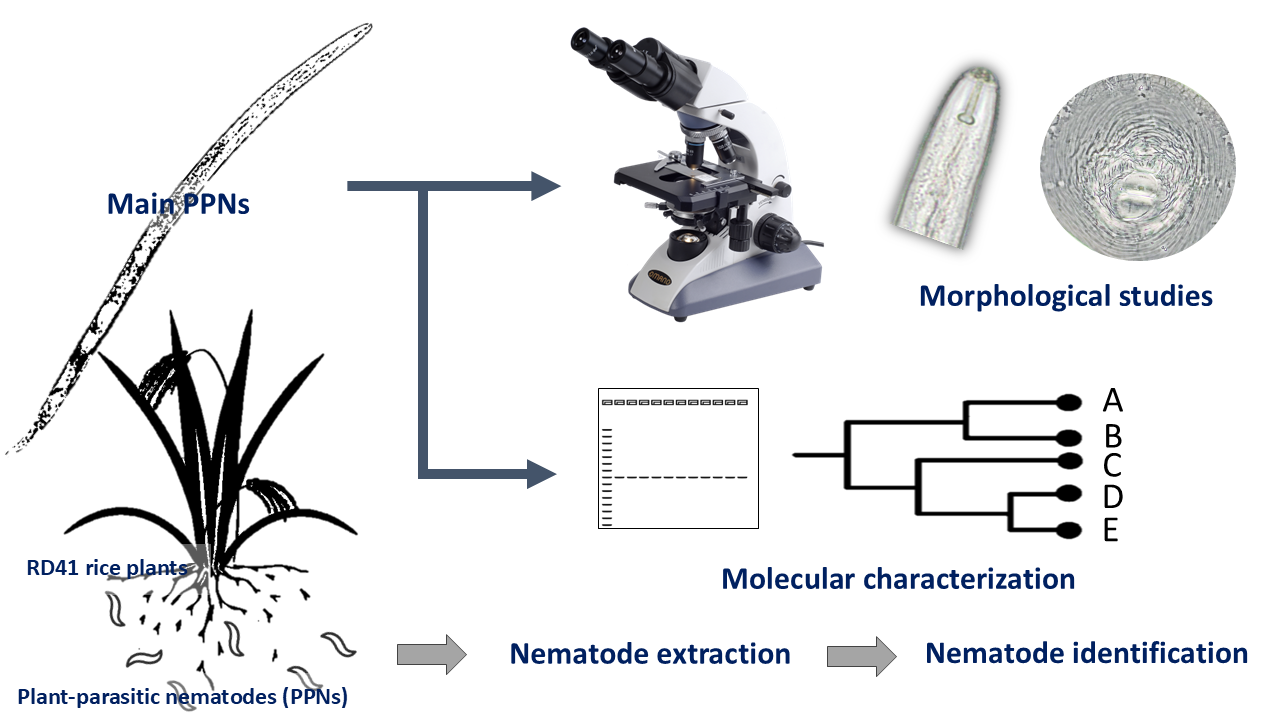
Downloads
References
Office of Agricultural Economics, Available at: https://www.oae.go.th/assets/portals
/1/fileups/prcaidata/files/second%20rice%2065%20province.pdf, accessed June 2024.
Rice Department, Available at: https://files.ricethailand.go.th/files/9/documents/page_doc/files-rice-1707277364541.pdf, accessed June 2024.
P Prakobna, P Sinchayakul, W Sorapongpaisal, K Kerdsuk and A Bunsak. Preference on planted rice varieties of farmers in central region and their relation to variety properties. Journal of Agricultural Science and Management 2020; 3, 29-38.
Bureau of Rice Research and Development, Available at: http://brrd.in.th/rkb/varieties/index.php-file¼content.php&id¼19.htm, accessed June 2024.
Rice Department, Available at: https://plantwiseplusknowledgebank.org/doi/10.1079/pwkb
.20167800083, accessed June 2024.
A Longya, S Talumphai and C Jantasuriyarat. Morphological characterization and genetic diversity of rice blast fungus, Pyricularia oryzae, from Thailand Using ISSR and SRAP markers. Journal of Fungi 2020; 6(1), 38.
JN Sasser and DW Freckman. A world prospective on nematology: The role of the society. In: JA Veech and DW Dickson (Eds.). Vistas on nematology. Society of Nematologists, Hyattsville, 1987, p. 7-14.
T Kyndt, D Fernandez and G Gheysen. Plant-parasitic nematode infections in rice: Molecular and cellular insights. Annual Review of Phytopathology 2014; 52(1), 135-153.
MLD Pascual, W Decraemer, I Tandingan, A Vierstraete, H Steel and W Bert. Prevalence and characterization of plant-parasitic nematodes in lowland and upland rice agro-ecosystems in Luzon, Philippines. Nematropica 2014; 44(2), 166-180.
CT Gilces, D Navia-Santillán and L Velasco. Plant-parasitic nematodes associated with rice in Ecuador. Nematropica 2016; 46(1), 45-53.
European and Mediterranean Plant Protection Organization. PM 7/94 (2) Hirschmanniella spp. EPPO Bulletin 2022; 52, 314-325.
MMA Youssef and MFM Eissa. The rice root nematode, Hirschmanniella oryzae, its identification, economic importance and control measures in Egypt: A review. Archives of Phytopathology and Plant Protection 2014; 47(19), 2340-2351.
D Peng, HS Gaur and J Bridge. Nematode parasites of rice. In: RA Sikora, D Coyne, J Hallmann and P Timper (Eds.). Plant parasitic nematodes in subtropical and tropical Agriculture. CAB International, Wallingford, 2018, p. 120-162.
J Bridge, RA Plowright and D Peng. Nematode parasites of rice. In: M Luc, RA Sikora and J Bridge (Eds.). Plant parasitic nematodes in subtropical and tropical agriculture. CAB International, UK, 2005, p. 87-130.
P Ruanpanun and A Khun-In. First report of Meloidogyne incognita caused root knot disease of upland rice in Thailand. International Society for Southeast Asian Agricultural Sciences 2015; 21(1), 68-77.
N Beesa, A Suwanngam, K Puttawong, P Phanbut, K Jindapunnapat, A Sasnarukkit and B Chinnasri. First report of the root-knot nematode Meloidogyne graminicola on shallot (Allium cepa var. aggregatum) in Thailand. New Disease Reports 2023; 47(1), e12158.
JR Christie and VG Perry. Removing nematodes from soil. Proceedings of the Helminthological Society of Washington 1951; 18, 106-108.
WD Courtney, D Polley and VL Miller. TAF, an improved fixative in nematode technique. Plant Disease Reporter 1955; 39(7), 570-571.
N Beesa, K Jindapunnapat, B Chinnasri and T Chairin. Nematode development and changes in enzymatic defensive activity in rice plants upon Meloidogyne graminicola infection for preliminary screening of resistant cultivars. Songklanakarin Journal of Science and Technology 2022; 44(1), 26-31.
G Thorne. On the classification of the Tylenchida, new order (Nematode, Phasmidia). Proceedings of the Helminthological Society of Washington 1949; 16, 37-73.
M Holterman, A Wurff, S Elsen, H Megen, T Bongers, O Holovachov, J Bakker and J Helder. Phylum-wide analysis of SSU rDNA reveals deep phylogenetic relationships among nematodes and accelerated evolution toward crown clades. Molecular Biology and Evolution 2006; 23(9), 1792-1880.
ML Blaxter, PD Ley, JR Garey, LX Liu, P Scheldeman, A Vierstraete, JR Vanfleteren, LY Mackey, M Dorris, LM Frisse, JT Vida and WK Thomas. A molecular evolutionary framework for the phylum Nematoda. Nature 1998; 392, 71-75.
GB Nunn. 1992, Nematode molecular evolution. Ph. D. dissertation. University of Nottingham, Nottingham, England.
TC Vrain, DA Wakarchuk, AC Levesque and RI Hamilton. Intraspecific rDNA restriction fragment length polymorphism in the Xiphinema americanum group. Fundamental and Applied Nematology 1992; 15(6), 563-573.
TO Powers and TS Harris. A polymerase chain reaction method for identification of five major Meloidogyne species. Journal of Nematology 1993; 25(1), 1-6.
P Phadungkit, N Beesa, K Jindapunnapat, S Chowpongpang, B Chinnasri and A Sasnarukkit. Morphological and molecular characterization of predominant plant-parasitic nematodes associated with pattawia pineapple-cultivated areas in Prachuap Khiri Khan, Thailand. Trends in Sciences 2024; 21(9), 8017.
M Suong, E Chapuis, V Leng, F Tivet, D Waele, HN Thi and S Bellafiore. Impact of a conservation agriculture system on soil characteristics, rice yield, and root-parasitic nematodes in a Cambodian lowland rice field. Journal of Nematology 2019; 51(2), e2019-85.
SV Nguyen, PTK Nguyen, K Araki, RN Perry, LB Tran, KM Chau, YY Min and K Toyota. Effects of cropping systems and soil amendments on nematode community and its relationship with soil physicochemical properties in a paddy rice field in the Vietnamese Mekong Delta. Applied Soil Ecology 2020; 156, 103683.
K Khun, W Decraemer, M Couvreur, G Karssen, H Steel and W Bert. Deceptive morphological variation in Hirschmanniella mucronata (Nematoda: Pratylenchidae) and a polytomous key to the genus. Nematology 2015; 17(4), 377-400.
N Beesa, A Sasnarukkit, K Jindapunnapat, F Tivet, S Bellafiore and B Chinnasri. Species characterization and population dynamics of Hirschmanniella mucronata in lowland rice fields managed under conservation agriculture in Cambodia. Journal of the Saudi Society of Agricultural Sciences 2021; 20(3), 137-145.
DY Chen, HF Ni, JH Yen, RS Chen and TT Tsay. Distribution of rice root nematode Hirschmanniella oryzae and a new recorded H. mucronata (Nematoda: Pratylenchidae) in Taiwan. Plant Pathology Bulletin 2006; 15, 197-210.
N Beesa, A Sasnarukkit, K Jindapunnapat, B Chinnasri and T Chairin. Incidence and characterization of rice root nematodes, Hirschmanniella mucronata, from rice fields in Pathum Thani province, Thailand. Trends in Sciences 2021; 18(22), 486.
R Salalia, RK Walia, VS Somvansh, P Kumar and A Kumar. Morphological, morphometric, and molecular characterization of intraspecific variations within Indian populations of Meloidogyne graminicola. Journal of Nematology 2017; 49(3), 254-267.
Z Tian, M Maria, EM Barsalote, P Castillo and J Zheng. Morphological and molecular characterization of the rice root-knot nematode, Meloidogyne graminicola, Golden and Birchfeild, 1965 occurring in Zhejiang, China. Journal of Integrative Agriculture 2018; 17(12), 2724-2733.
HT Nguyen, S Vang, NT Phan, P Czernic, PQ Trinh, CV Ha, J Aribi, A Masson, M Suong and S Bellafiore. Identification and characterization of a virulent population of Meloidogyne graminicola. Australasian Plant Pathology 2023; 52, 391-405.
AM Golden and W Birchfeild. Meloidogyne graminicola (Heterodera) a new species of root knot nematode from grass. Proceedings of the Helminthological Society of Washington 1965; 32, 228-231.
S Indarti, A Soffan and MMF Andrasmara. Short communication: first record of Hirschmanniella mucronata (Nematoda: Pratylenchidae) in Yogyakarta, Indonesia. Biodiversitas 2020; 21(5), 2068-2073.
AO Mwamula, TH Lim, Y Kim, H Lee, YH Kim and DW Lee. Morphological plasticity in the rice root nematode, Hirschmanniella oryzae (van Breda de Haan, 1902) Luc & Goodey, 1964 from Korea, with inferences from its ribosomal and mitochondrial DNA. European Journal of Plant Pathology 2022; 164, 337-352.
E Fanelli, F Gaffuri, A Troccoli, S Sacchi and FD Luca. New occurrence of Meloidogyne graminicola (Nematoda: Meloidogyninae) from rice fields in Italy: Variability and phylogenetic relationships. Ecology and Evolution 2022; 12(9), e9326.
S Pathak. Enhancing disaster resilience among women entrepreneurs in Thai SMEs: Learning from 2011 floods. In: Proceedings of the 5th International Conference New Voices in Global Health and Development, Thailand. 2018, p. 45-55.
M Jeger, C Bragard, D Caffier, T Candresse, E Chatzivassiliou, K Dehnen-Schmutz, G Gilioli, JC Grégoire, J Anton, J Miret, A MacLeod, MN Navarro, S Parnell, R Potting, T Rafoss, V Rossi, G Urek, AV Bruggen, WVD Werf, J West, S Winter and B Niere. Pest categorization of Hirschmanniella spp. EFSA Journal 2018; 16(6), e05297.
V Kumar, KK Verma and A Kumar. Effect of soil organic matter content and soil texture on reproduction of Meloidogyne graminicola on rice. Journal of Entomology and Zoology Studies 2017; 5(5), 1267-1270.
S So, Y Garan, K Miyahara and Y Ohshima. Body size change in various nematodes depending on bacterial food, sex and growth temperature. Worm 2012; 1(2), 93-97.
A Khun-In. Population of rice disease caused by rice nematodes in Phra Nakhon Si Ayutthaya, Thailand. Khon Kaen Agriculture Journal 2020; 48, 1374-1383.
N Beesa, P Macharoen, N Kuncharoen, T Dethoup, A Sasnarukkit and B Chinnasri. Cavalcade legume (Centrosema pascuorum) used as soil amendment in RD41 rice fields: Short-term effects on the soil nematode community, soil properties, and yield components. Applied Science and Engineering Progress 2025; 18(2), 7585.
N Beesa, N Kuncharoen, T Dethoup, K Jindapunnapat, A Sasnarukkit and B Chinnasri. Identification of bioactive compounds in cavalcade leaves for nematicidal activity against Hirschmanniella mucronata and Meloidogyne graminicola using LC-QTOF-MS. Crop Protection 2024; 185, 106875.
N Beesa, B Chinnasri, A Sasnarukkit, T Dethoup, K Jindapunnapat, AW Kiriga, K Saikai, S Haukeland and D Coyne. Potential of cavalcade, Centrosema pascuorum, leaves for controlling Meloidogyne javanica and quantification of active phytochemicals. Nematology 2023; 25, 1019-1032.
P Phanbut, K Puttawong, A Suwanngam, N Beesa, K Jindapunnapat, A Sasnarukkit and B Chinnasri. Nematicidal potential of green chiretta extracts against Meloidogyne enterolobii and M. incognita: In vitro assessment for agricultural application. Trends in Sciences 2024; 21(10), 8151.
K Puttawong, N Beesa, S Kasem, K Jindapunnapat, B Chinnasri and A Sasnarukkit. Potential of Bacillus spp. against root-knot nematode, Meloidogyne enterolobii parasitizing chili (Capsicum annuum L.). Crop Protection 2024; 184, 106780.
S Chungopast, W Intanoo and A Khun-In. Solubilization by nematode-controlling Trichoderma of nutrients to promote rice growth, yield and phosphorus content. Agriculture and Natural Resources 2023; 57(4), 667-676.
MR Khan, B Zaidi and Z Haque. Nematicides control rice root-knot, caused by Meloidogyne graminicola. Phytopathologia Mediterranea 2012; 51(2), 298-306.
Downloads
Published
How to Cite
Issue
Section
License
Copyright (c) 2024 Walailak University

This work is licensed under a Creative Commons Attribution-NonCommercial-NoDerivatives 4.0 International License.





