
Stabilization and Controlled Release of Curcumin from Temulawak by Spray-Drying Microencapsulation with Composite Wall Materials
DOI:
https://doi.org/10.48048/tis.2025.9125Keywords:
Temulawak, Curcumin, Microencapsulation, Stability, Release studyAbstract
Curcumin, is the main bioactive component of temulawak (Curcuma xanthorriza Roxb), which is a native Indonesian herbal plant. Although it has various health benefits, curcumin’s stability and release time are very low, limiting its application. This study aimed to improve curcumin stability through spray-drying microencapsulation using various wall materials, including maltodextrin (MDE), gum Arabic (GAR), whey protein isolate (WPI), and their composites with β-cyclodextrin (βCD). The resulting curcumin microcapsules from temulawak extract had an irregular morphology with a rough surface and grooves, averaging 2 μm in diameter. The stability of curcumin during storage, against heat and various pH conditions increased significantly, especially in microcapsules prepared with composite wall materials. Curcumin release was faster in single wall material microcapsules, while composite wall material microcapsules achieved release times over 120 min. In conclusion, curcumin from temulawak extract can be prepared by spray drying. MDE-βCD composite wall materials are highly recommended because they produce curcumin microcapsules with improved stability and controlled release compared to single wall materials or other composite wall materials. This research can facilitate the utilization of curcumin from temulawak extract in industrial and food applications.
HIGHLIGHTS
- Temulawak (Curcuma xanthorriza Roxb) is a herbal plant native to Indonesia.
- Curcumin is the primary polyphenol found in temulawak, which has various health benefits for the body.
- Curcumin has low stability and fast release time, thus limiting its application in the food and pharmaceutical fields.
- The microencapsulation process by spray drying can be proposed to increase the stability and release time of curcumin by considering the type of wall material used.
- The stability of curcumin from temulawak extract microcapsules prepared with maltodextrin (MDE) and β-cyclodextrin (βCD) composite wall materials increased significantly during storage, extreme heat conditions and different pH.
- The release time of the curcumin total prepared with MDE-βCD composite wall materials reached 158 min.
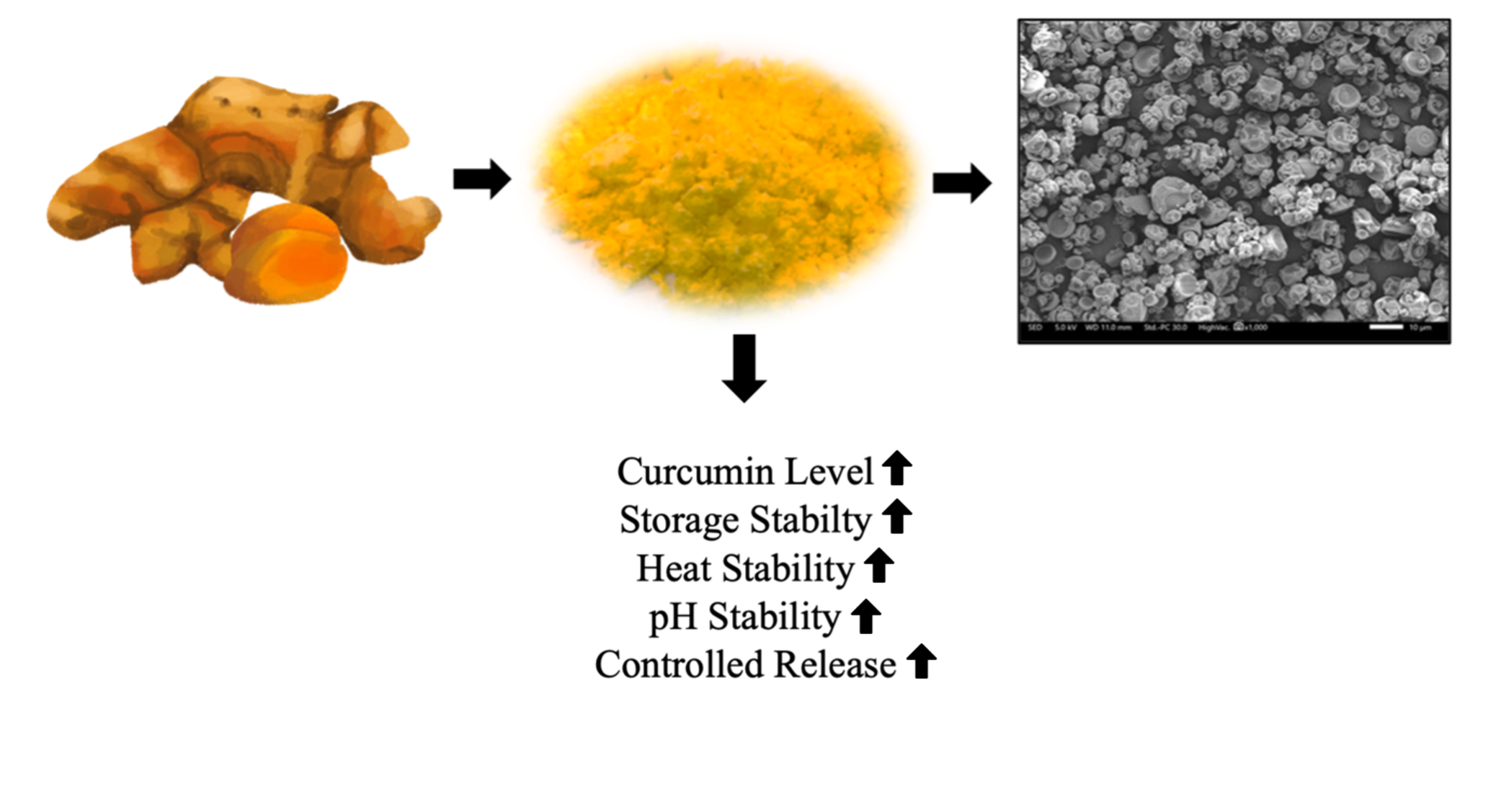
GRAPHICAL ABSTRACT
Downloads
References
E Rahmat, J Lee and Y Kang. Javanese turmeric (Curcuma xanthorrhiza Roxb.): Ethnobotany, phytochemistry, biotechnology, and pharmacological activities. Evidence-Based Complementary and Alternative Medicine 2021; 2021(1), 9960813.
VT Nguyen, TM Huynh, THQ Nguyen and TH Le. Enhancing the stability of synthesized curcumin by spray-drying microencapsulation with soy lecithin and gum Arabic. Brazilian Journal of Chemical Engineering 2021; 38, 563-572.
A Bucurescu, AC Blaga, BN Estevinho and F Rocha. Microencapsulation of curcumin by a spray-drying technique using gum Arabic as encapsulating agent and release studies. Food and Bioprocess Technology 2018; 11, 1795-1806.
J Lucas, M Ralaivao, BN Estevinho and F Rocha. A new approach for the microencapsulation of curcumin by a spray drying method, in order to value food products. Powder Technology 2020; 362, 428-435.
DM Cano-Higuita, CR Malacrida and VRN Telis. Stability of curcumin microencapsulated by spray and freeze drying in binary and ternary matrices of maltodextrin, gum arabic and modified starch. Journal of Food Processing and Preservation 2015; 39(6), 2049-2060.
K Li, MW Woo, H Patel and C Selomulya. Enhancing the stability of protein-polysaccharides emulsions via Maillard reaction for better oil encapsulation in spray-dried powders by pH adjustment. Food Hydrocolloids 2017; 69, 121-131.
J Guo, P Li, L Kong and B Xu. Microencapsulation of curcumin by spray drying and freeze drying. LWT 2020; 132, 109892.
V Goëlo, M Chaumun, A Gonçalves, BN Estevinho and F Rocha. Polysaccharide-based delivery systems for curcumin and turmeric powder encapsulation using a spray-drying process. Powder Technology 2020; 370, 137-146.
FP Chen, LL Liu and CH Tang. Spray-drying microencapsulation of curcumin nanocomplexes with soy protein isolate: Encapsulation, water dispersion, bioaccessibility and bioactivities of curcumin. Food Hydrocolloids 2020; 2020, 105821.
RU Jaidi, MFM Nordin and ASM Kassim. Wall material formulations for Zingiberaceae family rhizome extracts (Curcuma longa, Curcuma xanthorriza and Zingerol officinale) on microencapsulation efficiency of spray drying processing. Progress in Engineering Application and Technology 2023; 4(1), 1-12.
S Meena, W Prasad, K Khamrui, S Mandal and S Bhat. Preparation of spray-dried curcumin microcapsules using a blend of whey protein with maltodextrin and gum arabica and its in-vitro digestibility evaluation. Food Bioscience 2021; 41, 100990.
SS Patel, HA Pushpadass, MEE Franklin, SN Battula and P Vellingiri. Microencapsulation of curcumin by spray drying: Characterization and fortification of milk. Journal of Food Science and Technology 2021; 59(4), 1326-1340.
A Rosidi, A Khomsan, B Setiawan, H Riyadi and D Briawan. Antioxidant potential of temulawak (Curcuma xanthorrhiza roxb). Pakistan Journal of Nutrition 2016; 15(6), 556-560.
A Rosidi, R Farha, FF Jauharany, H Sulistyaningrum, AR Fitriyanti, Nurhidajah, E Sulistyowati and A Lahdji. The thermostability of temulawak extract encapsulation with several coating variations of sodium tripolyphosphate and chitosan. Food Research 2023; 7(6), 214-219.
SR Adsare and US Annapure. Microencapsulation of curcumin using coconut milk whey and Gum Arabic. Journal of Food Engineering 2021; 298, 110502.
SC Chew, CP Tan and KL Nyam. Microencapsulation of refined kenaf (Hibiscus cannabinus L.) seed oil by spray drying using β-cyclodextrin/gum arabic/sodium caseinate. Journal of Food Engineering 2018; 237, 78-85.
Nurhidajah, D Yonata and B Pranata. Microencapsulation of anthocyanin-rich extract from Indonesian black rice using maltodextrin, Arabic gum and skimmed milk powder as wall material by spray drying. Trends in Science 2024; 21(8), 7971.
W Liu, XD Chen, Z Cheng and C Selomulya. On enhancing the solubility of curcumin by microencapsulation in whey protein isolate via spray drying. Journal of Food Engineering 2016; 169, 189-195.
W Liu, WD Wu, C Selomulya and XD Chen. Facile spray-drying assembly of uniform microencapsulates with tunable core-shell structures and controlled release properties. Langmuir 2011; 27(21), 12910-12915.
N Laokuldilok, P Thakeow, P Kopermsub and N Utama-Ang. Optimisation of microencapsulation of turmeric extract for masking flavou. Food Chemistry 2016; 194, 695-704.
S Aminah, Nurrahman, B Pranata, R Amalia, ANAP Siregar and D Yonata. Microencapsulation of seafood flavor enhancers from Indonesian brown seaweed with maltodextrin, Arabic gum, and β-cyclodextrin. Egyptian Journal of Aquatic Biology & Fisheries 2023; 27(2), 811-821.
S Saffarionpour. Nanoencapsulation of hydrophobic food flavor ingredients and their cyclodextrin inclusion complexes. Food and Bioprocess Technology 2019; 12(7), 1157-1173.
E Dickinson. Hydrocolloids as emulsifiers and emulsion stabilizers. Food Hydrocolloids 2009; 23(6), 1473-1482.
RVDB Fernandes, SV Borges and DA Botrel. Gum arabic/starch/maltodextrin/inulin as wall materials on the microencapsulation of rosemary essential oil. Carbohydrate Polymers 2014; 101, 524-532.
N Čujić-Nikolić, N Stanisavljević, K Šavikin, A Kalaušević, V Nedović, D Bigović and T Janković. Application of gum Arabic in the production of spray-dried chokeberry polyphenols, microparticles characterisation and in vitro digestion method. Lekovite Sirovine 2018; 38, 10-18.
Y Wang, Z Lu, F Lv and X Bie. Study on microencapsulation of curcumin pigments by spray drying. European Food Research and Technology 2009; 229, 391-396.
Z Chen, Y Xia, S Liao, Y Huang, Y Li, Y He, Z Tong and B Li. Thermal degradation kinetics study of curcumin with nonlinear methods. Food Chemistry 2014; 155, 81-86.
B Abbastabr, MH Azizi and SR Nabavi. Curcumin microparticles produced by electrospraying technique with whey protein isolate and β-cyclodextrin complex. Journal of Agricultural Science and Technology 2020; 22(3), 709-722.
KM Nelson, JL Dahlin, J Bisson, J Graham, GF Pauli and MA Walters. The essential medical chemistry of curcumin. Journal of Medicinal Chemistry 2017; 60(5), 1620-1637.
S Solghi, Z Emam-Djomeh, M Fathi and F Farahani. The encapsulation of curcumin by whey protein: Assessment of the stability and bioactivity. Journal of Food Process Engineering 2020; 43(6), 13403.
M Khawar, Z Du, G Zhang and DJ McClements. Physical and chemical stability of curcumin in aqueous solutions and emulsions: Impact of pH, temperature, and molecular environment. Journal of Agricultural and Food Chemistry 2016; 65(8), 1525-1532.
ON Gordon, PB Luis, RE Ashley, N Osheroff and C Schneider. Oxidative transformation of demethoxy- and bisdemethoxycurcumin: Products, mechanism of formation, and poisoning of human topoisomerase IIα. Chemical Research in Toxicology 2015; 28(5), 989-996.
I Benucci, C Mazzocchi, C Lombardelli, FD Franco, M Cerreti and M Esti. Inclusion of curcumin in b-cyclodextrin: A promising prospective as food ingredient. Food Additives & Contaminants: Part A 2022; 39(12), 1942-1952.
CS Mangolim, C Moriwaki, AC Nogueira, F Sato, ML Baesso, AM Neto and G Matioli. Curcumin-β-cyclodextrin inclusion complex: Stability, solubility, characterisation by FT-IR, FT-Raman, X-ray diffraction and photoacoustic spectroscopy, and food application. Food Chemistry 2014; 153, 361-370.
B Gonçalves, M Moeenfard, F Rocha, A Alves, BN Estevinho and L Santos. Microencapsulation of a natural antioxidant from coffee - chlorogenic acid (3-caffeoylquinic acid). Food and Bioprocess Technology 2017; 10, 1521-1530.
BN Estevinho, I Carlan, A Blaga and F Rocha. Soluble vitamins (vitamin B12 and vitamin C) microencapsulated with different biopolymers by a spray drying process. Powder Technology 2016; 289, 71-78.
Downloads
Published
How to Cite
Issue
Section
License
Copyright (c) 2024 Walailak University

This work is licensed under a Creative Commons Attribution-NonCommercial-NoDerivatives 4.0 International License.





