
Structural Stability of Vacancy and Substitutional Defects in g-GaN: A First-Principles Study
DOI:
https://doi.org/10.48048/tis.2024.8592Keywords:
First-principles calculations, g-GaN, Defects, Symmetry, StabilityAbstract
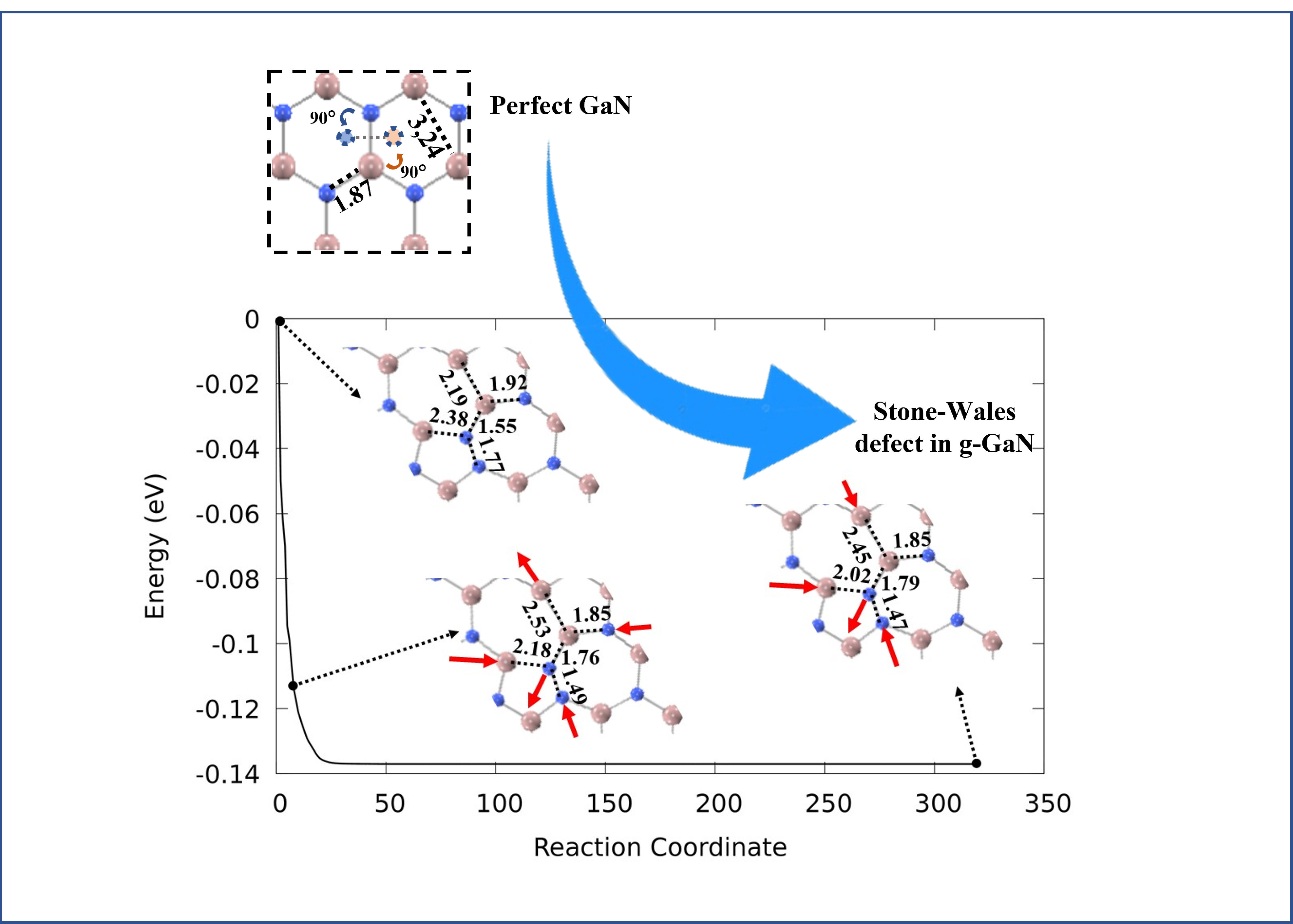
Herein, the first-principles calculations of defected monolayer graphene-like gallium nitride (g-GaN) were elucidated. The optimized geometric revealed that the nearest-neighbor distances of N-N (between N atoms) and Ga-Ga (between Ga atoms) were narrowing in most configurations. Interestingly, the VGa has a similar atomic symmetry as the pure g-GaN, which is D3h. Most defected configurations are degraded into C2V symmetries, while the Stone-Wales configuration has the lowest symmetry of CS. The formation energies of VNa systems are lower, which implies better energetic stability. For the divacancies, the VGa system is more stable than the VNa system. Moreover, the Stone-Wales configuration is energetically more stable than the interchange configuration. Furthermore, the reaction coordinates represent the geometric evolution of each defected system. The result revealed that the N-atoms are consistent with moving outward while the Ga-atoms move inward only for monovacancies and divacancies configurations. In contrast, the N-atoms move inward while the Ga-atoms move outward for substitutions, interchanges, and Stone-Wales configurations. We believe that this finding will be beneficial as the groundwork for future 2D g-GaN-based semiconductor devices.
HIGHLIGHTS
- The VNa defective system is more stable than the VGa system in monovacancies and substitutions.
- The VGaGa defective system is more stable than the VNa system in divacancies.
- The Stone-Wales system is a stable configuration with a Cs symmetry.
GRAPHICAL ABSTRACT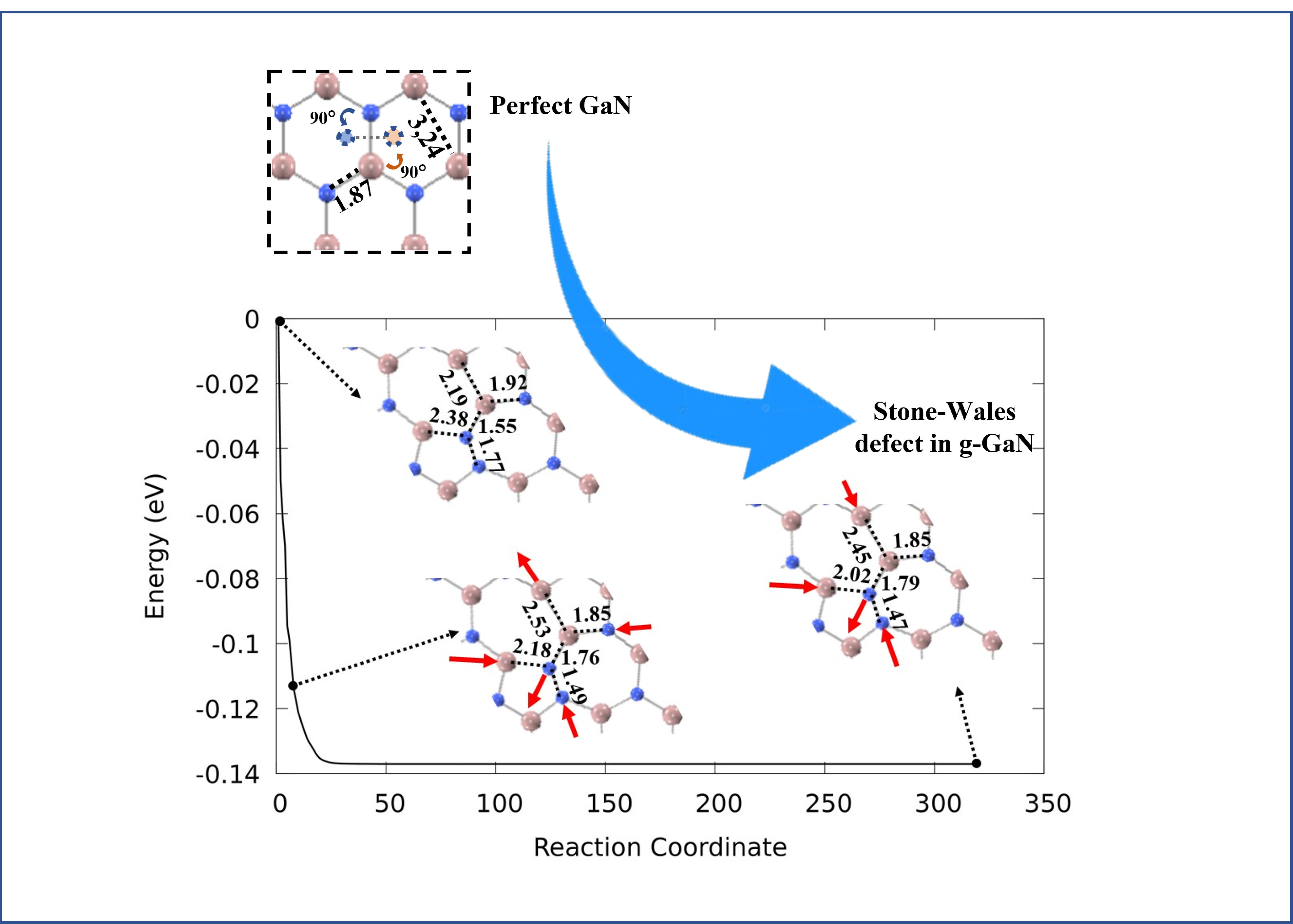
Downloads
References
KS Novoselov, AK Geim, SV Morozov, D Jiang, MI Katsnelson, IV Grigorieva, SV Dubonos and AA Firsov. Two-dimensional gas of massless Dirac fermions in graphene. Nature 2005; 438, 197-200.
R Nandee, MA Chowdhury, A Shahid, N Hossain and M Rana. Band gap formation of 2D material in graphene: Prospect and challenges. Results Eng. 2022; 15, 100474.
S Sholihun, D Purnawati, JP Bermundo, H Prayogi, ZS Fatomi and S Hidayati. Novel two-dimensional square-structured diatomic group-IV materials: The first-principles prediction. Phys. Scr. 2023; 98, 115903.
S Li, Y Wu, Y Tu, Y Wang, T Jiang, W Liu and Y Zhao. Defects in silicene: Vacancy clusters, extended line defects and di-adatoms. Sci. Rep. 2015; 5, 7881.
M Ali, X Pi, Y Liu and D Yang. Electronic and magnetic properties of graphene, silicene and germanene with varying vacancy concentration. AIP Adv. 2017; 7, 045308.
DP Hastuti and P Nurwantoro. Stability study of germanene vacancies: The first-principles calculations. Mater. Today Commun. 2019; 19, 459-63.
T Hu and J Dong. Geometric and electronic structures of mono-and di-vacancies in phosphorene. Nanotechnology 2015; 26, 065705.
KH Yeoh, KH Chew, TL Yoon, R Rusi and DS Ong. Strain-tunable electronic and magnetic properties of two-dimensional gallium nitride with vacancy defects. J. Appl. Phys. 2020; 127, 015305.
DS Gomes, JM Pontes and S Azevedo. Structural and electronic properties of hydrogenated gallium nitride with vacancy and doping defects. Appl. Phys. A 2022; 128, 1050.
W Amalia and P Nurwantoro. Density-functional-theory calculations of structural and electronic propertis of vacancies in monolayer hexagonal boron nitride (h-BN). Comput. Condes. Matter 2019; 16, e00354.
AN Sosa, BJ Cid, IJ Hernández-Hernández and Á Miranda. Effects of substitutional doping and vacancy formation on the structural and electronic properties of silicene: A DFT study. Mater. Lett. 2022; 307, 130993.
S Majidi, A Achour, DP Rai, P Nayebi, S Solaymani, NB Nezafat and SM Elahi. Effect of point defects on the electronic density states of SnC nanosheets: First-principles calculations. Results Phys. 2017; 7, 3209-15.
D Bayerl, SM Islam, CM Jones, V Protasenko, D Jena and E Kioupakis. Deep ultraviolet emission from ultra-thin GaN/AlN heterostructures. Appl. Phys. Lett. 2016; 109, 241102.
N Sanders, D Bayerl, G Shi, KA Mengle and E Kioupakis. Electronic and optical properties of two-dimensional GaN from first principles. Nano Lett. 2017; 17, 7345-9.
V Singh, D Joung, L Zhai, S Das, SI Khondaker and S Seal. Graphene-based materials: Past, present and future. Prog. Mater. Sci. 2011; 56, 1178-271.
JH Ryou. Gallium nitride (GaN) on sapphire substrates for visible LEDs. In: JJ Huang, HC Kuo and SC Shen (Eds.). Nitride semiconductor Light-Emitting Diodes (LEDs): Materials, technologies and applications. Woodhead Publishing, Sawston, 2014, p. 66-98.
T Mukai, S Nagahama, T Kozaki, M Sano, D Morita, T Yanamoto, M Yamamoto, K Akashi and S Masui. Current status and future prospects of GaN‐based LEDs and LDs. Phys. Status Solidi A 2004; 201, 2712-6.
Y Taniyasu, M Kasu and T Makimoto. An aluminium nitride light-emitting diode with a wavelength of 210 nanometres. Nature 2006; 441, 325-8.
S Nakamura and MR Krames. History of gallium-nitride-based light-emiting diodes for illumination. Proc. IEEE 2013; 101, 2211-20.
T Ueda. Recent advances and future prospects on GaN-based power devices. In: Proceedings of the 2014 International Power Electronics Conference, Hiroshima, Japan. 2014.
T Doi. Current status and future prospects of GaN substrates for green devices. Sens. Mater. 2013; 25, 141-54.
A Onen, D Kecik, E Durgun and S Ciraci. GaN: From three- to two-dimensional single-layer crystal and its multilayer van der Waals solids. Phys. Rev. B 2016; 93, 085431.
O Arbouche, B Belgoumène, B Soudini and M Driz. First principles study of the relative stability and the electronic properties of GaN. Comput. Mater. Sci. 2009; 47, 432-8.
FL Hsiao, TK Li, PC Chen, SC Wang, KW Lin, WL Lin, YP Tsai, WK Lin and BS Lin. Phase resonance and sensing application of an acoustic metamaterial based on a composite both-sides-open disk resonator arrays. Sens. Actuators A Phys. 2022; 339, 113524.
H Jiang, P Wan, J Yang, X Xu, W Li and X Li. Analysis of radiation defects in gallium nitride using deep level transient spectra and first principles methods. Nucl. Instrum. Methods Phys. Res. Sect. B 2022; 545, 165120.
Q Peng, C Liang, W Ji and S De. Mechanical properties of g-GaN: A first principles study. Appl. Phys. A 2013; 113, 483-90.
ZY Al Balushi, K Wang, RK Ghosh, RA Vilá, SM Eichfeld, JD Caldwell, X Qin, YC Lin, PA DeSario, G Stone, S Subramanian, DF Paul, RM Wallace, S Datta, JM Redwing and JA Robinson. Two-dimensional gallium nitride realized via graphene encapsulation. Nat. Mater. 2016; 15, 1166-71.
J Tian, L Liu and F Lu. Tuning the electronic and optical properties of two-dimensional GaN/AlGaN heterostructure by vacancy defect. Appl. Surf. Sci. 2022; 601, 154269.
H Şahin, S Cahangirov, M Topsakal, E Bekaroglu, E Akturk, RT Senger and S Ciraci. Monolayer honeycomb structures of group-IV elements and III-V binary compounds: First-principles calculations. Phys. Rev. B 2009; 80, 155453.
Q Chen, H Hu, X Chen and J Wang. Tailoring band gap in GaN sheet by chemical modification and electric field: Ab initio calculations. Appl. Phys. Lett. 2011; 98, 053102.
Z Qin, G Qin, X Zuo, Z Xiong and M Hu. Orbitally driven low thermal conductivity of monolayer gallium nitride (GaN) with planar honeycomb structure: A comparative study. Nanoscale 2017; 9, 4295-309.
W Wang, Y Li, Y Zheng, X Li, L Huang and G Li. Lattice structure and bandgap control of 2D GaN grown on graphene/Si heterostructures. Small 2019; 15, 1802995.
Y Dai, CX Yan, AY Li, Y Zhang and SH Han. Effects of hydrogen on electronic properties of doped diamond. Carbon 2005; 43, 1009-14.
MD Bhatt, H Kim and G Kim. Various defects in graphene: A review. RSC Adv. 2022; 12, 21520-47.
K Shen, BC Wang, Y Xiao and XF Wang. Stability of Stone-Wales defect in two-dimensional honeycomb crystals. J. Phys. Condens. Matter 2021; 33, 335001.
CN Brock, BB Baer and DG Walker. Low-valency gallium PAW for faster defect calculations in GaN using plane-wave DFT. Comput. Mater. Sci. 2020; 187, 110106.
R González, W López-Pérez, Á González-García, MG Moreno-Armenta and R González-Hernández. Vacancy-charged defects in two-dimensional GaN. Appl. Surf. Sci. 2018; 433, 1049-55.
X Wei, B Fragneaud, CA Marianetti and JW Kysar. Nonlinear elastic behavior of graphene: Ab initio calculations to continuum description. Phys. Rev. B 2009; 80, 205407.
Downloads
Published
How to Cite
Issue
Section
License
Copyright (c) 2024 Walailak University

This work is licensed under a Creative Commons Attribution-NonCommercial-NoDerivatives 4.0 International License.





