
Feature‑Optimized Electronic‑Nose Classification of Fermented and Non‑Fermented Teas
DOI:
https://doi.org/10.48048/tis.2026.11396Keywords:
E-nose, Feature selection, Fermented tea, Non-fermented tea, LDA, Tea classification, Silhouette scoreAbstract
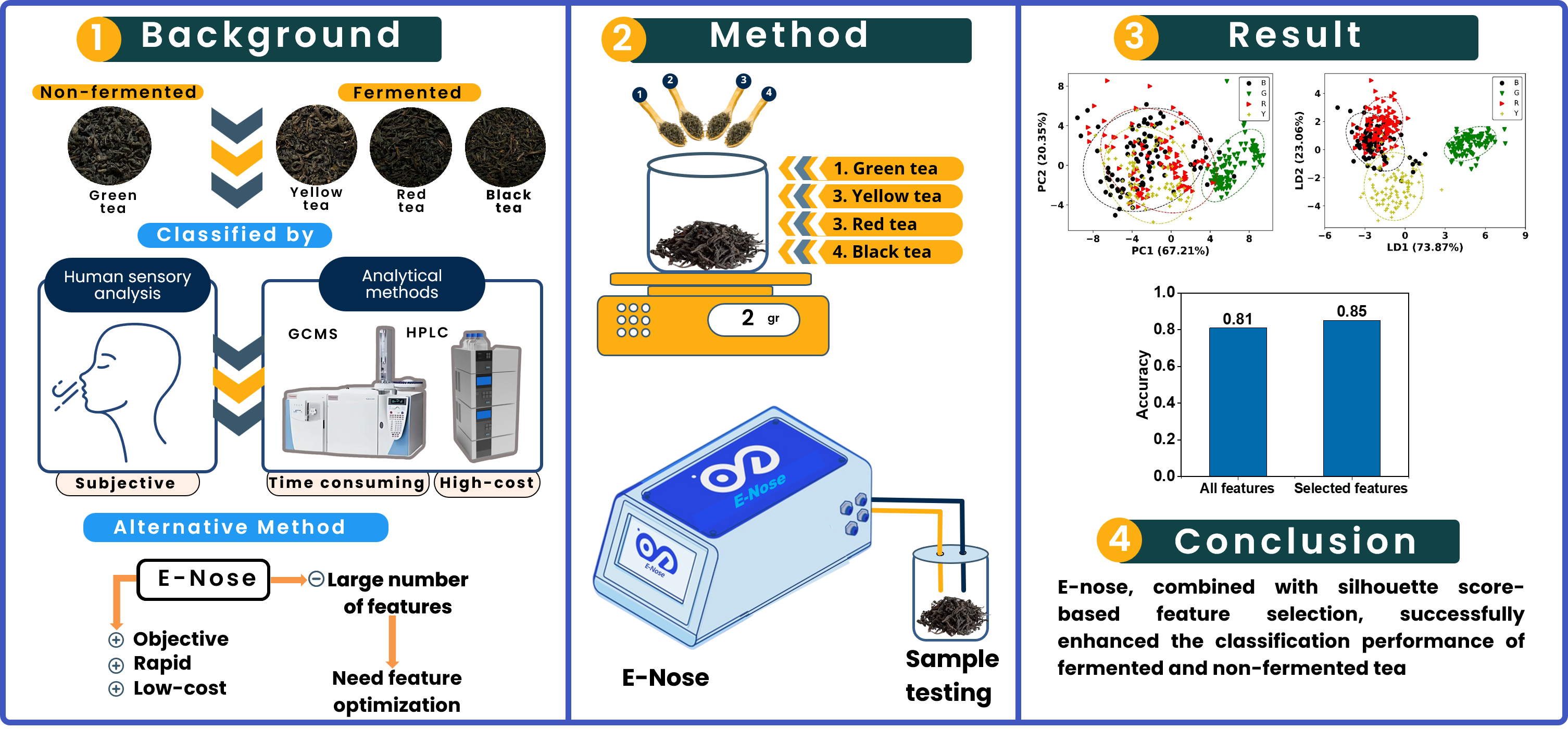
Fermentation plays a crucial role in establishing the extraordinary variety of flavors, fragrances, colors, nutritional attributes, and health advantages associated with teas. Considering the substantial disparities in quality and consumer preferences, it is essential to differentiate between fermented (yellow, red, and black) and non-fermented (green) teas for quality assurance and market viability. This study proposes a method to enhance tea classification performance using an electronic nose (e-nose) system. Five feature extraction methods (max, mean, median, gradient, and standard deviation) were applied to capture informative signals from the e-nose data. A silhouette score-based feature selection technique was then used to guide the determination of the optimal combination of these features. The best performance was achieved by combining the mean, median, and gradient features with a linear discriminant analysis (LDA) model, reaching a testing accuracy of 0.85, precision of 0.86, recall of 0.86, and an AUC of 0.97. The confusion matrix indicated perfect classification for green tea, with only minor misclassifications between red and black teas. To validate the e-nose results, gas chromatography-mass spectrometry (GC-MS) was employed. It identified key marker compounds for differentiating tea types. For instance, (1R)-4,7,7-trimethylbicyclo[2.2.1]heptan-2-one was found exclusively in yellow, red, and black teas, while nickel tetracarbonyl was unique to green tea. Overall, the study highlights the benefits of using feature selection to enhance e-nose classification performance and supports its use as a reliable, non-invasive tool for distinguishing fermented and non-fermented teas.
HIGHLIGHTS
- E-nose and LDA used to classify fermented vs non-fermented teas.
- Feature selection guided by silhouette score improves classification.
- GC-MS confirms e-nose findings in distinguishing tea fermentation types.
GRAPHICAL ABSTRACT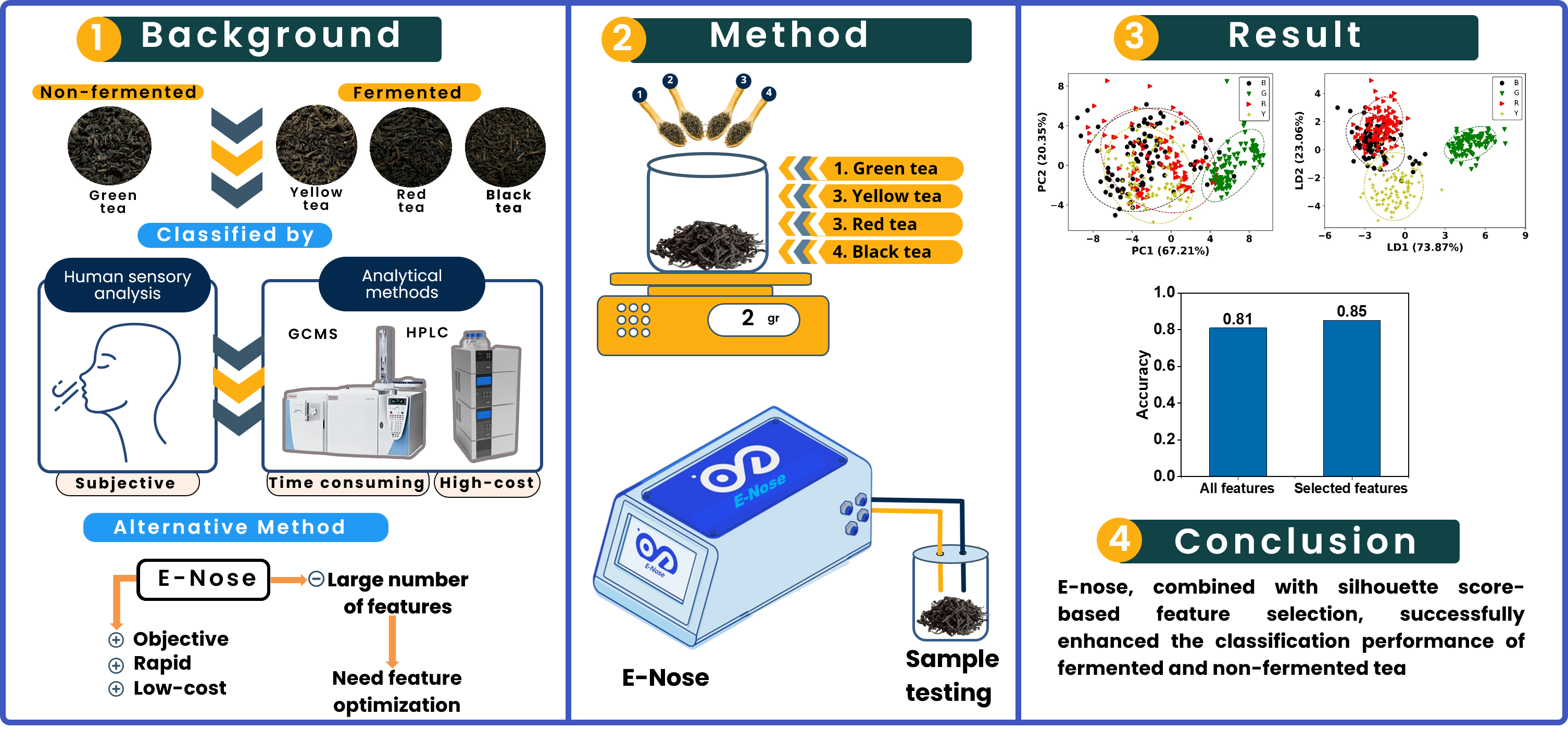
Downloads
References
L Xing, H Zhang, R Qi, R Tsao and Y Mine. Recent advances in the understanding of the health benefits and molecular mechanisms associated with green tea polyphenols. Journal of Agricultural and Food Chemistry 2019; 67(4), 1029-1043.
S Kaushal, P Nayi, D Rahadian and HH Chen. Applications of electronic nose coupled with statistical and intelligent pattern recognition techniques for monitoring tea quality: A review. Agriculture 2022; 12(9), 1359.
Food and Agriculture Organization. Current global market situation and medium-term outlook. Food and Agriculture Organization, Rome, Italy, 2024.
HF He. Research progress on theaflavins: Efficacy, formation, and preparation. Food and Nutrition Research 2017; 61(1), 1344521.
T Tanaka and Y Matsuo. Production mechanisms of black tea polyphenols. Chemical and Pharmaceutical Bulletin 2020; 68(12), 1131-1142.
LEA Camargo, LS Pedroso, SC Vendrame, RM Mainardes and NM Khalil. Antioxidant and antifungal activities of Camellia sinensis (L.) Kuntze leaves obtained by different forms of production. Brazilian Journal of Biology 2016; 76(2), 428-434.
J Xu, M Wang, J Zhao, YH Wang, Q Tang and IA Khan. Yellow tea (Camellia sinensis L.), a promising Chinese tea: Processing, chemical constituents and health benefits. Food Research International 2018; 107, 567-577.
KRJ Pou. Fermentation: The key step in the processing of black tea. Journal of Biosystems Engineering 2016; 41(2), 85-92.
A Shang, J Li, DD Zhou, RY Gan and HB Li. Molecular mechanisms underlying health benefits of tea compounds. Free Radical Biology and Medicine 2021; 172, 181-200.
Z Feng, Y Li, M Li, Y Wang, L Zhang, X Wan and X Yang. Tea aroma formation from six model manufacturing processes. Food Chemistry 2019; 285, 347-354.
LF Wang, JY Lee, JO Chung, JH Baik, S So and SK Park. Discrimination of teas with different degrees of fermentation by SPME-GC analysis of the characteristic volatile flavour compounds. Food Chemistry 2008; 109(1), 196-206.
H Yuan, X Chen, Y Shao, Y Cheng, Y Yang, M Zhang, J Hua, J Li, Y Deng, J Wang, C Dong, Y Jiang, Z Xie and Z Wu. Quality evaluation of green and dark tea grade using electronic nose and multivariate statistical analysis. Journal of Food Science 2019; 84(12), 3411-3417.
Q Chen, J Zhao, Z Chen, H Lin and DA Zhao. Discrimination of green tea quality using the electronic nose technique and the human panel test, comparison of linear and nonlinear classification tools. Sensors and Actuators B: Chemical 2011; 159(1), 294-300.
SN Hidayat, K Triyana, I Fauzan, T Julian, D Lelono, Y Yusuf, N Ngadiman, ACA Veloso and AM Peres. The electronic nose coupled with chemometric tools for discriminating the quality of black tea samples in situ. Chemosensors 2019; 7(3), 29.
AY Yashin, BV Nemzer, E Combet and YI Yashin. Determination of the chemical composition of tea by chromatographic methods: A review. Journal of Food Research 2015; 4(3), 56-88.
EJ Want, BF Cravatt and G Siuzdak. The expanding role of mass spectrometry in metabolite profiling and characterization. ChemBioChem 2005; 6(11), 1941-1951.
MW Dong. The essence of modern HPLC: Advantages, limitations, fundamentals, and opportunities. LCGC North America 2020; 31(6), 472-479.
M Bernabei, S Pantalei and I Sherrington. Development of an artificial olfactory system for lubricant degradation monitoring. International Journal of Condition Monitoring and Diagnostic Engineering Management 2020; 23, 3-12.
B Aouadi, JLZ Zaukuu, F Vitális, Z Bodor, O Fehér, Z Gillay, G Bazar and Z Kovacs. Historical evolution and food control achievements of near infrared spectroscopy, electronic nose, and electronic tongue—critical overview. Sensors 2020; 20(19), 5479.
M Xu, J Wang and L Zhu. Tea quality evaluation by applying e-nose combined with chemometrics methods. Journal of Food Science and Technology 2021; 58(4), 1549-1561.
X Lu, J Wang, G Lu, B Lin, M Chang and W He. Quality level identification of west lake longjing green tea using electronic nose. Sensors and Actuators, B: Chemical 2019; 301, 127056.
Q Chen, A Liu, J Zhao and Q Ouyang. Classification of tea category using a portable electronic nose based on an odor imaging sensor array. Journal of Pharmaceutical and Biomedical Analysis 2013; 84, 77-83.
S Kiani, S Minaei and M Ghasemi-Varnamkhasti. Application of electronic nose systems for assessing quality of medicinal and aromatic plant products: A review. Journal of Applied Research on Medicinal and Aromatic Plants 2016; 3(1), 1-9.
J Yan, X Guo, S Duan, P Jia, L Wang, C Peng and S Zhang. Electronic nose feature extraction methods: A review. Sensors 2015; 15(11), 27804-27831.
S Cui, P Ling, H Zhu and HM Keener. Plant pest detection using an artificial nose system: A review. Sensors 2018; 18(2), 378.
D Karakaya, O Ulucan and M Turkan. Electronic nose and its applications: A survey. International Journal of Automation and Computing 2020; 17, 179-209.
M Wang and Y Chen. Electronic nose and its application in the food industry: A review. European Food Research and Technology 2024; 250, 21-67.
Y Hu, Y Li, X Li, H Zhang, Q Chen and B Kong. Application of lactic acid bacteria for improving the quality of reduced-salt dry fermented sausage: Texture, color, and flavor profiles. LWT 2022; 154, 112723.
GA Fagundes, S Benedetti, MA Pagani, AM Fiorentini, J Severo and M Salas-Mellado. Electronic sensory assessment of bread enriched with cobia (Rachycentron canadum). Journal of Food Process Engineering 2022; 45(7), e13656.
L Qiu, M Zhang, AS Mujumdar and L Chang. Effect of edible rose (Rosa rugosa cv. Plena) flower extract addition on the physicochemical, rheological, functional and sensory properties of set-type yogurt. Food Bioscience 2021; 43, 101249.
H Tian, J Xiong, S Chen, H Yu, C Chen, J Huang, H Yuan and X Lou. Rapid identification of adulteration in raw bovine milk with soymilk by electronic nose and headspace-gas chromatography ion-mobility spectrometry. Food Chemistry: X 2023; 18, 100696.
Y Yang, J Chen, Y Jiang, MC Qian, Y Deng, J Xie, J Li, J Wang, C Dong and H Yuan. Aroma dynamic characteristics during the drying process of green tea by gas phase electronic nose and gas chromatography-ion mobility spectrometry. LWT 2022; 154, 112691.
S Nanga, AT Bawah, BA Acquaye, MI Billa, FD Baeta, NA Odai, SK Obeng and AD Nsiah. Review of dimension reduction methods. Journal of Data Analysis and Information Processing 2021; 9, 189-231.
LA Putri, I Rahman, M Puspita, SN Hidayat, AB Dharmawan, A Rianjanu, S Wibirama, R Roto, K Triyana and HS Wasisto. Rapid analysis of meat floss origin using a supervised machine learning-based electronic nose towards food authentication. NPJ Science of Food 2023; 7(1), 31.
GG Teixeira, LG Dias, N Rodrigues, ÍMG Marx, ACA Veloso, JA Pereira and AM Peres. Application of a lab-made electronic nose for extra virgin olive oils commercial classification according to the perceived fruitiness intensity. Talanta 2021; 226, 122122.
C Zhang, W Wang and Y Pan. Enhancing electronic nose performance by feature selection using an improved grey wolf optimization based algorithm. Sensors 2020; 20(15), 4065.
RA Putri, SI Sabilla and R Sarno. Optimal feature selection algorithm (FSA) for electronic nose signal. In: Proceedings of the 1st International Conference on Advanced Engineering and Technologies, East Java, Indonesia. 2023, p. 310-315.
B Langenberg, M Janczyk, V Koob, R Kliegl and A Mayer. A tutorial on using the paired t test for power calculations in repeated measures ANOVA with interactions. Behavior Research Methods 2023; 55, 2467-2484.
T Lin, X Lv, Z Hu, A Xu and C Feng. Semiconductor metal oxides as chemoresistive sensors for detecting volatile organic compounds: A review. Sensors 2019; 19(2), 233.
S Kim, G Singh, M Oh and K Lee. An analysis of a highly sensitive and selective hydrogen gas sensor based on a 3D Cu-doped SnO2 sensing material by efficient electronic sensor interface. ACS Sensors 2021; 6(11), 4145-4155.
SN Hidayat, T Julian, AB Dharmawan, M Puspita, L Chandra, A Rohman, M Julia, A Rianjanu, DK Nurputra, K Triyana and HS Wasisto. Hybrid Learning method based on feature clustering and scoring for enhanced COVID-19 breath analysis by an electronic nose. Artificial Intelligence in Medicine 2022; 129, 102323.
Z Wu, H Wang, X Wang, H Zheng, Z Chen and C Meng. Development of electronic nose for qualitative and quantitative monitoring of volatile flammable liquids. Sensors 2020; 20(7), 1817.
X Zhao, P Yu, N Zhong, H Huang and H Zheng. Impact of storage temperature on green tea quality: Insights from sensory analysis and chemical composition. Beverages 2024; 10(2), 35.
Y Sun, J Wang and S Cheng. Discrimination among tea plants either with different invasive severities or different invasive times using MOS electronic nose combined with a new feature extraction method. Computers and Electronics in Agriculture 2017; 143, 293-301.
R Gutierrez-Osuna, HT Nagle, B Kermani and SS Schiffman. Handbook of machine olfaction. WILEY-VCH Verlag GmbH & Co. KGaA, Weinheim, Germany, 2004, p. 105-132.
K Qian, Y Bao, J Zhu, J Wang and Z Wei. Development of a portable electronic nose based on a hybrid filter-wrapper method for identifying the Chinese dry-cured ham of different grades. Journal of Food Engineering 2021; 290, 110250.
A Gorji-Chakespari, AM Nikbakht, F Sefidkon, M Ghasemi-Varnamkhasti and EL Valero. Classification of essential oil composition in Rosa damascena Mill. genotypes using an electronic nose. Journal of Applied Research on Medicinal and Aromatic Plants 2017; 4, 27-34.
KO Kombo, SN Hidayat, M Puspita, A Kusumaatmaja, R Roto, H Nirwati, R Susilowati, EL Haksari, T Wibowo, S Wandita, Wahyono, M Julia and K Triyana. A machine learning-based electronic nose for detecting neonatal sepsis: Analysis of volatile organic compound biomarkers in fecal samples. Clinica Chimica Acta 2025; 565, 119974.
K Korjus, MN Hebart and R Vicente. An efficient data partitioning to improve classification performance while keeping parameters interpretable. Plos One 2016; 11(8), e0161788.
A Nazarkar, H Kuchulakanti, CS Paidimarry and S Kulkarni. Impact of various data splitting ratios on the performance of machine learning models in the classification of lung cancer. In: Proceedings of the 2nd International Conference on Emerging Trends in Engineering, Hyderabad, India. 2023, p. 96-104.
T Wang, H Zhang, Y Wu, W Jiang, X Chen, M Zeng, J Yang, Y Su, N Hu and Z Yang. Target discrimination, concentration prediction, and status judgment of electronic nose system based on large-scale measurement and multi-task deep learning. Sensors and Actuators B: Chemical 2022; 351, 130915.
IC Valenzuela, LKS Tolentino and ROS Juan. Utilization of e-nose sensory modality as add-on feature for advanced driver assistance system. International Journal of Advanced Trends in Computer Science and Engineering 2019; 8(4), 1783-1788.
P Borowik, T Grzywacz, R Tarakowski, M Tkaczyk, S Ślusarski, V Dyshko and T Oszako. Development of a low-cost electronic nose with an open sensor chamber: Application to detection of Ciboria batschiana. Sensors 2023; 23(2), 627.
J Bu, W Liu, Z Pan and K Ling. Comparative study of hydrochemical classification based on different hierarchical cluster analysis methods. International Journal of Environmental Research and Public Health 2020; 17(24), 9515.
R Graf, M Zeldovich and S Friedrich. Comparing linear discriminant analysis and supervised learning algorithms for binary classification—A method comparison study. Biometrical Journal 2024; 66(1), 2200098.
N Liu, S Shen, L Huang, G Deng, Y Wei, J Ning and Y Wang. Revelation of volatile contributions in green teas with different aroma types by GC-MS and GC-IMS. Food Research International 2023; 169, 112845.
Y Shi, M Wang, Z Dong, Y Zhu, J Shi, W Ma, Z Lin and H Lv. Volatile components and key odorants of Chinese yellow tea (Camellia sinensis). LWT 2021; 146, 111512.
W Hu, G Wang, S Lin, Z Liu, P Wang, J Li, Q Zhang and H He. Digital evaluation of aroma intensity and odor characteristics of tea with different types—based on OAV-splitting method. Foods 2022; 11(15), 2204.
Y Yang, H Zhu, J Chen, J Xie, S Shen, Y Deng, J Zhu, H Yuan and Y Jiang. Characterization of the key aroma compounds in black teas with different aroma types by using gas chromatography electronic nose, gas chromatography-ion mobility spectrometry, and odor activity value analysis. LWT 2022; 163, 113492.
X Chang, Y Long, C Wang and Y Xiao. Chemical fingerprinting of volatile organic compounds from asphalt binder for quantitative detection. Construction and Building Materials 2023; 371, 130766.
V Kraujalyte, E Pelvan and C Alasalvar. Volatile compounds and sensory characteristics of various instant teas produced from black tea. Food Chemistry 2016; 194, 864-872.
JY Jeon and SH Choi. Aroma characteristics of dried citrus fruits-blended green tea. Journal of Life Science 2011; 21(5), 739-745.
JS Gong, C Tang and CX Peng. Characterization of the chemical differences between solvent extracts from Pu-erh tea and Dian Hong black tea by CP-Py-GC/MS. Journal of Analytical and Applied Pyrolysis 2012; 95, 189-197.
X Zhai, J Wang, H Wang, M Xue, X Yao, M Li, J Yu, L Zhang and X Wan. Formation of dimethyl sulfide from the decomposition of S-methylmethionine in tea (Camellia sinensis) during manufacturing process and infusion brewing. Food Research International 2022; 162, 112106.
J Chen, Y Yang, Y Deng, Z Liu, J Xie, S Shen, H Yuan and Y Jiang. Aroma quality evaluation of Dianhong black tea infusions by the combination of rapid gas phase electronic nose and multivariate statistical analysis. LWT 2022; 153, 112496.
S Gong, Z Zhang, J Chen, H Wu, H Jiang, C Teng and Z Dai. Enhanced understanding of dark tea quality through integrated GC-IMS and e-nose analysis. LWT 2025; 224, 117806.
X Guo, W Schwab, CT Ho, C Song and X Wan. Characterization of the changes of aroma profiles in large-leaf yellow tea during processing using GC-MS and electronic nose analysis. Food Chemistry: X 2025; 27, 102507.
L Zhou, W Zheng, Y Sui, Z Zhu, S Li, J Shi, T Xiong, F Cai, J Wen, Z Zheng and X Mei. Characterization of volatile organic compounds in selenium-enriched brown rice tea of different colors using e-nose, HS-GC-IMS and HS-SPME-GC-MS. LWT 2025; 224, 117830.
Published
How to Cite
Issue
Section
License
Copyright (c) 2025 Walailak University

This work is licensed under a Creative Commons Attribution-NonCommercial-NoDerivatives 4.0 International License.





