
Analysis of Low Frequency on Dielectric Barrier Discharge Plasma Reactor for Ozone Production
DOI:
https://doi.org/10.48048/tis.2025.9335Keywords:
DBD reactor, Low frequency, Ozone production, EfficiencyAbstract
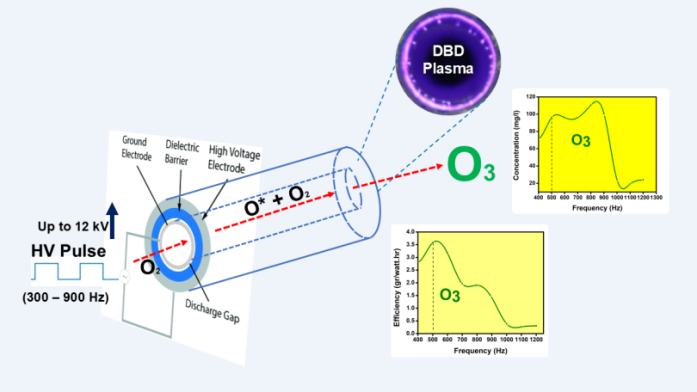
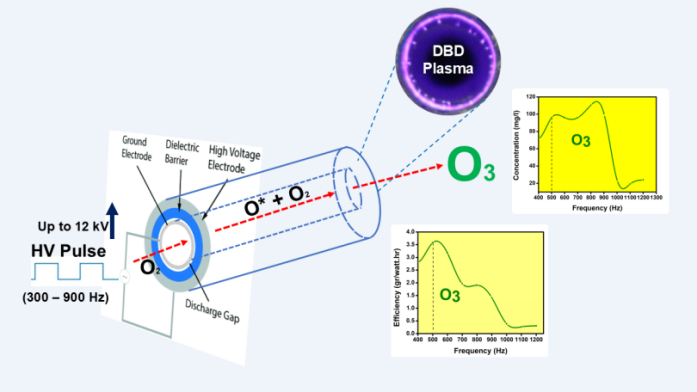
The current study investigates the effects of pulse frequency and magnitude of AC voltage applied on a cylindrical dielectric barrier discharge (DBD) plasma reactor with mesh electrodes, operated at atmospheric pressure, for ozone production have been systematically investigated. Results showed that increasing the discharge current and the operational power consumed by the DBD plasma reactor, which were proportional to the square and the cubic polynomials of the operational voltage, respectively, were essential for enhancing the concentration of ozone produced by the DBD plasma reactor. With pulse frequency being in the range of 500 - 900 Hz, the AC voltage of 9, 8 and 7 kV applied to the DBD reactor produced ozone with the concentration in the range of 140 - 180, 110 - 150 and 95 - 110 mg/L, respectively. The effect of pulse frequency is reflected by different frequency dependencies; i.e. in the ranges of 300 - 600, 600 - 900 and 1,000 - 1,200 Hz, which produce ozone with concentrations of 10 - 185, 10 - 220 and 10 - 225 mg/L based on a power consumption of 1.5 - 30, 10 - 80 and 15 - 200 W, respectively. The best performance, in terms of the efficiency, capacity and stability of ozone production as well as the input power efficiency and the specific energy input, was achieved at pulse frequency of 500 Hz. Overall, this study provides insights into the construction of an efficient DBD plasma-based ozone generator with low power input requirements.
HIGHLIGHTS
- Optimized DBD plasma reactor for ozone generation at atmospheric pressure.
- Voltage increase leads to quadratic current rise and cubic power growth.
- The pulse frequency for optimum ozone production efficiency was found to be at 500 Hz.
- Frequencies between 500 - 900 Hz ensure stable and efficient ozone output.
- Enhanced ozone generation with low power input requirements.
GRAPHICAL ABSTRACT
Downloads
References
F Bai, Y Ran, S Zhai and Y Xia. Cold atmospheric plasma: A promising and safe therapeutic strategy for atopic dermatitis. International Archives of Allergy and Immunology 2023; 184, 1184-1197.
NS Razuqi, FS Muftin, HH Murbat and NK Abdalameer. Influence of dielectric-barrier discharge (DBD) cold plasma on water contaminated bacteria. Annual Research & Review in Biology 2017; 14(4), 1-9.
P Dimitrakellis, M Giannoglou, A Zeniou, E Gogolides and G Katsaros. Food container employing a cold atmospheric plasma source for prolonged preservation of plant and animal origin food products. MethodsX 2021; 8, 101177.
AT Khalaf, AN Abdalla, K Ren and X Liu. Cold atmospheric plasma (CAP): A revolutionary approach in dermatology and skincare. European Journal of Medical Research 2024; 29, 487.
DP Subedi, UM Joshi and CS Wong. Dielectric barrier discharge (DBD) plasmas and their applications. In: R Rawat (Ed.). Plasma science and technology for emerging economies. Springer, Heidelberg, Germany, p. 693-737.
M Nur, AI Susan, Z Muhlisin, F Arianto, AW Kinandana, I Nurhasanah, S Sumariyah, PJ Wibawa, G Gunawan and A Usman. Evaluation of novel integrated dielectric barrier discharge plasma as ozone generator. Bulletin of Chemical Reaction Engineering & Catalysis 2017; 12(1), 24-31.
M Nur, YA Amelia, F Arianto, AW Kinanda, I Zahar, AI Susan and JP Wibawa. Dielectric barrier discharge plasma analysis and application for processing palm oil mill effluent (POME). Procedia Engineering 2017; 170, 325-333.
U Kogelschat. Dielectric-barrier discharges: Their history, discharge physics, and industrial applications. Plasma Chemistry and Plasma Processing 2003; 23, 1-46.
SL Park, JD Moon, SH Lee and SY Shin. Effective ozone generation utilizing a meshed-plate electrode in a dielectric-barrier discharge type ozone generator. Journal of Electrostatics 2006; 64(5), 275-282.
M Domonkos, P Ticha, J Trejbal and P Demo. Applications of cold atmospheric pressure plasma technology in medicine, agriculture and food industry. Applied Sciences 2021; 11(11), 4809.
AK Martusevich, AG Galka, ES Golygina, AS Fedotova, AN Tuzhilkin and SL Malinovskaya. Comparative study of the influence of helium and argon. Plasma on Crystallogenic Properties of the Blood 2021; 11(1), 69-79.
TL Sung, S Teii, CM Liu, RC Hsiao, PC Chen, YH Wu, CK Yang, K Teii, S Ono and K Ebihara. Effect of pulse power characteristics and gas flow rate on ozone production in a cylindrical dielectric barrier discharge ozonizer. Vacuum 2013; 90, 65-69.
R Teguh, Istadi, H Luqman, DA Didi and BDN Asep. Plasma-assisted catalytic cracking as an advanced process for vegetable oils conversion to biofuels: A mini review. Industrial & Engineering Chemistry Research 2020; 59(40), 17632-17652.
L Xie, D Yuan, L Wang, G Zhang, B Peng, L Wei and Z Ling. A novel dielectric barrier discharge ozone generator with excellent microdischarge temperature behavior. Applied Thermal Engineering 2024; 250, 123453.
K Okazaki and T Nozaki. Ultrashort pulsed barrier discharges and applications. Pure and Applied Chemistry 2002; 74(3), 447-452.
K Ollegott, P Wirth, C Oberste-Beulmann, P Awakowicz and M Muhler. Fundamental properties and applications of dielectric barrier discharges in plasma-catalytic processes at atmospheric pressure. Chemie Inginieur Technik 2020; 92(10), 1542-1558.
NK Abdulameer. Impact of dielectric barrier discharge (DBD) plasma on the optical properties of thin films. Journal of Engineering and Applied Science 2020; 15(8), 1937-1942.
I Istadi and NAS Amin. Catalytic-dielectric barrier discharge plasma reactor for methane and carbon dioxide conversion. Bulletin of Chemical Reaction Engineering & Catalysis 2007; 2(2-3), 37-44.
S Chatterjee, R Mukherjee, S Chandra, AR Maity, S Kumar and PS Maji. Harnessing Tamm-plasmon polaritons in cantor sequence photonic quasicrystals for enhanced cancer cell detection. Plasmonics 2024. https://doi.org/10.1007/s11468-024-02269-6
U Chowdhury, P Mandi, R Mukherjee, S Chandra, S Sutradhar, S Kumar and PS Maji. Dual self-referenced refractive index sensor utilizing tamm plasmons in photonic quasicrystal for Multistage malaria parasite detection. Plasmonics 2024. https://doi.org/10.1007/s11468-024-02308-2.
SB Verinda, M Muniroh, E Yulianto, N Maharani, G Gunawan NF Amalia, J Hobley, A Usman and M Nur. Degradation of ciprofloxacin in aqueous solution using ozone microbubbles: Spectroscopic, kinetics, and antibacterial analysis. Heliyon 2022; 8, e10137.
RD Menéndez and F Tabares. High frequency ozone generation system. Ozone Science and Engineering 2001; 23(2), 171-176.
AA Garamoon, FF Elakshar and M Elsawah. Optimizations of ozone generator at low resonance frequency. The European Physical Journal Applied Physics 2009; 48(2), 21002.
WJM Samaranayake, Y Miyahara, T Namihira, S Katsuki, R Hackam and H Akiyama. Ozone production using pulsed dielectric barrier discharge in oxygen. IEEE Transactions on Dielectrics and Electrical Insulation 2000; 7(6), 849-854.
D Hegemann. Plasma activation mechanisms governed by specific energy input: Potential and perspectives. Plasma Processes and Polymers 2023; 20, e2300010.
J Liu, X Zhu, X Li, K Li, C Shi and A Zhu. Effect of O2/CH4 ratio on the optimal specific-energy-input (SEI) for oxidative reforming of biogas in a plasma-shade reactor. Journal of Energy Chemistry 2013; 22, 681-684.
Y Sheng, Z Zhang and W Li. Effects of pulse frequency and duty cycle on the plasma discharge characteristics and surface microstructure of carbon steel by plasma electrolytic nitrocarburizing. Surface & Coatings Technology 2017; 330, 113-120.
P Vanraes, A Nikiforov, A Bogaerts and C Leys. Study of an AC dielectric barrier single micro-discharge filament over a water film. Scientific Reports 2018; 8, 10919.
C Liang, Z Liu, B Sun, H Zou and G Chu. Improvement in discharge characteristics and energy yield of ozone generation via configuration optimization of a coaxial dielectric barrier discharge reactor. Chinese Journal of Chemical Engineering 2023; 60, 61-68.
X Wang, ZH Shu, SJ Duan, HN Wang and S Liu. Study of space charge accumulation property in polyethylene under applied voltage of square wave. In: Proceedings of the 2nd International Conference on Electrical Materials and Power Equipment (ICEMPE), Guangzhou, China. 2019, p. 178-181.
M Robinson. Movement of air in the electric wind of the corona discharge. Transactions of the American Institute of Electrical Engineers 1961; 80(2), 143-150.
Z Farooq, DA Chestakov, B Yan, GC Groenenboom, WJVD Zande and DH Parker. Photodissociation of singlet oxygen in the UV region. Physical Chemistry Chemical Physics 2014; 16(7), 3305-3316.
HL Chen, HM Lee and MB Chang. Enhancement of energy yield for ozone production via packed-bed reactors. Ozone Science and Engineering 2006; 28(2), 111-118.
J Anuntagool, N Srangsomjit, P Thaweewong and G Alvarez. A review on dielectric barrier discharge nonthermal plasma generation, factors affecting reactive species, and microbial inactivation. Food Control 2023; 153, 109913.
Downloads
Published
How to Cite
Issue
Section
License
Copyright (c) 2024 Walailak University

This work is licensed under a Creative Commons Attribution-NonCommercial-NoDerivatives 4.0 International License.





