
Wound Healing Potent of Lyophilized-Secretome Gel from Human Wharton’s Jelly Mesenchymal Stem Cells
DOI:
https://doi.org/10.48048/tis.2024.8028Keywords:
Antioxidant, Carbomer, Secretome, Human Wharton’s Jelly Mesenchymal Stem Cells, Wound healingAbstract
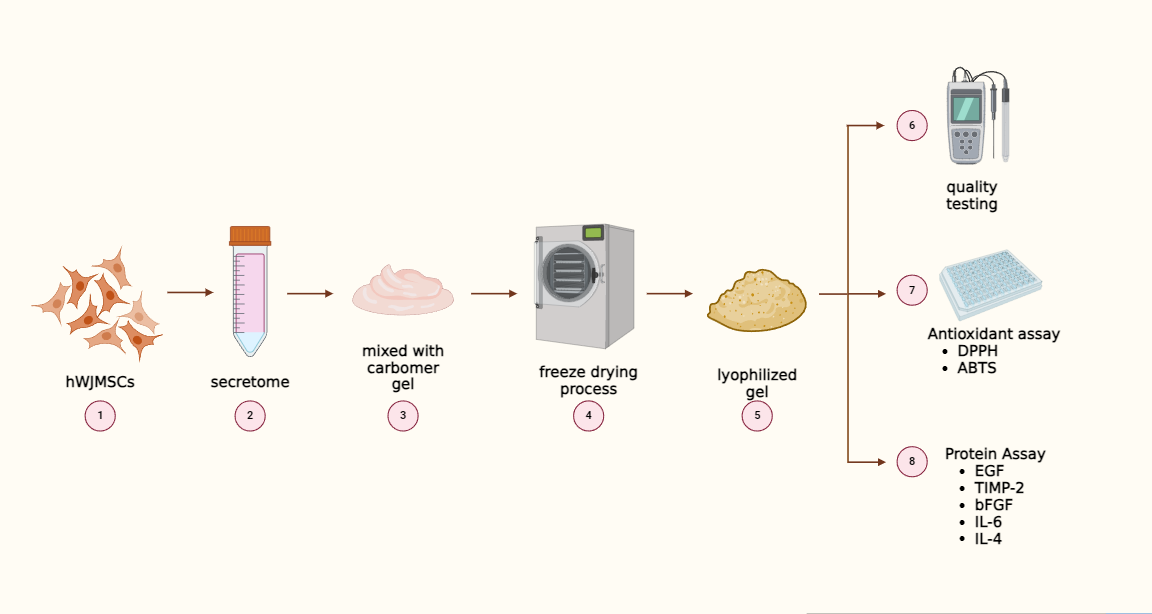
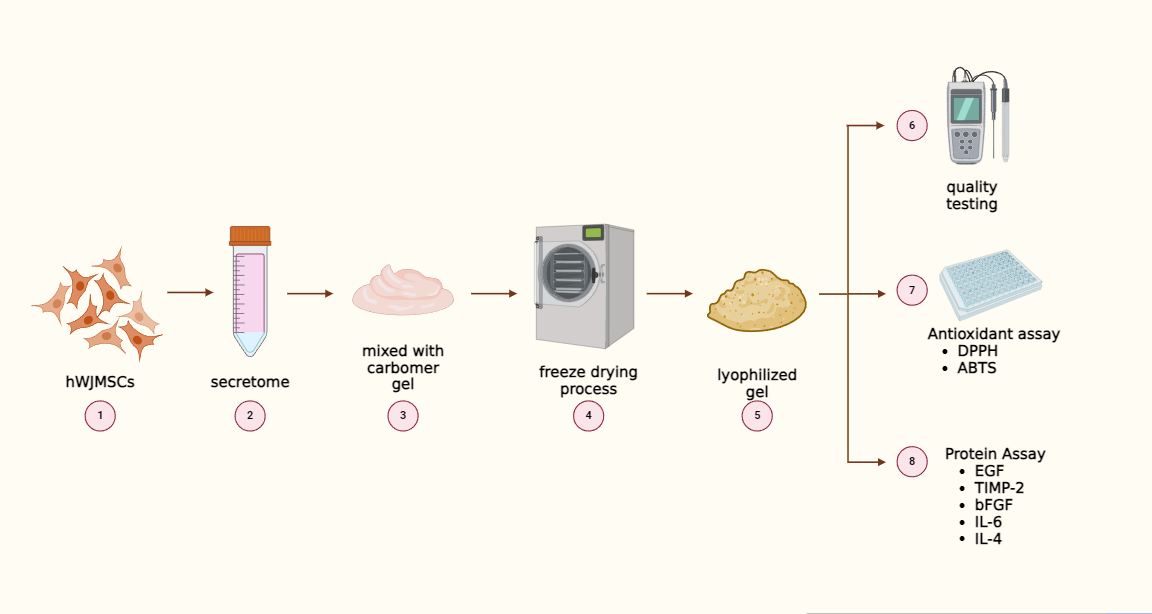
Wounds that become infected can lead to serious illness or even death if left untreated. Unfortunately, current wound healing treatments don’t always work well. Achieving optimal wound healing involves the coordination of diverse cellular events facilitated by numerous growth factors, cytokines, and chemokines. One potential solution for addressing the wound healing process is using lyophilized-secretome gel from human Wharton’s Jelly Mesenchymal Stem Cells (hWJMSCs-Sec). This gel, called lyophilized-hWJMSCs-Sec gel (LSG) is created by mixing carbomer gel with hWJMSCs-Sec, then freeze-dry it into a powder to maintain its quality and stability. The quality testing of the topical gel formulation is conducted by measuring. The gel is tested for pH, viscosity, consistency, and its appearance. It’s also tested for antioxidant activity using 2,2-Diphenyl-1-picrylhydrazyl (DPPH), and 2,2’-azino-bis (3-ethylbenzothiazoline-6-sulfonic acid) (ABTS) assays were employed to identify the antioxidant activities of the lyophilized-gel. Proteins level of Tissue Inhibitor of Metalloproteinases-2 (TIMP-2), Epidermal Growth Factor (EGF), basic Fibroblast Growth Factor (bFGF), Interleukin-6 (IL-6), and IL-4 were also measured with the ELISA method. The LSG has a soft and non-sticky texture with clarity, a pandan-like aroma, and excellent adhesion and spreadability. It contains proteins and antioxidants that help wound healing. The lyophilized-Sec gel contained TIMP-2, EGF, bFGF, IL-6, and IL-4 as well as stronger antioxidant properties compared to un-lyophilized-hWJMSCs-Sec gel, and showed promise as an effective remedy for wound healing.
HIGHLIGHTS
- Assessment of the mechanism of action underlying the wound healing effects of the gel, such as its influence on cellular processes, growth factor release, and antioxidant activity.
- Investigation of the secretome combination with carbomer gel in providing a convenient application for wound treatment.
- Preservation of active ingredients in the secretome through lyophilization, ensuring stability and enabling extended storage duration.
GRAPHICAL ABSTRACT
Downloads
References
M Boer, E Duchnik, R Maleszka and M Marchlewicz. Structural and biophysical characteristics of human skin in maintaining proper epidermal barrier function. Adv. Dermatol. Allergol. 2016; 33, 1-5.
G Han and R Ceilley. Chronic wound healing: A review of current management and treatments. Adv. Ther. 2017; 34, 599-610.
J Boateng and O Catanzano. Advanced therapeutic dressings for effective wound healing-a review. J. Pharm. Pharmaceut. Sci. 2015; 104, 3653-80.
V Vachhrajani and P Khakhkhar. Science of wound healing and dressing materials. Springer, Singapore, 2020.
SA Eming, P Martin and M Tomic-Canic. Wound repair and regeneration: mechanisms, signaling, and translation. Sci. Transl. Med. 2014; 6, 265sr6.
MS Ackerman, M Prilla, C Stary, T Herrmann and S Goggins. Designing healthcare that works: A sociotechnical approach. Academic Press, Florida, 2017.
LP Kamolz, M Keck and C Kasper. Wharton’s jelly mesenchymal stem cells promote wound healing and tissue regeneration. Stem Cell Res. Ther. 2014; 5, 62.
M Ullah and Z Sun. Stem cells and anti-aging genes: Double-edged sword-do the same job of life extension. Stem Cell Res. Ther. 2018; 9, 3.
LL Liau, BHI Ruszymah, MH Ng and JX Law. Characteristics and clinical applications of Wharton’s jelly-derived mesenchymal stromal cells. Curr. Res. Transl. Med. 2020; 68, 5-16.
R Waters, P Alam, S Pacelli, AR Chakravarti, RP Ahmed and A Paul. Stem cell-inspired secretome-rich injectable hydrogel to repair injured cardiac tissue. Acta Biomater. 2018; 69, 95-106.
G Wang, F Yang, W Zhou, N Xiao, M Luo and Z Tang. The initiation of oxidative stress and therapeutic strategies in wound healing. Biomed. Pharmacother. 2023; 157, 114004.
MR Tabandeh, A Oryan and A Mohammadalipour. Polysaccharides of Aloe vera induce MMP-3 and TIMP-2 gene expression during the skin wound repair of rat. Int. J. Biol. Macromol. 2014; 65, 424-30.
DEA Komi, K Khomtchouk and MPL Santa. A review of the contribution of mast cells in wound healing: Involved molecular and cellular mechanisms. Clin. Rev. Allergy Immunol. 2019; 58, 298-312.
JA Knipper, S Willenborg, J Brinckmann, W Bloch, T Maaß, R Wagener, T Krieg, T Sutherland, A Munitz, ME Rothenberg, A Niehoff, R Richardson, M Hammerschmidt, JE Allen and SA Eming. Interleukin-4 receptor α signaling in myeloid cells controls collagen fibril assembly in skin repair. Immunity 2015; 43, 803-16.
MR Fernando, JL Reyes, J Iannuzzi, G Leung and DM McKay. The pro-inflammatory cytokine, interleukin-6, enhances the polarization of alternatively activated macrophages. PLos One 2014; 9, e94188.
SM Choi, KM Lee, HJ Kim, IK Park, HJ Kang, HC Shin, D Baek, Y Choi, KH Park and JW Lee. Effects of structurally stabilized EGF and bFGF on wound healing in type I and type II diabetic mice. Acta Biomater. 2018; 66, 325-34.
SD Suyudi. 2014, Formulasi gel semprot menggunakan kombinasi karbopol 940 dan hidroksipropil metilselulosa (HPMC) sebagai pembentuk gel. Ph. D. Dissertation. Syarif Hidayatullah State Islamic University Jakarta, Jakarta, Indonesia.
T Zhu, J Mao, Y Cheng, H Liu, L Lv, M Ge, S Li, J Huang, Z Chen, H Li, L Yang and Y Lai. Recent progress of polysaccharide‐based hydrogel interfaces for wound healing and tissue engineering. Adv. Mater. Interfaces 2019; 6, 1900761.
K Unger, F Greco and AM Coclite. Temporary tattoo pH sensor with pH‐responsive hydrogel via initiated chemical vapor deposition. Adv. Mater. Tech. 2022; 7, 2100717.
KS Ariyanthini, E Angelina, KNB Permana, FJ Thelmalina and IGNJA Prasetia. Antibacterial activity testing of hand sanitizer gel extract of coriander (Coriandrum sativum L.) seeds against Staphylococcus aureus. J. Pharmaceut. Sci. Appl. 2021; 3, 98-107.
Z Rani, HM Nasution, VE Kaban, N Nasri and NB Karo. Antibacterial activity of freshwater lobster (Cherax quadricarinatus) shell chitosan gel preparation against Escherichia coli and Staphylococcus aureus. J. Appl. Pharmaceut. Sci. 2023; 13, 146-53.
A Molnar, T Lakat, A Hosszu, B Szebeni, A Balogh, L Orfi, AJ Szabo, A Fekete and J Hodrea. Lyophilization and homogenization of biological samples improves reproducibility and reduces standard deviation in molecular biology techniques. Amino Acids 2021; 53, 917-28.
W Widowati, E Afifah, T Mozef, F Sandra, R Rizal, A Amalia, Y Arinta, I Bachtiar and H Murti. Effects of insulin-like growth factor-induced Wharton jelly mesenchymal stem cells toward chondrogenesis in an osteoarthritis model. Iran. J. Basic Med. Sci. 2018; 21, 745.
W Widowati, RF Gunanegara, R Rizal, WS Widodo, A Amalia, SHB Wibowo, K Handono, M Marlina, INE Lister and L Chiuman. Comparative analysis of Wharton’s Jelly mesenchymal stem cell (WJ-MSCs) isolated using explant and enzymatic methods. J. Phys. Conf. Ser. 2019; 1374, 012024.
Z Zukhiroh, A Putra, C Chodidjah, T Sumarawati, P Subchan, P Trisnadi and ND Amalina. Effect of Secretome-hypoxia mesenchymal stem cells on regulating SOD and MMP-1 mRNA expressions in skin hyperpigmentation rats. Open Access Maced. J. Med. Sci. 2022; 10, 1-7.
D Nowak and E Jakubczyk. The freeze-drying of foods-the characteristic of the process course and the effect of its parameters on the physical properties of food materials. Foods 2020; 10, 1488.
A Yunita and W Anwarudin. Formulasi sediaan pengaruh carbomer 940 pada sediaan gel ekstrak daun kemangi (Ocimum sanctum L.) sebagai anti nyamuk. HERBAPHARMA J. Herb Farmacological 2020; 2, 46-54.
AF Tsabitah, AK Zulkarnain, MSH Wahyuningsih and DAA Nugrahaningsih. Optimasi carbomer, propilen glikol, dan trietanolamin dalam formulasi sediaan gel ekstrak etanol daun kembang bulan (tithonia diversifolia). Majalah Farmaseutik 2020; 16, 111-18.
E Afifah, T Mozef, F Sandra, S Arumwardana, DD Rihibiha, H Nufus, R Rizal, A Amalia, I Bachtiar, H Murti and W Widowati. Induction of matrix metalloproteinases in chondrocytes by interleukin IL-1β as an osteoarthritis model. J. Math. Fundam. Sci. 2019; 51, 103-11.
W Widowati, TL Wargasetia, F Rahardja, RF Gunanegara, D Priyandoko, ME Gondokesumo, E Afifah, CR Wijayanti and R Rizal. Human Wharton’s jelly mesenchymal stem cells inhibit cytokine storm in acute respiratory distress syndrome in a rat model. Asian Pac. J. Trop. Biomed. 2022; 12, 343-50.
W Widowati, TL Wargasetia, TM Zakaria, M Marthania, RATPP Akbar, MS Gunadi, N Halim and S Santiadi. Antioxidant activity of TEMON (Clitoria ternatea and Citrus sp.) as an infused herbal tea. Tradit. Med. J. 2022; 27, 32-40.
W Widowati, D Pryandoko, CD Wahyuni, M Marthania, HSW Kusuma, T Handayani and R Rizal. Antioxidant properties of soybean (Glycine max L.) extract and isoflavone. In: Proceedings of the 2021 IEEE International Conference on Health, Instrumentation & Measurement, and Natural Sciences (InHeNce), Medan, Indonesia. 2021.
R Guillamat-Prats. The role of MSC in wound healing, scarring and regeneration. Cells 2021; 10, 1729.
IM Sikumbang, RA Astuti, ES Wahyuningtyas, H Lutfiyati, R Wijayatri and N Nasruddin. Wound healing activity of aloe vera extract spray on acute wound in male balb/c mice. Pharmaciana 2020; 10, 315.
S Suryani. Formulasi dan uji stabilitas sediaan gel ekstrak terpurifikasi daun paliasa (Kleinhovia Hospita L.) yang berefek antioksidan. PHARMACON 2017; 6, 157-69.
AY Ho, JL Wright, RC Blitzblau, RW Mutter, DG Duda, L Norton, A Bardia, L Spring, SJ Isakoff, JH Chen, C Grassberger, JR Bellon, S Beriwal, AJ Khan, C Speers, SA Dunn, A Thompson, CA Santa-Maria, IE Krop, E Mittendorf, TA King and GP Gupta. Optimizing radiation therapy to boost systemic immune responses in breast cancer: A critical review for breast radiation oncologists. Int. J. Radiat. Oncol. Biol. Phys. 2020; 108, 227-41.
S Esposito. “Traditional” sol-gel chemistry as a powerful tool for the preparation of supported metal and metal oxide catalysts. Materials 2019; 12, 668.
M Estanqueiro, MH Amaral and LJM Sousa. Comparison between sensory and instrumental characterization of topical formulations: Impact of thickening agents. Int. J. Cosmet. Sci. 2016; 38, 389-98.
SR Park, JW Kim, HS Jun, JY Roh, HY Lee and IS Hong. Stem cell Secretome and its effect on cellular mechanisms relevant to wound healing. Mol. Ther. 2018; 26, 606-17.
M Goh, Y Hwang and G Tae. Epidermal growth factor loaded heparin-based hydrogel sheet for skin wound healing. Carbohydr. Polym. 2016; 147, 251-60.
S Akita, K Akino and A Hirano. Basic fibroblast growth factor in scarless wound healing. Adv. Wound Care 2013; 2, 44-9.
G Lao, M Ren, X Wang, J Zhang, Y Huang, D Liu and L Yan. Human tissue inhibitor of metalloproteinases-1 improved wound healing in diabetes through its anti-apoptotic effect. Exp. Dermatol. 2019; 28, 528-35.
BZ Johnson, AW Stevenson, CM Prêle, MW Fear and FM Wood. The role of IL-6 in skin fibrosis and cutaneous wound healing. Biomedicines 2020; 8, 101.
I Arranz-Valsero, L Soriano-Romaní, L García-Posadas, A López-García and Y Diebold. IL-6 as a corneal wound healing mediator in an in vitro scratch assay. Exp. Eye Res. 2014; 125, 183-92.
Z Xu, S Han, Z Gu and J Wu. Advances and impact of antioxidant hydrogel in chronic wound healing. Adv. Healthcare Mater. 2019; 9, e1901502.
XP Cao, YF Chen, JL Zhang, MM You, K Wang and FL Hu. Mechanisms underlying the wound healing potential of propolis based on its in vitro antioxidant activity. Phytomedicine 2017; 34, 76-84.
Downloads
Published
How to Cite
Issue
Section
License
Copyright (c) 2024 Walailak University

This work is licensed under a Creative Commons Attribution-NonCommercial-NoDerivatives 4.0 International License.





