
Curcumin as an Antitumor Agent: Targeting Cancer Stem Cell Markers in Glioblastoma through In Silico and In Vitro Approaches
DOI:
https://doi.org/10.48048/tis.2025.9485Keywords:
Antitumor, Curcumin, IGFBP2, In silico, In vitro, Glioblastoma, OCT-4, SOX-2Abstract
Glioblastoma is prevalent and aggressive primary malignant brain tumor in adults with an annual incidence rate approximately 0.59 to 5 cases per 100,000 individuals. Curcumin, a bioactive compound from Curcuma longa, holds promise as a potential antitumor agent for use in drug or functional food development. This study aimed to analyze the in silico and in vitro antitumor potency of curcumin. Molecular docking was conducted to assess curcumin’s interactions with tumor-related proteins SOX-2, OCT-4, and IGFBP2. In vitro experiments involved quantifying the SOX-2 and OCT-4 genes expression in glioblastoma (GBM) cells treated with curcumin using qRT-PCR method. Molecular docking revealed that curcumin binds effectively to all target proteins, with SOX-2 and OCT-4 exhibiting the lowest binding energy also the highest number of interactions, indicating stronger binding. In vitro analysis demonstrated that curcumin significantly downregulated the SOX-2 and OCT-4 expression in GBM cells, surpassing the effects of temozolomide, a standard cancer treatment. These findings highlight curcumin's potential as an antitumor agent by targeting cancer stem cell markers and pathways. This study provides foundational evidence for the future development of curcumin-based drugs or functional foods aimed at cancer therapy.
HIGHLIGHTS
- Curcumin effectively binds to cancer stem cell markers such as SOX-2, OCT-4, and IGFBP2 as evidenced by molecular docking with strong binding affinity and multiple protein-ligand interactions.
- Curcumin significantly downregulates the SOX-2 and OCT-4 gene expression in glioblastoma cells, surpassing the effects of temozolomide, the current standard chemotherapeutic.
- The findings highlight curcumin's role in inhibiting cancer stemness and reducing tumor aggressiveness, providing a foundation for its development into curcumin-based functional foods or drugs for cancer therapy.
GRAPHICAL ABSTRACT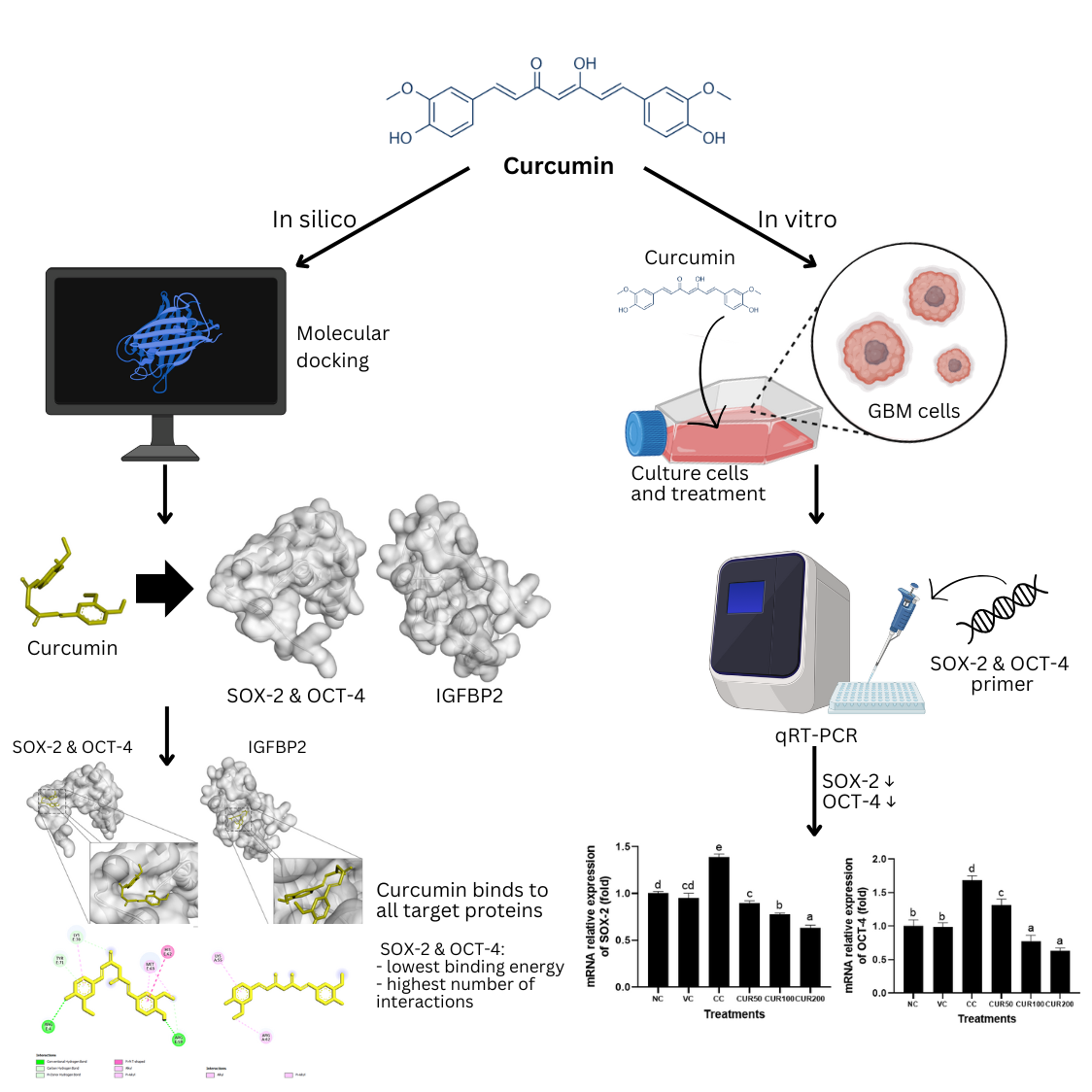
Downloads
References
N Grech, T Dalli, S Mizzi, L Meilak, N Calleja and A Zrinzo. Rising incidence of glioblastoma multiforme in a welldefined population. Cureus 2020; 12(5), e8195.
Z Peng, L Liu, W Zhang and X Wei. Pluripotency of dental pulp cells and periodontal ligament cells was enhanced through cell‐cell communication via STAT3/Oct‐4/Sox2 signaling. Stem Cells International 2021; 2021(1), 8898506.
X Wu, N Wang, J Liang, B Wang, Y Jin, B Liu and Y Yang. Is the triggering of PD-L1 dimerization a potential mechanism for food-derived small molecules in cancer immunotherapy? A study by molecular dynamics. International Journal of Molecular Sciences 2023; 24(2), 1413.
S Chen, W Gao, MJ Zhang, JYW Chan and TS Wong. Curcumin enhances cisplatin sensitivity by suppressing NADPH oxidase 5 expression in human epithelial cancer. Oncology Letters 2019; 18(2), 2132-2139.
T Li, ME Forbes, GN Fuller, J Li, X Yang and W Zhang. IGFBP2: Integrative hub of developmental and oncogenic signaling network. Oncogene 2020; 39(11), 2243-2257.
D Diki and M Dwisatyadini. Curcumin affecting caspase 1 and caspase 9 increase and cell death in cervical cancer cell culture. In: Proceedings of the 3rd Konsorsium Biologi Indonesia Congress, Bengkulu, Indonesia, 2020.
S Katta, A Srivastava, RL Thangapazham, IL Rosner, J Cullen, H Li and S Sharad. Curcumin-gene expression response in hormone-dependent and independent metastatic prostate cancer cells. International Journal of Molecular Sciences 2019; 20(19), 4891.
V Zoi, V Galani, GD Lianos, S Voulgaris, AP Kyritsis and GA Alexiou. The role of curcumin in cancer treatment. Biomedicines 2021; 9(9), 1086.
W Shi, W Lin, W Ge, L Chen, T Zhang, W Guo and D Yin. Curcumin inhibits liquid–liquid phase separation of fused in sarcoma and attenuates the sequestration of pyruvate kinase to restore cellular metabolism. Food & Function 2023; 14(10), 4621-4631.
NA Satar, MN Ismail and BH Yahaya. Synergistic roles of curcumin in sensitising the cisplatin effect on a cancer stem cell-like population derived from non-small cell lung cancer cell lines. Molecules 2021; 26(4), 1056.
D Rahmat, Y Farida, AT Brylianto, R Sumarny and S Kumala. Antidiabetic activity of nanoparticles containing javanese turmeric rhizome extract: The strategy to change particle size. International Journal of Applied Pharmaceutics 2020; 12(4), 90-93.
GM Morris, H Ruth, W Lindstrom, MF Sanner, RK Belew, DS Goodsell and AJ Olson. Automated docking with selective receptor flexibility. International Journal of Computational Chemistry 2009; 30(16), 2785-2791.
O Trott and AJ Olson. AutoDock vina: Improving the speed and accuracy of docking with a new scoring function, efficient optimization, and multithreading. Journal of Computational Chemistry 2010; 31(2), 455-461.
W Widowati, CN Ginting, INE Lister, E Girsang, A Amalia, SHB Wibowo and HSW Kusuma. Anti-aging effects of mangosteen peel extract and its phytochemical compounds: Antioxidant activity, enzyme inhibition and molecular docking simulation. Tropical Life Sciences Research 2020; 31(3), 127-144.
W Widowati, TL Wargasetia, F Rahardja, RF Gunanegara, D Priyandoko, ME Gondokesumo, A Novianto, A Yati and R Rizal. hWJMSCs inhibit inflammation and apoptosis in an ARDS cell model. Journal of Taibah University Medical Sciences 2023; 18(6), 1519-1526.
A Faried, W Widowati, R Rizal, HMB Bolly, D Halim, WS Widodo, HB Satrio, N Wibowo, R Noverina, FP Thajono and MZ Arifin. Assessment of intratumoral heterogeneity in isolated human primary high-grade glioma: Cluster of differentiation 133 and cluster of differentiation 15 double staining of glioblastoma subpopulations. Journal of Medical Sciences 2021; 9(A), 87-94.
W Widowati, DK Jasaputra, SB Sumitro, MA Widodo, T Mozef, R Rizal, HSW Kusuma, DR Lasksmitawati, H Murti, I Bachtiar and A Faried. Effect of interleukins (Il-2, il-15, il-18) on receptors activation and cytotoxic activity of natural killer cells in breast cancer cell. African Health Sciences 2020; 20(2), 822-832.
INE Lister, CN Ginting, E Girsang, ED Nataya, AM Azizah and W Widowati. Hepatoprotective properties of red betel (Piper crocatum Ruiz and Pav) leaves extract towards H2O2-induced HepG2 cells via anti-inflammatory, antinecrotic, antioxidant potency. Saudi Pharmaceutical Journal 2020; 28(10), 1182-1189.
W Widowati, L Darsono, MR Natariza, NW Waluyo, AMG Tenda, BH Siahaan, R Oktaviani, FH Zahiroh, HS Utomo and R Rizal. Antidiabetic, antidyslipidemia, and renoprotector potency of butterfly pea flower extract (Clitorea ternatea L.) in diabetes mellitus and dyslipidemia rats model. Open Veterinary Journal 2024; 14(5), 1135-1145.
MJ Ahsan, K Choudhary, A Ali, A Ali, F Azam, AH Almalki, EY Santali, MA Bakht, A Tahir and Salahuddin. Synthesis, DFT analyses, antiproliferative activity, and molecular docking studies of curcumin analogues. Plants 2022; 11(21), 2835.
F Zheng, J Lu, C Wang, H Yu, Y Fu and D Ma. Curcumin enhances ATG3-dependent autophagy and inhibits metastasis in cervical carcinoma. Cell Division 2024; 19(1), 33.
F Yang, S Li, X Hu, X Li and H Li. Identifying the antitumor effects of curcumin on lung adenocarcinoma using comprehensive bioinformatics analysis. Drug Design, Development and Therapy 2022; 16, 2365-2382.
S Dotolo, C Cervellera, M Russo, GL Russo and A Facchiano. Virtual screening of natural compounds as potential PI3K-AKT1 signaling pathway inhibitors and experimental validation. Molecules 2021; 26(2), 492.
S Singh and S Bhatia. In silico identification of albendazole as a quorum sensing inhibitor and its in vitro verification using CviR and LasB receptors based assay systems. BioImpacts 2018; 8(3), 201-209.
R Yousefi. Binding of curcumin near the GBT440 binding site at the alpha cleft in the sickle cell hemoglobin model [Pdb ID: 1NEJ]. Journal of Advanced Biomedical and Pharmaceutical Sciences 2024; 7(2), 70-74.
R Ortiz, G Perazzoli, L Cabeza, C Jimenez-Luna, R Luque, J Prados and C Melguizo. Temozolomide: An updated overview of resistance mechanisms, nanotechnology advances and clinical applications. Current Neuropharmacology 2021; 19(4), 513-537.
GB Carballo, D Matias, JH Ribeiro, LS Pessoa, AM Arrais-Neto and TCLDSE Spohr. Cyclopamine sensitizes glioblastoma cells to temozolomide treatment through Sonic hedgehog pathway. Life Sciences 2020; 257, 118027.
DC Venugopal, CL Caleb, NP Kirupakaran, V Shyamsundar, S Ravindran, M Yasasve, A Krishnamurthy, T Harikrishnan, S Sankarapandian and V Ramshankar. Clinicopathological significance of cancer stem cell markers (OCT-3/4 and SOX-2) in oral submucous fibrosis and oral squamous cell carcinoma. Biomedicines 2023; 11(4), 1040.
MT Mirgani, B Isacchi, M Sadeghizadeh, F Marra, AR Bilia, SJ Mowla, F Najafi and E Babaei. Dendrosomal curcumin nanoformulation downregulates pluripotency genes via miR-145 activation in U87MG glioblastoma cells. International Journal of Nanomedicine 2014; 9, 403-417.
Published
How to Cite
Issue
Section
License
Copyright (c) 2025 Walailak University

This work is licensed under a Creative Commons Attribution-NonCommercial-NoDerivatives 4.0 International License.





