Phytochemical Profiling, Molecular Docking, and Biological Activities of Psidium Guajava and Piper Betle Extracts Incorporated into Chitosan-Based Hydrogel for Dental Wound Antimicrobial Applications
DOI:
https://doi.org/10.48048/tis.2027.14492Keywords:
Psidium guajava, Piper betle, Chitosan hydrogel, Antimicrobial activity, Molecular docking, Dental applicationAbstract
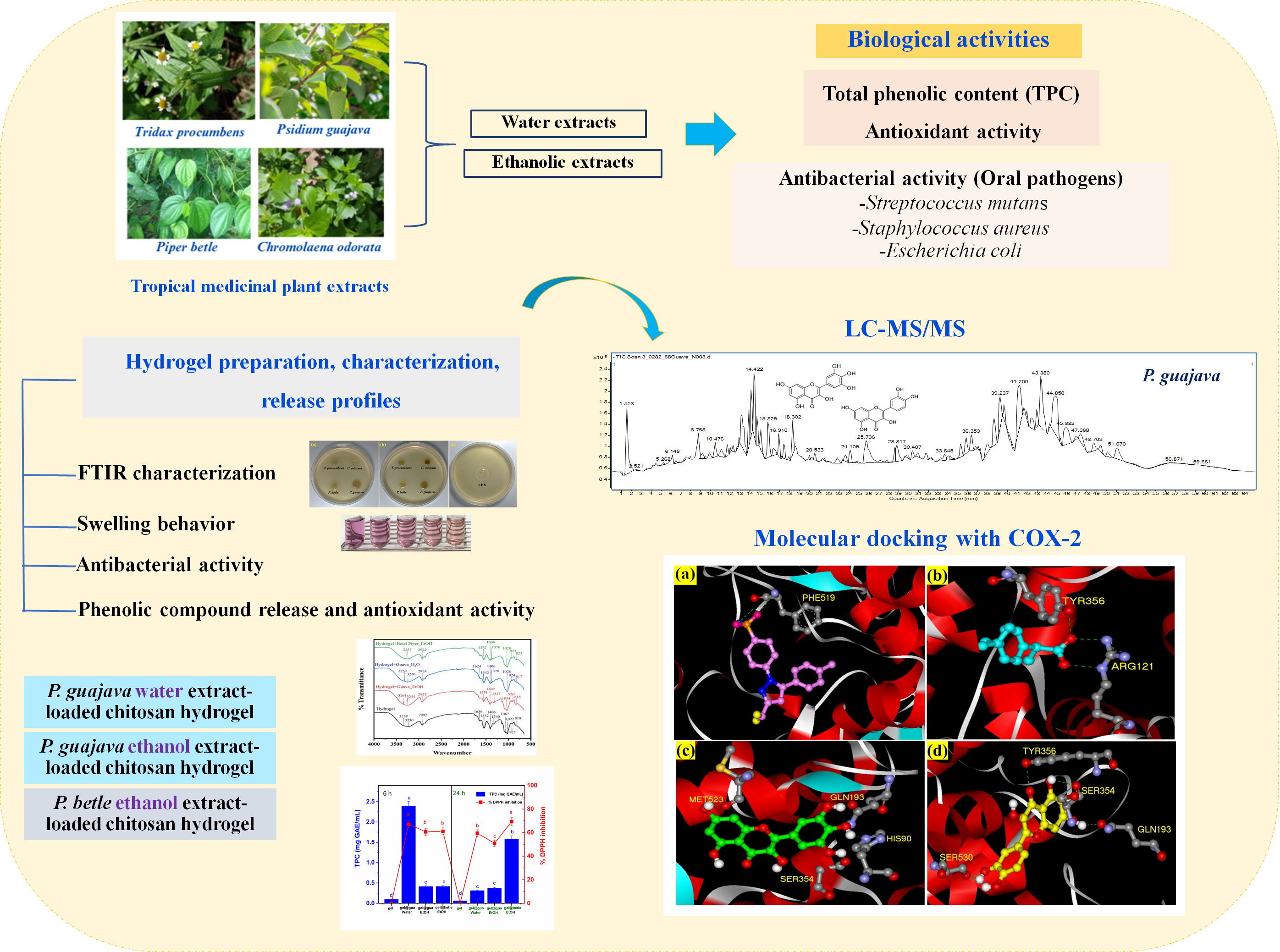
Post-extraction dental wound management remains a clinical challenge owing to the risk of microbial infection and delayed tissue regeneration. This study evaluated water and ethanol extracts of four Thai medicinal plants, namely Psidium guajava, Piper betle, Chromolaena odorata, and Tridax procumbens, and developed chitosan/PVA hydrogels incorporating selected extracts. P. betle ethanol extract exhibited the highest total phenolic content (559.30 ± 15.25 mg GAE/g) and strongest DPPH radical scavenging activity (IC50 14.46 ± 0.02 µg/mL), while P. guajava water and ethanol extracts demonstrated comparable antioxidant activity (IC50 15.59 and 15.04 µg/mL, respectively). P. guajava water, P. guajava ethanol, and P. betle ethanol extracts were incorporated into chitosan/PVA hydrogels. The P. guajava water extract formulation produced the largest inhibition zones against S. mutans (13.86 ± 0.09 mm), S. aureus (13.58 ± 0.08 mm), and E. coli (17.44 ± 0.13 mm). Release profiling revealed distinct patterns: The P. guajava water extract hydrogel achieved peak phenolic release (2.38 mg GAE/mL) at 6 h, while the P. betle ethanol extract hydrogel showed prolonged release up to 24 h (1.60 mg GAE/mL). LC-MS/MS profiling annotated 24 compounds in P. guajava water extract, predominantly flavonoids and phenolic acids. Molecular docking against COX-2 predicted that myricetin and quercetin exhibited favorable binding free energies of ˗8.68 and ˗8.59 kcal/mol, surpassing that of ibuprofen (˗6.77 kcal/mol), with interactions at key active site residues including SER530, SER354, TYR356, GLN193, MET523, and HIS90. Collectively, these in vitro findings provide preliminary evidence supporting the potential of P. guajava water extract-loaded chitosan/PVA hydrogel as a plant-derived biomaterial candidate for post-extraction dental wound management.
HIGHLIGHTS
- First comprehensive in vitro characterization of chitosan/PVA hydrogels incorporating Psidium guajava and Piper betle extracts for dental wound management applications, evaluated against clinically relevant oral pathogens including mutans.
- betle ethanol extract exhibited superior total phenolic content and antioxidant activity, while P. guajava water extract demonstrated broad-spectrum antibacterial activity and rapid early phenolic release at 6 h, complemented by prolonged release over 24 h from the P. betle formulation.
- LC-MS/MS annotated 24 compounds in guajava extract; myricetin and quercetin exhibited superior predicted COX-2 binding affinity over ibuprofen (˗8.68 and ˗8.59 vs. ˗6.77 kcal/mol), providing a computational basis for potential anti-inflammatory activity.
GRAPHICAL ABSTRACT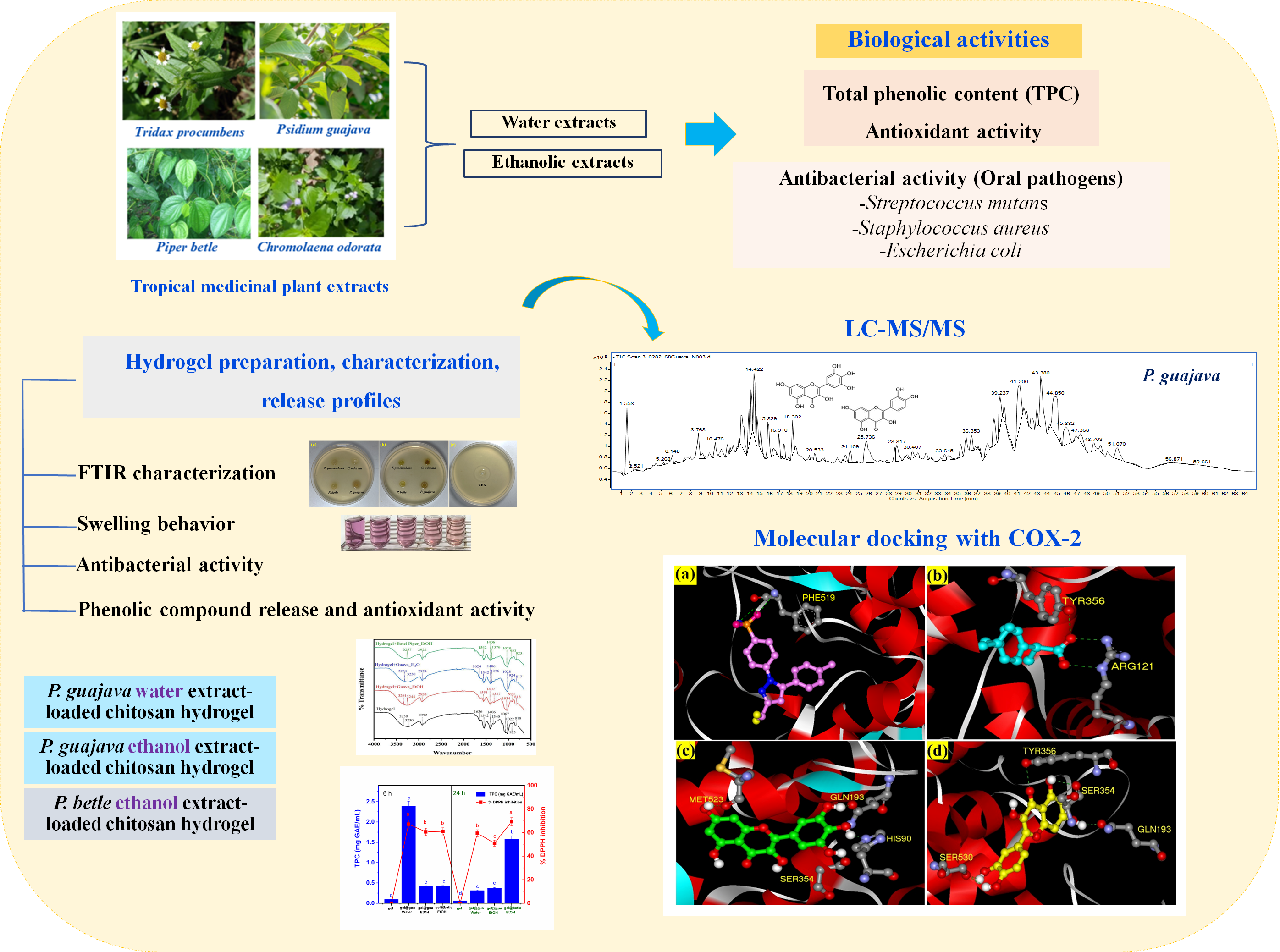
Downloads
References
G Lodi, L Azzi, EM Varoni, M Pentenero, MD Fabbro, A Carrassi, A Sardella and M Manfredi. Antibiotics to prevent complications following tooth extractions. Cochrane Database of Systematic Reviews 2021; 2, CD003811.
P Dignam, M Elshafey, A Jeganathan, M Foo, JS Park and M Ratnaweera. Prevalence and factors influencing post-operative complications following tooth extraction: A narrative review. International Journal of Dentistry 2024; 2024, 7712829.
MD Rossary, JKP Djunaedi, TPR Riyantoro and A Setiawati. Tailoring strategy of chitosan-based hydrogel for improving wound healing: A systematic review. Trends in Sciences 2025; 22(11), 11023.
X Zhou, C Liu, Y Han, C Li, S Liu, X Li, G Zhao and Y Jiang. An antibacterial chitosan-based hydrogel as a potential degradable bio-scaffold for alveolar ridge preservation. RSC Advances 2022; 12(50), 32219-32229.
H Chen, M Hu, N Liu and Y Li. Research progress on modified chitosan hydrogels for tissue repair and regeneration. Carbohydrate Polymers 2026; 385, 125347.
Z Zeng, L Kang, Y He, Y Guan, Y Cao, X Zhang and WE Yuan. A chitosan-tea polyphenol composite hydrogel with integrated antibacterial, antioxidant and immunomodulatory functions for the tissue regeneration of MRSA-infected wounds. Bioorganic Chemistry 2026; 174, 109722.
A Sirinthipaporn and W Jiraungkoorskul. Wound healing property review of Siam weed, Chromolaena odorata. Pharmacognosy Reviews 2017; 11(21), 35-38.
J Seo, U Lee, S Seo, AE Wibowo, OB Pongtuluran, K Lee, SB Han and S Cho. Anti-inflammatory and antioxidant activities of methanol extract of Piper betle L. leaves and stems by inhibiting NF-κB/MAPK/Nrf2 signaling pathways in RAW 264.7 macrophages. Biomedicine & Pharmacotherapy 2022; 155, 113734.
Y Andriana, TD Xuan, TN Quy, TN Minh, TM Van and TD Viet. Antihyperuricemia, antioxidant, and antibacterial activities of Tridax procumbens L. Foods 2019; 8(1), 21.
HD Huynh, P Nargotra, HMD Wang, CJ Shieh, YC Liu and CH Kuo. Bioactive compounds from guava leaves (Psidium guajava L.): Characterization, biological activity, synergistic effects, and technological applications. Molecules 2025; 30(6), 1278.
S Bhagavathy, C Mahendiran and R Kanchana. Identification of glucosyl transferase inhibitors from Psidium guajava against Streptococcus mutans in dental caries. Journal of Traditional and Complementary Medicine 2019; 9(2), 124-137.
A Sakthivel, K Sankaran, G Rengasamy, VV Priya and P Sathishkumar. Formulation of mouthwash using combined herbal extracts to control the predominant oral pathogens and biofilm. Journal of Herbal Medicine 2024; 46, 100905.
NNT Nguyen, TTD Nguyen, TS Nguyen, DTM Than, TTY Le and HN Nguyen. Nanoemulsion-based mouthwash with Litsea cubeba essential oil and Piper betle extract for inflammatory dental condition. Pharmacia 2025; 72, 1-17.
R Teanpaisan, P Kawsud, N Pahumunto and J Puripattanavong. Screening for antibacterial and antibiofilm activity in Thai medicinal plant extracts against oral microorganisms. Journal of Traditional and Complementary Medicine 2017; 7(2), 172-177.
C Lorena, A Ressaissi and ML Serralheiro. Bioactives from Psidium guajava leaf decoction: LC-HRMS-MS-Qtof identification, bioactivities and bioavailability evaluation. Food Chemistry Advances 2022; 1, 100003.
WX Waresindo, HR Luthfianti, D Edikresnha, T Suciati, FA Noor and K Khairurrijal. A freeze–thaw PVA hydrogel loaded with guava leaf extract: Physical and antibacterial properties. RSC Advances 2021; 11(48), 30156-30171.
ER Kenawy, EA Kamoun, SM Elsigeny, S Heikal, AA El-Shehawy and YAG Mahmoud. Vanillin loaded-physically crosslinked PVA/chi¬tosan/itaconic membranes for topical wound heal¬ing applications. Journal of Applied Biomaterials & Functional Materials 2024. https://doi.org/10.1177/22808000241281273
DM Suflet, I Popescu, IM Pelin, DL Ichim, OM Daraba, M Constantin and G Fundueanu. Dual cross-linked chitosan/PVA hydrogels containing silver nanoparticles with antimicrobial properties. Pharmaceutics 2021; 13(9), 1461.
P Kongsune, K Sangthongchin, P Ampha, M Maneechote and N Chana. Enhancement of anti¬oxidant activity and inhibition of polyphenol oxidase from green oak lettuce by chitosan-encapsulated rambutan (Nephelium lappaceum L.) peel extract. Chiang Mai Journal of Science 2025; 52(4), e2025035.
BJ Orlando, MJ Lucido and MG Malkowski. The structure of ibuprofen bound to cyclooxygenase-2. Journal of Structural Biology 2015; 189(1), 62-66.
QD Do, AE Angkawijaya, PL Tran-Nguyen, LH Huynh, FE Soetaredjo, S Ismadji and YH Ju. Effect of extraction solvent on total phenol content, total flavonoid content, and antioxidant activity of Limnophila aromatica. Journal of Food and Drug Analysis 2014; 22(3), 296-302.
T Singh, VK Pandey, SA Mukarram, R Singh, KK Dash and B Kovács. Ultrasound assisted extraction of phytochemicals from Piper betle L. Ultrasonics Sonochemistry 2024; 106, 106894.
ND Anh, CN Linh, LTM Hiep and DV Kien. Application of Piper betle leaf extract as a bioactive additive in eco-friendly antifouling coatings. Surfaces 2025; 8(4), 72.
KMSAK Dehideniya, VP Bulugahapitiya, RS Sabaragamuwa and TC Kananke. Anti-diabetic, lipid peroxidase, antimicrobial, anti-oxidant, general toxicity properties and polyphenol content of Psidium guajava, Garcinia quaesita, and Cinnamon verum extracts along with their potential as nutraceuticals. Food and Humanity 2025; 4, 100537.
J Seo, S Lee, ML Elam, SA Johnson, J Kang and BH Arjmandi. Study to find the best extraction solvent for use with guava leaves (Psidium guajava L.) for high antioxidant efficacy. Food Science & Nutrition 2014; 2(2), 174-180.
EA Ainsworth and KM Gillespie. Estimation of total phenolic content and other oxidation substrates in plant tissues using Folin–Ciocalteu reagent. Nature Protocols 2007; 2(4), 875-877.
L Ruiz-Vasquez, LR Mesia, MM Maco, JA Zapata, HR Cotrina, M Cobos, V Pinedo-Cancino, F Tello and JC Castro. Optimized Folin–ciocalteu method for determination of total polyphenols in medicinal plants of the Peruvian Amazon: Validation and application to twelve species. AppliedChem 2026; 6(1), 17.
R Albani, SR Habib, A AlQahtani, AA AlHelal and M Alrabiah. Streptococcus mutans and Porphyromonas gingivalis adhesion to glazed/polished surfaces of CAD/CAM restorations. Heliyon 2024; 10(22), e40276.
AM Hall, S Baskiyar, KL Heck, MD Hayden, C Ren, C Nguyen, CD Seals, E Monu and AI Calderón. Investigation of the chemical composition of antibacterial Psidium guajava extract and partitions against foodborne pathogens. Food Chemistry 2023; 403, 134400.
D Kurnia, GS Hutabarat, D Windaryanti, T Herlina, Y Herdiyati and MH Satari. Potential allylpyrocatechol derivatives as antibacterial agent against oral pathogen of S. sanguinis ATCC 10,556 and as inhibitor of MurA enzymes: In vitro and in silico study. Drug Design, Development and Therapy 2020; 14, 2977-2985.
S Gupta, TJ Webster and A Sinha. Evolution of PVA gels prepared without crosslinking agents as a cell adhesive surface. Journal of Materials Science: Materials in Medicine 2011; 22, 1763-1772.
M Demeter, A Scărișoreanu and I Călina. State of the art of hydrogel wound dressings developed by ionizing radiation. Gels 2023; 9(1), 55.
M Nasaj, M Chehelgerdi, B Asghari, A Ahmadieh-Yazdi, M Asgari, S Kabiri-Samani, E Sharifi and M Arabestani. Factors influencing the antimicrobial mechanism of chitosan action and its derivatives: A review. International Journal of Biological Macromolecules 2024; 277(P2), 134321.
KS Dhlamini, CT Selepe, B Ramalapa, L Tshweu and SS Ray. Reimagining chitosan-based antimicrobial biomaterials to mitigate antibiotic resistance and alleviate antibiotic overuse: A review. Macromolecular Materials and Engineering 2024; 309, 2400018.
EM Costa, S Silva, FK Tavaria and MM Pintado. Study of the effects of chitosan upon Streptococcus mutans adherence and biofilm formation. Anaerobe 2013; 20, 27-31.
TLA Nguyen and D Bhattacharya. Antimicrobial activity of quercetin: An approach to its mechanistic principle. Molecules 2022; 27(8), 2494.
H Yuan, H Xun, J Wang, J Wang, X Yao and F Tang. Integrated metabolomic and transcriptomic analysis reveals the underlying antibacterial mechanisms of the phytonutrient quercetin-induced fatty acids alteration in Staphylococcus aureus ATCC 27217. Molecules 2024; 29(10), 2266.
K Ratchasong, P Saengsawang, G Yusakul, K Kabploy, HK Lakhanapuram, A Harudeen, P Wintachai, T Thomrongsuwannakij, OF Nwabor and W Mitsuwan. Deep eutectic solvent-based emulsion containing Piper betle L. extract and hydroxychavicol prevent biofilm development and surface adhesion of avian pathogenic Escherichia coli on stored chicken meat. Antibiotics 2026; 15(4), 328.
A El-Araby, W Janati, R Ullah, S Ercisli and F Errachidi. Chitosan, chitosan derivatives, and chitosan-based nanocomposites: Eco-friendly materials for advanced applications (a review). Frontiers in Chemistry 2024; 11, 1327426.
G Ekanayake, S Wijayawardana, M Jayanetti, C Thambiliyagodage, H Liyanaarachchi and A Mendis. In vitro release kinetics of bioactive compounds (gallic acid, ellagic acid, and eugenol) from chitosan polymer and the bioactivity of herb-loaded chitosan–CuO nanocomposites. Scientific Reports 2025; 15(1), 35743.
E Morales, M Quilaqueo, R Morales-Medina, S Drusch, R Navia, A Montillet, M Rubilar, D Poncelet, F Galvez-Jiron and A Acevedo. Pectin–chitosan hydrogel beads for delivery of functional food ingredients. Foods 2024; 13(18), 2885.
K Ukaegbu, E Allen and KKH Svoboda. Reactive oxygen species and antioxidants in wound healing: Mechanisms and therapeutic potential. International Wound Journal 2025; 22(5), e70330.
R Wang, Z Wang and N Jiang. The preparation, properties, and applications of polyphenol hydrogels for the treatment of oral diseases: A comprehensive overview. International Journal of Biological Macromolecules 2025; 321(P3), 146310.
PP Putra, A Asnawi, F Hamdayuni, Arfan and LO Aman. Pharmacoinformatics analysis of Morus macroura for drug discovery and development. International Journal of Applied Pharmaceutics 2024; 16(1), 111-117.
V García-Mediavilla, I Crespo, PS Collado, A Esteller, S Sánchez-Campos, MJ Tuñón and J González-Gallego. The anti-inflammatory flavones quercetin and kaempferol cause inhibition of inducible nitric oxide synthase, cyclooxygenase-2 and reactive C-protein, and down-regulation of the nuclear factor kappaB pathway in Chang Liver cells. European Journal of Pharmacology 2007; 557(2-3), 221-229.
HW Bai and BT Zhu. Myricetin and quercetin are naturally occurring co-substrates of cyclooxygenases in vivo. Prostaglandins Leukotrienes Essent Fatty Acids 2010; 82(1), 45-50.
J Lei, Y Zhou, D Xie and Y Zhang. Mechanistic insights into a classic wonder drug—Aspirin. Journal of the American Chemical Society 2015; 137(1), 70-73.
Downloads
Published
How to Cite
Issue
Section
License
Copyright (c) 2026 Walailak University

This work is licensed under a Creative Commons Attribution-NonCommercial-NoDerivatives 4.0 International License.