
Geraniin-Rich Rambutan Peel Nanoemulsion: Enzyme Inhibition and Antioxidant Activities for Cosmeceutical Applications
DOI:
https://doi.org/10.48048/tis.2026.13136Keywords:
Anti-aging, Enzyme inhibition, Molecular docking, Nanoemulsion, Rambutan peel, Anti-aging, Enzyme inhibition, Molecular docking, Nanoemulsion, Rambutan peelAbstract
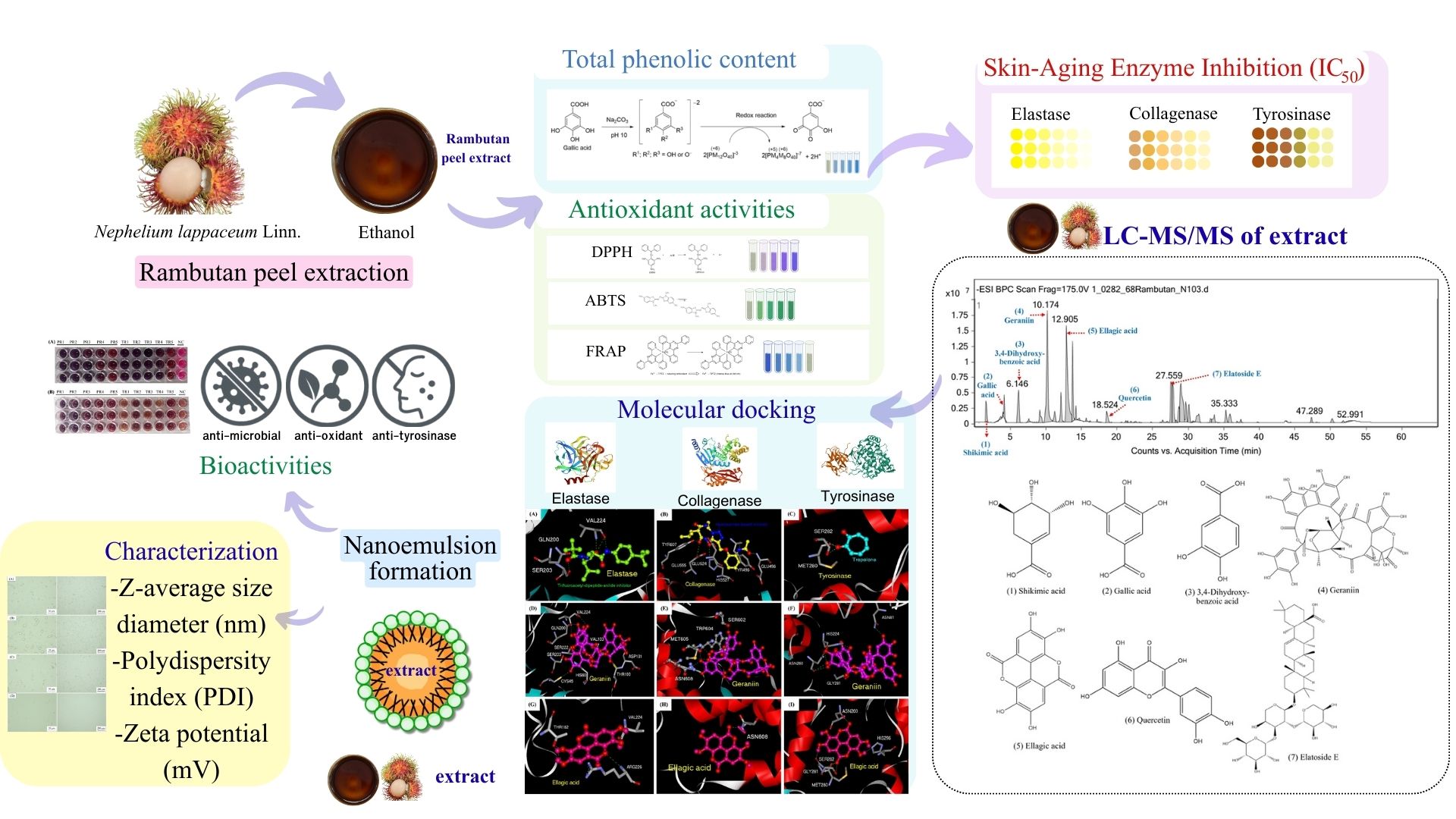
This study evaluated the anti-aging potential of rambutan (Nephelium lappaceum L.) peel extract through phytochemical profiling, enzyme inhibition, molecular docking, and nanoemulsion formulation. The extract showed high phenolic content and strong antioxidant activity (DPPH IC50 = 3.53 ± 0.05 µg/mL). LC-MS/MS analysis identified geraniin and ellagic acid as major bioactive compounds. The extract exhibited concentration-dependent inhibition of key skin-aging enzymes, with pronounced collagenase inhibition and moderate elastase and tyrosinase inhibition, supported by molecular docking demonstrating strong binding affinity of geraniin. Optimized oil-in-water nanoemulsions displayed nanoscale particle sizes (266.7 - 275.5 nm) with moderate polydispersity (PDI = 0.325 - 0.332) and excellent physicochemical stability over 7 days. Notably, the nanoemulsion system enhanced the stability and functional delivery of phenolic compounds, providing a practical approach for improving bioactivity in cosmeceutical formulations while promoting the valorization of rambutan peel waste within a circular economy framework. The formulations retained high antioxidant activity (91% - 95%), tyrosinase inhibition, and antibacterial activity against Staphylococcus aureus. These results demonstrate the potential of geraniin-rich rambutan peel nanoemulsions as promising candidates for cosmeceutical applications.
HIGHLIGHTS
- Rambutan peel extract inhibits skin-aging enzymes, with strong collagenase inhibition
- Geraniin shows strong binding to key anti-aging enzymes (−9.09 to −10.32 kcal/mol)
- Phenolics reduce nanoemulsion particle size (3–5-fold)
- Nanoemulsions retain antioxidant, antibacterial, and anti-tyrosinase activities
GRAPHICAL ABSTRACT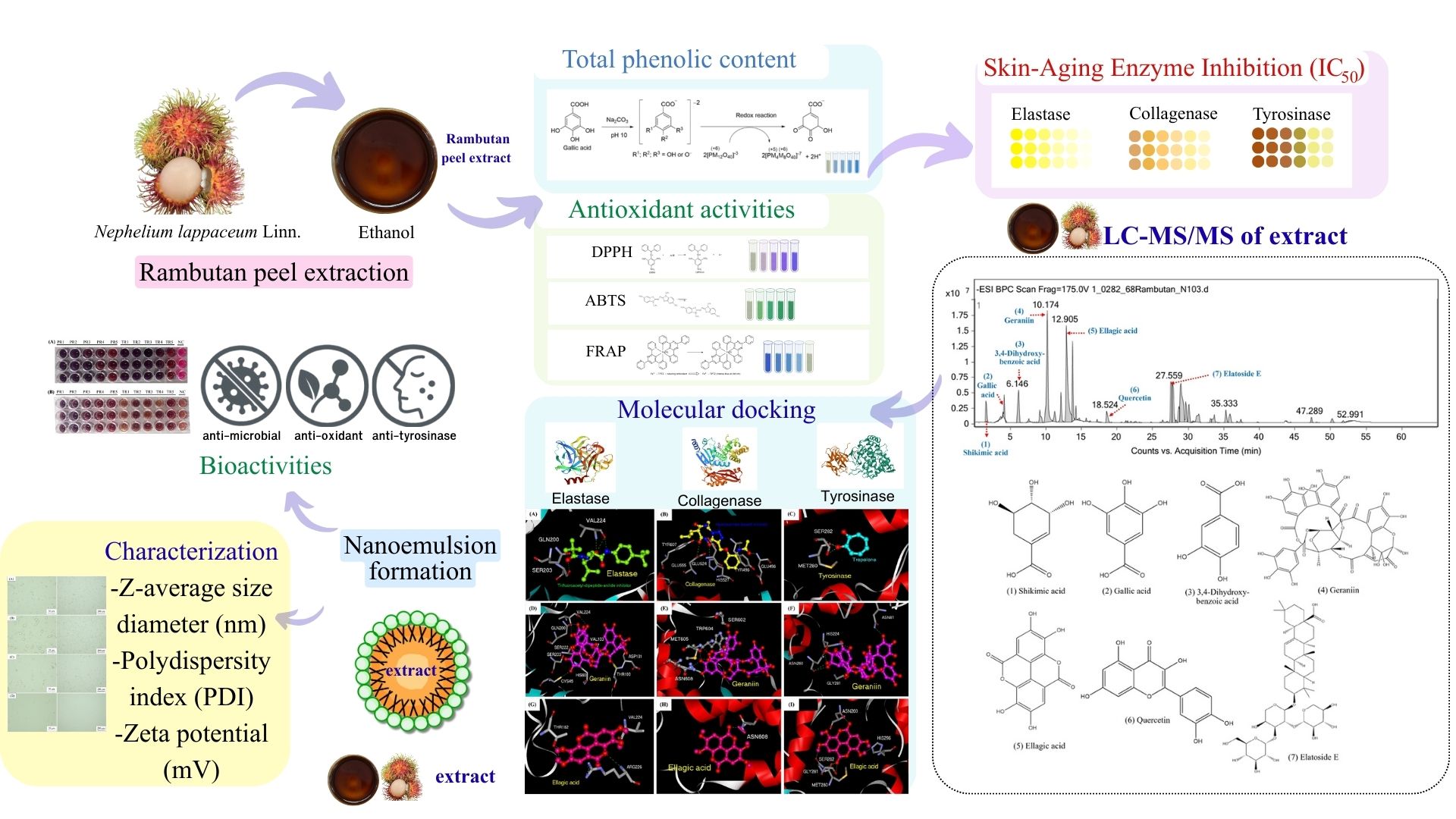
Downloads
References
Z Wang, F Yuan, X Zhong, S Feng and T Song. Skin microbiome and skin aging: Emerging strategies for manipulation. Microbiological Research 2025; 300, 128285.
NH Hussen, SK Abdulla, NM Ali, VA Ahmed, AH Hasan and EE Qadir. Role of antioxidants in skin aging and the molecular mechanism of ROS: A comprehensive review. Aspects of Molecular Medicine 2025; 5, 100063.
RI Amer, SM Ezzat, NM Aborehab, MF Ragab, D Mohamed, A Hashad, D Attia, MM Salama and MH El Bishbishy. Downregulation of MMP1 expression mediates the anti-aging activity of Citrus sinensis peel extract nanoformulation in UV induced photoaging in mice. Biomedicine & Pharmacotherapy 2021; 138, 111537.
A Bhardwaj, B Saroha, P Bishnoi, G Kumar, R Kumar and S Kumar. Kojic acid - a blossoming scaffold of biological significance: An overview of synthesis, properties, and biological applications. Current Organic Chemistry 2025; 29(17), 1321-1332.
M Xie, Z Jiang, X Lin and X Wei. Application of plant extracts cosmetics in the field of anti-aging. Journal of Dermatology Science and Cosmetic Technology 2024; 1(2), 100014.
Đ Ivković, F Andrić, M Senćanski, T Stević, M Krstić Ristivojević and P Ristivojević. Innovative analytical methodology for skin anti-aging compounds discovery from plant extracts: Integration of high-performance thin-layer chromatography-in vitro spectrophotometry bioassays with multivariate modeling and molecular docking. Journal of Chromatography A 2025; 1742, 465640.
O Babich, S Ivanova, A Bakhtiyarova, O Kalashnikova and S Sukhikh. Medicinal plants are the basis of natural cosmetics. Process Biochemistry 2025; 154, 35-51.
Q Liu, L Sun, Y Zhong, Q Ma and Y Zhuang. Current extraction techniques, biological activities, bioavailability, and patents of rambutan (Nephelium lappaceum L.) peel polyphenols: An updated review. Trends in Food Science & Technology 2025; 166, 105373.
Z Tingting, Z Xiuli, W Kun, S Liping and Z Yongliang. A review: Extraction, phytochemicals, and biological activities of rambutan (Nephelium lappaceum L) peel extract. Heliyon 2022; 8(11), e11314.
JF Osorio-Tobón. Recent advances and comparisons of conventional and alternative extraction techniques of phenolic compounds. Journal of Food Science and Technology 2020; 57(12), 4299-4315.
E Yulianti, W Warsit, A Sabarudin, B Muchtaromah, IA Putri and SAJN Sholikah. Impact of boiling, ultrasonic, and microwave-ultrasonic assisted extraction on phenolic content, antioxidant activity, and sun protection factor of black tea (Camellia sinensis) extracts. Natural and Life Sciences Communications 2026; 25(2), E2026035.
Y Zhuang, Q Ma, Y Guo and L Sun. Protective effects of rambutan (Nephelium lappaceum) peel phenolics on H₂O₂-induced oxidative damages in HepG2 cells and D-galactose induced aging mice. Food and Chemical Toxicology 2017; 108, 554-562.
N Chana, A Muengpoon, S Pethkaew, N Kulsin, A Mahasuk and S Srirat. Screening for phenolic compounds and oxidative capacity of fruit peels, agricultural waste, and traditional herbal medicine for use as biodiesel fuel additive. Songklanakarin Journal of Science & Technology 2022; 44(4), 1067-1074.
K Boonpisuttinant, R Srisuttee, HY Khong, R Chutoprapat, W Ruksiriwanich, S Udompong, W Chompoo, R Boonbai, R Rakkaew, J Sangsee, K Sriprasert and W Malilas. In vitro anti-ageing activities of ethanolic extracts from Pink rambutan (Nephelium lappaceum Linn.) for skin applications. Saudi Pharmaceutical Journal 2023; 31(4), 535-546.
N Lourith, M Kanlayavattanakul, P Chaikul, C Chansriniyom and P Bunwatcharaphansakun. In vitro and cellular activities of the selected fruits residues for skin aging treatment. Anais da Academia Brasileira de Ciências 2017; 89(S1), 577-589.
S Klongdee, W Katekhong, W Jittanit, S Matsukawa and U Klinkesorn. Encapsulation of polyphenol rich extract from rambutan (Nephelium lappaceum L.) peel for application as dual functional ingredient in ice cream. Scientific Reports 2025; 15(1), 30564.
R Meral, Y Erim Kose, Z Ceylan and İ Cavidoglu. The potential use of agro-industrial by-products as sources of bioactive compounds: a nanotechnological approach. Studies in Natural Products Chemistry 2022; 73, 435-466.
JR Nunes, TS Martins and LB Lopes. Nanoemulsions for topical-transdermal administration of a retinoid: understanding the effects of oil phase and terpene concentration on nanoemulsion characteristics, irritation potential, skin penetration and cytotoxicity. Journal of Drug Delivery Science and Technology 2025; 113, 107397.
S Li and Z Zhou. Deciphering the role of endogenous polyphenols in the stability and rheological properties of walnut Oleosome emulsions. Food Chemistry 2025; 495, 146457.
I Lukman, WD Prahastuti, H Herlina, N Chiuman and R Kartasasmita. Insights into molecular interaction of flavonoid compounds in citrus peel bound to collagenase and elastase enzymes: A computational study. Pharmaceutical Sciences and Research 2021; 8(2), 103-112.
DY Pratiwi, R Saputri, A Nuryanto and N Atikah. Molecular docking study of Illicium verum hook f. as elastase and collagenase inhibitor in anti-aging mechanism. Borneo Journal of Pharmacy 2025; 8(2), 168-177.
U Sukatta, P Rugthaworn, N Khanoonkon, P Anongjanya, K Kongsin, P Sukyai, N Harnkarnsujarit, R Sothornvit and R Chollakup. Rambutan (Nephelium lappaceum) peel extract: Antimicrobial and antioxidant activities and its application as a bioactive compound in whey protein isolate film. Food Packaging and Shelf Life 2021; 30, 100735.
S Pedišić, P Čulina, T Pavlešić, N Vahčić, I Elez Garofulić, Z Zorić, V Dragović-Uzelac and M Repajić. Efficiency of microwave- and ultrasound-assisted extraction as a green tool for polyphenolic isolation from monofloral honeys. Molecules 2023; 11(11), 3141.
S Siricoon, P Sombatmak, W Sumsakul, T Ploypetchara, W Sorndech, S Butseekhot and C Auranwiwat. Ultrasonic assisted extraction enhanced total phenolic and antioxidant activities from Aegle marmelos (L.) Corr. extract. Journal of Health Science and Alternative Medicine 2022; 4(3), 275-278.
P Kongsune, K Sangthongchin, P Ampha, M Maneechote and N Chana. Enhancement of antioxidant activity and inhibition of polyphenol oxidase from green oak lettuce by chitosan-encapsulated rambutan (Nephelium lappaceum L.) peel extract. Chiang Mai Journal of Science 2025; 52(4), e2025035.
R Re, N Pellegrini, A Proteggente, A Pannala, M Yang and C Rice-Evans. Antioxidant activity applying an improved ABTS radical cation decolorization assay. Free Radical Biology and Medicine 1999; 26(9-10), 1231-1237.
IF Benzie and JJ Strain. The ferric reducing ability of plasma (FRAP) as a measure of “antioxidant power”: The FRAP assay. Analytical Biochemistry 1996; 239(1), 70-76.
YF Fan, SX Zhu, FB Hou, DF Zhao, QS Pan, YW Xiang, XK Qian, GB Ge and P Wang. Spectrophotometric assays for sensing tyrosinase activity and their applications. Biosensors 2021; 11(8), 290.
W Wang, Y Gao, W Wang, J Zhang, J Yin, T Le, J Xue, UH Engelhardt and H Jiang. Kojic acid showed consistent inhibitory activity on tyrosinase from mushroom and in cultured B16F10 cells compared with arbutins. Molecules 2022; 11(3), 502.
B Deri, M Kanteev, M Goldfeder, D Lecina, V Guallar, N Adir and A Fishman. The unravelling of the complex pattern of tyrosinase inhibition. Scientific Reports 2016; 6(1), 34993.
SH Lee, S Sancheti, S Sancheti and S Seo. Potent antielastase and antityrosinase activities of Astilbe chinensis. American Journal of Pharmacology and Toxicology 2009; 4(4), 127-129.
VL Bodiga and S Bodiga. Ascorbic acid is a potential inhibitor of collagenases-in silico and in vitro biological studies. In Silico Drug Design 2019; 22, 649-677.
TI Morales and JF Woessner. PZ-peptidase from chick embryos. Purification, properties, and action on collagen peptides. Journal of Biological Chemistry 1977; 252(14), 4855-4860.
HW Ng, Y Zhang, R Naffa and S Prabakar. Monitoring the degradation of collagen hydrogels by collagenase clostridium histolyticum. Gels 2020; 6(4), 46.
K Bouchemal, S Briancon, E Perrier and H Fessi. Nano-emulsion formulation using spontaneous emulsification: Solvent, oil and surfactant optimisation. International Journal of Pharmaceutics 2004; 280, 241-251.
C Yucel, GS Karatoprak, S Yalcintas and TE Boncu. Ethosomal (-)-epigallocatechin-3-gallate as a novel approach to enhance antioxidant, anti-collagenase and anti-elastase effects. Beilstein Journal of Nanotechnology 2022; 13(1), 491-502.
G Feinstein, A Kupfer and M Sokolovsky. N-acetyl-(L-Ala) 3-p-nitroanilide as a new chromogenic substrate for elastase. Biochemical and Biophysical Research Communications 1973; 50(4), 1020-1026.
M Irakli, A Skendi, E Bouloumpasi, P Chatzopoulou and CG Biliaderis. LC-MS identification and quantification of phenolic compounds in solid residues from the essential oil industry. Antioxidants 2021; 10(12), 2016.
WT Ismaya, HJ Rozeboom, A Weijn, JJ Mes, F Fusetti, HJ Wichers and BW Dijkstra. Crystal structure of Agaricus bisporus mushroom tyrosinase: Identity of the tetramer subunits and interaction with tropolone. Biochemistry 2011; 50(24), 5477-5486.
A Alhayek, AS Abdelsamie, E Schonauer, V Camberlein, E Hutterer, G Posselt, J Serwanja, C Blochl, CG Huber, J Haupenthal, H Brandstetter, S Wessler and AKH Hirsch. Discovery and characterization of synthesized and FDA-approved inhibitors of clostridial and bacillary collagenases. Journal of Medicinal Chemistry 2022; 65, 12933-12955.
C Mattos, DA Giammona, GA Petsko and D Ringe. Structural analysis of the active site of porcine pancreatic elastase based on the X-ray crystal structures of complexes with trifluoroacetyl-dipeptide-anilide inhibitors. Biochemistry 1995; 34(10), 3193-3203.
MJ Frisch, M Frisch, G Trucks, K Schlegel, G Scuseria, M Robb, J Cheeseman, J Montgomery, T Vreven, KN Kudin, J Burant, J Millam, S Iyengar, J Tomasi, V Barone, B Mennucci, M Cossi, G Scalmani, N Rega, …, BA Johnson. Gaussian 03, revision C.02. Gaussian, Connecticut, United States, 2004.
GM Morris, DS Goodsell, RS Halliday, R Huey, WE Hart, RK Belew and AJ Olson. Automated docking using a Lamarckian genetic algorithm and an empirical binding free energy function. Journal of Computational Chemistry 1998; 19(14), 1639-1662.
J Stetefeld, SA McKenna and TR Patel. Dynamic light scattering: A practical guide and applications in biomedical sciences. Biophysical Reviews 2016; 8(4), 409-427.
SD Sarker, L Nahar and Y Kumarasamy. Microtitre plate-based antibacterial assay incorporating resazurin as an indicator of cell growth, and its application in the in vitro antibacterial screening of phytochemicals. Methods 2007; 42, 321-324.
A Floegel, DO Kim, SJ Chung, SI Koo and OK Chun. Comparison of ABTS/DPPH assays to measure antioxidant capacity in popular antioxidant-rich US foods. Journal of Food Composition and Analysis 2011; 24(7), 1043-1048.
B Zou, Y Zhang, R Dai, X Liu and M Zang. Rambutan peel polyphenols improve color and texture of ground pork: Identification, antioxidant and bacteriostatic function, and molecular docking. LWT 2025; 220, 117575.
J Jandaruang, S Phosri, N Poomsuk, S Arthan, S Posoongnoen, T Thummavongsa, K Siriwong and S Preecharram. Bioactivities of leaf extracts from Urceola polymorpha (Pierre) D.J.Middleton & Livsh., Hyptis suaveolens (L.) Poit, and Passiflora foetida L. leaf: Antioxidant, antibacterial, cytotoxic and anti-tyrosinase potential with molecular docking analysis. Trends in Sciences 2025; 22(8), 10162.
J Xiao, B Liu and Y Zhuang. Effects of rambutan (Nephelium lappaceum) peel phenolics and Leu-Ser-Gly Tyr-Gly-Pro on hairless mice skin photoaging induced by ultraviolet irradiation. Food and Chemical Toxicology 2019; 129, 30-37.
CV Ortiz-Ruiz, J Berna, J Tudela, R Varon and F Garcia-Canovas. Action of ellagic acid on the melanin biosynthesis pathway. Journal of Dermatological Science 2016; 82(2), 115-122.
HL Yang, CP Lin, YV Gowrisankar, PJ Huang, WL Chang, S Shrestha and YC Hseu. The anti-melanogenic effects of ellagic acid through induction of autophagy in melanocytes and suppression of UVA-activated alpha-MSH pathways via Nrf2 activation in keratinocytes. Biochemical Pharmacology 2021; 185, 114454.
M Yoshikawa, H Matsuda, E Harada, T Murakami, N Wariishi, J Yamahara and N Murakami. Elatoside E, a new hypoglycemic principle from the root cortex of Aralia elata Seem.: Structure-related hypoglycemic activity of oleanolic acid glycosides. Chemical and Pharmaceutical Bulletin 1994; 42(6), 1354-1356.
K Jiang, X Zhang, T Li, J Liu, M Liu and S Han. Gibberellin and shikimic acid enhance ascorbic acid accumulation and ROS scavenging ability to delay the senescence of postharvest jujube fruit. Postharvest Biology and Technology 2025; 222, 113340.
D Ren, W Xiong, S Fan, Y Luo, X Jin, F Lai, Z Zhao, R Pei and J Li. Surface functionalization of MXene with gallic acid for enhanced UV aging resistance in SBS-modified asphalt: A study of interface interaction and molecular dynamics. Colloids and Surfaces A: Physicochemical and Engineering Aspects 2025; 711, 136316.
M Bhatiya, S Pathak, G Jothimani, AK Duttaroy and A Banerjee. A comprehensive study on the anti-cancer effects of quercetin and its epigenetic modifications in arresting progression of colon cancer cell proliferation. Archivum Immunologiae et Therapiae Experimentalis 2023; 71(1), 6.
SA Abdul Ahmad, UD Palanisamy, BA Tejo, MF Chew, HW Tham and SS Hassan. Geraniin extracted from the rind of Nephelium lappaceum binds to dengue virus type-2 envelope protein and inhibits early stage of virus replication. Virology Journal 2017; 14(1), 229.
S Chan, S Kantham, VM Rao, MK Palanivelu, HL Pham, PN Shaw, RP McGeary and BP Ross. Metal chelation, radical scavenging and inhibition of Abeta42 fibrillation by food constituents in relation to Alzheimer's disease. Food Chemistry 2016; 199, 185-194.
B Iskandar, TW Liu, HC Mei, IC Kuo, MDC Surboyo, HM Lin and CK Lee. Herbal nanoemulsions in cosmetic science: A comprehensive review of design, preparation, formulation, and characterization. Journal of Food and Drug Analysis 2024; 32(4), 428.
O Sarheed, M Dibi and KV Ramesh. Studies on the effect of oil and surfactant on the formation of alginate-based O/W lidocaine nanocarriers using nanoemulsion template. Pharmaceutics 2020; 12(12), 1223.
Q Liu, H Huang, H Chen, J Lin and Q Wang. Food-grade nanoemulsions: Preparation, stability and application in encapsulation of bioactive compounds. Molecules 2019; 24(23), 4242.
T Xiao, B Adhikari, X Ma, Q Wang, H Hu, F Xiang, A Shi and X Zha. Advances in emulsion stability: A review on mechanisms, role of emulsifiers, and applications in food. Food Chemistry: X 2025; 29, 102792.
P Rousta, M Shahamirian, S Yazdanpanah and A Shirazinejad. Co-encapsulation of vitamin D3 and Cordia myxa fruit peel extract in nanoemulsions. British Food Journal 2025; 127(2), 431-450.
BR Albuquerque, J Pinela, MI Dias, C Pereira, J Petrovic, M Sokovic, RC Calhelha, MBPP Oliveira, ICFR Ferreira and L Barros. Valorization of rambutan (Nephelium lappaceum L.) peel: Chemical composition, biological activity, and optimized recovery of anthocyanins. Food Research International 2023; 165, 112574.
Published
How to Cite
Issue
Section
License
Copyright (c) 2026 Walailak University

This work is licensed under a Creative Commons Attribution-NonCommercial-NoDerivatives 4.0 International License.





