
Comparative Analysis of Mitragynine and Alkaloid Content in Cultivated M. speciosa Leaves and Their α-Glucosidase Inhibitory Activity
DOI:
https://doi.org/10.48048/tis.2025.10852Keywords:
Kratom, Mitragynine, Alkaloid content, Propagation method, α-glucosidase inhibition, Molecular docking, Kratom, Mitragynine, Alkaloid content, Propagation method, α-glucosidase inhibition, Molecular dockingAbstract
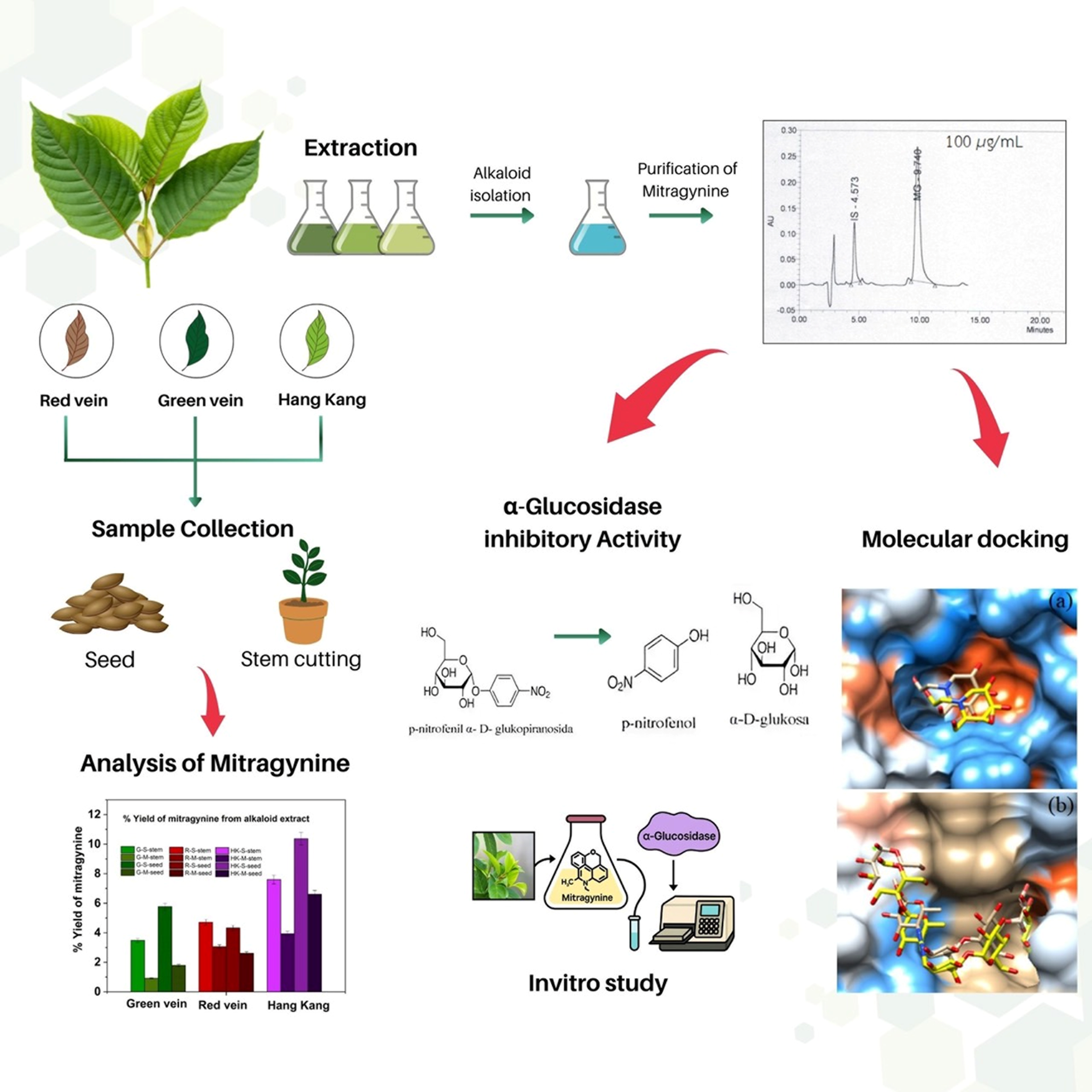
Mitragyna speciosa (kratom) is a Southeast Asian medicinal plant rich in indole and oxindole alkaloids, with mitragynine as its major bioactive component. However, the influence of propagation method, variety, and leaf maturity on alkaloid biosynthesis remains underexplored. This study conducted a comparative analysis of total alkaloid and mitragynine content in kratom leaves from 3 varieties - green vein, red vein, and “Hang Kang” - propagated by seed or stem cutting and harvested at 2 maturity stages (4th and 6th leaf pairs). Methanolic extracts yielded the highest alkaloid levels, and mitragynine was isolated and structurally confirmed by HPLC, ¹H NMR, and ¹³C NMR spectroscopy. Quantitative results showed that seed-propagated semi-mature leaves of the Hang Kang variety (HK-S-seed) contained the highest total alkaloids (1.59 %w/w) and mitragynine (10.37%, or 103.70 mg/g alkaloid extract). Additionally, α-glucosidase inhibitory assays revealed strong activity of mitragynine (IC₅₀ = 48.09 µg/mL), exceeding that of acarbose on a µg/mL basis. Molecular docking further supported these findings, showing high binding affinities of mitragynine and related alkaloids (−9.84 to −11.87 kcal/mol). Collectively, the results highlight the impact of cultivation variables on bioactive compound accumulation and suggest the potential of mitragynine as a natural scaffold for α-glucosidase inhibition.
HIGHLIGHTS
- Mitragynine was isolated and structurally confirmed by NMR and HPLC methods.
- Seed-propagated Hang Kang leaves showed highest mitragynine content (10.37%).
- Mitragynine exhibited strong α-glucosidase inhibition with IC₅₀ of 48.09 µg/mL.
- Molecular docking revealed high binding affinity of mitragynine to the enzyme.
- Cultivation method and leaf maturity influence alkaloid and mitragynine biosynthesis.
GRAPHICAL ABSTRACT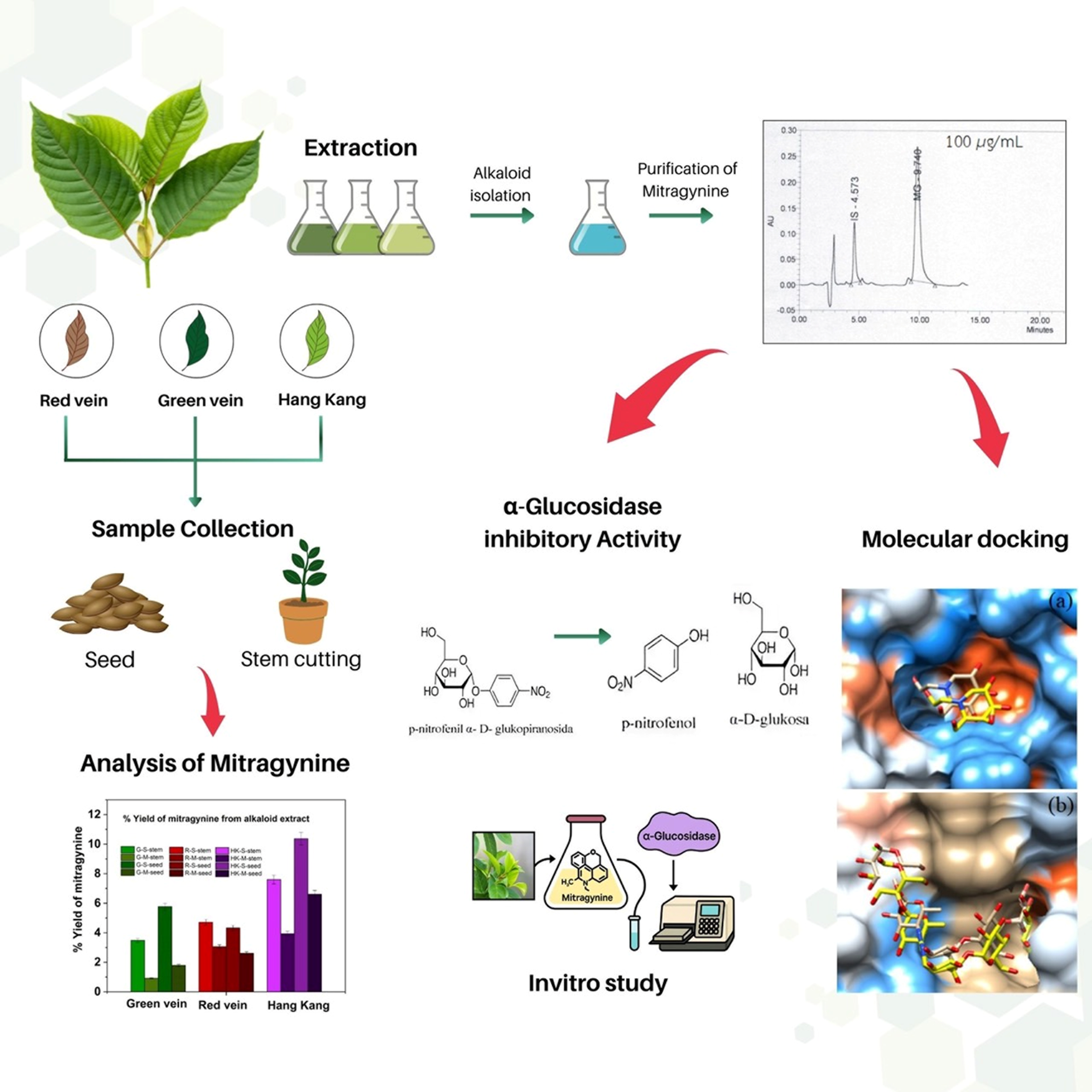
Downloads
References
T Begum, MH Arzmi, A Khatib, ABMH Uddin, MA Abdullah, K Rullah, SZ Mat So’ad, NFZ Haspi, MN Sarian, H Parveen, S Mukhtar and QU Ahmed. A review on Mitragyna speciosa (Rubiaceae) as a prominent medicinal plant based on ethnobotany, phytochemistry and pharmacological activities. Natural Product Research 2025; 39(6), 1636-1652.
T Begum, MH Arzmi, MN Sarian, SAA Shah, SNH Azmi, ABMH Uddin, A Khatib and QU Ahmed. A review on multi-therapeutic potential of the Mitragyna speciosa (kratom) alkaloids mitragynine and 7-hydroxymitragynine: Experimental evidence and future perspectives. Kuwait Journal of Science 2025; 52(2), 100381.
SC Eastlack, EM Cornett and AD Kaye. Kratom - pharmacology, clinical implications, and outlook: A comprehensive review. Pain and Therapy 2020; 9(1), 55-69.
T Petcharat, T Sae-leaw, S Benjakul, TH Quan, S Indriani, Y Phimolsiripol and S Karnjanapratum. Extraction of kratom (Mitragyna speciosa) leaf compounds by enzymatic hydrolysis-assisted process: Yield, characteristics and its in vitro cytotoxicity in cell lines. Process Biochemistry 2024; 142, 212-222.
YS Goh, T Karunakaran, V Murugaiyah, R Santhanam, MHA Bakar and S Ramanathan. Accelerated solvent extractions (ASE) of Mitragyna speciosa Korth. (kratom) leaves: Evaluation of its cytotoxicity and antinociceptive activity. Molecules 2021; 26(3), 3704.
W Innok, A Hiranrat, N Chana, T Rungrotmongkol and P Kongsune. In silico and in vitro anti-AChE activity investigations of constituents from Mitragyna speciosa for Alzheimer’s disease treatment. Journal of Computer-Aided Molecular Design 2021; 35(3), 325-336.
P Thepthong, S Srirat, W Hiranrat, P Kongsune and N Chana. Development of chitosan-based microencapsulation system for Mitragyna speciosa alkaloids: A novel approach for Alzheimer’s disease treatment. Journal of Pharmaceutical Innovation 2025; 20(2), 58.
S Suwanlert. A study of kratom eaters in Thailand. Bulletin on Narcotics 1975; 27(3), 21-27.
LC Laforest, MA Kuntz, SRR Kanumuri, S Mukhopadhyay, A Sharma, SE O’Connor, CR McCurdy and SS Nadakuduti. Metabolite and molecular characterization of Mitragyna speciosa identifies developmental and genotypic effects on monoterpene indole and oxindole alkaloid composition. Journal of Natural Products 2023; 86(4), 1042-1052.
P Tabboon, E Limpongsa, S Tuntiyasawasdikul, R Jarungsirawat, T Pongjanyakul and N Jaipakdee. Screening the potential of pharmaceutical liquids on enhancing dissolution, intestinal permeation, and stability of Mitragyna speciosa bioactive for peroral delivery systems. Industrial Crops and Products 2025; 225, 120525.
S Tuntiyasawasdikul, J Junlatat, P Tabboon, E Limpongsa and N Jaipakdee. Mitragyna speciosa ethanolic extract: Extraction, anti-inflammatory, cytotoxicity, and transdermal delivery assessments. Industrial Crops and Products 2024; 208, 117909.
M Jeddi, NE Hachlafi, ME Fadili, N Benkhaira, SH Al-Mijalli, F Kandsi, EM Abdallah, ZB Ouaritini, A Bouyahya, LH Lee, G Zengin, HN Mrabti and KF Benbrahim. Antimicrobial, antioxidant, α-amylase and α-glucosidase inhibitory activities of a chemically characterized essential oil from Lavandula angustifolia mill.: In vitro and in silico investigations. Biochemical Systematics and Ecology 2023; 111, 104731.
P Zhang, W Wei, X Zhang, C Wen, C Ovatlarnporn and OJ Olatunji. Antidiabetic and antioxidant activities of Mitragyna speciosa (kratom) leaf extract in type 2 diabetic rats. Biomedicine & Pharmacotherapy 2023; 162, 114689.
NFZ Zailan, SNE Sarchio and M Hassan. Evaluation of phytochemical composition, antioxidant and anti-diabetic activities of Mitragyna speciosa methanolic extract (MSME). Malaysian Journal of Medicine and Health Sciences 2022; 18, 93-100.
T Limcharoen, P Pouyfung, N Ngamdokmai, A Prasopthum, AR Ahmad, W Wisdawati, W Prugsakij and S Warinhomhoun. Inhibition of α-glucosidase and pancreatic lipase properties of Mitragyna speciosa (Korth.) Havil. (kratom) leaves. Nutrients 2022; 14(19), 4094.
FA Saddique, M Ahmad, UA Ashfaq, A Mansha, SG Khan. Alpha-glucosidase inhibition and molecular docking studies of 4-hydroxy-n'-[benzylidene/1-phenylethylidene]-2h-1,2-benzothiazine-3-carbohydrazide 1,1-dioxides. Chiang Mai Journal of Science 2021; 48(2), 460-469.
F Hermawan, T Ernawati and S Kusumaningrum. A review on isolation, characterization, biosynthesis, synthesis, modification, pharmacological activities and toxicology of mitragynine. Gazi University Journal of Science 2024; 37(4), 1654-1672.
N Leksungnoen, T Andriyas, Y Ku-Or, S Chongdi, R Tansawat, A Aramrak, C Ngernsaengsaruay, S Uthairatsamee, W Sonjaroon, P Thongchot, S Ardsiri and P Pongchaidacha. The effect of light intensity and polyethylene-glycol-induced water stress on the growth, mitragynine accumulation, and total alkaloid content of kratom (Mitragyna speciosa). Horticulturae 2025; 11(5), 573.
S Chongdi, S Uthairatsamee, C Ngernsaengsaruay, T Andriyas and N Leksungnoen. Regional variability in growth and leaf functional traits of Mitragyna speciosa in Thailand. International Journal of Plant Biology 2025; 16(1), 52-60.
N Leksungnoen, T Andriyas, C Ngernsaengsaruay, S Uthairatsamee, P Racharak, W Sonjaroon, R Kjelgren, BJ Pearson, CR McCurdy and A Sharma. Variations in mitragynine content in the naturally growing kratom (Mitragyna speciosa) population of Thailand. Frontiers in Plant Science 2022; 13, 1028547.
EM Mudge and PN Brown. Determination of mitragynine in Mitragyna speciosa raw materials and finished products by liquid chromatography with UV detection: Single-laboratory validation. Journal of AOAC International 2017; 100(4), 18-24.
AB Jaykumar MHS Shihabudeen and K Thirumurugan. Screening of fifteen Indian Ayurvedic plants for alpha-glucosidase inhibitory activity and enzyme kinetics. International Journal of Pharmacy and Pharmaceutical Sciences 2011; 3(4), 267-274.
L Sim, K Jayakanthan, S Mohan, R Nasi, BD Johnston, BM Pinto and DR Rose. New glucosidase inhibitors from an Ayurvedic herbal treatment for type 2 diabetes: Structures and inhibition of human intestinal maltase-glucoamylase with compounds from Salacia reticulata. Biochemistry 2010; 49(3), 443-451.
K Wangpaiboon, P Laohawuttichai, SY Kim, T Mori, S Nakapong, R Pichyangkura, P Pongsawasdi, T Hakoshima and K Krusong. A GH13 α-glucosidase from Weissella cibaria uncommonly acts on short-chain maltooligosaccharides. Acta Crystallographica Section D: Structural Biology 2021; 77, 1064-1076.
FC Bernstein, TF Koetzle, GJ Williams, EFJ Meyer, MD Brice, JR Rodgers, O Kennard, T Shimanouchi and M Tasumi. The protein data bank: A computer-based archival file for macromolecular structures. Journal of Molecular Biology 1977; 112(3), 535-542.
R Dennington, T Keith and J Millam. GaussView, version 5. Semichem Inc., Shawnee Mission, Kansas, 2009.
MJ Frisch, M Frisch, G Trucks, K Schlegel, G Scuseria, M Robb, J Cheeseman, J Montgomery, T Vreven, KN Kudin, J Burant, J Millam, S Iyengar, J Tomasi, V Barone, B Mennucci, M Cossi, G Scalmani, N Rega, A Petersson, …, BA Johnson. Gaussian 03, revision C02. Gaussian, Inc., Wallingford, Connecticut, 2004.
GM Morris, DS Goodsell, RS Halliday, R Huey, WE Hart, RK Belew and AJ Olson. Automated docking using a Lamarckian genetic algorithm and empirical binding free energy function. Journal of Computational Chemistry 1998; 19(14), 1639-1662.
J Gasteiger and M Marsili. Iterative partial equalization of orbital electronegativity - a rapid access to atomic charges. Tetrahedron 1980; 36(22), 3219-3228.
GM Morris, R Huey, W Lindstrom, MF Sanner, RK Belew, DS Goodsell and AJ Olson. AutoDock4 and AutoDockTools4: Automated docking with selective receptor flexibility. Journal of Computational Chemistry 2009; 30(16), 2785-2791.
E Ermakova. Structural insight into the glucokinase-ligands interactions: Molecular docking study. Computational Biology and Chemistry 2016; 64, 281-296.
L Flores-Bocanegra, HA Raja, TN Graf, M Augustinović, ED Wallace, S Hematian, JJ Kellogg, DA Todd, NB Cech and NH Oberlies. The chemistry of kratom (Mitragyna speciosa): Updated characterization data and methods to elucidate indole and oxindole alkaloids. Journal of Natural Products 2020; 83(7), 2165-2177.
W Innok, T Rungrotmongkol and P Kongsune. Insights into binding affinity of flavonoid compounds from Thai herbs against 2009 H1N1 hemagglutinin. Trends in Sciences 2022; 19(5), 2689.
Published
How to Cite
Issue
Section
License
Copyright (c) 2025 Walailak University

This work is licensed under a Creative Commons Attribution-NonCommercial-NoDerivatives 4.0 International License.





