Quercetin-Rich Apple Extract (Malus sylvestris Mill.) for Persistent Allergic Rhinitis: Symptom Improvement and Biomarker Trends
DOI:
https://doi.org/10.48048/tis.2027.13492Keywords:
Allergic rhinitis, Apple extract, Quercetin, Anti-Inflammatory, Antioxidant, CytokinesAbstract
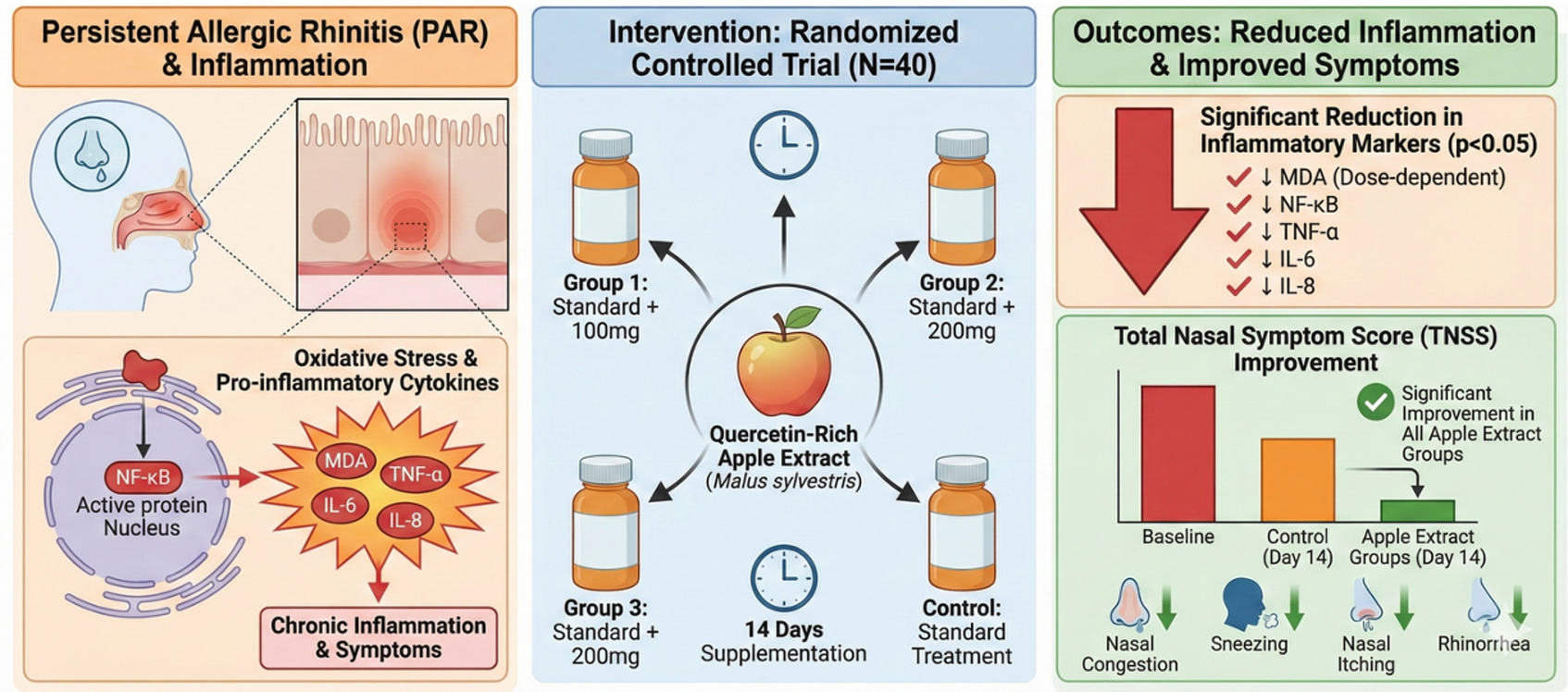
Persistent allergic rhinitis (PAR) is characterized by chronic inflammation mediated by oxidative stress and pro-inflammatory cytokines. Apple extract rich in quercetin demonstrates promising anti-inflammatory and antioxidant properties. To evaluate the therapeutic efficacy of apple extract supplementation on inflammatory biomarkers and clinical symptoms in patients with persistent allergic rhinitis. This double-blind, randomized controlled trial enrolled 40 adults with PAR confirmed by skin prick test or specific IgE. Participants were randomized into four groups: Control (standard treatment), treatment group 1 (standard treatment + 100mg/day apple extract), treatment group 2 (standard treatment + 200mg/day apple extract), and treatment group 3 (200mg/day apple extract alone). Primary outcomes included serum levels of malondialdehyde (MDA), nuclear factor-kappa B (NF-κB), tumor necrosis factor-alpha (TNF-α), interleukin-6 (IL-6), and interleukin-8 (IL-8) measured at baseline and day 14. Secondary outcomes included Total Nasal Symptom Score (TNSS) for nasal congestion, sneezing, nasal itching, and rhinorrhea. All treatment groups showed decreases in inflammatory markers and oxidative stress indicators compared with baseline; however, these changes did not reach statistical significance (p > 0.05), and should therefore be interpreted as trends rather than confirmed effects. The greatest mean reductions in NF-κB and IL-8 levels were observed in the 200 mg/day group, suggesting a possible trend toward dose-related change rather than a confirmed dose-dependent effect. TNSS scores improved in all apple extract groups, with the 200 mg/day group demonstrating the largest mean improvement. Despite the absence of statistically significant changes, these findings suggest only a possible trend toward modulation of inflammatory and oxidative pathways in PAR, and do not provide statistically supported evidence of biochemical efficacy. Further studies with larger sample sizes and longer treatment durations are warranted to confirm these preliminary observations.
HIGHLIGHTS
- A double-blind RCT shows that apple extract (quercetin-rich) is associated with nonsignificant downward trends in inflammatory and oxidative stress markers in PAR.
- Nonsignificant decreases in oxidative stress marker MDA and pro-inflammatory cytokines (TNF-α, IL-6, IL-8, NF-κB) across treatment groups
- Significant clinical improvements in Total Nasal Symptom Score (TNSS) across all apple extract groups, with the maximal improvement in 200 mg/day monotherapy.
- Supports quercetin-rich apple extract as an effective complementary therapy for PAR inflammation and symptoms.
GRAPHICAL ABSTRACT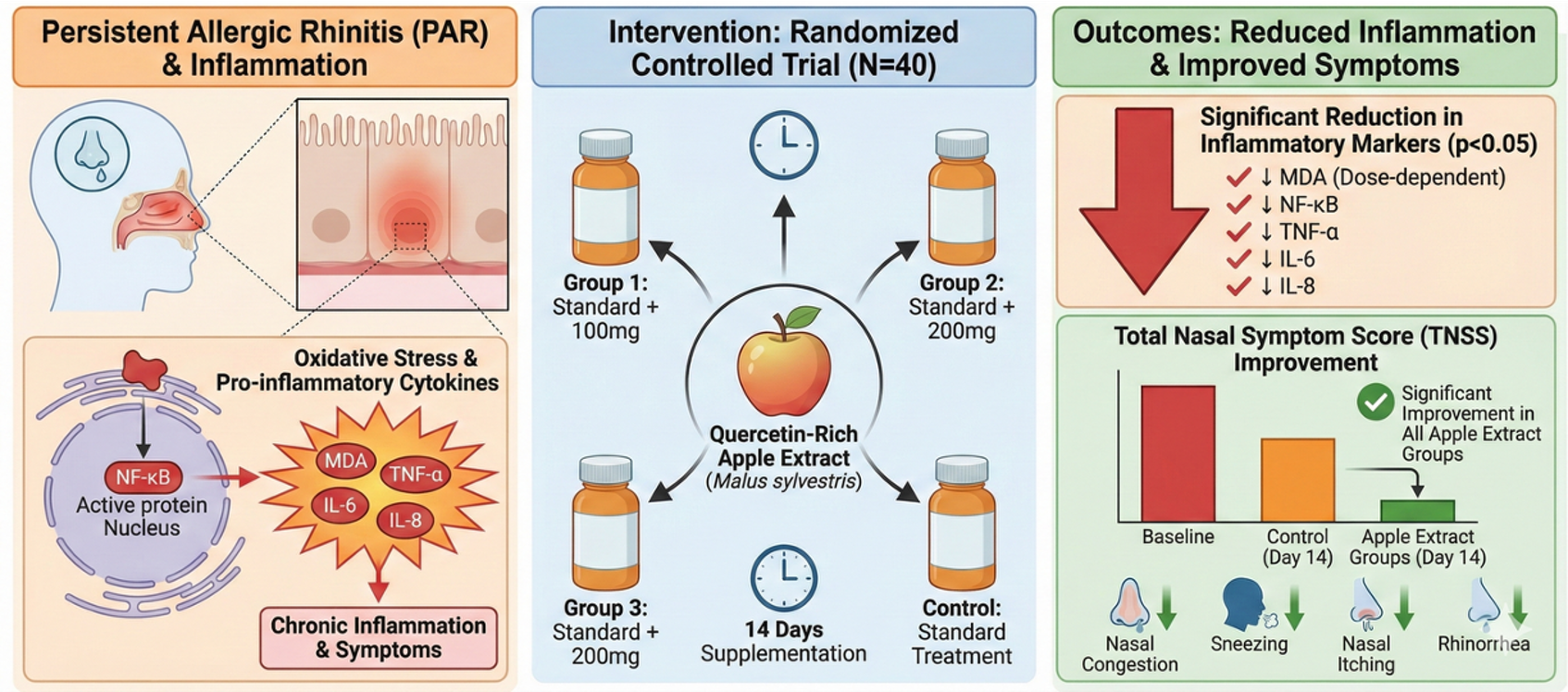
Downloads
References
LM Wheatley and A Togias. Clinical practice. Allergic rhinitis. New England Journal of Medicine 2015; 372(5), 456-63.
J Varshney and H Varshney. Allergic rhinitis: An overview. Indian Journal of Otolaryngology and Head and Neck Surgery 2015; 67(2), 143-149.
P Small, PK Keith and H Kim. Allergic rhinitis. Allergy, Asthma and Clinical Immunology 2018; 14(2), 51.
JR May and WK Dolen. Management of allergic rhinitis: A review for the community pharmacist. Clinical Therapeutics 2017; 39(12), 2410-2419.
AO Eifan and SR Durham. Pathogenesis of rhinitis. Clinical and Experimental Allergy 2016; 46(9), 1139-1151.
E Savi, S Peveri and O Capelli. Allergic sensitization in rhinitis and asthma. IntechOpen, London, 2016.
B Sin and A Togias. Pathophysiology of allergic and nonallergic rhinitis. Proceedings of the American Thoracic Society 2011; 8(1), 106-114.
SN Chong and FT Chew. Epidemiology of allergic rhinitis and associated risk factors in Asia. World Allergy Organization Journal 2018; 11, 17.
L Sun, J Sha, C Meng and D Zhu. Mesenchymal stem cell-based therapy for allergic rhinitis. Stem Cells International 2020; 2020, 2367524.
TY Jang, AY Jung and YH Kim. Hormetic effect of chronic hypergravity in a mouse model of allergic asthma and rhinitis. Scientific Reports 2016; 6, 27260.
Z Pan, Y Zhou, X Luo, Y Ruan, L Zhou, Q Wang, YJ Yan, Q Liu and J Chen. Against NF-κB/thymic stromal lymphopoietin signaling pathway, catechin alleviates the inflammation in allergic rhinitis. International Immunopharmacology 2018; 61, 241-248.
IS Park, JH Kim, JS Bae, DK Kim and JH Mo. The supernatant of tonsil-derived mesenchymal stem cell has antiallergic effects in allergic rhinitis mouse model. Mediators of Inflammation 2020; 2020, 6982438.
TV Nguyen, CH Piao, YJ Fan, DU Shin, SY Kim, HJ Song, CH Song, HS Shin and OH Chai. Anti-allergic rhinitis activity of α-lipoic acid via balancing Th17/Treg expression and enhancing Nrf2/HO-1 pathway signaling. Scientific Reports 2020; 10, 12528.
SB Wang, YQ Deng, J Ren, BK Xiao, Z Liu and ZZ Tao. Exogenous interleukin-10 alleviates allergic inflammation but inhibits local interleukin-10 expression in a mouse allergic rhinitis model. BMC Immunology 2014; 15, 9.
L Restimulia, S Ilyas, D Munir, A Putra, T Madiadipoera, Farhat, RJ Sembiring, M Ichwan and ND Amalina. Rats’ umbilical-cord mesenchymal stem cells ameliorate mast cells and Hsp70 on ovalbumin-induced allergic rhinitis rats. Medicinski Glasnik 2022; 19(1), 389.
M Wang, N Zhao, C Wang, ZB Jin and L Zhang. Immunomodulatory properties of mesenchymal stem cells: A potential therapeutic strategy for allergic rhinitis. Allergy 2023; 78, 1425-1440.
S Mursiti, ND Amalina and A Marianti. Inhibition of breast cancer cell development using Citrus maxima extract through increasing levels of Reactive Oxygen Species (ROS). Journal of Physics: Conference Series 2021; 1918, 052005.
M Suzery, B Cahyono and ND Amalina. Citrus sinensis (L) peels extract inhibits metastasis of breast cancer cells by targeting the downregulation matrix metalloproteinases-9. Open Access Macedonian Journal of Medical Sciences 2021; 9, 464-469.
ND Amalina, S Wahyuni and Harjito. Cytotoxic effects of the synthesized Citrus aurantium peels extract nanoparticles against MDA-MB-231 breast cancer cells. Journal of Physics: Conference Series 2021; 1918, 032006.
RA Rather and M Bhagat. Quercetin as an innovative therapeutic tool for cancer chemoprevention: Molecular mechanisms and implications in human health. Cancer Medicine 2019; 9(24), 9181-9192.
B Salehi, L Machin, L Monzote, J Sharifi-Rad, SM Ezzat, MA Salem, RM Merghany, NME Mahdy, CS Kılıç, O Sytar, M Sharifi-Rad, F Sharopov, N Martins, M Martorell and WC Cho. Therapeutic potential of quercetin: New insights and perspectives for human health. ACS Omega 2020; 5(20), 11849-11872.
CM Liu, YZ Sun, JM Sun, JQ Ma and C Cheng. Protective role of quercetin against lead-induced inflammatory response in rat kidney through the ROS-mediated MAPKs and NF-κB pathway. Biochimica et Biophysica Acta (BBA) - General Subjects 2012; 1820(10), 1693-1703.
M Naso, C Trincianti, MA Tosca and G Ciprandi. Quercetin and its lecithin-based formulation: Potential applications for allergic diseases based on a narrative review. Nutrients 2025; 17(9), 1476.
YR Lai, YH Liao, L Huang, HBP Linh, FA Utami, MMD Giudice, G Ciprandi and YC Chen. Clinical effects of polyphenolic compounds on allergic rhinitis: A systematic review and meta-analysis. The Journal of Allergy and Clinical Immunology: In Practice 2025; 13(9), 2475-2491.
M Starowicz, B Achrem–Achremowicz, MK Piskuła and H Zieliński. Phenolic compounds from apples: Reviewing their occurrence, absorption, bioavailability, processing, and antioxidant activity - A review. Polish Journal of Food and Nutrition Sciences 2020; 70(4), 321-336.
T Shoji, M Obara, T Takahashi, S Masumoto, H Hirota and T Miura. The differences in the flavan-3-ol and procyanidin contents of the japanese ‘Fuji’ and ‘Orin’ apples using a rapid quantitative high-performance liquid chromatography method: Estimation of the Japanese intake of flavan-3-ols and procyanidins from apple as case study. Foods 2021; 10(2), 274.
MR Marasco, AM Conteh, CA Reissaus, JE Cupit V, EM Appleman, RG Mirmira and AK Linnemann. Interleukin-6 reduces β-cell oxidative stress by linking autophagy with the antioxidant response. Diabetes 2018; 67(8), 1576-1588.
B Baby, P Antony, WA Halabi, ZA Homedi and R Vijayan. Structural insights into the polypharmacological activity of quercetin on serine/threonine kinases. Drug Design, Development and Therapy 2016; 10, 3109-3123.
AK Maurya and M Vinayak. Quercetin attenuates cell survival, inflammation, and angiogenesis via modulation of AKT signaling in murine T-Cell lymphoma. Nutrition and Cancer 2017; 69(3), 470-480.
OM Ahmed, AA Ahmed, HI Fahim and MY Zaky. Quercetin and naringenin abate diethylnitrosamine/acetylaminofluorene-induced hepatocarcinogenesis in Wistar rats: The roles of oxidative stress, inflammation and cell apoptosis. Drug and Chemical Toxicology 2022; 45(1), 262-273.
MR Indra, S Karyono, R Ratnawati and SG Malik. Quercetin suppresses inflammation by reducing ERK1/2 phosphorylation and NF kappa B activation in Leptin-induced Human Umbilical Vein Endothelial Cells (HUVECs). BMC Research Notes 2013; 6, 275.
AN Kamali, SM Noorbakhsh, H Hamedifar, F Jadidi-Niaragh, R Yazdani, JM Bautista and G Azizi. A role for Th1-like Th17 cells in the pathogenesis of inflammatory and autoimmune disorders. Molecular Immunology 2019; 105, 107-115.
L Xie, W Gong, J Chen, HW Xie, M Wang, XP Yin and W Wu. The flavonoid kurarinone inhibits clinical progression of EAE through inhibiting Th1 and Th17 cell differentiation and proliferation. International Immunopharmacology 2018; 62, 227-236.
S Wang, X Gao, G Shen, W Wang, J Li, J Zhao, YQ Wei and CK Edwards. Interleukin-10 deficiency impairs regulatory T cell-derived neuropilin-1 functions and promotes Th1 and Th17 immunity. Scientific Reports 2016; 6, 24249.
N Abdollahi, A Nadjarzadeh, A Salehi-Abargouei, H Fallahzadeh, E Razmpoosh, E Lorzaedeh and S Safi. The effect of Nigella sativa on TAC and MDA in obese and overweight women: Secondary analysis of a crossover, double blind, randomized clinical trial. Journal of Diabetes & Metabolic Disorders 2022; 21(1), 171-179.
S Sun, F Gong, P Liu and Q Miao. Metformin combined with quercetin synergistically repressed prostate cancer cells via inhibition of VEGF/PI3K/Akt signaling pathway. Gene 2018; 664, 50-57.
Q Lu, XJ Ji, YX Zhou, XQ Yao, YQ Liu, F Zhang and XX Yin. Quercetin inhibits the mTORC1/p70S6K signaling-mediated renal tubular epithelial-mesenchymal transition and renal fibrosis in diabetic nephropathy. Pharmacological Research 2015; 99, 237-247.
M Han, Y Song and X Zhang. Quercetin suppresses the migration and invasion in human colon cancer caco-2 cells through regulating toll-like receptor 4/nuclear factor-kappa B pathway. Pharmacognosy Magazine 2016; 12(2), 237-244.
S Lee, YJ Kim, S Kwon, Y Lee, SY Choi, J Park and HJ Kwon. Inhibitory effects of flavonoids on TNF-α-induced IL-8 gene expression in HEK 293 cells. BMB Reports 2009; 42, 265-270.
A Putra, I Alif, MA Nazar, A Prasetio, R Chandra, S Irawan, D Amalina, EP Sari, AR Kustiyah and IPA Nasution. IL-6 and IL-8 suppression by bacteria-adhered mesenchymal stem cells co-cultured with PBMCs under TNF-α exposure. In: Proceedings of the 1st Jenderal Soedirman International Medical Conference in conjunction with the 5th Annual Scientific Meeting (Temilnas) Consortium of Biomedical Science Indonesia (JIMC 2020), Central Java, Indonesia. 2020, p. 311-317.
Downloads
Published
How to Cite
Issue
Section
License
Copyright (c) 2026 Walailak University

This work is licensed under a Creative Commons Attribution-NonCommercial-NoDerivatives 4.0 International License.