
Moisture Sorption Isotherms and Drying Kinetics of Lepironia articulata: Effects of Hot Air Drying on Mechanical Properties and Structural Changes
DOI:
https://doi.org/10.48048/tis.2026.13491Keywords:
Equilibrium moisture content, Lepironia articulate, Hot-air drying, Mathematic drying modelingAbstract
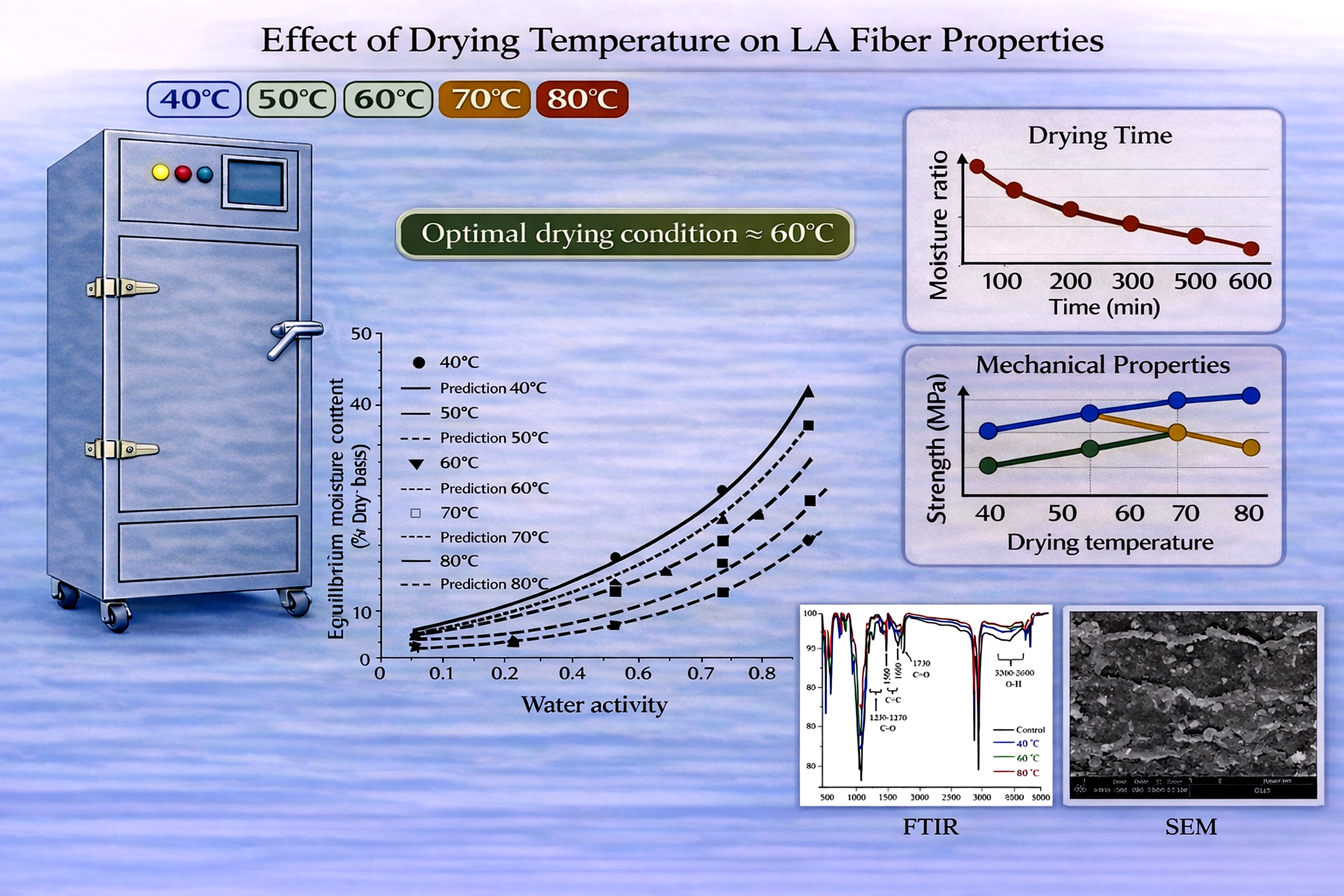
This study systematically investigates the moisture sorption behavior, drying kinetics, and coupled structural-mechanical responses of Lepironia articulata (LA) fiber under controlled hot-air drying conditions (40 - 80 °C). Equilibrium moisture content (EMC) was determined at water activity levels ranging from 0.1 to 0.9 and modeled using several empirical equations. Among these, the Modified Guggenheim-Anderson-de Boer (GAB) model provided the best fit across all temperatures, exhibiting the highest coefficient of determination (R²) and lowest root mean square error (RMSE), indicating its suitability for describing sorption behavior in lignocellulosic fibers. Drying kinetics were analyzed using nine thin-layer drying models, where the Modified Page model consistently demonstrated superior predictive accuracy. The drying process was dominated by the falling-rate period, confirming that internal moisture diffusion governs mass transfer. Increasing drying temperature significantly accelerated moisture removal, reducing the drying time required to reach a moisture ratio of 0.10 from approximately 540 min at 40 °C to 140 min at 80 °C. Mechanical testing revealed a non-linear dependence of tensile strength on temperature, with an initial reduction at 40 - 50 °C, followed by recovery at 60 - 70 °C, and a maximum value at 80 °C, while elongation at break remained relatively stable. FTIR analysis indicated progressive dehydration, reduction of hydroxyl groups, and degradation of hemicellulose, accompanied by increased cellulose ordering. SEM observations confirmed corresponding morphological changes, including fiber densification at moderate temperatures and micro-crack formation and cell wall collapse at higher temperatures. The apparent contradiction between increased tensile strength and structural damage at elevated temperatures is explained by crystallinity-driven stiffening and improved microfibril alignment, which dominate bulk mechanical behavior despite localized defects. Overall, drying at 60 °C was identified as the optimal condition, providing a balance between efficient moisture removal, mechanical performance, and structural integrity. These findings provide a comprehensive framework for optimizing drying processes and enhancing the utilization of natural lignocellulosic fibers in sustainable material applications.
HIGHLIGHTS
- Modified GAB model accurately predicts EMC of Lepironia articulata fiber across aw 0.1 - 0.9.
- The modified Page model best describes drying kinetics dominated by internal moisture diffusion.
- Drying temperature significantly affects structure-property relationships, with tensile strength peaking at 80 °C due to increased cellulose crystallinity.
- The optimal drying condition is 60 °C, balancing moisture removal efficiency, mechanical performance, and structural integrity.
GRAPHICAL ABSTRACT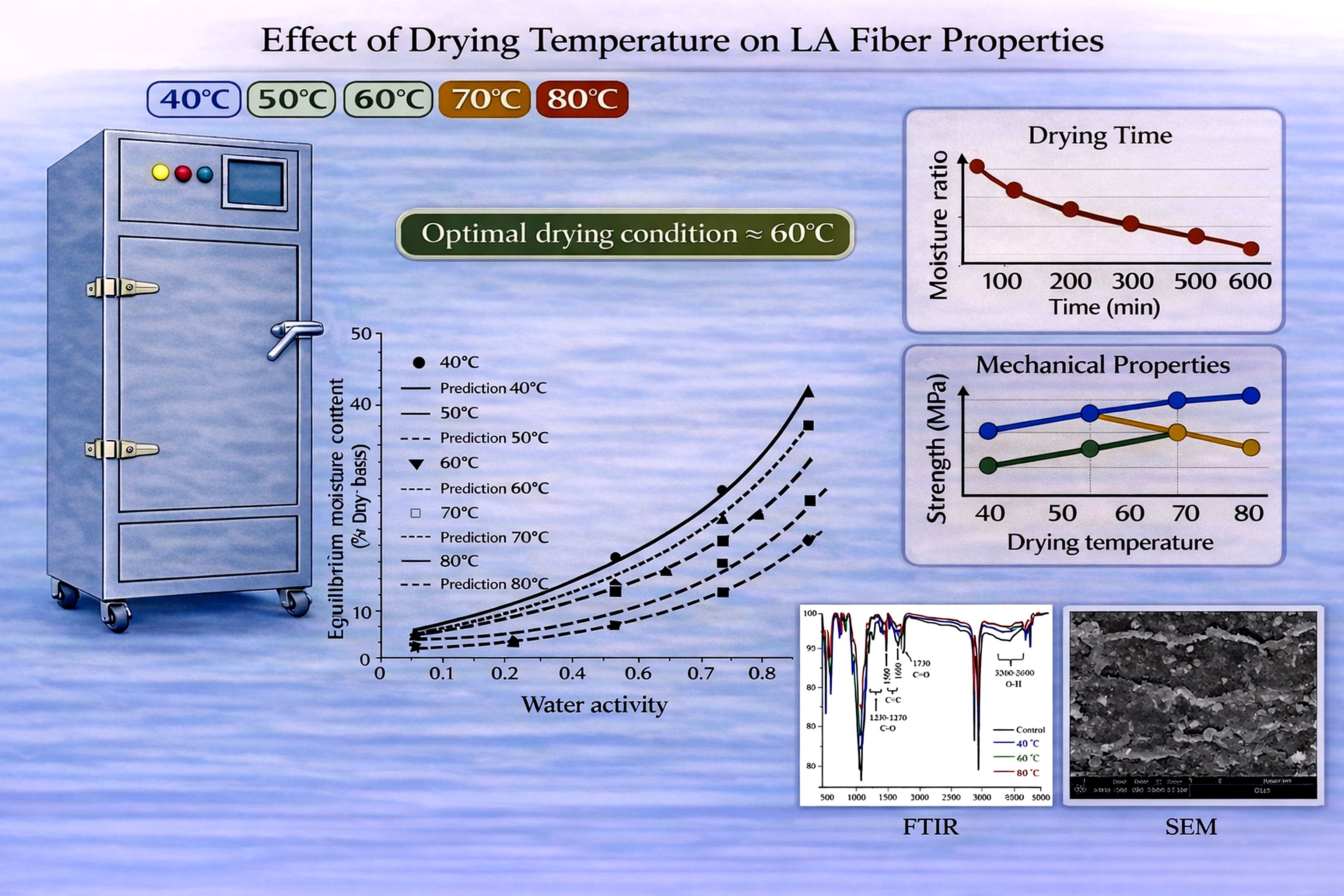
Downloads
References
P Domyos. 2013, In vitro propagation and germplasm conservation of Lepironia articilata (Retz.) Domin in Phru Kuan Kreng Wetlands, Nakhon Si Thammarat. Ph. D. Dissertation. Prince of Songkla University, Songkla, Thailand.
AZN Elangko, J Jai, SA Ali and NM Manshor. Moisture sorption isotherm of cassava starch film incorporated with kaffir lime oil. ASM Science Journal 2022; 17, 1-11.
C Taveesuvun, S Tirawanichakul and Y Tirawanichakul. Equilibrium moisture content modeling and study of circulating bed drying kinetics of non-fragrant and fragrant paddy varieties. Trends in Sciences 2022; 19(14), 4950.
S Simal, A Femenia, A Castell-Palou and C Rosselló. Moisture desorption isotherms of agricultural products: Influence of temperature and modeling. Journal of Food Engineering 2007; 79(1), 175-183.
HA Iglesias and J Chirife. Handbook of food isotherms: Water sorption parameters for food and food components. Academic Press, New York, 1982.
H Togrul and N Arslan. Moisture sorption isotherms and thermodynamic properties of sesame seeds. Journal of Food Engineering 2006; 76(3), 405-415.
NA Aviara, OO Ajibola and KC Oni. Moisture sorption isotherms of agricultural materials: A review. Nigerian Food Journal 2014; 32(1), 95-105.
JA Olguín-Rojas, A Martinez-Candelario, ID Pérez-Landa, P Aguirre-Lara, MM González-Urrutia and M González-Pérez. Convective drying of pirul (Schinus molle) leaves: Kinetic modeling of water vapor and bioactive compound retention. Processes 2025; 13(10), 3259.
ESG Khater, AH Bahnasawy, AE Elwakeel, AA Tantawy, A Salem, SA Marey, AM Okasha and KA Metwally. Comparative analysis of drying kinetics, thermodynamic properties, and mathematical modeling of pomegranate peel (Punica granatum L.) in a hybrid solar dryer and an oven dryer. Scientific Reports 2025; 15, 26288.
AS Muthia, DY Susanti, S Rahayoe and KQ Anyjani. Oven-drying kinetics and physical characterization of ganyong starch biofoam with various sizes of bagasse filler. Trends in Sciences 2025; 22(6), 9591.
Y Joo, S Chang and S Oh. Effect of drying kinetics model on energy efficiency of drying systems. Energy 2024; 291, 130390.
JLC Alves, KS Prado and JMF de Paiva. Compressive and interlaminar shear strength properties of biaxial fibreglass laminates hybridized with jute fibre produced by vacuum infusion. Journal of Natural Fibers 2021; 18(11), 1772-1787.
DA Asrate and AN Ali. Review on the recent trends of food dryer technologies and optimization methods of drying parameters. Applied Food Research 2025; 5(1), 100927.
J Zhang, H Huo, L Zhang, Y Yang, H Li, Y Ren and Z Zhang. Effect of high-temperature hydrothermal treatment on the cellulose derived from the Buxus plant. Polymers 2022; 14(10), 2053.
M Poletto, V Pistor, AJ Zattera and RMC Santana. Native cellulose: Structural characteristics and thermal properties. Materials 2014; 7(9), 6105-6119.
IN Ramos, TRS Brandão and CLM Silva. Structural changes during air drying of fruits and vegetables. Food Science and Technology International 2003; 9(3), 201-206.
X Huang, Z Zhang, Y Li, Y Yang, A Mulati, D Shataer and J Wang. The Effects of hot air and microwave drying on the structural and physicochemical properties of soluble dietary fiber from sugar beet pulp. Foods 2025 14(19), 3435.
IS Santos, BL Nascimento, RH Marino, EM Sussuchi, MP Matos and S Griza. Influence of drying heat treatments on the mechanical behavior and physico-chemical properties of mycelial biocomposite. Composites Part B: Engineering 2021; 217, 108870.
SM Henderson and S Pabis. Grain drying theory I temperature effects on drying coefficient. Journal of Agricultural Engineering Research 1961; 6, 169-174.
G Halsey. Physical adsorption on non-uniform surfaces. Journal of Chemical Physics 1948; 16, 931-937.
CR Oswin. The kinetic of package life. III isotherm. Journal of Chemical Industry 1946; 65(12), 419-421.
DS Chung and HB Pfost. Adsorption and desorption of water vapour by cereal grains and their products. Part II: Development of the general isotherm equation. Transactions of the ASAE 1967; 10, 549-557.
SM Henderson. A basic concept of equilibrium moisture. Agricultural Engineering 1952; 33, 29-32.
RB Anderson. Modifications of the B.E.T. equation. Journal of American Chemical Society 1946; 68, 686-691.
JH De Boer. The dynamical character of adsorption. Clarendon Press, Oxford, 1953.
EA Guggenheim. Applications of statistical mechanics. Clarendon Press, Oxford, 1966.
AO Raji and JO Ojediran. Moisture sorption isotherms of two varieties of millet. Food and Bioproducts Processing 2011; 89(3), 178-184.
OA Aregbesola, BS Ogunsina, AE Sofolahan and NN Chime. Mathematical modeling of thin layer drying characteristics of dika (Irvingia gabonensis) nuts and kernels. Nigerian Food Journal 2015; 33, 83-89.
GM White, IJ Ross and CG Poneleit. Fully exposed drying of popcorn. Transactions of the ASAE 1981; 24, 466-0468.
C Ertekin and MZ Firat. A comprehensive review of thin layer drying models used in agricultural products. Critical Reviews in Food Science and Nutrition 2017; 57(4), 701-717.
EK Akpinar, Y Bicer and C Yildiz. Thin layer drying of red pepper. Journal of Food Engineering 2003; 59, 99-104.
İT Toğrul and D Pehlivan. Modelling of thin layer drying kinetics of some fruits under open-air sun drying process. Journal of food Engineering 2004; 65(3), 413-425.
DS Chung and HB Pfost. Adsorption and desorption of water vapor by cereal grains and their products. Transactions of the ASAE 1967; 10, 549-557.
M Sanjeev and A Singh. Adsorption isotherms for red chili (Capsicum annum L.). European Food Research and Technology2006; 223, 849-852.
K Strømdahl. 2000, Water sorption in wood and plant fibres. Ph. D. Dissertation. Technical University of Denmark, Lyngby, Denmark.
GY Farag, EMA Abou Taleb and T Hamouda. Natural fibers extraction methods and properties: A review. Egyptian Journal of Chemistry 2025; 68(3), 445-464.
MJ Mohd Nor and A Putra. Lepironia articulata as a sustainable acoustic absorber. Research Progress in Mechanical and Manufacturing Engineering 2022; 2(2), 201-212.
MS Alamri, AA Mohamed, S Hussain, MA Ibraheem and AA Abdo Qasem. Determination of moisture sorption isotherm of crosslinked millet flour and oxirane using GAB and BET. Journal of Chemistry 2018; 2018(1), 2369762.
M Chanpet, N Rakmak, N Matan and C Siripatana. Effect of air velocity, temperature, and relative humidity on drying kinetics of rubberwood. Heliyon 2020; 6(10), e05151.
W Zhao, J Zhang, W Zhang, J Wang and G Wang. Changes in the structural composition and moisture-adsorption properties of mechanically rolled bamboo fibers. Materials 2022; 15(10), 3463.
Y Hfaiedh, H Hachem and D Mihoubi. Drying kinetics and sorption isotherms of biocomposite materials: Experimental investigation and modeling analysis. ACS Omega 2024; 9(42), 42957-42969.
T Defraeye. Advanced computational modeling of drying processes - a review. Applied Energy 2014; 131, 323-344.
Y Dadmohammadi and AK Datta. Food as porous media: A review of the dynamics of porous properties during processing. Food Reviews International 2022; 38(5), 953-985.
IP Owoh, WI Okonkwo, CN Anyanwu, O Ojike and NI Nwagugu. A review on modeling the drying kinetics of agricultural bio materials and wastes. International Journal of Research and Innovation in Applied Science 2025; 10(5), 954-966.
CM de Alcântara, IdS Moreira, MT Cavalcanti, RP Lima, HV Moura, R da Silva Neves, CAL Cassimiro, JJA Martins, FR da Costa Batista and EM Pereira. Mathematical modeling of drying kinetics and technological and chemical properties of Pereskia sp. leaf powders. Processes 2024; 12, 2077.
X Zhang, Y Liu and Q Li. Research on the prediction model and formation law of drying cracks of paddy based on multi-physical field coupling. Agriculture 2025; 15(4), 383.
Y Buelvas Arrieta, L Díaz Reyes, C Ávila-Díaz, J Altamiranda Suárez, O Rivero-Romero and J Unfried-Silgado. Effects of drying temperature, mercerizing, and coating on the properties of Colombian Coir fibers and their interfacial adhesion with polylactic acid. Scientific Reports 2025; 15, 32346.
K Prawiranto, T Defraeye, D Derome, A Bühlmann, S Hartmann, P Verboven, B Nicolai and J Carmeliet. Impact of drying methods on the changes of fruit microstructure unveiled by X-ray micro-computed tomography. RSC Advances 2019; 9(19), 10606-10624.
I Doymaz. Evaluation of some thin-layer drying models of persimmon slices (Diospyros kaki L.). Energy Conversion and Management 2012; 56, 199-205.
Z Erbay and F Icier. A review of thin layer drying of foods: theory, modeling, and experimental results. Critical Reviews in Food Science and Nutrition 2010; 50(5), 441-464.
AS Mujumdar. Handbook of industrial drying. 4th ed. CRC Press, Boca Raton, United States, 2014.
Z Wang, J Sun, F Chen, X Liao, G Zhao, J Wu and X Hu. Mathematical modeling on thin layer drying of apple pomace. Food Research International 2007; 40, 39-46.
AO Abioye, AA Adekunle, OA Jeremiah, IO Bazambo, OB Adetoro, KO Mustapha, CF Onyeka and TA Ayorinde. Modelling the influence of temperature on the drying kinetics of Turmeric slices. Croatian Journal of Food Science and Technology 2021; 13(2), 167-175.
M Nowacka, M Dadan and U Tylewicz. Drying Technologies in Food Processing. Applied Sciences 2023; 13(19), 10597.
S Nansereko, J Muyonga and YB Byaruhanga. Influence of drying methods on jackfruit drying behavior and dried products physical characteristics. International Journal of Food Science 2022; 2022(1), 8432478.
K Prasad and P Ankita. Temperature dependent dehydration kinetics and effective diffusivity of Spinach leaves. Indian Journal of Biotechnology 2017; 13(4), 142.
W Senadeera, J Banks, G Adiletta and K Brewer. Microstructural approach application for morphological change determinations of grapes during drying. Processes 2024; 12(4), 720.
K Limpaiboon. Mathematical modeling of drying kinetics of bird’s eye chilies in a convective hot-air dryer. Walailak Journal of Science and Technology 2020; 12(2), 219.
OO George, KR Erick, OA Patrick and BG Benson. Evaluation of thin layer models for simulating drying kinetics of black nightshade seeds in a solar-exhaust gas greenhouse dryer. Bioprocess Engineering 2023, 7(1), 10-31.
M Kaveh and P Abbaszadeh. Review of mathematical modelling of thin layer drying processes. International Journal of Current Engineering and Scientific Research 2015; 2(11), 96-107.
K Górnicki, A Kaleta and A Choińska. Suitable model for thin-layer drying of root vegetables and onion. International Agrophysics 2020, 34(1), 79-86.
M Krokida and Z Maroulis. Quality changes during drying of food materials. Drying Technology in Agriculture and Food Sciences 2000; 4(2), 61-68.
FRB Martinelli, MG Pariz, R de Andrade, SR Ferreira, FA Marques, SN Monteiro and ARG de Azevedo. Influence of drying temperature on coconut-fibers. Scientific Reports 2024; 14, 6421.
O Faruk, AK Bledzki, HP Fink and M Sain. Biocomposites reinforced with natural fibers: 2000 - 2010. Progress in Polymer Science 2012; 37(11), 1552-1596.
D Ray, BK Sarkar, AK Rana and NR Bose. Effect of alkali treated jute fibres on composite properties. Bulletin of Materials Science 2001; 24(2), 129-135.
KL Pickering, MGA Efendy and TM Le. A review of recent developments in natural fibre composites and their mechanical performance. Composites Part A: Applied Science and Manufacturing 2016; 83, 98-112.
M Thiruchitrambalam, A Alavudeen, A Athijayamani, N Venkateshwaran and AE Perumal. Improving mechanical properties of banana/kenaf hybrid fiber reinforced composites using sodium hydroxide treatment. Materials & Design 2012; 47, 283-290.
H Yang, R Yan, H Chen, DH Lee and C Zheng. Characteristics of hemicellulose, cellulose and lignin pyrolysis. Fuel 2007; 86(12-13), 1781-1788.
D Kocaefe, S Poncsak and Y Boluk. Effect of thermal treatment on the chemical composition and mechanical properties of birch and aspen. BioResources 2008; 3(2), 517-537.
DU Shah. Developing plant fibre composites for structural applications by optimising composite parameters: a critical review. Journal of Materials Science 2013; 48(18), 6083-6107.
HM Akil, MF Omar, AM Mazuki, SZ Safiee, ZM Ishak and AA Bakar. Kenaf fiber reinforced composites: A review. Materials & Design 2011; 32(8-9), 4107-4121.
N Reddy and Y Yang. Biofibers from agricultural byproducts for industrial applications. Trends in Biotechnology 2005; 23(1), 22-27.
HPS Abdul Khalil, IUH Bhat, M Jawaid, A Zaidon, D Hermawan and YS Hadi. Bamboo fibre reinforced biocomposites: A review. Materials & Design 2012; 42, 353-368.
Y Yu, B Fei, B Zhang and X Yu. Cell-wall mechanical properties of bamboo investigated by nanoindentation. Wood Science and Technology 2007; 39(4), 527-535.
W Dawmanee, S Ruang-on and P Nuengmatcha. Preparation and characterization of activated carbon from Lepironia articulata (Retz.) Domin waste as an adsorbent for methylene blue dye removal from wastewater. Asian Journal of Chemistry 2024; 36(2), 294-300.
A Şencan and M Kılıç. Investigation of the changes in surface area and FT-IR spectra of activated carbons obtained from hazelnut shells by physicochemical treatment methods. Journal of Chemistry 2015; 2015, 651651.
J Montoya Berrio, J Negrete Martínez, J Altamiranda Suárez, C Ávila Díaz, O Rivero-Romero and J Unfried-Silgado. Influence of drying temperature on the properties of Colombian banana pseudostem fibers for its potential use as reinforcement in composite materials. Scientific Reports 2024; 14, 25180.
A Célino, S Fréour, F Jacquemin and P Casari. The hygroscopic behavior of plant fibers: A review. Frontiers in Chemistry 2014; 1, 43.
A Bakkour, SE Ouldoukhitine, P Biwole and S Amziane. A review of multi-scale hygrothermal characteristics of plant-based building materials. Construction and Building Materials 2024; 412, 134850.
MM Kabir, H Wang, KT Lau and F Cardona. Chemical treatments on plant-based natural fibre reinforced polymer composites: An overview. Composites Part B: Engineering 2012; 43(7), 2883-2892.
M Poletto, AJ Zattera, MMC Forte and RMC Santana. Thermal decomposition of wood: Influence of wood components and cellulose crystallite size. Bioresource Technology 2014; 109, 148-153.
Published
How to Cite
Issue
Section
License
Copyright (c) 2026 Walailak University

This work is licensed under a Creative Commons Attribution-NonCommercial-NoDerivatives 4.0 International License.





