
Transparent P(VDF-HFP) Coatings for Enhancing Fungal Resistance, Hydrophobicity, and Durability of Krajood-Based Natural Fibers
DOI:
https://doi.org/10.48048/tis.2025.10441Keywords:
Hydrophobicity, Antifungal coating, P(VDF-HFP), Water-repellent coating, Natural fibersAbstract
This study investigates the use of poly(vinylidene fluoride-co-hexafluoropropylene) [P(VDF-HFP)] as a transparent, water-repellent, and antifungal coating for Krajood (Lepironia articulata) products—traditional natural fibers widely used in Thailand. Coatings with P(VDF-HFP) were formulated at concentrations ranging from 2.5 to 25% and applied via a solution casting technique. The surface, thermal, mechanical, and biological properties of the coated samples were systematically characterized and compared to uncoated and lacquer-coated controls using Fourier-transform infrared spectroscopy (FTIR), water contact angle (WCA) measurements, thermogravimetric analysis (TGA), scanning electron microscopy (SEM), and tensile testing. Results indicate that the 15% P(VDF-HFP) coating provides the most optimal performance, offering high hydrophobicity (WCA = 124.2°), enhanced tensile strength (112.26 MPa), superior thermal resistance (onset degradation at 241.9 °C), and significant fungal inactivation over a 30-day incubation period. The formation of a microporous surface structure, due to slow solvent evaporation, was found to play a key role in improving both water repellency and fungal resistance. These findings demonstrate the potential of P(VDF-HFP) coatings in extending the lifespan and functionality of natural fiber products, providing a sustainable alternative for moisture-prone applications.
HIGHLIGHTS
- A transparent P(VDF-HFP) coating was developed to improve the water repellency, fungal resistance, and durability of Krajood natural fibers.
- The optimal performance was achieved at 15% P(VDF-HFP), offering high tensile strength (112.26 MPa), strong hydrophobicity (WCA = 124.2°), and delayed thermal degradation (241.9 °C).
- Microporous surface morphology formed during drying enhanced both hydrophobic and antifungal properties through the Cassie–Baxter mechanism.
- Compared to lacquer, P(VDF-HFP) provided superior mechanical, thermal, and biological resistance without altering the fiber’s natural aesthetics.
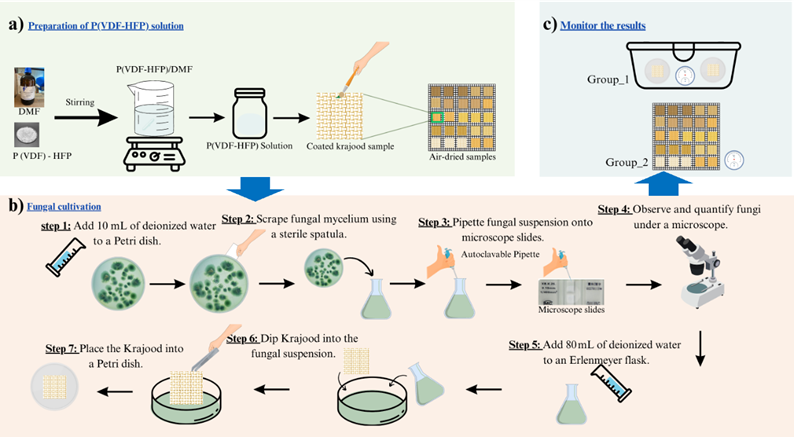
GRAPHICAL ABSTRACT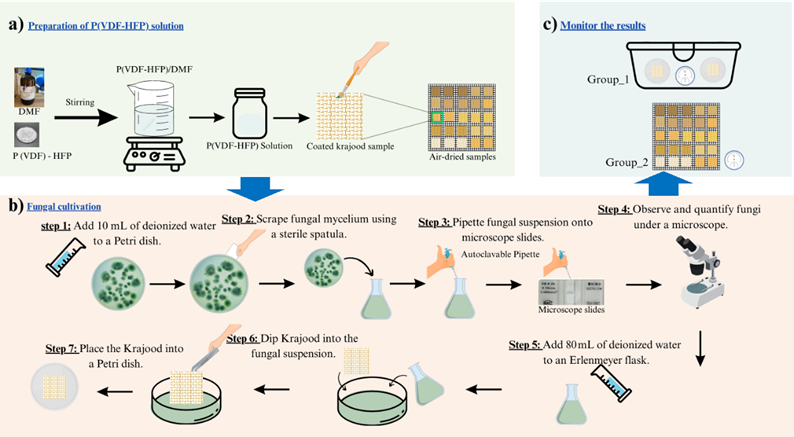
Downloads
References
K Chucheep, N Suwanpayak and N Phanchindawan. A study of the feasibility of using grey sedge residue to facilitate zero waste production. Recycling 2022; 7(3), 34.
C Homkhiew, C Srivabut, S Rawangwong and W Boonchouytan. Performance of wood-plastic composites manufactured from post-consumer plastics and wood waste under coastal weathering in Thailand. Fibers and Polymers 2022; 23, 2679-2693.
CJF Rana, AL Quintos-Cortiguerra, AB Dorado and JJP Jimenez. Influence of lacquer sanding sealer treatment on the properties of bamboo waste particleboards for sustainable handicrafts. Advances in Bamboo Science 2025; 11, 100158.
Y Okahisa, C Narita and T Yoshimura. Resistance of wood coated with oriental lacquer (urushi) against damage caused by subterranean termite. Journal of Wood Science 2019; 65(1), 41.
N Sgriccia, MC Hawley and M Misra. Characterization of natural fiber surfaces and natural fiber composites. Composites Part A: Applied Science and Manufacturing 2008; 39(10), 1632-1637.
P Jin, C Huang, J Li, Y Shen and L Wang. Surface modification of poly(vinylidene fluoride) hollow fibre membranes for biogas purification in a gas–liquid membrane contactor system. Royal Society Open Science 2017; 4(11), 171321.
X Wang, C Xiao, H Liu, Q Huang, J Hao and H Fu. Poly(vinylidene Fluoride-Hexafluoropropylene) porous membrane with controllable structure and applications in efficient oil/water separation. Materials (Basel) 2018; 11(3), 443.
Y Liu, X Zhu, Y Chen, C Zhou, Z Chen, M Hao, X Hu and B Yang. Cross-electrospun PVDF/PVDF-HFP nanofibrous membrane with central combination design and its waterproof and moisture permeable composite fabric. Textile Research Journal 2023; 93(9-10), 2273-2289.
J Yuennan, N Tohluebaji, C Putson, N Muensit and P Channuie. Enhanced electroactive β-phase and dielectric properties in P(VDF-HFP) composite flexible films through doping with three calcium chloride salts: CaCl, CaCl·2HO, and CaCl·6HO. Polymers for Advanced Technologies 2024; 35(6), e6437.
H Wang, Z Liu, E Wang, R Yuan, D Gao, X Zhang and Y Zhu. A robust superhydrophobic PVDF composite coating with wear/corrosion-resistance properties. Applied Surface Science 2015; 332, 518-524.
J Knapczyk-Korczak, PK Szewczyk and U Stachewicz. The importance of nanofiber hydrophobicity for effective fog water collection. RSC Advances 2021; 11(18), 10866-10873.
N Tohluebaji, R Siri, N Muensit, C Putson, P Channuie, P Porrawatkul and J Yuennan. Hydrophobic and optical properties of P(VDF-HFP) nanofiber filled with nickel (II) chloride hexahydrate for dye-sensitized solar cells application. Trends in Sciences 2024; 21(9), 8796.
M Spasova, N Manolova, N Markova and I Rashkov. Superhydrophobic PVDF and PVDF-HFP nanofibrous mats with antibacterial and anti-biofouling properties. Applied Surface Science 2015; 363, 363-371.
DM Zhang, HD Wang, MC Huang,TT Fan, FQ Deng, CH Xue and XJ Guo. Fabrication of radiative cooling film with superhydrophobic self-cleaning property. Surface Innovations 2022; 11(5), 285-296.
I Tournis, D Tsiourvas, Z Sideratou, LG Boutsika, A Papavasiliou, NK Boukos and AA Sapalidis. Superhydrophobic nanoparticle-coated PVDF-HFP membranes with enhanced flux, anti-fouling and anti-wetting performance for direct contact membrane distillation-based desalination. Environmental Science: Water Research & Technology 2022; 8(10), 2373-2380.
J Žigon, UG Centa, M Remškar and M Humar. Application and characterization of a novel PVDF-HFP/PVP polymer composite with MoO(3) nanowires as a protective coating for wood. Scientific Reports 2023; 13(1), 3429.
J Yuennan, C Kaew-on, A Khanklaeo, U Wanthong and C Sangpud. Development of water-repellent coating from P(VDF-HFP) polymer for krajood product substrate. Journal of Science, Agriculture and Technology 2024; 2(2), 22-32.
G Concetto. Measurement of surface tension by the dripping from a needle. Physics Education 2006; 41(5), 440.
NA Goy, Z Denis, M Lavaud, A Grolleau, N Dufour, A Deblais and U Delabre. Surface tension measurements with a smartphone. The Physics Teacher 2017; 55, 498-499.
M Nosonovsky and B Bhushan. Superhydrophobic surfaces and emerging applications: Non-adhesion, energy, green engineering. Current Opinion in Colloid & Interface Science 2009; 14(4), 270-280.
K Manabe, M Saikawa, T Iwai and Y Norikane. Durable superhydrophobic surfaces on 3D-Printed structures inspired by beehive architecture. Science and Technology of Advanced Materials 2025; 26(1), 2481824.
Y Pei and XC Zeng. Elastic properties of poly(vinyldene fluoride) (PVDF) crystals: A density functional theory study. Journal of Applied Physics 2011; 109(9), 093514.
J Xu, Y Bai, M Wan, Y Liu, L Tao and X Wang. Antifungal paper based on a polyborneolacrylate coating. Polymers 2018; 10(4), 448.
F Mokhtari, A Samadi, AO Rashed, X Li, JM Razal, L Kong, RJ Varley and S Zhao. Recent progress in electrospun polyvinylidene fluoride (PVDF)-based nanofibers for sustainable energy and environmental applications. Progress in Materials Science 2025; 148, 101376.
S Lee, JS Park and TR Lee. The wettability of fluoropolymer surfaces: Influence of surface dipoles. Langmuir 2008; 24(9), 4817-4826.
N Rungruangkitkrai, P Phromphen, N Chartvivatpornchai, A Srisa, Y Laorenza, P Wongphan and N Harnkarnsujarit. Water repellent coating in textile, paper and bioplastic polymers: A comprehensive review. Polymers 2024; 16(19), 2790.
G McHale, R Ledesma-Aguilar and C Neto. Cassie’s law reformulated: composite surfaces from superspreading to superhydrophobic. Langmuir 2023; 39(31), 11028-11035.
LK Sakti, GAN Sheha, CPSM Radhiyah, J Nugraha, DR Eddy, MD Permana, IP Maksum and Y Deawati. Cotton fabric coating by rGO and polymethylsiloxane layer with antibacterial, hydrophobic and photothermal properties. Trends in Sciences 2023; 20(11), 6813.
A Tarhini and A Tehrani-Bagha. Graphene-based polymer composite films with enhanced mechanical properties and ultra-high in-plane thermal conductivity. Composites Science and Technology 2019; 184, 107797.
R Singh, S Janakiraman, A Agrawal, S Ghosh, A Venimadhav and K Biswas. An amorphous poly(vinylidene fluoride-co-hexafluoropropylene) based gel polymer electrolyte for magnesium ion battery. Journal of Electroanalytical Chemistry 2020; 858, 113788.
A Galletti, A D’Alessio, D Licursi, C Antonetti, G Valentini, A Galia and NND Nasso. Midinfrared FT-IR as a tool for monitoring herbaceous biomass composition and its conversion to furfural. Journal of Spectroscopy 2015; 2015, 1-12.
Z He, Y Liu, HJ Kim, H Tewolde and H Zhang. Fourier transform infrared spectral features of plant biomass components during cotton organ development and their biological implications. Journal of Cotton Research 2022; 5(1), 11.
R Javier-Astete, J Jimenez-Davalos and G Zolla. Determination of hemicellulose, cellulose, holocellulose and lignin content using FTIR in Calycophyllum spruceanum (Benth.) K. Schum. and Guazuma crinita Lam. PLoS One 2021; 16(10), e0256559.
A Heginbotham, M Schilling, H Khanjian and R Rivenc. A procedure for the efficient and simultaneous analysis of Asian and European lacquers in furniture of mixed origin. In: Proccedings of the International Council of Museums - Committee for Conservation, New Delhi, India. 2008.
A Koochakzaei, AN Babaylou and BJ Bidgoli. Identification of coatings on persian lacquer papier mache penboxes by fourier transform infrared spectroscopy and luminescence imaging. Heritage 2021; 4(3), 1962-1969.
C Kaew-on, J Yuennan, N Tohluebaji, P Channuie, S Ruangdit, R Samran, T Tochomphoo and R Siri. Enhanced hydrophobicity, thermal stability, and x-ray shielding efficiency of BaSO4/P(VDF-HFP) nanocomposites for advanced lead-free radiation protection. Polymers 2025; 17(6), 723.
L Li, H Li, Y Wang, S Zheng, Y Zou and Z Ma. Poly(vinylidenefluoride-hexafluoropropylene)/cellulose/carboxylic TiO2 composite separator with high temperature resistance for lithium-ion batteries. Ionics 2020; 26(9), 4489-4497.
BJ Deka, EJ Lee, J Guo, J Kharraz and AK An. Electrospun nanofiber membranes incorporating PDMS-aerogel superhydrophobic coating with enhanced flux and improved antiwettability in membrane distillation. Environmental Science & Technology 2019; 53(9), 4948-4958.
S Rasouli, N Rezaei, H Hamedi, S Zendehboudi and X Duan. Superhydrophobic and superoleophilic membranes for oil-water separation application: A comprehensive review. Materials & Design 2021; 204, 109599.
M Goliszek, B Podkościelna, T Klepka and O Sevastyanova. Preparation, thermal, and mechanical characterization of uv-cured polymer biocomposites with lignin. Polymers 2020; 12(5), 1159.
Q Xiao, Y Cao, H Tan, Q Feng, X Gu, J Lyu, H Xiao, M Chen and Y Chen. Preparation and properties of chinese lacquer modified by methylolureas. Journal of Renewable Materials 2023; 11(2), 1003-1016.
P Shabeeba, J kavil, P Shameela, P Sreya and N Aparna. Room temperature ionic liquids encapsulated PVDF-HFP gel electrolytes for flexible supercapacitors. Next Materials 2025; 6, 100330.
Published
How to Cite
Issue
Section
License
Copyright (c) 2025 Walailak University

This work is licensed under a Creative Commons Attribution-NonCommercial-NoDerivatives 4.0 International License.





