
UV-C Dose-Response and Antifungal Efficacy Against Trichoderma on Gray Sedge Fibers
DOI:
https://doi.org/10.48048/tis.2026.13393Keywords:
UV-C irradiation, Trichoderma sp., Grey sedge, Natural fiber materials, Antifungal control, Device designAbstract
Fungal contamination in grey sedge (Lepironia articulata) fibers, particularly by Trichoderma sp., poses a significant challenge to product quality due to rapid fungal proliferation under humid tropical conditions. Effective fungal control at the early stage of production is therefore essential. This study reports an efficient and environmentally friendly antifungal approach using UV-C irradiation (254 nm) generated by a custom-built device to inactivate Trichoderma sp. on the surfaces of contaminated grey sedge fibers, compared with non-irradiated controls. The results demonstrated that antifungal efficacy was dose-dependent, influenced by sample positioning and irradiation time. UV-C doses ranging from 575.3 ± 4.6 mJ/cm² to 2,876.4 ± 22.8 mJ/cm² effectively delayed fungal growth, with suppression positively correlated with increasing dose. However, doses ≥ 1,438 ± 11 mJ/cm² resulted in a slight reduction in tensile strength. UV-C exposure also induced statistically significant and visually discernible color modifications of sedge surfaces. Notably, doses up to approximately 7,200 mJ/cm² were insufficient to cause significant surface chemical alterations of the grey sedge fibers. These findings highlight the potential of optimized UV-C treatment as a practical non-chemical strategy for controlling fungal contamination in grey sedge fibers while maintaining acceptable material integrity.
HIGHLIGHTS
- Spatial UV-C irradiance heterogeneity significantly influences fungal inactivation efficiency, highlighting the importance of optimized sample positioning for reliable dose delivery.
- UV-C irradiation effectively suppressed Trichoderma sp. growth on grey sedge fibers.
- An optimal UV-C dose range (≈1,700–2,300 mJ/cm²) balanced antifungal efficacy and material preservation.
- UV-C treatment induced visible color changes but caused minimal effects on wettability and mechanical properties.
GRAPHICAL ABSTRACT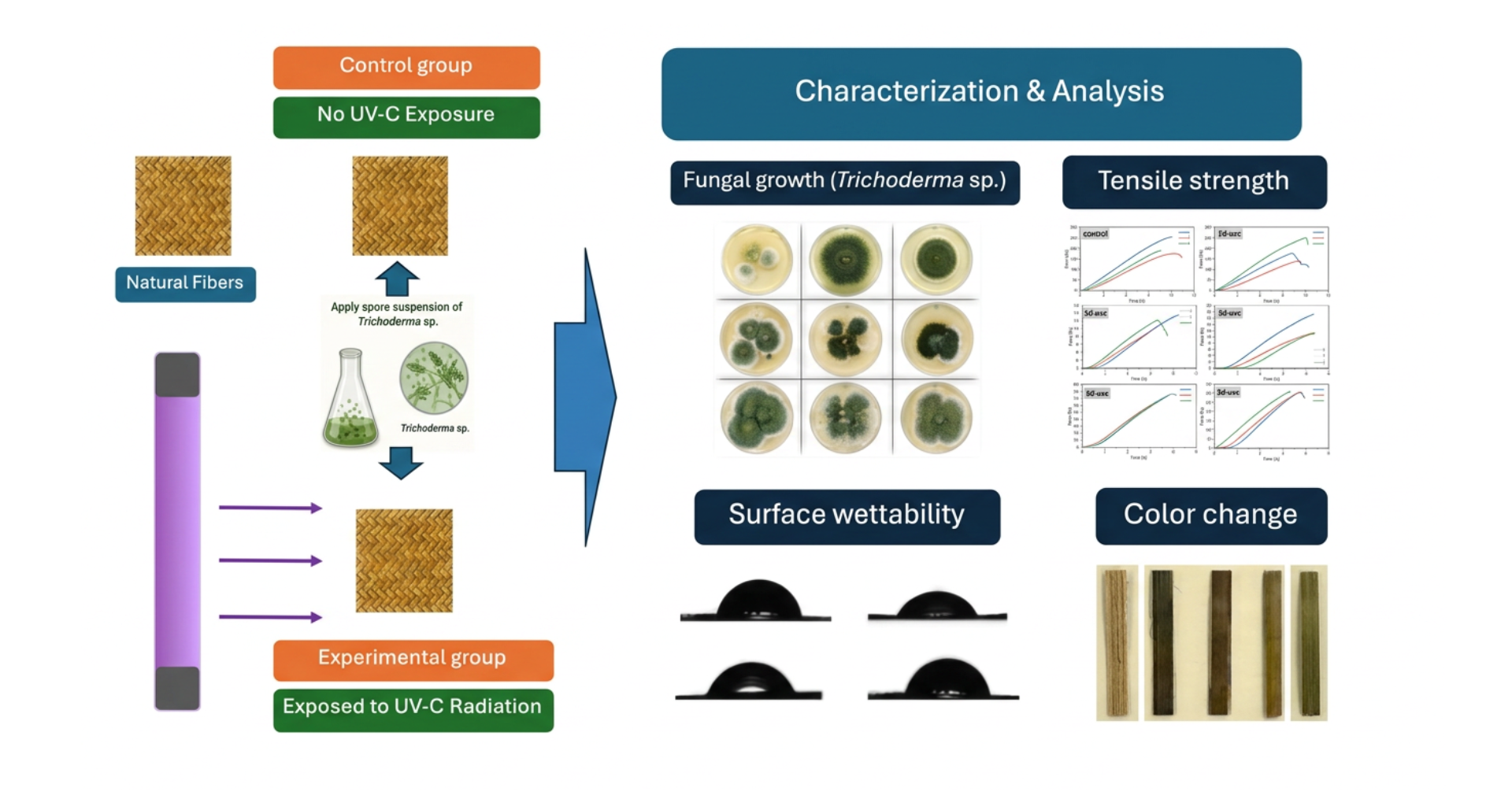
Downloads
References
P Domyos and S Te-Chato. In vitro propagation of Lepironia articulata in Kuan Kreng Peat lands, Nakhon Si Thammarat. Journal of Agricultural Technology 2013; 9(7), 1993-2004.
K Kaewpradit, Y Keeratiburana and A Janta-Po. Krajood: Creative Economics Development in communities through indigenous handicraft of southern Thailand. International Journal of Academic Research in Business and Social Sciences 2013; 3(9), 707.
M Rahayu, R Rugayah and D Sulistiarini. Overview of the handicraft products of Lepironia Articulata (Retz.) Domin (Cyperaceae) in Wawonii Island, Southeast Sulawesi, Indonesia. Indian Journal of Traditional Knowledge 2024; 23, 862-868.
S Mahmeen and C Kaewdee. Furniture and home decoration products development from Lepironia articulata: A case study of Khreng Subdistrict Community, Cha-uat District, Nakhon Si Thammarat Province. Academic Journal of Industrial Technology Innovation 2023; 1(3), 43-56.
N Matan, N Matan and S Ketsa. Enhanced inhibition of Aspergillus niger on sedge (Lepironia articulata) treated with heat-cured lime oil. Journal of Applied Microbiology 2013; 115(2), 376-381.
X Yao, H Guo, K Zhang, M Zhao, J Ruan and J Chen. Trichoderma and its role in biological control of plant fungal and nematode disease. Frontiers in Microbiology 2023; 14, 1160551.
M Zhao, H Zhao, P Wang, L Jin, Y Yue and D Zhang. Research progress on the application of Trichoderma in plant abiotic stress. Horticulturae 2025; 12(1), 29.
P Guzman-Guzman, H Etesami and G Santoyo. Trichoderma: A multifunctional agent in plant health and microbiome interactions. BMC Microbiology 2025; 25(1), 434.
AO Campos, EA Asevedo, PF Souza Filho and ES D Santos. Extraction of cellulases produced through solid-state fermentation by Trichoderma reesei CCT-2768 using green coconut fibers pretreated by steam explosion combined with alkali. Biomass 2024; 4(1), 92-106.
R Kumari, B Koul, V Kumar, A Kumar, MK Somal and RSK Sachan. Protease and chitinase activity of Trichoderma isolates and their synergy with biochar in enhancing chickpea defense related enzymes. Frontiers in Microbiology 2025; 16, 1699251.
PH Campiteli, MA Horta, RR Rosolen, JS Mendes, CC da Silva, D Sforca and AP de Souza. Targeting lignocellulolytic gene clusters in novel Trichoderma atroviride and Trichoderma harzianum strains through bacterial artificial chromosome-guided analysis. Mycologia 2025; 117(5), 884-898.
S Das and S Gupta-Bhattacharya. Trichoderma harzianum: Occurrence in the air and clinical significance. Aerobiologia 2009; 25(3), 137-145.
AM Ivasko, C Ureche, OC Marginean, M Grama and T Nicola-Varo. Pollen and fungal spore co-exposure in allergic respiratory diseases: A systematic review. Aerobiology 2025; 3(4), 11.
G Kampf. Sodium hypochlorite. In: G Kampf (Ed.). Antiseptic stewardship. Springer, Cham, Switzerland, 2024.
NV Groza, TA Yarkova, NN Gessler and AV Rozumiy. Synthesis of benzoic acid esters and their antimicrobial activity. Pharmaceutical Chemistry Journal 2024; 58(4), 625-630.
S Singh, R Balodi, PN Meena and S Singhal. Biocontrol activity of Trichoderma harzianum, Bacillus subtilis and Pseudomonas fluorescens against Meloidogyne incognita, Fusarium oxysporum and Rhizoctonia solani. Indian Phytopathology 2021; 74(3), 703-714.
AS Hashem, AH Abdelwahab, MAM Shahat, J Alharbi, JA Kelthoum, F Khalil, HS Al-Rashidi, T Alghamdi, JA Mahyoub and MM Aljameeli. Synergistic use of phosphine and botanical fumigants: A sustainable strategy for pest resistance mitigation and postharvest food protection. Journal of Crop Health 2025; 77(5), 166.
MW Ahmed, MA Haque, M Mohibbullah, MSI Khan, MA Islam, MHT Mondal and R Ahmmed. A review on active packaging for quality and safety of foods: Current trends, applications, prospects and challenges. Food Packaging and Shelf Life 2022; 33, 100913.
S Pethuan, N Tammachat, C Kaew-on, R Siri, N Tohluebaji, P Channuie and J Yuennan. Transparent P(VDF-HFP) coatings for enhancing fungal resistance, hydrophobicity, and durability of krajood-based natural fibers. Trends in Sciences 2025; 22(7), 10441-10441.
M Ion. Action of UV-C radiation for biomolecules inactivation, with application in diagnostics. Technology 2023; 52(1), 43282-43287.
M Khan, M McDonald, K Mundada and M Willcox. Efficacy of ultraviolet radiations against coronavirus, bacteria, fungi, fungal spores and biofilm. Hygiene 2022; 2(3), 120-131.
AM Gierke, P Vatter and M Hessling. Fungal photoinactivation doses for UV radiation and visible light-a data collection. AIMS Microbiology 2024; 10(3), 694.
MM Kulišová, M Rabochová, J Lorinčík, O Maťátková, T Brányik, J Hrudka, V Scholtz and IJ Kolouchová. Comparative assessment of UV-C radiation and non-thermal plasma for inactivation of foodborne fungal spores suspension in vitro. RSC Advances 2024; 14(24), 16835-16845.
M Begum, AD Hocking and DI Miskelly. Inactivation of food spoilage fungi by ultra violet (UVC) irradiation. International Journal of Food Microbiology 2009; 129(1), 74-77.
E Jhahan, S Bhattacharyya, A Chaudhuri, N Sarkar, S Akhtar and P Chaudhuri. Optimization and application of UVC irradiation for prevention of fungal biodeterioration of vegetable tanned and chrome tanned leather. Journal of Leather Science and Engineering 2022; 4(1), 28.
RL Górny, M Golofit-Szymczak, A Pawlak, A Lawniczek-Walczyk, M Cyprowski, A Stobnicka-Kupiec, M Plocinska and J Kowalska. Effectiveness of UV-C radiation in inactivation of microorganisms on materials with different surface structures. Annals of Agricultural and Environmental Medicine 2024; 31(2), 287-293.
K Fitzhenry, E Clifford, N Rowan and AV del Rio. Bacterial inactivation, photoreactivation and dark repair post flow-through pulsed UV disinfection. Journal of Water Process Engineering 2021; 41, 102070.
Y Wu, Y Wang, J Liu, X Xu, Y Song, X Zhang, L Jiang and P Chen. Effects of distance, temperature, and relative humidity on the irradiance of ultraviolet-C germicidal lamp: A quantitative study. Indoor Air 2024; 2024, 1951792.
MK Nag and P Kumar. Fabrication and characterization of laminated natural fibers and SS303 wire mesh reinforced epoxy-based hybrid composite. Proceedings of the Institution of Mechanical Engineers, Part L: Journal of Materials: Design and Applications 2024; 238(1), 73-99.
K Arkusz, K Pasik, A Jędrzejewska, T Klekiel, W Woźniak, M Nycz and R Stryjski. Shedding light on the problem: Influence of the radiator power, source-sample distance, and exposure time on the performance of UV-C lamps in laboratory and real-world conditions. PLoS One 2024; 19(4), e0302258.
A Bączyk, T Klekiel, K Arkusz, W Woźniak and R Stryjski. Evaluation of bactericidal and virucidal effectiveness of UV-C lamps. In: M Gzik, Z Paszenda, E Piętka, E Tkacz, K Milewski and J Jurkojć (Eds.). Lecture notes in networks and systems. Springer, Cham, Switzerland, 2023.
P Fredes, U Raff, E Gramsch and M Tarkowski. Estimation of the ultraviolet-C doses from mercury lamps and light-emitting diodes required to disinfect surfaces. Journal of Research of the National Institute of Standards and Technology 2021; 126, 126025.
PV de Weijer and RMM Cremers. Pulsed optical pumping in low-pressure mercury discharges. In: JM Proud and LH Luessen (Eds.). Radiative processes in discharge plasmas. Springer, Boston, 1986, p. 65-93.
J Chen, W Liu, Z Song, H Wang and Y Xie. Photocatalytic Degradation of β-O-4 Lignin Model Compound by In2S3 Nanoparticles Under Visible Light Irradiation. BioEnergy Research 2018; 11(1), 1-8.
C Yao, F Yongming, G Jianmin and L Houkun. Coloring characteristics of in situ lignin during heat treatment. Wood Science and Technology 2012; 46(1), 33-40.
S Lv, S Liang, J Zuo, S Zhang, J Wang and D Wei. Lignin-based anti-UV functional materials: Recent advances in preparation and application. Iranian Polymer Journal 2023; 32(11), 1477-1497.
Z Yu, F Liu, Y Zhuo, L Chen, M Chen, Y Xia and F Zhong. Light-colored, easily dispersible, and emulsifying-active lignin-nanocellulose UV-resistant materials: Derived from the original composition of natural bagasse. Food Hydrocolloids 2025; 174, 112340.
D Wang, Y Gu, S Feng, W Yang, H Dai, H Xiao and J Han. Lignin-containing biodegradable UV-blocking films: A review. Green Chemistry 2023; 25(22), 9020-9044.
Z Zhao, H Fu, L Ling, T Li, A Brewer, AG Delgado and P Westerhoff. Control of fungal spores on surfaces with UV-C exposure necessitates complete inactivation to prevent mycorrhizal network establishment. Environmental Science & Technology 2025; 59(17), 8800-8811.
L Yeoh, L Cogar, M Barak, LY Tan, G Spargo and J Burdach. UV-C disinfection of ultrasound probes: Challenges of uneven irradiance on complex surfaces. PLoS One 2024; 19(10), e0312931.
A Hahlbohm, C Struck, F de Mol and B Strehlow. UV-C treatment has a higher efficacy on reducing germination of spores rather than mycelium growth. European Journal of Plant Pathology 2025; 172(4), 761-777.
Z Mirzaeipour, E Bazgir, D Zafari and M Darvishnia. Effect of temperature and culture medium on the growth and sporulation of eight Trichoderma species. Plant Pathology Science 2023; 12(2), 105-116.
HA Ahmed, LM Kasem, HS Attaby, NM Khalil, DA El-Amir, MR Diab, MM El-Baghdady, KH Radwan and AE Ibrahim. Molecular and genetic adaptations of heat-treated Trichoderma harzianum for enhanced stress resilience and biocontrol efficiency. Annals of Microbiology 2025; 75(1), 12.
ALA Cavalcante, AMP Negreiros, NJDA Melo, FJQ Santos, CSAAS Silva, PSL Pinto, S Khan, IMM Sales and RS Júnior. Adaptability and sensitivity of Trichoderma spp. isolates to environmental factors and fungicides. Microorganisms 2025; 13(7), 1689.
Q Feng, L Wang, Z Wan, X Bu, Q Deng, D Li, C Chen and Z Xu. Efficient ultraviolet blocking film on the lignin-rich lignocellulosic nanofibril from bamboo. International Journal of Biological Macromolecules 2023; 250, 126059.
M Fazeli, S Mukherjee, H Baniasadi, R Abidnejad, M Mujtaba, J Lipponen, J Seppala and OJ Rojas. Lignin beyond the status quo: Recent and emerging composite applications. Green Chemistry 2024; 26(2), 593-630.
J Hynynen, A Riddell, A Achour, Z Takacs, M Wallin, J Parkås and D Bernin. ‘Lignin and extractives first’ conversion of lignocellulosic residual streams using UV light from LEDs. Green Chemistry 2021; 23(20), 8251-8259.
E Pola-Sánchez, JM Villalobos-Escobedo, N Carreras-Villaseñor, P Martínez-Hernández, EB Beltrán-Hernández, EU Esquivel-Naranjo and A Herrera-Estrella. A global analysis of photoreceptor-mediated transcriptional changes reveals the intricate relationship between central metabolism and DNA repair in the filamentous fungus Trichoderma atroviride. Frontiers in Microbiology 2021; 12, 724676.
PV Kose, MV Totawar, SW More, AV Zope and ST Ingle. Cultural and morphological characteristics of Trichoderma spp. and soil borne plant pathogens. International Journal of Advanced Biochemistry Research 2024; 8(3), 244-249.
Downloads
Published
How to Cite
Issue
Section
License
Copyright (c) 2026 Walailak University

This work is licensed under a Creative Commons Attribution-NonCommercial-NoDerivatives 4.0 International License.





