
Sustainable EMI Shielding Composites from Recycled PE/PP and Coconut Shell–Derived Activated Carbon
DOI:
https://doi.org/10.48048/tis.2026.12852Keywords:
Polyethylene, Polypropylene, Recycled PE/PP, EMI shielding, Polyethylene, Polypropylene, Recycled PE/PP, Activated carbon, EMI shielding, Mechanical properties, Thermal behaviorAbstract
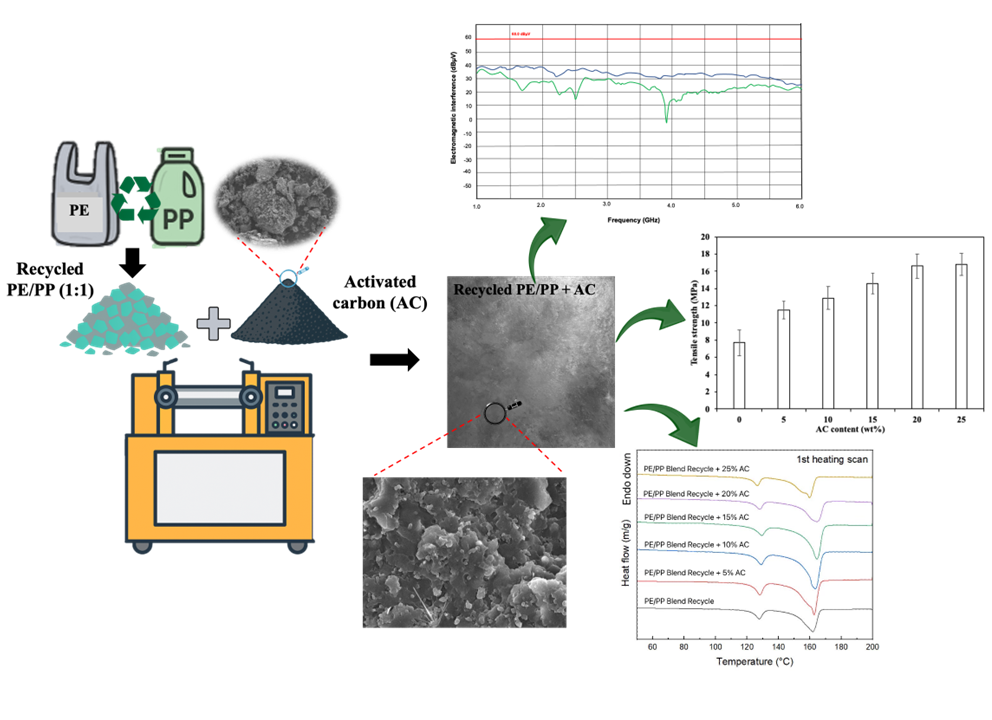
This work explores the use of coconut-shell-derived activated carbon (AC) to improve the properties of recycled polyethylene/polypropylene (PE/PP) composites. AC was added at 0 - 25 wt% using melt blending followed by compression moulding. As the AC content increased, the composite density rose from 0.8987 to 0.9627 g/cm³, while the melt flow index dropped from 58.29 to 17.47 g/10 min, reflecting reduced chain mobility and stronger interactions between the filler and polymer matrix. Mechanical properties also improved, with the tensile modulus and tensile strength reaching 1643 and 16.8 MPa, together with a noticeable increase in ductility. DSC analysis showed two melting transitions at around 128 and 163 °C, and both the crystallization temperature (122.24 °C) and crystallization enthalpy (574 J/g at 5 wt% AC) increased, confirming that AC acts as an effective nucleating agent. The EMI-shielding performance of the composites improved steadily with AC loading. The best attenuation was obtained at 25 wt% AC, where the transmitted signal reached –18.64 dBµV at 3.82 GHz. This enhancement is attributed to the development of semi-continuous conductive pathways and stronger dielectric loss mechanisms. Overall, the results show that incorporating bio-based AC into recycled PE/PP is a practical and sustainable way to produce lightweight, low-cost composites with improved mechanical performance and effective EMI-shielding capability for use in electronic and packaging applications.
HIGHLIGHTS
- Recycled PE/PP composites reinforced with bio-derived activated carbon were successfully fabricated.
- AC addition improved tensile strength, modulus, toughness, and crystallinity.
- EMI-shielding performance increased with AC loading, reaching –18.64 dBµV at 3.82 GHz.
- AC served as an efficient nucleating agent, raising crystallization temperature and enthalpy.
- The composites offer a sustainable, low-cost, lightweight solution for EMI-shielding applications.
GRAPHICAL ABSTRACT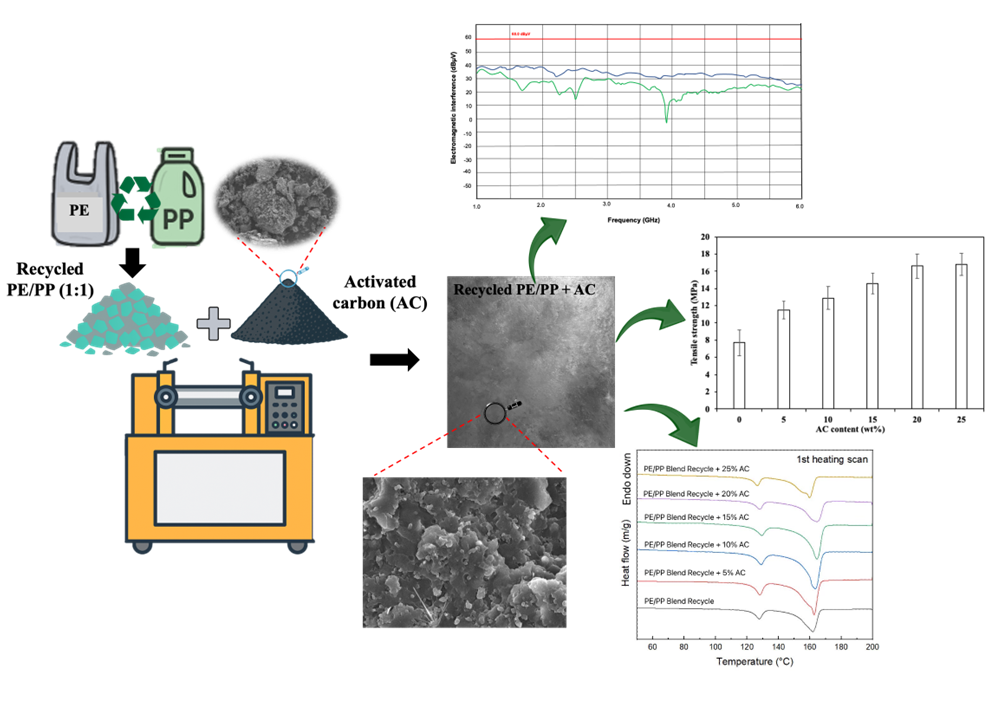
Downloads
References
AA Isari, A Ghaffarkhah, SA Hashemi, S Wuttke and M Arjmand. Structural design for EMI shielding: From underlying mechanisms to common pitfalls. Advanced Materials 2024; 36(24), 2310683.
JP Filipovic, M Milenkovic, D Kepic, S Dorontic, M Yasir, B Nardin and S Jovanovic. Electromagnetic interference in the Modern Era: Concerns, trends, and nanomaterial-based solutions. Nanomaterials 2025; 15(20), 1558.
MA Morales, TC Henry and LG Salamanca-Riba. Model of electromagnetic interference shielding effectiveness for a multifunctional composite containing carbon-fiber-reinforced polymer and copper mesh layers. Carbon 2023; 212, 118179.
D Wanasinghe and F Aslani. A review on recent advancement of electromagnetic interference shielding novel metallic materials and processes. Composites Part B: Engineering 2019; 176, 107207.
D Jiang, V Murugadoss, Y Wang, J Lin, T Ding, Z Wang, Q Shao, C Wang, H Liu, N Lu, R Wei, A Subramania and Z Guo. Electromagnetic interference shielding polymers and nanocomposites - a review. Polymer Reviews 2019; 59(2), 280-337.
F Safdar, M Ashraf, A Javid and K Iqbal. Polymeric textile-based electromagnetic interference shielding materials, their synthesis, mechanism and applications – a review. Journal of Industrial Textiles 2022; 51(5), 7293-7358.
H Zhang and S Lin. Research progress with membrane shielding materials for electromagnetic/radiation contamination. Membranes 2023; 13(3), 315.
V MG, M Vatnalmath and V Auradi. A review on conductive polymer composites focusing on advancements in electrical conductivity, and electromagnetic shielding capabilities. Polymer Composites 2025; 46(18), 16507-16537.
F Xie, Q Liu, X Dai, H Wei and Z Lu. Highly durable hollow sandwich MXene/h-AgNWs/ANF composite films for exceptional electromagnetic interference shielding performance. Composites Science and Technology 2024; 256, 110766.
GM Mamatha, P Dixit, RH Krishna and SG Kumar. Polymer based composites for electromagnetic interference (EMI) shielding: The role of magnetic fillers in effective attenuation of microwaves, a review. Hybrid Advances 2024; 6, 100200.
Y Wang, W Zhao, L Tan, Y Li, L Qin and S Li. Review of polymer-based composites for electromagnetic shielding application. Molecules 2023; 28(15), 5628.
Y Zhang, M Qiu, Y Yu, B Wen and L Cheng. A novel polyaniline-coated bagasse fiber composite with core–shell heterostructure provides effective electromagnetic shielding performance. ACS Applied Materials & Interfaces 2017; 9(1), 809-818.
H Zhao, L Hou, S Bi and Y Lu. Enhanced X-band electromagnetic-interference shielding performance of layer-structured fabric-supported Polyaniline/Cobalt–Nickel coatings. ACS Applied Materials & Interface 2017; 9(38), 33059-33070.
W Chailad, P Nanthananon, W Jakarbutr, N Phansroy and S Mathurosemontri. Impact of graphene nanoplatelet size and hybridisation on the properties of natural rubber nanocomposites. Journal of Polymer Research 2024; 31, 223.
V Yadav, D Pal and AK Poonia. Nanofillers as a potential key for shaping the future of the industries. Hybrid Advances 2024; 7, 100340.
D Li, C Dong, AP Zhang, HL Lin, BY Peng, KY Ni, KC Yang, J Bian and DQ Chen. Polymer-based composites for electromagnetic interference shielding: Principles, fabrication, and applications. Composites Part A: Applied Science and Manufacturing 2025; 194, 108927.
Y Zhang and J Gu. A perspective for developing polymer-based electromagnetic interference shielding composites. Nano-Micro Letters 2022; 14, 89.
R Seidel, K Katzer, J Bieck, M Langer, J Hesselbach and M Heilig. Influence of carbon-based fillers on the electromagnetic shielding properties of a silicone-potting compound. Materials 2024; 17(2), 280.
B Ucpinar and A Aytac. Promising electromagnetic interference shielding materials: Hybrid fillers reinforced bio‐based composites. Journal of Applied Polymer Science 2025; 142(12), 56618.
Shivani, J Vishwakarma, DK Rajak, R Kumar, C Dhand, A Mishra and N Dwivedi. Sustainable approaches based on waste materials for developing electromagnetic radiation shielding systems. Next Materials 2025; 9, 101285.
EC Gokce, MD Calisir, S Selcuk, M Gungor and ME Acma. Electromagnetic interference shielding using biomass-derived carbon materials. Materials Chemistry and Physics 2024; 317, 129165.
M Mehmandoust, G Li and N Erk. Biomass-derived carbon materials as an emerging platform for advanced electrochemical sensors: Recent advances and future perspectives. Industrial & Engineering Chemistry Research 2022; 62(11), 4628-4635.
YJ Yim and BJ Kim. Preparation and characterization of activated carbon/polymer composites: A review. Polymers 2023; 15(16), 3472.
W Chailad, W Ariyawiriyanan, S Pavasupree, N Sosa, Y Wongnongwa, J Yuennan, E Martwong, SIN Ayutthaya, L Yang and N Sukhawipat. Elastomeric dielectric materials from natural rubber/copper-modified coconut-shell-derived activated carbon composite: Combined experimental and density functional theory study. Industrial Crops and Products 2025; 234, 121511.
JY Yusuf, H Soleimani, N Yahya, YK Sanusi, G Kozlowski, A Öchsner, LL Adebayo, FA Wahaab, S Sikiru and BB Balogun. Electromagnetic wave absorption of coconut fiber-derived porous activated carbon. Boletín de la Sociedad Española de Cerámica y Vidrio 2022; 61(5), 417-427.
SUD Khan, M Arora, MA Wahab and P Saini. Permittivity and electromagnetic interference shielding investigations of activated charcoal loaded acrylic coating compositions. Journal of Polymers 2014; 2014, 193058.
L Umdagas, R Orozco, I Kings, W Thom and B Al-Duri. Advances in chemical recycling of polyolefins by hydrothermal liquefaction in supercritical water: A comprehensive review. The Journal of Supercritical Fluids 2026; 227, 106761.
L Carvalho, G Mattos, N Sitton, J Barros, D Miranda, R Luciano and JC Pinto. A survey on the chemical recycling of polyolefins into monomers. Processes 2025; 13(7), 2114.
C Aumnate, N Rudolph and M Sarmadi. Recycling of polypropylene/polyethylene blends: Effect of chain structure on the crystallization behaviors. Polymers 2019; 11(9), 1456.
B Gayretli, R Shanthar, TT Öpöz and C Abeykoon. Mechanical properties of LDPE and PS polymer matrix composites reinforced with GNP and CF — A critical review. International Journal of Lightweight Materials and Manufacture 2024; 7(4), 572-596.
S Saikrishnan, D Jubinville, C Tzoganakis and TH Mekonnen. Thermo-mechanical degradation of polypropylene (PP) and low-density polyethylene (LDPE) blends exposed to simulated recycling. Polymer Degradation and Stability 2020; 182, 109390.
C Rosales, N Aranburu, I Otaegi, V Pettarin, C Bernal, AJ Müller and G Guerrica-Echevarría. Improving the mechanical performance of LDPE/PP blends through microfibrillation. ACS Applied Polymer Materials 2022; 4(5), 3369-3379.
J Kruželák, A Kvasničáková, K Hložeková and I Hudec. Progress in polymers and polymer composites used as efficient materials for EMI shielding. Nanoscale Advances 2021; 3(1), 123-172.
MMA Nassar, KI Alzebdeh, MMM Alsafy and M Jawaid. Optimization and predictive modelling of chemically crosslinked recycled PE/PP blends for enhanced mechanical properties. Results in Engineering 2025; 28, 108360.
W Chailad, K Tongsom, K Chaochanchaikul and C Sakulkhaemaruethai. Enhancing air retention in natural rubber: A path to improved performance. Polymer Bulletin 2025; 82, 3841-3866.
C Sakulkhaemaruethai, S Sakulkhaemaruethai, A Pholsuwan and W Chailad. Flame-retardant natural rubber composites: the synergistic role of zeolite and aluminium trihydrate. Polymer Bulletin 2025; 82, 7427-7446.
W Chailad, J Yuennan, N Tohluebaji, P Nuchnong, Y Tran, E Martwong, L Yang and N Sukhawipat. Silane-modified waste amethyst as a functional filler in PVDF-HFP composites for flexible dielectric and energy applications. Journal of Materials Science 2025; 60, 25297-25321.
NAA Rahim, ZM Ariff, A Ariffin and SS Jikan. Study on effect of filler loading on the flow and swelling behaviors of polypropylene‐kaolin composites using single‐screw extruder. Journal of Applied Polymer Science 2010; 119(1), 73-83.
EP Wulandari, P Marlina, Nasruddin, Lanjar, H Yohanes, WE Widodo, SJ Munarso, Astuti, EB Susetyo, Y Bakhtiar, H Guo and WB Setianto. Application of sawdust-derived activated carbon as a bio-based filler in vulcanized rubber bushings. Polymers 2025; 17(22), 2996.
A Kasgoz, D Akın, Aİ Ayten and A Durmus. Effect of different types of carbon fillers on mechanical and rheological properties of cyclic olefin copolymer (COC) composites. Composites Part B: Engineering 2014; 66, 126-135.
VM Nazarychev, GV Vaganov, SV Larin, AL Didenko, VY Elokhovskiy, VM Svetlichnyi, VE Yudin and SV Lyulin. Rheological and mechanical properties of thermoplastic crystallizable polyimide-based nanocomposites filled with carbon nanotubes: Computer simulations and experiments. Polymers 2022; 14(15), 3154.
DC Kong, MH Yang, XS Zhang, ZC Du, Q Fu, XQ Gao and JW Gong. Control of polymer properties by entanglement: A review. Macromolecular Materials and Engineering 2021; 306(12), 2100536.
J Yuennan, N Muensit, N Tohluebaji, W Chailad, L Yang, N Sukhawipat, GA Ashraf and P Channuie. Tailoring dielectric properties and crystallinity in poly(vinylidene fluoride-co-hexafluoropropylene) nanocomposites via iron (III) chloride hexahydrate incorporation. Scientific Reports 2025; 15, 17810.
H Jones, J McClements, D Ray, M Kalloudis and V Koutsos. High-density polyethylene–polypropylene blends: Examining the relationship between nano/microscale phase separation and thermomechanical properties. Polymers 2025; 17(2), 166.
W Jakarbutr, K Sungsanit, S Mathurosemontri, N Phansroy, C Sakulkhaemaruethai, W Ariyawiriyanan, N Sukhawipat and W Chailad. Structure–property relationships in biowaste-filled natural rubber: Effects of particle size and ageing on mechanical and thermal performance. Polymer Bulletin 2025; 82, 10197-10234.
DE Huang, AP Kotula, CR Snyder and KB Migler. Crystallization kinetics in an immiscible polyolefin blend. Macromolecules 2022; 55(24), 10921-10932.
V Dananjaya, M Yang, Y Zheng and C Abeykoon. Effect of filler characteristics and processing route on bamboo powder-reinforced PLA composites. Journal of Cleaner Production 2025; 537, 147193.
IS Sani, NR Demarquette and E David. Enhancing the dielectric properties of recycled polyolefin streams through blending. Sustainability 2025; 17(9), 4123.
SS Hota, D Panda, R Panda, S Mishra, S Choudhury, L Biswal, RNP Choudhary and A Satapathy. Dielectric characteristics and energy storage capabilities of PVDF-based composite incorporating 2D GnP nanofiller. Results in Engineering 2025; 26, 105593.
C Wang, V Murugadoss, J Kong, Z He, X Mai, Q Shao, Y Chen, L Guo, C Liu, S Angaiah and Z Guo. Overview of carbon nanostructures and nanocomposites for electromagnetic wave shielding. Carbon 2018; 140, 696-733.
BU Durmaz, AO Salman and A Aytac. Electromagnetic interference shielding performances of carbon-fiber-reinforced PA11/PLA composites in the x-band frequency range. ACS Omega 2023; 8(25), 22762-22773.
M Li, Q Xu, W Jiang, A Farooq, Y Qi and L Liu. Preparation and investigation of Fe3O4@rGO/CNF foams for electromagnetic interference shielding. Fibers and Polymers 2023; 24, 771-778.
K Zhang, Z Huang, M Yang, M Liu, Y Zhou, J Zhan and Y Zhou. Recent progress in melt pyrolysis: Fabrication and applications of high‐value carbon materials from abundant sources. SusMat 2023; 3(5), 558-580.
H Zhu, W Luo, PN Ciesielski, Z Fang, JY Zhu, G Henriksson, ME Himmel and L Hu. Wood-derived materials for green electronics, biological devices, and energy applications. Chemical Reviews 2016; 116(16), 9305-9374.
Published
How to Cite
Issue
Section
License
Copyright (c) 2025 Walailak University

This work is licensed under a Creative Commons Attribution-NonCommercial-NoDerivatives 4.0 International License.





