
Enhanced Surface Hydrophilicity of Polysulfone Membrane via Atmospheric Pressure Plasma Jet: A Comparative Evaluation with Low-pressure Plasma
DOI:
https://doi.org/10.48048/tis.2025.10629Keywords:
Atmospheric-Pressure Plasma Jet (APPJ), DC Low-Pressure Plasma (LPP), Hydrophilicity enhancement, Plasma discharge treatment, Polysulfone membrane surface modificationAbstract
Polysulfone, a hydrophobic polymer, requires modifications to its hydrophilicity for applications in water or gas filtration. This study investigates the effectiveness of atmospheric-pressure plasma jet (APPJ) and low-pressure plasma (LPP) techniques in altering the hydrophilicity of polysulfone surfaces. Initially, the membranes were prepared using the dry-wet phase inversion technique. Subsequently, their surfaces were modified using APPJ and LPP treatment. The prepared membranes were exposed to argon plasma gases from APPJ and LPP, both operating power of 60 W and with an exposure time of 4 min. From a physical perspective, APPJ’s ambient operation promoted higher hydroxyl radical (OH) densities (∼1015 cm–3) due to collisions between argon metastables and atmospheric water vapor. In contrast, LPP’s vacuum environment favored ion bombardment mechanisms. Plasma properties were diagnosed using an Optical Emission Spectrometer (OES). Spectroscopic analysis confirmed that the APPJ exhibited a 40% stronger OH emission intensity (309 nm peak) compared to LPP, indicating enhanced surface functionalization. The modified membranes were also evaluated for water contact angle (WCA), surface energy, surface roughness and chemical composition. Surface characterization revealed that the APPJ-treated membranes exhibited superior hydrophilicity, with a lower water contact angle (32.4° ± 1.7°) and higher surface energy (61.3 ± 1.2 mJ/m²) compared to the LPP-treated membranes (36.9° ± 1.0°, 58.6 ± 0.4 mJ/m²). The results from WCA and surface energy indicate that the hydrophilicity of the PSF membrane treated with APPJ was significantly enhanced compared to that of the LPP-treated membrane. Meanwhile, X-ray photoelectron spectroscopy (XPS) and atomic force microscopy (AFM) demonstrated increased oxygen-containing groups and surface roughness post-treatment. Therefore, the APPJ technique emerges as a promising method for enhancing the hydrophilicity of polysulfone membranes due to its operational simplicity, cost-effectiveness, and superior performance.
HIGHLIGHTS
- Polysulfone membranes can be hydrophilized using atmospheric pressure plasma discharge.
- Comparing to the membrane characteristics of the modified membrane using an atmospheric-pressure plasma jet (APPJ) and a low-pressure plasma (LPP) technique.
- Atmospheric-pressure plasma jet (APPJ) offers promising results in enhancing the hydrophilicity properties of polysulfone membranes.
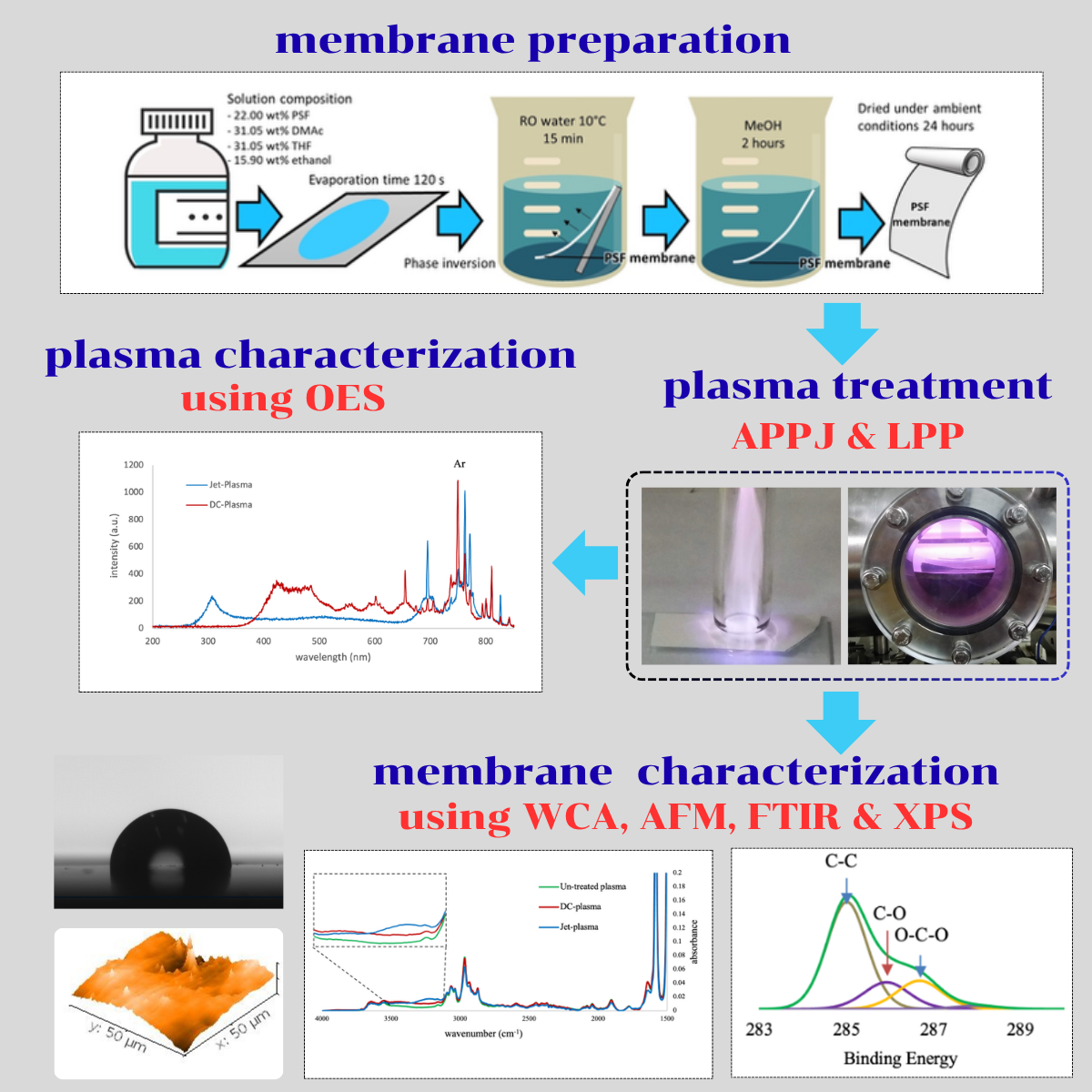
GRAPHICAL ABSTRACT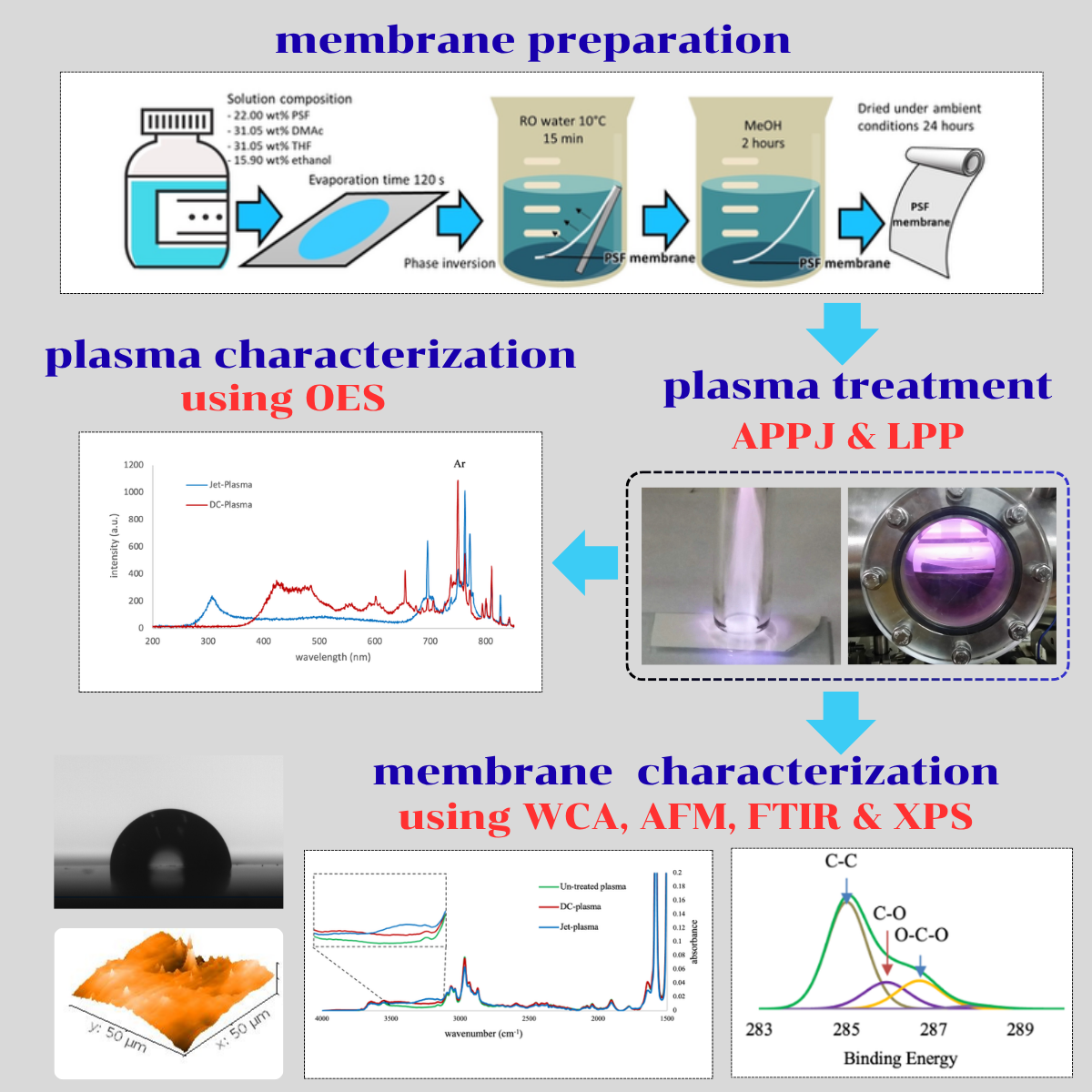
Downloads
References
HA Mannan, H Mukhtar, T Murugesan, R Nasir, DF Mohshim and A Mushtaq. Recent applications of polymer blends in gas separation membranes. Chemical Engineering and Technology 2013; 36(11), 1838-1846.
AS Shabaev, AA Zhansitov, ZI Kurdanova, SY Khashirova and AK Mikitaev. New method of investigation of polysulfone thermal destruction. Polymer Science, Series B 2017; 59(2), 216-224.
HA Mannan, H Mukhtar, MS Shaharun, MR Othman and T Murugesan. Polysulfone/poly(ether sulfone) blended membranes for CO2 separation. Journal of Applied Polymer Science 2015; 133(5), 42946.
M Farrokhara and F Dorosti. New high permeable polysulfone/ionic liquid membrane for gas separation. Chinese Journal of Chemical Engineering 2020; 28(9), 2301-2311.
S Saqib, S Rafiq, N Muhammad, AL Khan, A Mukhtar, S Ullah, MH Nawaz, F Jamil, C Zhang and V Ashokkumar. Sustainable mixed matrix membranes containing porphyrin and polysulfone polymer for acid gas separations. Journal of Hazardous Materials 2021; 411, 125155.
MFA Al-Ogaili, MHD Othman, M Rava, ZS Tai, MH Puteh, J Jaafar, MA Rahman, TA Kurniawan, O Samuel and A Imtiaz. Enhancing hydrophobic/hydrophilic dual-layer membranes for membrane distillation: The influence of polytetrafluoroethylene (PTFE) particle size and concentration. Sustainability 2023; 15(20), 14931.
B Díez and R Rosal. A critical review of membrane modification techniques for fouling and biofouling control in pressure-driven membrane processes. Nanotechnology for Environmental Engineering 2020. https://doi.org/ 10.1007/s41204-020-00077-x.
A Ali, M Awang, R Mat, A Johari, MJ Kamaruddin and WRW Sulaiman. Influence of hydrophilic polymer on pure water permeation, permeability coefficient, and porosity of polysulfone blend membranes. Advanced Materials Research 2014; 931-932, 168-172.
X Deng, F Yang, J Ma, Y Li, J Dang and M Ouyang. Ternary phase field model and characterization of water/NMP/polysulfone membrane prepared by non-solvent induced phase separation. Separation and Purification Technology 2024; 330(A), 125307.
A Shokri. Synthesize and characterization of polysulfone membrane for the separation of hydrogen sulfide from natural gas. Surfaces and Interfaces 2021; 25, 101233.
RO Tasci, MA Kaya and M Celebi. Hydrophilicity and flux properties improvement of high performance polysulfone membranes via sulfonation and blending with poly(lactic acid). High Performance Polymers 2022; 34(10), 1115-1130.
S Ruangdit, S Sirijaruku, T Chittrakarn and C Kaew-On. Enhancing hydrophilicity of polysulfone membrane surface by UV irradiation of different wavelengths and by Peg Grafting. Jurnal Teknologi 2021; 83(4), 111-117.
M Ganj, M Asadollahi, SB Mousavi, D Bastani and F Aghaeifard. Surface modification of polysulfone ultrafiltration membranes by free radical graft polymerization of acrylic acid using response surface methodology. Journal of Polymer Research 2019; 26, 231.
R Teotia, SK Verma, D Kalita, A Singh, G Dahe and J Bellare. Porosity and compatibility of novel polysulfone-/vitamin E-TPGS-grafted composite membrane. Journal of Materials Science 2017; 52, 12513-12523.
KS Kim, KH Lee, K Cho and CE Park. Surface modification of polysulfone ultrafiltration membrane by oxygen plasma treatment. Journal of Membrane Science 2002; 199(1-2), 135-145.
Z Zheng, W Wang, X Huang, W Fan and L Li. Surface modification of polysulfone hollow fiber membrane for extracorporeal membrane oxygenator using low‐temperature plasma treatment. Plasma Processes and Polymers 2017; 15(1), 1700122.
M Gryta. Surface modification of polypropylene membrane by helium plasma treatment for membrane distillation. Journal of Membrane Science 2021; 628, 119265.
A Fridman. Plasma chemistry. Cambridge University Press, Cambridge, 2008.
I Levchenko, S Xu, O Baranov, O Bazaka, EP Ivanova and K Bazaka. Plasma and polymers: Recent progress and trends. Molecules 2021; 26(13), 4091.
SP Sakti, PS Arinda, TN Zafirah, T Putro, NF Khusnah and DJDH Santjojo. Morphology and wettability of polystyrene film on QCM sensor caused by oxygen plasma with DC bias. Trends in Sciences 2024; 21(11), 8318.
P Chankuson, P Chumsri and A Plodkaew. The simulation of dielectric barrier discharge for breakdown voltage in starch modification. Applied Sciences 2023; 13(22), 12143.
D Pal, S Neogi and S De. Hydrophilic surface modification of polyacrylonitrile based membrane: Effect of low temperature radio frequency carbon dioxide plasma. Polymer Bulletin 2017; 75(8), 3567-3586.
N Ahmed, A Suhaimi, A Masood, E Mahmoudi, KS Siow and MFMR Wee. Antimicrobial property of polyethersulfone (PES) membrane by plasma copolymerization of TEOS and oxazoline for organic dyes filtration. Results in Engineering 2023; 19, 101339.
P Chytrosz-Wrobel, M Golda-Cepa, E Stodolak-Zych, J Rysz and A Kotarba. Effect of oxygen plasma-treatment on surface functional groups, wettability, and nanotopography features of medically relevant polymers with various crystallinities. Applied Surface Science Advances 2023; 18, 100497.
M Domonkos, P Tichá, J Trejbal and P Demo. Applications of cold atmospheric pressure plasma technology in medicine, agriculture and food industry. Applied Sciences 2021; 11(11), 4809.
KG Kostov, TMC Nishime, AHR Castro, A Toth and LRO Hein. Surface modification of polymeric materials by cold atmospheric plasma jet. Applied Surface Science 2014; 314, 367-375.
M Narimisa, Y Onyshchenko, R Morent and ND Geyter. Improvement of PET surface modification using an atmospheric pressure plasma jet with different shielding gases. Polymer 2021; 215, 123421.
R Morent, ND Geyter, T Desmet, P Dubruel and C Leys. Atmospheric pressure plasma jet for polymer surface modification: A comparative study with low-pressure plasmas. Plasma Processes and Polymers 2018; 15(3), e1700221.
MY Qian, SQ Liu, XK Pei, XP Lu, JL Zhang and DZ Wang. LIF diagnostics of hydroxyl radical in a methanol containing atmospheric-pressure plasma jet. Chinese Physics B 2016; 25(10), 105205.
G Memos, E Lidorikis and G Kokkoris. Roughness evolution and charging in plasma-based surface engineering of polymeric substrates: The effects of ion reflection and secondary electron emission. Micromachines 2018; 9(8), 415.
DK Owens and RC Wendt. Estimation of the surface free energy of polymers. Applied Polymer Science 1969; 13(8), 1741-1747.
M Černák, L Černáková, I Hudec, D Kováčik and A Zahoranová. Hydroxyl radical generation in atmospheric pressure plasma jets and its impact on polymer surface modification. Plasma Sources Science and Technology 2019; 28(5), 55013.
MC López-Santos, F Yubero, JP Espinós and AR González-Elipe. Non-destructive depth compositional profiles by XPS peak-shape analysis. Analytical and Bioanalytical Chemistry 2009; 396(8), 2757-2768.
S Guruvenket, M Khader, G Srimivasan, J Szanyi and P Kandasamy. Role of oxygen functional groups in the wettability of plasma-modified polymer surfaces. Applied Surface Science 2019; 475, 1048-1056.
L Pranovičius, R Stalnionis, A Guobienė, K Šlapikas and M Andrulevičius. Correlating Surface Roughness (AFM) with Wettability (WCA) in plasma-treated polymers. Surface and Coatings Technology 2019; 359, 132-140.
T Desmet, R Morent, ND Geyter, C Leys and E Schacht. XPS analysis of oxygen-containing functional groups on plasma-treated polymeric surfaces. Journal of Electron Spectroscopy and Related Phenomena 2019; 231, 75-82.
ED Giglio, N Ditaranto and L Sabbatini. Polymer surface chemistry: Characterisation by XPS. In: L Sabbatini (Ed). Polymer surface characterization. De Gruyter Brill, Berlin, Germany, 2014, p. 73-112.
K Ostrikov. Plasma nanoscience: From fundamentals to applications in energy, biomedicine, and environmental protection. Journal of Physics D: Applied Physics 2021; 25(30), 303001.
M Bakhshzadmahmoudi, S Jamali and E Ahmadi. Wettability modification of polystyrene surface by cold atmospheric pressure plasma jet. Colloid and Polymer Science 2022; 300, 103-110.
S Klébert, M Mohai and E Csiszár. Can plasma surface treatment replace traditional wood modification methods? Coatings 2022; 12(4), 487.
Thierry Corporation. Atmospheric plasma vs low pressure plasma. Thierry Corporation, Royal Oak, Michigan, 2025.
J Hegemann, D Heuberger, M Nisol, S Watson and R Morent. Low-pressure vs. atmospheric plasma: Mechanisms of polymer surface functionalization. Plasma Chemistry and Plasma Processing 2019; 39(3), 607-623.
Y Wang, H Li, X Feng, L Zhang and J Wang. Enhancing polysulfone membrane hydrophilicity via atmospheric pressure plasma jet: Mechanisms and long-term stability. Journal of Membrane Science 2021; 635, 119487.
H Yasuda. Operational parameters of plasma polymerization. H Yasuda (Ed.). Plasma polymerization. Academic Press, Cambridge, 1985, p. 277-333.
Published
How to Cite
Issue
Section
License
Copyright (c) 2025 Walailak University

This work is licensed under a Creative Commons Attribution-NonCommercial-NoDerivatives 4.0 International License.





