
Design of A Stable Microemulsion with Phenolic Compounds from Acanthus ebracteatus for Hair Tonic Applications
DOI:
https://doi.org/10.48048/tis.2026.13201Keywords:
Acanthus ebracteatus, Human hair follicle dermal papilla cells, Cell viability, Hair proliferation, Pseudo-ternary phase diagram, Hair tonic microemulsion, StabilityAbstract
Botanical ingredients have been increasingly incorporated into cosmeceutical hair tonic formulations due to their potential to promote hair growth. Acanthus ebracteatus Vahl. has attracted interest as a functional natural ingredient with potential hair growth-enhancing effects. This study aims to evaluate the capacity of A. ebracteatus extract (AEE) to promote the proliferation of human hair follicle dermal papilla cells (HDPCs) and to develop a hair tonic AEE microemulsion (AEE-ME). Total phenolic content (TPC) of AEE was determined using the Folin-Ciocalteu assay. The cytotoxicity and proliferation of HDPCs treated with AEE were assessed using a resazurin reduction assay. Microemulsions were constructed using pseudo-ternary phase diagrams composed of isononyl isononanoate (oil), deionized water, and various mass ratios of laureth-9 (surfactant) and ethanol (cosurfactant) (Smix). AEE-ME was characterized by droplet size, polydisperse index (PDI), zeta potential, pH, conductivity, and viscosity, as well as TPC. The stability of AEE-ME was evaluated over 12 weeks. The results showed that AEE contained TPC at 220.71 ± 9.28 mg of gallic acid equivalents (GAE)/g. AEE was safe for HDPCs at concentrations ranging from 3.125 to 200 μg/mL. HDPCs proliferation increased significantly after 48 h of incubation compared to the control. Microemulsion regions expanded as the mass ratio of Smix increased. AEE was incorporated into a suitable microemulsion base (MB1) composed of 70% Smix (2:1), 20% water, and 10% oil. The droplet size, PDI, zeta potential, pH, electrical conductivity, and viscosity were 97.37 ± 2.46 nm, 0.38 ± 0.01, −2.16 ± 0.06 mV, 6.20 ± 0.02, 24.07 ± 0.55 mS/cm, and 22.1 ± 1.5 MPa, respectively. TPC value of AEE-ME was 294.32 ± 6.44 mg GAE/g. All parameters remained stable after storage at 4 °C, ambient temperature, and 45 °C. Therefore, hair tonic AEE-ME may be used for hair loss protection with high stability.
HIGHLIGHTS
- High phenolic compounds were found in Acanthus ebracteatus extract (AEE)
- AEE is safe for human hair follicle dermal papilla cells (HDPCs).
- AEE increases HDPCs proliferation.
- The developed hair tonic AEE microemulsion (AEE-ME) exhibits good characteristics.
- AEE-ME remained stable under the tested conditions for a period of 12 weeks.
GRAPHICAL ABSTRACT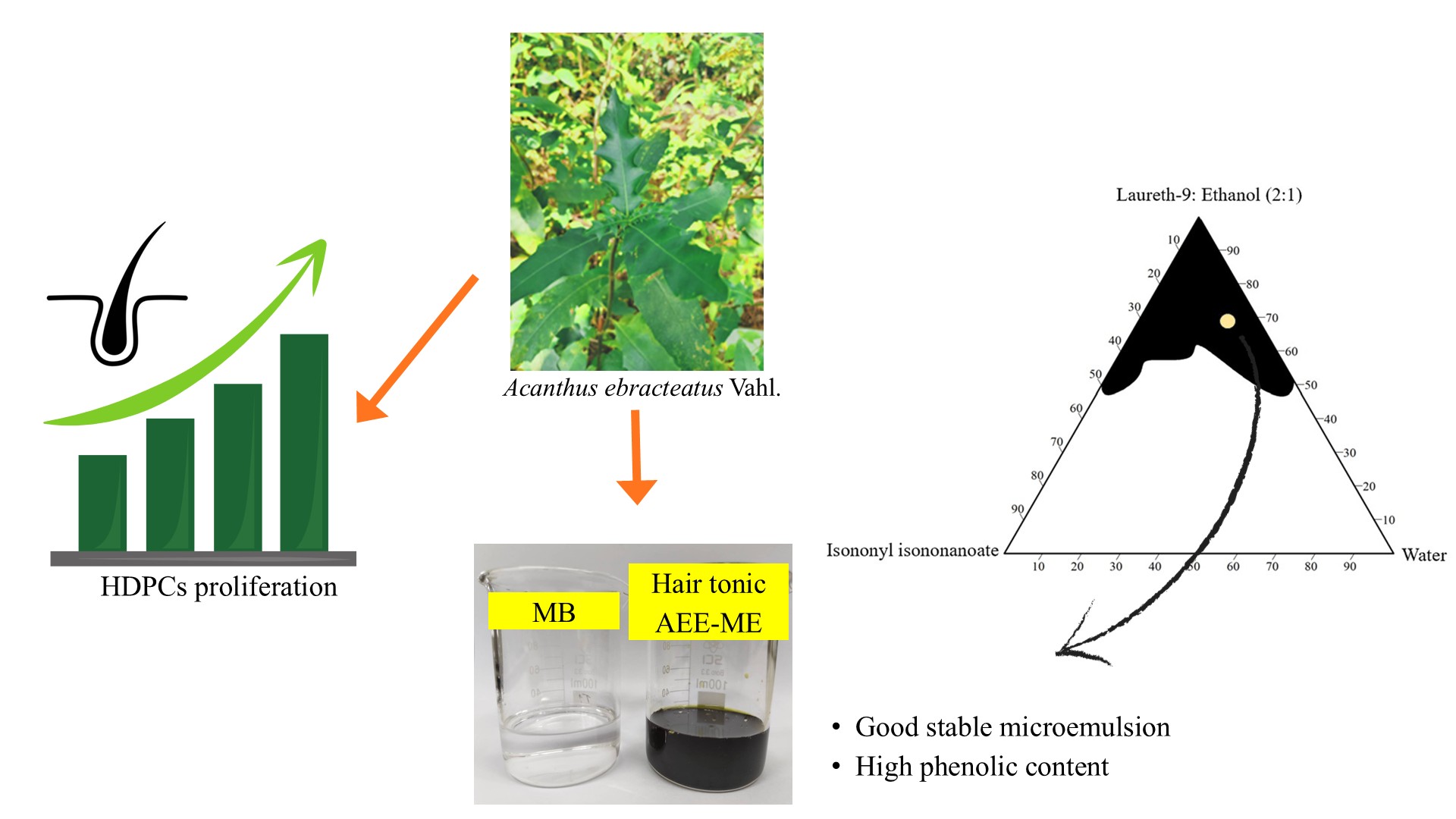
Downloads
References
N Natarelli, N Gahoonia and RK Sivamani. Integrative and mechanistic approach to the hair growth cycle and hair loss. Journal of Clinical Medicine 2023; 12(3), 893.
A Kidangazhiathmana and P Santhosh. Pathogenesis of androgenetic alopecia. Clinical Dermatology Review 2022; 6(2), 69-74.
AK Gupta, V Economopoulos, A Mann, T Wang and P Mirmirani. Menopause and hair loss in women: Exploring the hormonal transition. Maturitas 2025; 198, 108378.
EL Guo and R Katta. Diet and hair loss: Effects of nutrient deficiency and supplement use. Dermatology Practical & Conceptual 2017; 7(1), 1-10.
HM Almohanna, AA Ahmed, JP Tsatalis and A Tosti. The role of vitamins and minerals in hair loss: A review. Dermatology and Therapy 2019; 9(1), 51-70.
A Liang, Y Fang, L Ye, J Meng, X Wang, J Chen and X Xu. Signaling pathways in hair aging. Frontiers in Cell and Developmental Biology 2023; 11, 1278278.
T Samra, RR Lin and AD Maderal. The effects of environmental pollutants and exposures on hair follicle pathophysiology. Skin Appendage Disorders 2024; 10(4), 262-272.
W Liang, Y Zhao, B Cai, Y Huang, X Chen, N Ni, Y Wang, Z Lin, C Lin and K Huang. Psychological stress induces hair regenerative disorders through corticotropin-releasing hormone-mediated autophagy inhibition. Biochemical and Biophysical Research Communications 2024; 699, 149564.
N Peyravian, S Deo, S Daunert and JJ Jimenez. The inflammatory aspect of male and female pattern hair loss. Journal of Inflammation Research 2020; 13, 879-881.
A Freites-Martinez, J Shapiro, CVD Hurk, S Goldfarb, JJ Jimenez, AM Rossi, R Paus and ME Lacouture. Hair disorders in cancer survivors. Journal of the American Academy of Dermatology 2019; 80(5), 1199-1213.
F Du, J Li, S Zhang, X Zeng, J Nie and Z Li. Oxidative stress in hair follicle development and hair growth: Signalling pathways, intervening mechanisms and potential of natural antioxidants. Journal of Cellular and Molecular Medicine 2024; 28(12), 18486.
MS Nestor, G Ablon, A Gade, H Han and DL Fischer. Treatment options for androgenetic alopecia: Efficacy, side effects, compliance, financial considerations, and ethics. Journal of Cosmetic Dermatology 2021; 20(12), 3759-3781.
P Matos, MT Batista and A Figueirinha. A review of the ethnomedicinal uses, chemistry, and pharmacological properties of the genus Acanthus (Acanthaceae). Journal of Ethnopharmacology 2022; 293, 115271.
OJ Olatunji, OO Olatunde, TJ Jayeoye, S Singh, S Nalinbenjapun, S Sripetthong, W Chunglok and C Ovatlarnporn. New insights on Acanthus ebracteatus Vahl: UPLC-ESI-QTOF-MS profile, antioxidant, antimicrobial and anticancer activities. Molecules 2022; 27(6), 1981.
S Khabuanchalad and P Saleethong. Comparative analysis of phenolic compounds, carotenoid, and antioxidant activity of leaf and stem of Acanthus ebracteatus Vahl (Sea Holly). Journal of Health Science and Alternative Medicine 2024; 6(02), 96-106.
V Rakkhitawatthana, C Sillapachaiyaporn, S Nilkhet, J Brimson and T Tencomnao. Effect of Thai medicinal plants Acanthus ebracteatus Vahl. Carthamus tinctorius L. and Streblus asper Lour. on neurite outgrowth activity in Neuro-2A cells. Journal of Associated Medical Sciences 2022; 56(1), 71-84.
V Wisuitiprot, K Ingkaninan, P Chakkavittumrong, W Wisuitiprot, N Neungchamnong, R Chantakul and N Waranuch. Effects of Acanthus ebracteatus Vahl. extract and verbascoside on human dermal papilla and murine macrophage. Scientific Reports 2022; 12, 1491.
N Suhail, A Alzahrani, WJ Basha, NA Kizilbash, AH Zaidi, J Ambreen and MK Hassan. Microemulsions: Unique properties, pharmacological applications, and targeted drug delivery. Frontiers in Nanotechnology 2021; 3, 754889.
GK Sahu, H Sharma, A Gupta and CD Kaur. Advancements in microemulsion based drug delivery systems for better therapeutic effects. International Journal of Pharmaceutical Sciences and Developmental Research 2015; 1(1), 8-15.
W Poomanee, W Chaiyana, RR Wickett and P Leelapornpisid. Stability and solubility improvement of Sompoi (Acacia concinna Linn.) pod extract by topical microemulsion. Asian Journal of Pharmaceutical Sciences 2017; 12(4), 386-393.
A Muangsanguan, W Ruksiriwanich, P Linsaenkart, P Jantrawut, P Rachtanapun, K Jantanasakulwong, SR Sommano, K Sringarm, C Arjin, M Sainakham and JM Castagnini. Synergistic phytochemical and pharmacological actions of hair RiseTM microemulsion: A novel herbal formulation for androgenetic alopecia and hair growth stimulation. Plants 2024; 13(19), 2802.
J Heroweti, DN Wibowo, H Khoeriyah and R Adelia. Hair growth activity of hair tonic preparations containing cinnamon essential oil (Cinnamomum burmanii) and virgin coconut oil. Jurnal Ilmu Kefarmasian Indonesia 2023; 21(2), 186-192.
W Cai, K Cai, Z Li, X Zhang, S Gong, L Liao, J Gao, Q Xu, E Liu, J Liang and Y Huang. Rosemary oil-based microemulsion co-delivering quercetin and adenosine promotes hair regeneration in androgenetic alopecia via multiple actions. Chemical Engineering Journal 2026; 528, 172193.
NA Aliudin, SR David and R Rajabalaya. Formulation and in vitro efficacy evaluation of polyherbal hair tonics for enhancing hair health on various hair types. Biomedical and Pharmacology Journal 2024; 17(4), 2643-2660.
S Thungmungmee and N Wisidsri. Protective effects of avocado peel and seed extracts against UVB-damaged fibroblasts for the development of an anti-photoaging nanoemulgel. Scientific Reports 2025; 15, 28006.
K Hughes, R Ho, S Greff, E Filaire, E Ranouille, C Chazaud, G Herbette, JF Butaud, JY Berthon and P Raharivelomanana. Hair growth activity of three plants of the Polynesian cosmetopoeia and their regulatory effect on dermal papilla cells. Molecules 2020; 25(19), 4360.
S Thungmungmee, B Sritularak, N Wisidsri, N Kanana and N Nimmano. Exploring anti-aging potential of Dendrobium species and novel microemulsion delivery of Dendrobium kentrophyllum extract for anti-aging effect. Nanotechnology, Science and Applications 2025; 18, 157-171.
S Thungmungmee, B Sritularak, N Wisidsri and N Nimmano. Preparation and evaluation of Dendrobium formosum extract-loaded microemulsions for anti-aging purpose. Scientific Reports 2025; 15, 41451.
H Xiong, LX Yu and H Qu. Batch-to-batch quality consistency evaluation of botanical drug products using multivariate statistical analysis of the chromatographic fingerprint. AAPS PharmSciTech 2013; 14(2), 802-810.
J Lu, X Fu, T Liu, Y Zheng, J Chen and F Luo. Phenolic composition, antioxidant, antibacterial and anti-inflammatory activities of leaf and stem extracts from Cryptotaenia japonica Hassk. Industrial Crops and Products 2018; 122, 522-532.
N Maheshwari and MC Sharma. Anticancer properties of some selected plant phenolic compounds: Future leads for therapeutic development. Journal of Herbal Medicine 2023; 42, 100801.
S Park, N Choi, LNH Trang, M Oh, Y Oh, JH Sung and SH Kim. Dermal papilla cell proliferation of phytochemicals isolated from chestnut shells (Castanea crenata). Plants 2023; 12(5), 1018.
WA Boisvert, M Yu, Y Choi, GH Jeong, YL Zhang, S Cho, C Choi, S Lee and BH Lee. Hair growth-promoting effect of Geranium sibiricum extract in human dermal papilla cells and C57BL/6 mice. BMC Complementary Medicine and Therapies 2017; 17, 109.
B Vieira-Da-Silva and M Castanho. Resazurin reduction-based assays revisited: Guidelines for accurate reporting of relative differences on metabolic status. Molecules 2023; 28(5), 2283.
S Miyata, Y Oda, C Matsuo, H Kumura and K Kobayashi. Stimulatory effect of Brazilian propolis on hair growth through proliferation of keratinocytes in mice. Journal of Agricultural and Food Chemistry 2014; 62(49), 11854-11861.
ACK Lin, P Netcharoensirisuk, K Sanachai, W Sukma, C Chansriniyom, C Chaotham, W De-Eknamkul, T Rungrotmongkol and S Chamni. Caffeic acid N-[3,5-bis(trifluoromethyl)phenyl] amide as a non-steroidal inhibitor for steroid 5α-reductase type 1 using a human keratinocyte cell-based assay and molecular dynamics. Scientific Reports 2022; 12, 20858.
V Wisuitiprot, K Ingkaninan, W Wisuitiprot, J Srivilai, P Chakkavittumrong and N Waranuch. Effects of some medicinal plant extracts on dermal papilla cells. Journal of Cosmetic Dermatology 2022; 21(11), 6109-6117.
X Sun, H Qi, H Wu, Y Qu and K Wang. Anti-pruritic and anti-inflammatory effects of natural verbascoside through selective inhibition of temperature-sensitive Ca2+-permeable TRPV3 channel. Journal of Dermatological Science 2020; 97(3), 229-231.
J Hyun, J Im, SW Kim, HY Kim, I Seo and SH Bhang. Morus alba root extract induces the anagen phase in the human hair follicle dermal papilla cells. Pharmaceutics 2021; 13(8), 1155.
R Parveen, N Akhtar, MA Farooq, S Ghayas, R Bushra, DH Khan and M Aquib. Preparation of microemulsion containing Lycopersicon esculentum extract: In vitro characterization and stability studies. Pakistan Journal of Pharmaceutical Sciences 2019; 32(4), 1821-1827.
RC Racovita, MD Ciuca, D Catana, C Comanescu and O Ciocirlan. Microemulsions of nonionic surfactant with water and various homologous esters: Preparation, phase transitions, physical property measurements, and application for extraction of tricyclic antidepressant drugs from aqueous media. Nanomaterials 2023; 13(16), 2311.
S Chouhan, LS Chauhan and H Khambete. Effect of structural parameters of Brij surfactants on self-emulsification of poorly soluble drug. International Journal of Applied Pharmaceutics 2024; 16(4), 218-230.
Leny, K Fitri, YK Lase, I Hafiz and B Iskandar. Formulation of hair tonic from ethanol extract of Sea Hibiscus (Hibiscus tileaceus L.) leaves in promoting hair growth on guinea pig (Cavia porcellus). Journal of Drug Delivery and Therapeutics 2022; 12(2), 1-5.
H Abadi, HS Winata, Parhan, VE Diana, A Chan and R Haryani. Hair tonic formulation of clove leaves (Syzygium aromaticum) ethanol extract and the effectiveness on rabbit hair growth. International Journal of Applied Pharmaceutics 2020; 12(6), 245-248.
MR Patel, RB Patel, JR Parikh, AB Solanki and BG Patel. Investigating effect of microemulsion components: In vitro permeation of ketoconazole. Pharmaceutical Development and Technology 2011; 16(3), 250-258.
P Szumala. Structure of microemulsion formulated with monoacylglycerols in the presence of polyols and ethanol. Journal of Surfactants and Detergents 2015; 18(1), 97-106.
ML Klossek, J Marcus, D Touraud and W Kunz. The extension of microemulsion regions by combining ethanol with other cosurfactants. Colloids and Surfaces A: Physicochemical and Engineering Aspects 2013; 427, 95-100.
S Khajitkhajonwong and W Leesajakul. Optimization and characterization of indomethacin-loaded plai oil microemulsion using a 23 full factorial design. The Thai Journal of Pharmaceutical Sciences 2023; 47(4), 8.
ALM Carvalho, JA da Silva, AAM Lira, TMF Conceição, R de Souza Nunes, RL Cavalcanti de Albuquerque Junior, VHV Sarmento, LB Leal and DP de Santana. Evaluation of microemulsion and lamellar liquid crystalline systems for transdermal zidovudine delivery. Journal of Pharmaceutical Sciences 2016; 105(7), 2188-2193.
Y Gu, Q Bian, Y Zhou, Q Huang and J Gao. Hair follicle-targeting drug delivery strategies for the management of hair follicle-associated disorders. Asian Journal of Pharmaceutical Sciences 2022; 17(3), 333-352.
A Salimi, S Jafarian, A Salimi and SM Soleymani. Formulation and evaluation of valproic acid microemulsions for enhanced transfollicular delivery in guinea pig skin. Journal of Cosmetic Dermatology 2025; 24(2), 16685.
D Anggraini, NH Sandi and M Djohari. Formulation of microemulsion of cayenne pepper (Capsicum frutescens L.) ethanol extract and hair growth activity test. Majalah Obat Tradisional 2024; 29(2), 114-120.
T Subongkot, N Charernsriwilaiwat, R Chanasongkram, K Rittem, T Ngawhirunpat and P Opanasopit. Development and skin penetration pathway evaluation using confocal laser scanning microscopy of microemulsions for dermal delivery enhancement of finasteride. Pharmaceutics 2022; 14(12), 2784.
FR Ali, MH Shoaib, RI Yousuf, SA Ali, MS Imtiaz, L Bashir and S Naz. Design, development, and optimization of dexibuprofen microemulsion based transdermal reservoir patches for controlled drug delivery. BioMed Research International 2017; 2017(1), 4654958.
M Tagavifar, S Herath, UP Weerasooriya, K Sepehrnoori and G Pope. Measurement of microemulsion viscosity and its implications for chemical enhanced oil recovery. SPE Journal 2017; 23(1), 66-83.
F Dehghani, N Farhadian, S Golmohammadzadeh, A Biriaee, M Ebrahimi and M Karimi. Preparation, characterization and in-vivo evaluation of microemulsions containing tamoxifen citrate anti-cancer drug. European Journal of Pharmaceutical Sciences 2017; 96, 479-89.
G Coneac, V Vlaia, I Olariu, AM Muţ, DF Anghel, C Ilie, C Popoiu, D Lupuleasa and L Vlaia. Development and evaluation of new microemulsion-based hydrogel formulations for topical delivery of fluconazole. AAPS PharmSciTech 2015; 16(4), 889-904.
J Leanpolchareanchai, K Padois, F Falson, R Bavovada and P Pithayanukul. Microemulsion system for topical delivery of Thai mango seed kernel extract: Development, physicochemical characterisation and ex vivo skin permeation studies. Molecules 2014; 19(11), 17107-17129.
SS Adav, ARYL Wu and KW Ng. Insights into structural and proteomic alterations related to pH-induced changes and protein deamidation in hair. International Journal of Cosmetic Science 2024; 47(2), 281-296.
AS Yoon and P Sakdiset. Development of microemulsions containing Glochidion wallichianum leaf extract and potential for transdermal and topical skin delivery of gallic acid. Scientia Pharmaceutica 2020; 88(4), 53.
D Chatziharalambous, C Kaloteraki, P Potsaki, O Papagianni, K Giannoutsos, DI Koukoumaki, D Sarris, K Gkatzionis and AE Koutelidakis. Study of the total phenolic content, total antioxidant activity and in vitro digestibility of novel wheat crackers enriched with cereal, legume and agricultural by-product flours. Oxygen 2023; 3(2), 256-273.
J Pan, Y Tang, Z Liang, Y Cao and Y Chen. Improvement in the stability of perilla seed oil microemulsion and its role in fat accumulation reduction in Caenorhabditis elegans. Colloids and Interfaces 2025; 9(5), 56.
Published
How to Cite
Issue
Section
License
Copyright (c) 2026 Walailak University

This work is licensed under a Creative Commons Attribution-NonCommercial-NoDerivatives 4.0 International License.





