
Protective Effects of Syringaresinol against UVB-Induced Human Dermal Fibroblast Senescence and Apoptosis
DOI:
https://doi.org/10.48048/tis.2025.9395Keywords:
Syringaresinol, UVB, Human dermal fibroblasts, Antioxidant system, Cellular senescence, Apoptosis, PhotoagingAbstract
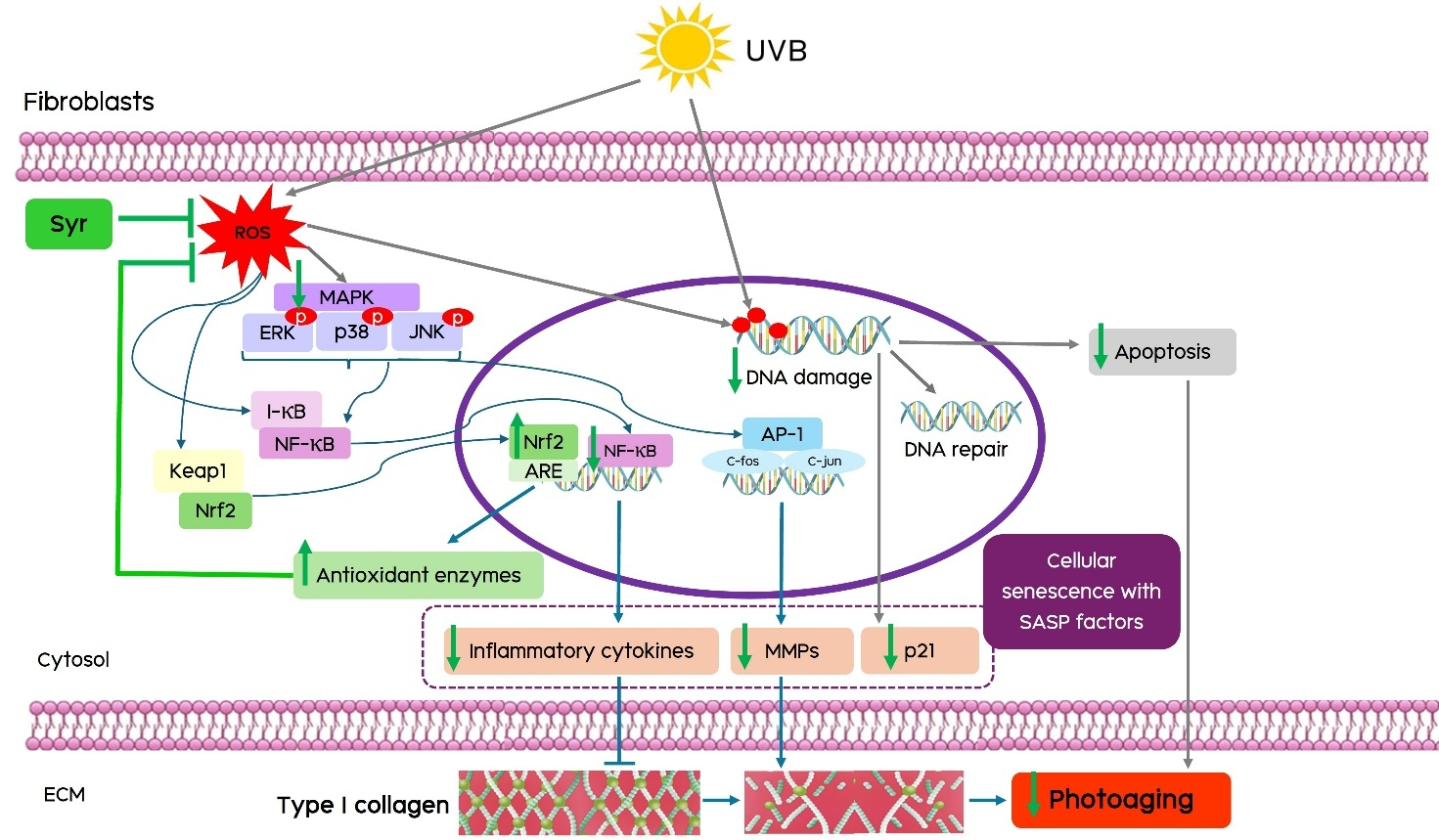
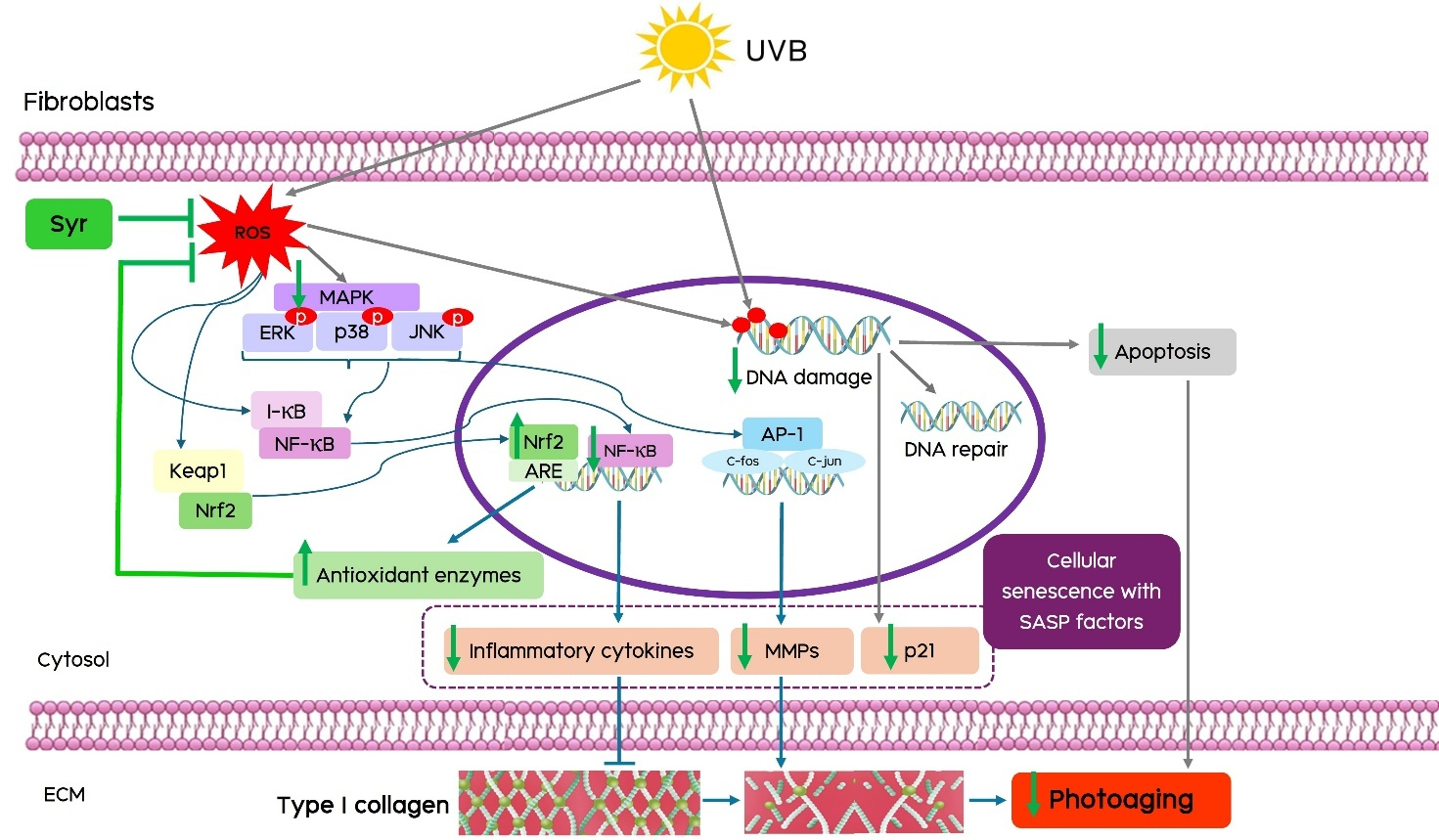
UV radiation can cause skin photoaging by damaging DNA and generating excess intracellular ROS in skin cells. This study aimed to evaluate the protective effects of syringaresinol (Syr) isolated from Carallia brachiata on UVB-induced skin cell damage. Syr demonstrated potent antioxidant activity, IC50 16.90 ± 0.89 μM, by DPPH assay. To evaluate the protective effect of Syr, human dermal fibroblasts, BJ cells, were pretreated with Syr, at noncytotoxic concentrations (3 - 30 μM), for 24 h before UVB irradiation. Syr increased cell survival and the levels of antioxidant enzymes, including superoxide dismutase (SOD), catalase (CAT), and heme oxygenase-1 (HO-1) of the irradiated cells. It also increased the level of nuclear Nrf-2, an important transcription factor for antioxidant gene expression. Syr suppressed UVB-induced ROS production. It attenuated UVB-induced cellular senescence by decreasing the number of β-galactosidase (β-gal) positive cells, suppressing p21, and reducing senescence-associated secretory phenotype (SASP) including levels of pro-inflammatory cytokines and matrix metalloproteinases (MMP1, MMP3), and increasing the level of collagen-1A1 (COL-1A1). Syr prevented UVB-induced DNA damage by decreasing cyclobutane pyrimidine dimer (CPD) photoproducts. Syr also suppressed UVB-induced apoptosis of BJ cells by decreasing the levels of active caspase 3, cleaved poly (ADP-ribose) polymerase (PARP). Syr remarkably inhibited the phosphorylation of extracellular signal-regulated kinase (ERK), c-Jun N-terminal kinase (JNK), and p38 mitogen-activated protein kinase (p38) proteins of the mitogen-activated protein kinase (MAPK) signaling pathway. It also inhibited the activation of nuclear factor kappa B (NF-κB). The results in this study suggest that Syr prevents UVB-induced dermal fibroblast damage, possibly via its antioxidant activity through down-regulating MAPK signaling and NF-κB activation. The protective effects of Syr lead to suppression of ROS production, DNA damage, senescence, and apoptosis of the UVB-irradiated cells.
HIGHLIGHTS
- Low-dose UVB irradiation causes aging of human dermal fibroblasts by increasing intracellular ROS, DNA damage and senescence biomarkers.
- High-dose UVB irradiation triggers apoptosis of human dermal fibroblasts.
- Syringaresinol protects dermal fibroblasts from UVB-induced damage through its antioxidant activity by downregulating MAPK signaling and inhibiting NF-κB activation.
- Syringaresinol has protective effects on UVB-irradiated human skin fibroblasts by reducing ROS production, preventing DNA damage, mitigating senescence and apoptosis, and restoring Type I collagen production.
GRAPHICAL ABSTRACT
Downloads
References
AV Nguyen and AM Soulika. The dynamics of the skin’s immune system. International Journal of Molecular Sciences 2019; 20(8), 1811.
C Parrado, S Mercado-Saenz, A Perez-Davo, Y Gilaberte, S Gonzalez and A Juarranz. Environmental stressors on skin aging. Mechanistic insights. Frontiers in Pharmacology 2019; 10, 759.
X Tang, T Yang, D Yu, H Xiong and S Zhang. Current insights and future perspectives of ultraviolet radiation (UV) exposure: Friends and foes to the skin and beyond the skin. Environment International 2024; 185, 108535.
M Wei, X He, N Liu and H Deng. Role of reactive oxygen species in ultraviolet-induced photodamage of the skin. Cell Division 2024; 19(1), 1.
T Al-Sadek and N Yusuf. Ultraviolet radiation biological and medical implications. Current Issues in Molecular Biology 2024; 46, 1924-1942.
AP Schuch, NC Moreno, NJ Schuch, CFM Menck and CCM Garcia. Sunlight damage to cellular DNA: Focus on oxidatively generated lesions. Free Radical Biology and Medicine 2017; 107, 110-124.
J Cadet, T Douki and JL Ravanat. Oxidatively generated damage to cellular DNA by UVB and UVA radiation. Photochemistry and Photobiology 2015; 91(1), 140-155.
D Mohania, S Chandel, P Kumar, V Verma, K Digvijay, D Tripathi, K Choudhury, SK Mitten and D Shah. Ultraviolet radiations: Skin defense-damage mechanism. Advances in Experimental Medicine and Biology 2017; 996, 71-87.
U Panich, G Sittithumcharee, N Rathviboon and S Jirawatnotai. Ultraviolet radiation-induced skin aging: The role of DNA damage and oxidative stress in epidermal stem cell damage mediated skin aging. Stem Cells International 2016; 2016, 7370642.
C Espinosa-Diez, V Miguel, D Mennerich, T Kietzmann, P Sanchez-Perez, S Cadenas and S Lamas. Antioxidant responses and cellular adjustments to oxidative stress. Redox Biology 2015; 6, 183-197.
TM Ansary, MR Hossain, K Kamiya, M Komine and M Ohtsuki. Inflammatory molecules associated with ultraviolet radiation-mediated skin aging. International Journal of Molecular Sciences 2021; 22(8), 3974.
J Zhang, X Wang, V Vikash, Q Ye, D Wu, Y Liu and W Dong. ROS and ROS-mediated cellular signaling. Oxidative Medicine and Cellular Longevity 2016; 2016, 4350965.
C Anerillas, K Abdelmohsen and M Gorospe. Regulation of senescence traits by MAPKs. GeroScience 2020; 42, 397-408.
A Gegotek and E Skrzydlewska. The role of transcription factor Nrf2 in skin cells metabolism. Archives of Dermatological Research 2015; 307(5), 385-396.
JA Zhang, C Luan, D Huang, M Ju, K Chen and H Gu. Induction of autophagy by baicalin through the AMPK-mTOR pathway protects human skin fibroblasts from ultraviolet B radiation-induced apoptosis. Drug Design, Development and Therapy 2020; 14, 417-428.
W Choi, HS Kim, SH Park, D Kim, YD Hong, JH Kim and JY Cho. Syringaresinol derived from Panax ginseng berry attenuates oxidative stress-induced skin aging via autophagy. Journal of Ginseng Research 2022; 46(4), 536-542.
YS Cho, WS Song, SH Yoon, KY Park and MH Kim. Syringaresinol suppresses excitatory synaptic transmission and picrotoxin-induced epileptic activity in the hippocampus through presynaptic mechanisms. Neuropharmacology 2018; 131, 68-82.
W Monthong, S Pitchuanchom, N Nuntasaen and W Pompimon. (+)-Syringaresinol lignan from new species Magnolia Thailandica. American Journal of Applied Sciences 2011; 8(12), 1268-1271.
VK Bajpai, MB Alam, KT Quan, MK Ju, R Majumder, S Shukla, YS Huh, M Na, SH Lee and YK Han. Attenuation of inflammatory responses by (+)-syringaresinol via MAP-Kinase-mediated suppression of NF-κB signaling in vitro and in vivo. Scientific Reports 2018; 8(1), 9216.
Y Lin, S Li, T Chen, Y Lin, Z Cheng, L Ni, JJ Lu and M Huang. Phytochemical compositions and biological activities of the branches and leaves of Ormosia hosiei Hemsl. et Wils. Journal of Pharmaceutical and Biomedical Analysis 2023; 226, 115238.
N Nalinratana, U Suriya, C Laprasert, N Wisidsri, P Poldorn, T Rungrotmongkol, W Limpanasitthikul, HC Wu, HS Chang and C Chansriniyom. In vitro and in silico studies of 7′′,8′′-buddlenol D anti-inflammatory lignans from Carallia brachiata as p38 MAP kinase inhibitors. Scientific Reports 2023; 13(1), 3558.
G Li, C Liu, L Yang, L Feng, S Zhang, J An, J Li, Y Gao, Z Pan, Y Xu, J Liu, Y Wang, J Yan, J Cui, Z Qi and L Yang. Syringaresinol protects against diabetic nephropathy by inhibiting pyroptosis via NRF2-mediated antioxidant pathway. Cell Biology and Toxicology 2023; 39(3), 621-639.
BY Park, SR Oh, KS Ahn, OK Kwon and HK Lee. (-)-Syringaresinol inhibits proliferation of human promyelocytic HL-60 leukemia cells via G1 arres and apoptosis. International Immunopharmacology 2008; 8(7), 967-973.
L Zhang, X Jiang, J Zhang, H Gao, L Yang, D Li, Q Zhang, B Wang, L Cui and X Wang. (-)-Syringaresinol suppressed LPS-induced microglia activation via downregulation of NF-κB p65 signaling and interaction with ER. International Immunopharmacology 2021; 99, 107986.
X Wang, D Wang, B Deng and L Yan. Syringaresinol attenuates osteoarthritis via regulating the NF-κB pathway. International Immunopharmacology 2023; 118, 109982.
S Cho, M Cho, J Kim, M Kaeberlein, SJ Lee and Y Suh. Syringaresinol protects against hypoxia/reoxygenation-induced cardiomyocytes injury and death by destabilization of HIF-1 in a FOXO3-dependent mechanism. Oncotarget 2015; 6(1), 43-55.
A Wei, J Liu, D Li, Y Lu, L Yang, Y Zhuo, W Tian and H Cong. Syringaresinol attenuates sepsis-induced cardiac dysfunction by inhibiting inflammation and pyroptosis in mice. European Journal of Pharmacology 2021; 913, 174644.
M Miyazawa, H Utsunomiya, K Inada, T Yamada, Y Okuno, H Tanaka and M Tatematsu. Inhibition of Helicobacter pylori motility by (+)-Syringaresinol from unripe Japanese apricot. Biological & Pharmceutical Bulletin 2006; 29(1), 172-173.
J Kim, T Toda, K Watanabe, S Shibuya, Y Ozawa, N Izuo, S Cho, DB Seo, K Yokote and T Shimizu. Syringaresinol reverses age-related skin atrophy by suppressing FoxO3a-mediated matrix metalloproteinase-2 activation in copper/zinc superoxide dismutase-deficient dice. Journal of Investigative Dermatology 2019; 139(3), 648-655.
JH Oh, YH Joo, F Karadeniz, J Ko and CS Kong. Syringaresinol inhibits UVA-induced MMP-1 expression by suppression of MAPK/AP-1 signaling in HaCaT keratinocytes and human dermal fibroblasts. International Journal of Molecular Sciences 2020; 21(11), 3981.
AP Schuch, NC Moreno, NJ Schuch, CFM Menck and CCM Garcia. Sunlight damage to cellular DNA: Focus on oxidatively generated lesions. Free Radical Biology & Medicine 2017; 107, 110-124.
H Masaki. Role of antioxidants in the skin: Anti-aging effects. Journal of Dermatological Science 2010; 58(2), 85-90.
E Markiewicz and OC Idowu. DNA damage in human skin and the capacities of natural compounds to modulate the bystander signalling. Open Biology 2019; 9(12), 190208.
Y Xu and GJ Fisher. Ultraviolet (UV) light irradiation induced signal transduction in skin photoaging. Journal of Dermatological Science Supplement 2005; 1(2), S1-S8.
R Pandel, B Poljšak, A Godic and R Dahmane. Skin photoaging and the role of antioxidants in its prevention. ISRN Dermatology 2013; 2013, 930164.
O Tavana, CL Benjamin, N Puebla-Osorio, M Sang, SE Ullrich, HN Ananthaswamy and C Zhu. Absence of p53-dependent apoptosis leads to UV radiation hypersensitivity, enhanced immunosuppression and cellular senescence. Cell Cycle 2010; 9(16), 3328-3336.
Y Sha, V Vartanian, N Owen, SJM Koon, MJ Calkins, CS Thompson, Z Mirafzali, S Mir, LE Goldsmith, H He, C Luo, SM Brown, PW Doetsch, A Kaempf, JY Lim, AK McCullough and RS Lloyd. Modulation of UVB-induced carcinogenesis by activation of alternative DNA repair pathways. Scientific Reports 2018; 8(1), 705.
F Bonté, D Girard, JC Archambault and A Desmouliere. Skin changes during ageing. Sub-cellular Biochemistry 2019; 91, 249-280.
M Furue, H Uchi, C Mitoma, A Hashimoto-Hachiya, T Chiba, T Ito, T Nakahara and G Tsuji. Antioxidants for healthy skin: The emerging role of aryl hydrocarbon receptors and nuclear factor-erythroid 2-related factor-2. Nutrients 2017; 9(3), 223.
C Yu and JH Xiao. The Keap1-Nrf2 system: A mediator between oxidative stress and aging. Oxidative Medicine and Cellular Longevity 2021; 2021, 6635460.
L Baird and M Yamamoto. The molecular mechanisms regulating the KEAP1-NRF2 pathway. Molecular and Cellular Biology 2020; 40(13), e00099-20.
RA Zinovkin, ND Kondratenko and LA Zinovkina. Does Nrf2 play a role of a master regulator of mammalian aging? Biochemistry 2022; 87(12), 1465-1476.
D Xian, X Xiong, J Xu, L Xian, Q Lei, J Song and J Zhong. Nrf2 overexpression for the protective effect of skin-derived precursors against UV-induced damage: Evidence from a three-dimensional skin model. Oxidative Medicine and Cellular Longevity 2019; 2019, 7021428.
YC Boo. Natural Nrf2 modulators for skin protection. Antioxidants 2020; 9(9), 812.
T Budden and NA Bowden. The role of altered nucleotide excision repair and UVB-induced DNA damage in melanomagenesis. International Journey of Molecular Sciences 2013; 14(1), 1132-1151.
M Mijit, V Caracciolo, A Melillo, F Amicarelli and A Giordano. Role of p53 in the regulation of cellular senescence. Biomolecules 2020; 10(3), 420.
BG Childs, DJ Baker, JL Kirkland, J Campisi and JMV Deursen. Senescence and apoptosis: Dueling or complementary cell fates? EMBO Reports 2014; 15, 1139-1153.
SI Choi, JH Lee, JM Kim, TD Jung, BY Cho, SH Choi, DW Lee, J Kim, JY Kim and OH Lee. Ulmus macrocarpa hance extracts attenuated H₂O₂ and UVB-induced skin photo-aging by activating antioxidant enzymes and inhibiting MAPK pathways. International Journal Molecular Sciences 2017; 18(6), 1200.
HS Han, JS Shin, DB Myung, HS Ahn, SH Lee, HJ Kim and KT Lee. Hydrangea serrata (Thunb.) Ser. extract attenuate UVB-induced photoaging through MAPK/AP-1 inactivation in human skin fibroblasts and hairless mice. Nutrients 2019; 11(3), 533.
JP Kumar and BB Mandal. Inhibitory role of silk cocoon extract against elastase, hyaluronidase and UV radiation-induced matrix metalloproteinase expression in human dermal fibroblasts and keratinocytes. Photochemical & Photobiological Sciences 2019; 18(5), 1259-1274.
JW Shin, SH Kwon, JY Choi, JI Na, CH Huh, HR Choi and KC Park. Molecular mechanisms of dermal aging and antiaging approaches. International Journal of Molecular Sciences 2019; 20(9), 2126.
C Marionnet, C Pierrard, F Lejeune and F Bernerd. Modulations of gene expression induced by daily ultraviolet light can be prevented by a broad spectrum sunscreen. Journal of Photochemistry and Photobiology B: Biology 2012; 116, 37-47.
SW Shin, E Jung, S Kim, JH Kim, EG Kim, J Lee and D Park. Antagonizing effects and mechanisms of afzelin against UVB-induced cell damage. PLoS One 2013; 8(4), e61971.
M Deng, D Li, Y Zhang, G Zhou, W Liu, Y Cao and W Zhang. Protective effect of crocin on ultraviolet B‑induced dermal fibroblast photoaging. Molecular Medicine Reports 2018; 18, 1439-1446.
E Mavrogonatou, M Angelopoulou, SV Rizou, H Pratsinis, VG Gorgoulis and D Kletsas. Activation of the JNKs/ATM-p53 axis is indispensable for the cytoprotection of dermal fibroblasts exposed to UVB radiation. Cell Death & Disease 2022; 13(7), 647.
AS Gary and PJ Rochette. Apoptosis, the only cell death pathway that can be measured in human diploid dermal fibroblasts following lethal UVB irradiation. Scientific Reports 2020; 10(1), 18946.
AB Parrish, CD Freel and S Kornbluth. Cellular mechanisms controlling caspase activation and function. Cold Spring Harbor Perspective in Biology 2013; 5(6), a008672.
HJ Choi, MB Alam, ME Baek, YG Kwon, JY Lim and SH Lee. Protection against UVB-induced photoaging by Nypa fruticans via inhibition of MAPK/AP-1/MMP-1 signaling. Oxidative Medicine and Cellular Longevity 2020; 2020, 2905362.
V Muthusamy and TJ Piva. The UV response of the skin: A review of the MAPK, NFκB and TNF signal transduction pathways. Archives of Dermatological Research 2010; 302(1), 5-17.
T Shi and TB Dansen. Reactive oxygen species induced p53 activation: DNA damage, redox signaling, or both? Antioxidants & Redox Signaling 2020; 33(12), 839-859.
S Dunaway, R Odin, L Zhou, L Ji, Y Zhang and AL Kadekaro. Natural antioxidants: Multiple mechanisms to protect skin from solar radiation. Frontiers Pharmacology 2018; 9, 392.
Downloads
Published
How to Cite
Issue
Section
License
Copyright (c) 2025 Walailak University

This work is licensed under a Creative Commons Attribution-NonCommercial-NoDerivatives 4.0 International License.





