
Polyvinyl Chloride and Polyethylene Microplastics Promote Cardiac Oxidative Stress and Histopathological Remodeling in Wistar Rats
DOI:
https://doi.org/10.48048/tis.2026.13013Keywords:
Microplastics, Polyethylene, Polyvinyl chloride, Inhalation exposure, Oxidative stress, NF-kappa B, CardiotoxicityAbstract
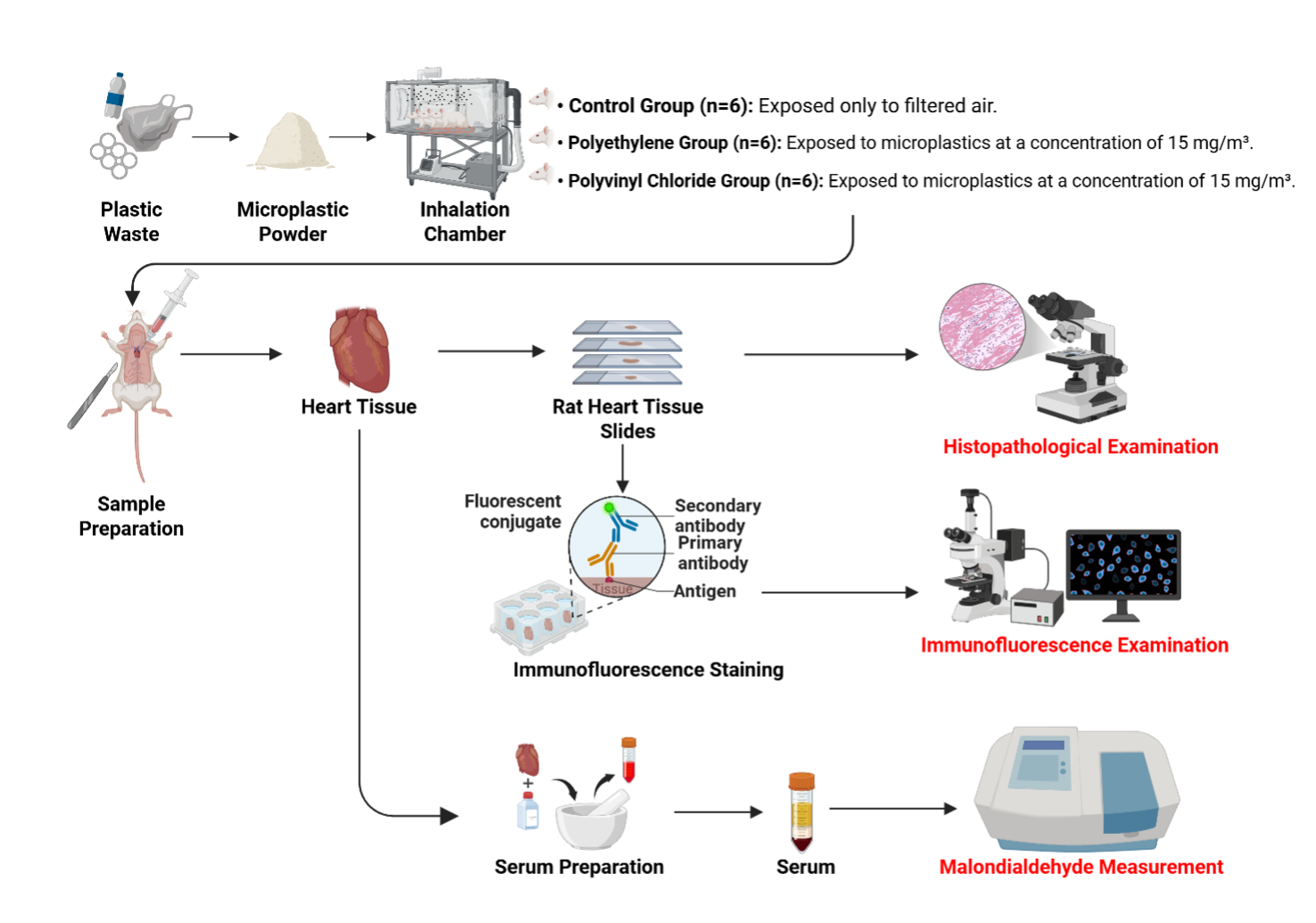
Microplastic pollution is an emerging environmental concern with accumulating evidence of systemic toxicity. Polyethylene (PE) and polyvinyl chloride (PVC) are persistent polymers that may promote oxidative stress and influence redox-sensitive signaling pathways such as nuclear factor kappa-B (NF-κB). This study investigated the cardiac effects of subacute inhalation of PE and PVC microplastics (MPs) in Wistar rats, focusing on oxidative stress, structural alterations, and NF-κB-related responses. Eighteen female Wistar rats were randomly assigned to control, PE, or PVC groups. Exposure groups underwent whole-body inhalation of 15 mg/m³ PE or PVC MPs for 4 h/day, 5 days/week, for 28 days. Cardiac tissue was examined histologically and assessed for malondialdehyde (MDA) levels and p65 NF-κB expression {a marker of NF-κB pathway activity} using immunofluorescence. Microplastic exposure resulted in significant cardiac structural alterations. Mean ventricular wall diameter increased by approximately 48% in the PE group and 75% in the PVC group compared with controls {p < 0.05}, indicating more pronounced histopathological remodeling in PVC-exposed animals. Cardiac MDA concentrations increased markedly {control: 0.0189 µmol/g; PVC: 0.272 µmol/g; PE: 0.554 µmol/g}, corresponding to roughly 14-fold (PVC) and 29-fold (PE) increases relative to controls {p < 0.001}. In contrast, p65 NF-κB expression did not differ significantly among groups {p > 0.05}, suggesting that any potential inflammatory pathway involvement remains exploratory and was not statistically demonstrated under subacute exposure conditions. Subacute inhalation of PE and PVC MPs induces oxidative stress and early cardiac remodeling in Wistar rats. Notably, PVC produced greater structural alterations, whereas PE generated higher oxidative stress, indicating distinct cardiotoxic profiles. These findings reflect early cardiac responses, and long-term studies are needed to determine whether sustained exposure leads to persistent inflammation and definitive NF-κB pathway activation.
HIGHLIGHTS
- Subacute whole-body inhalation of polyethylene (PE) and polyvinyl chloride (PVC) microplastics for 28 days resulted in measurable cardiac effects in female Wistar rats.
- Microplastic exposure significantly elevated cardiac oxidative stress, with MDA levels increasing from 0.0189 ng/mL in controls to 0.272 ng/mL in PVC and 0.554 ng/mL in PE groups (p < 0.001), indicating stronger oxidative induction by PE.
- These oxidative changes were accompanied by marked structural remodelling, as mean ventricular wall diameter increased from 37 mm (control) to 2.03 mm (PE) and 2.40 mm (PVC) (p < 0.001), confirming hypertrophic alterations after microplastic exposure.
- Despite oxidative and structural changes, cardiac NF-κB p65 expression did not differ significantly among groups (p = 0.650), suggesting that early tissue injury may occur prior to detectable NF-κB activation under subacute conditions.
- Collectively, these findings support airborne microplastics as a potential cardiovascular risk factor and underscore the importance of long-term exposure studies to clarify downstream signalling progression.
GRAPHICAL ABSTRACT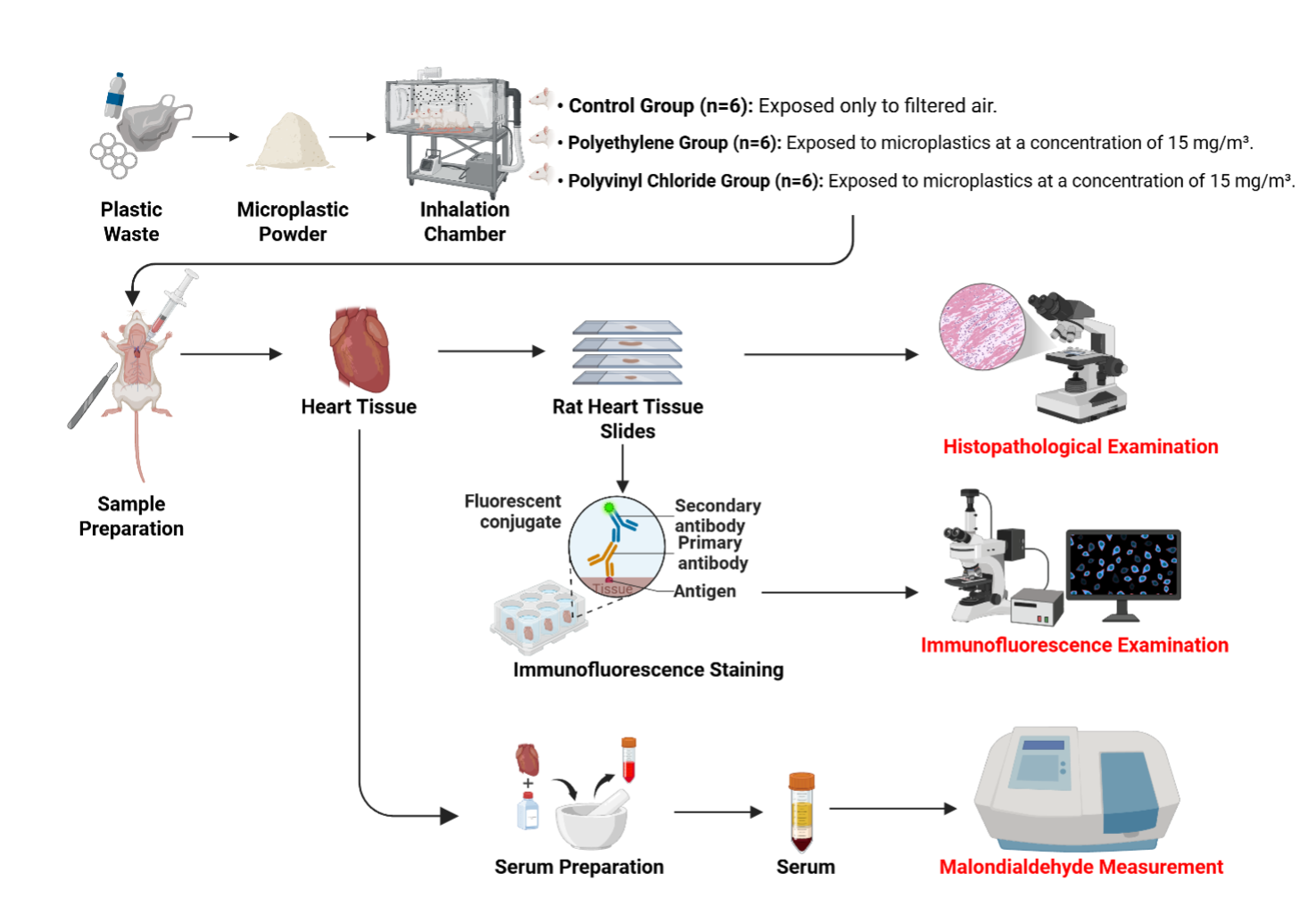
Downloads
References
R Kumar, A Verma, A Shome, R Sinha, S Sinha, PK Jha, R Kumar, P Kumar, Shubham, S Das and P Sharma. Impacts of plastic pollution on ecosystem services, sustainable development goals, and need to focus on circular economy and policy interventions. Sustainability 2021; 13(17), 9963.
J Lee, S Kim, SB Park, M Shin, S Kim, MS Kim, G Shin, T Kang, HJ Kim, DX Oh and J Park. Mimicking real-field degradation of biodegradable plastics in soil and marine environments: From product utility to end-of-life analysis. Polymer Testing 2024; 131, 108338.
VG Le, MK Nguyen, HL Nguyen, C Lin, M Hadi, MNT Hung, HG Hoang, KN Nguyen, HT Tran, D Hou, T Zhang and T Zhang. A comprehensive review of micro-and nano-plastics in the atmosphere: Occurrence, fate, toxicity, and strategies for risk reduction. Science of the Total Environment 2023; 904, 166649
Y Yu, N Craig and L Su. A hidden pathway for human exposure to micro-and nanoplastics - the mechanical fragmentation of plastic products during daily use. Toxics 2023; 11(9), 774.
E Dube and GE Okuthe. Plastics and micro/nano-plastics (MNPs) in the environment: Occurrence, impact, and toxicity. International Journal of Environmental Research and Public Health 2023; 20(17), 6667.
S Islam. Toxicity and transport of nanoparticles in agriculture: Effects of size, coating, and aging. Frontiers in Nanotechnology 2025; 7, 1622228.
V Stock, L Böhmert, G Coban, G Tyra, ML Vollbrecht, L Voss, MB Paul, A Braeuning and H Sieg. Microplastics and nanoplastics: Size, surface and dispersant-what causes the effect? Toxicology In Vitro 2022; 80, 105314.
D Pal, R Prabhakar, VB Barua, I Zekker, J Burlakovs, A Krauklis, W Hogland and Z Vincevica-Gaile. Microplastics in aquatic systems: A comprehensive review of its distribution, environmental interactions, and health risks. Environmental Science and Pollution Research 2025; 32(1), 56-88.
DM El-Sherif, MG Eloffy, A Elmesery, M Abouzid, M Gad, HR El-Seedi, M Brinkmann, K Wang and Y Al-Naggar. Environmental risk, toxicity, and biodegradation of polyethylene: A review. Environmental Science and Pollution Research 2022; 29(54), 81166-81182.
P Kowalczyk, K Kadac-Czapska and M Grembecka. Polyethylene Packaging as a Source of Microplastics: Current Knowledge and Future Directions on Food Contamination. Foods 2025; 14(14), 2408.
M Manjunatha, D Seth, S Roy and RB Tangadagi. Utilization of industrial-based PVC waste powder in self-compacting concrete: A sustainable building material. Journal of Cleaner Production 2023; 428, 139428.
MH Kudzin, D Piwowarska, N Festinger and JJ Chruściel. Risks associated with the presence of polyvinyl chloride in the environment and methods for its disposal and utilization. Materials 2023; 17(1), 173.
T Zhang, C Ma, Z Zhang, H Zhang and H Hu. NF‐κB signaling in inflammation and cancer. MedComm 2021; 2(4), 618-653.
J Cornice, D Verzella, P Arboretto, D Vecchiotti, D Capece, F Zazzeroni and G Franzoso. NF-κB: Governing macrophages in cancer. Genes 2024; 15(2), 197.
T Xu, J Cui, R Xu, J Cao and MY Guo. Microplastics induced inflammation and apoptosis via ferroptosis and the NF-κB pathway in carp. Aquatic Toxicology 2023; 262, 106659.
JH Woo, HJ Seo, JY Lee, I Lee, K Jeon, B Kim, K Lee and K Lee. Polypropylene nanoplastic exposure leads to lung inflammation through p38-mediated NF-κB pathway due to mitochondrial damage. Particle and Fibre Toxicology 2023; 20(1), 2.
M Borgatta and F Breider. Inhalation of microplastics - a toxicological complexity. Toxics 2024; 12(5), 358.
R Jia, J Han, X Liu, K Li, W Lai, L Bian, J Yan and Z Xi. Exposure to polypropylene microplastics via oral ingestion induces colonic apoptosis and intestinal barrier damage through oxidative stress and inflammation in mice. Toxics 2023; 11(2), 127.
YL Wang, CC Huang, CM Zheng, WC Liu, YH Lee, HW Chiu and HW Chiu. Polystyrene microplastic-induced extracellular vesicles cause kidney-related effects in the crosstalk between tubular cells and fibroblasts. Ecotoxicology and Environmental Safety 2024; 273, 116098.
L Bridgeman, A Cimbalo, D López-Rodríguez, D Pamies and M Frangiamone. Exploring toxicological pathways of microplastics and nanoplastics: Insights from animal and cellular models. Journal of Hazardous Materials 2025; 490, 137795.
OECD. OECD guidelines on the testing of chemicals: Test no. 412 - 28-day (subacute) inhalation toxicity study. Organisation for Economic Co-operation and Development (OECD), Paris, France, 2018.
R Pohjanvirta, H Miettinen, S Sankari, N Hegde and J Lindén. Unexpected gender difference in sensitivity to the acute toxicity of dioxin in mice. Toxicology and Applied Pharmacology 2012; 262(2), 167-176.
N Kania, E Mayangsari, B Setiawan, D Nugrahenny, F Tony, ES Wahyuni and MA Widodo. The effects of Eucheuma cottonii on signaling pathway inducing mucin synthesis in rat lungs chronically exposed to particulate matter 10 (PM10) coal dust. Journal of Toxicology 2013; 2013, 528146.
RK Saputri, B Setiawan, D Nugrahenny, N Kania, ES Wahyuni and MA Widodo. The effects of Eucheuma cottonii on alveolar macrophages and malondialdehyde levels in bronchoalveolar lavage fluid in chronically particulate matter 10 coal dust-exposed rats. Iranian Journal of Basic Medical Sciences 2014; 17(7), 541-545.
AR Muhammad, MR Aditya, B Lestari and HW Sulistomo. Sub-acute polyethylene microplastic inhalation exposure induced pulmonary toxicity in wistar rats through inflammation and oxidative stress. Toxicology Reports 2025; 14, 102067.
MR Aditya, AR Muhammad, T Astuti, HW Sulistomo and D Nugrahenny. Pulmonary toxicity induced by subacute inhalation of polyvinyl chloride microplastics: Oxidative stress and NF-κB pathway activation in rat models. Iranian Journal of Toxicology 2025; 19(4), 227-234.
B Setiawan, N Kania, D Nugrahenny, N Nurdiana and MA Widodo. Subchronic inhalation of particulate matter 10 coal dust induces atherosclerosis in the aorta of diabetic and nondiabetic rats. Biomarkers and Genomic Medicine 2014; 6(2), 67-73.
S Kauts, S Shabir, S Yousuf, Y Mishra, R Bhardwaj, AA Milibari, SK Singh and MP Singh. The evidence of in-vivo and in-vitro studies on microplastic and nano plastic toxicity in mammals: A possible threat for an upcoming generation? Physics and Chemistry of the Earth, Parts A/B/C 2023; 132, 103511.
CM Cary, TN Seymore, D Singh, KN Vayas, MJ Goedken, S Adams, M Polunas, VR Sunil, DL Laskin, P Demokritou and PA Stapleton. Single inhalation exposure to polyamide micro and nanoplastic particles impairs vascular dilation without generating pulmonary inflammation in virgin female Sprague Dawley rats. Particle and Fibre Toxicology 2023; 20(1), 16.
T Zhang, S Yang, Y Ge, X Wan, Y Zhu, F Yang, J Li, S Gong, Y Cheng, C Hu and Z Chen. Multi-dimensional evaluation of cardiotoxicity in mice following respiratory exposure to polystyrene nanoplastics. Particle and Fibre Toxicology 2023; 20(1), 46.
AJ de Almeida, JC de Oliveira, LV da Silva Pontes, JF de Souza Júnior, TA Gonçalves, SH Dantas, MS de Almeida Feitosa, AO Silva and IA de Medeiros. ROS: Basic concepts, sources, cellular signaling, and its implications in aging pathways. Oxidative Medicine and Cellular Longevity 2022; 2022, 1225578.
X Meng, J Zhang, W Wang, G Gonzalez-Gil, JS Vrouwenvelder and Z Li. Effects of nano-and microplastics on kidney: Physicochemical properties, bioaccumulation, oxidative stress and immunoreaction. Chemosphere 2022; 288, 132631.
Y Zhou, Q Wu, Y Li, Y Feng, Y Wang and W Cheng. Low-dose of polystyrene microplastics induce cardiotoxicity in mice and human-originated cardiac organoids. Environment International 2023; 179, 108171.
M Leela, V Pushpalatha, S Swetha, S Anusuya, S Madhavan, S Eswari, H Thilagam, R Thiagarajan and R Krishnamurthy. Ingestion of weathered high density polyethylene microplastics-induced oxidative stress and modulation of antioxidant responses in post larval stages of Litopenaeus vannamei. Frontiers in Marine Science 2025; 12, 1617070.
A Dimitriadi, C Papaefthimiou, E Genizegkini, I Sampsonidis, S Kalogiannis, K Feidantsis, DC Bobori, G Kastrinaki, G Koumoundouros, DA Lambropoulou and GZ Kyzas. Adverse effects polystyrene microplastics exert on zebrafish heart-molecular to individual level. Journal of Hazardous Materials 2021; 416, 125969.
Published
How to Cite
Issue
Section
License
Copyright (c) 2026 Walailak University

This work is licensed under a Creative Commons Attribution-NonCommercial-NoDerivatives 4.0 International License.





