
Integrated Network Pharmacology, In Silico, and In Vitro Evaluation of Antioxidant Activity from the Methanol Extract of Salacca zalacca Skin
DOI:
https://doi.org/10.48048/tis.2026.11630Keywords:
Methanol extract of Salacca zalacca skin, Oxidative stress, Molecular docking, Molecular dynamics, Natural compound, ABTS, DPPHAbstract
Salacca zalacca (SZ) is an indigenous tropical fruit from Indonesia, rich in phytochemicals with notable antioxidant potential. However, the antioxidant mechanisms of the methanol extract from SZ skin remain unclear. This study evaluated the antioxidant properties of the methanol extracts from SZ skin using an integrated approach combining network pharmacology, in silico, and in vitro analyses. The methanol extract of SZ skin was analyzed using targeted liquid chromatography-mass spectrometry (LC-MS), while the pharmacokinetic properties were assessed using the pkCSM and PASS Online databases. Protein-protein interactions were explored using NCBI and GeneCards. Molecular docking and dynamic simulations were performed with PyRx v8.0, PyMol, and YASARA. Targeted LC-MS identified 8 bioactive compounds: caffeic acid (C1), chlorogenic acid (C2), rutin (C3), stigmasterol (C4), gallic acid (C5), ferulic acid (C6), quercetin (C7), and β-sitosterol (C8). Pharmacokinetic analysis demonstrated that C1, C6, and C7 complied with Lipinski's Rule of Five. Biological activity predictions revealed that C3 had the highest antioxidant potential (Pa = 0.923) and free radical scavenging ability (Pa = 0.988). Molecular docking confirmed the strong binding affinity of C3 with KEAP1 (−9.3 kcal/mol), supported by molecular dynamics simulations showing stable ligand-receptor interactions and minimal residue fluctuations (< 3 Å). In vitro antioxidant assays showed that the methanol extract of SZ skin had stronger ABTS radical scavenging activity (EC50 = 87.83 µg/mL) than Trolox (EC50 = 325.1 µg/mL), although its DPPH activity was lower (EC50 = 496.0 vs. 61.18 µg/mL for Trolox). Overall, these findings suggest that the methanol extract of SZ skin is a promising natural source of antioxidants. However, further studies are needed to clarify the antioxidant mechanism.
HIGHLIGHTS
- Targeted LC-MS identified 8 bioactive compounds in the methanol extract of Salacca zalacca skin, including rutin, caffeic acid, chlorogenic acid, gallic acid, stigmasterol, ferulic acid, β-sitosterol, and quercetin.
- Rutin exhibited the strongest binding affinity and stable interactions with KEAP1 proteins.
- The methanol extract of Salacca zalacca skin had higher ABTS radical scavenging activity compared to DPPH activity.
- The methanol extract of Salacca zalacca skin represents a promising natural source of antioxidants.
GRAPHICAL ABSTRACT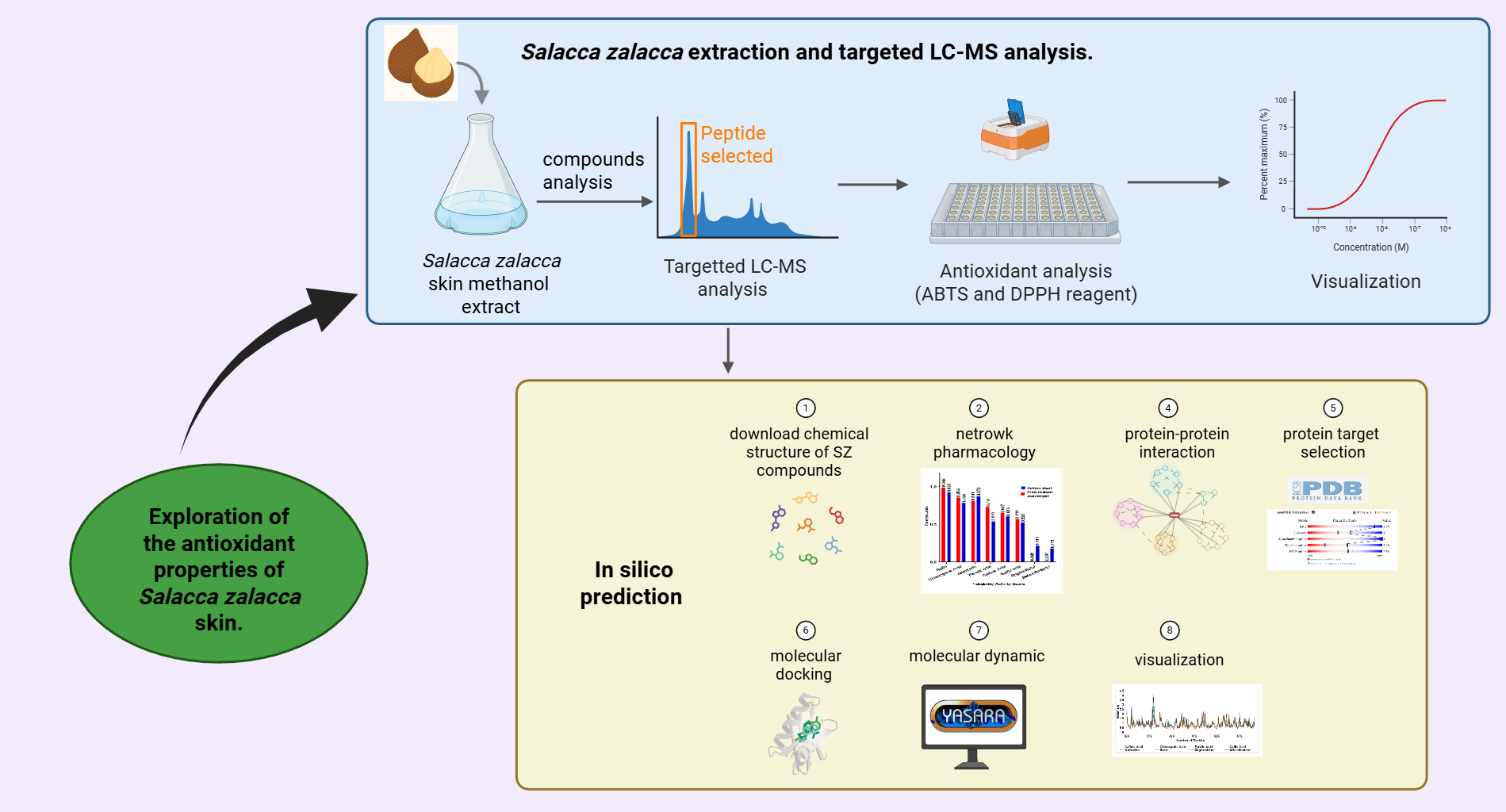
Downloads
References
H Sies. Oxidative stress: Concept and some practical aspects. Antioxidants 2020; 9(9), 852.
R Vona, L Pallotta, M Cappelletti, C Severi and P Matarrese. The impact of oxidative stress in human pathology: Focus on gastrointestinal disorders. Antioxidants 2021; 10(2), 201.
M Sharifi-Rad, NVA Kumar, P Zucca, EM Varoni, L Dini, E Panzarini, J Rajkovic, PVT Fokou, E Azzini, I Peluso, AP Mishra, M Nigam, Y El-Rayess, ME Beyrouthy, L Polito, M Iriti, N Martins, M Martorell, AO Docea, WN Setzer, D Calina, WC Cho and J Sharifi-Rad. Lifestyle, oxidative stress, and antioxidants: Back and forth in the pathophysiology of chronic diseases. Frontiers in Physiology 2020; 11, 552535.
HH Ilmiah, E Sulistyaningsih and T Joko. Fruit morphology, antioxidant activity, total phenolic and flavonoid contents of Salacca zalacca (Gaertner) voss by applications of goat manures and Bacillus velezensis B-27. Journal of Sustainable Agriculture 2021; 36(2), 270-282.
IR Suica-Bunghez, S Teodorescu, ID Dulama, OC Voinea, S Imionescu and RM Ion. Antioxidant activity and phytochemical compounds of snake fruit (Salacca Zalacca). IOP Conference Series: Materials Science and Engineering 2016; 133(1), 012051.
SS Tan, ST Tan and CX Tan. Antioxidant, hypoglycemic and anti-hypertensive properties of extracts derived from peel, fruit and kernel of Salak. British Food Journal 2020; 122(10), 3029-3038.
SN Begum, M Hossain, MD Adnan, CH Rahaman and A Reza. Optimization and characterization of phenolic extraction conditions and antioxidant activity evaluation of Adenanthera pavonina L. Bark. Plants 2023; 12(22), 3902.
TH Fatoki, TC Balogun, AE Ojewuyi, AC Omole, OV Olukayode, AP Adewumi, AJ Umesi, NP Ijeoma, AE Apooyin, CP Chinedu, IE Idowu and MJ Isah. In silico molecular targets, docking, dynamics simulation and physiologically based pharmacokinetics modeling of oritavancin. BMC Pharmacology and Toxicology 2024; 25(1), 79.
J Liigand, T Wang, J Kellogg, J Smedsgaard, N Cech and A Kruve. Quantification for non-targeted LC/MS screening without standard substances. Scientific Reports 2020; 10(1), 5808.
A Vignesh, S Selvakumar and K Vasanth. Comparative LC-MS analysis of bioactive compounds, antioxidants and antibacterial activity from leaf and callus extracts of Saraca asoca. Phytomedicine Plus 2022; 2(1), 100167.
HTT Trang, NH Xuan, CL Hong, TTT Nhung, DTT Giang, NTD Hang and PT Thuy. In silico molecular docking, DFT, and toxicity studies of potential inhibitors derived from Millettia dielsiana against human inducible nitric oxide synthase. Journal of Chemical Research 2024; 48(4), 17475198241263837.
RAP Irsal, GM Gholam, MA Dwicesaria and F Chairunisa. Computational investigation of Y. aloifolia variegate as anti-Human Immunodeficiency Virus (HIV) targeting HIV-1 protease: A multiscale in-silico exploration. Pharmacological Research - Modern Chinese Medicine 2024; 11, 100451.
S Zhou, H Zhang, J Li, W Li, M Su, Y Ren, F Ge, H Zhang and H Shang. Potential anti-liver cancer targets and mechanisms of kaempferitrin based on network pharmacology, molecular docking and experimental verification. Computers in Biology and Medicine 2024; 178, 108693.
Y Yueniwati, M Syaban, D Kurniawan, A Azam, D Alvenia, Y Savira, R Muhammad, B Adnani, A Violita, S Arviana, A Hasibuan, E Norahmawati, Y Fatmasari, A Mufidah, K Savitri, U Zulfikri, D Putri and S Utami. 7,8‑Dihydroxyflavone functions as an antioxidant through the inhibition of Kelch‑like ECH‑associated protein 1: Molecular docking and an in vivo approach in a rat model of ischemia‑reperfusion brain injury. World Academy of Sciences Journal 2024; 6(2), 15.
SC Lo, X Li, MT Henzl, LJ Beamer and M Hannink. Structure of the Keap1: Nrf2 interface provides mechanistic insight into Nrf2 signaling. The EMBO Journal 2006; 25(15), 3605-3617.
A Siddiqa, A Tajammal, A Irfan, A Munawar, M Azam and MAR Basra. Synthesis, antioxidant, in silico and computational investigation of 2,5-dihydroxyacetophenone derived chloro-substituted hydroxychalcones, hydroxyflavanones and hydroxyflavindogenides. Journal of Biomolecular Structure and Dynamics 2022; 40(20), 10265-10277.
EM Hussen and SA Endalew. In vitro antioxidant and free-radical scavenging activities of polar leaf extracts of Vernonia amygdalina. BMC Complementary Medicine and Therapies 2023; 23(1), 146.
E Girsang, INE Lister, CN Ginting, A Khu, B Samin, W Widowati, S Wibowo and R Rizal. Chemical constituents of snake fruit (Salacca zalacca (Gaert.) Voss) peel and in silico anti-aging analysis. Molecular and Cellular Biomedical Sciences 2019; 3(2), 122-128.
M Kanlayavattanakul, N Lourith, D Ospondpant, U Ruktanonchai, S Pongpunyayuen and C Chansriniyom. Salak plum peel extract as a safe and efficient antioxidant appraisal for cosmetics. Bioscience, Biotechnology, and Biochemistry 2013; 77(5), 1068-1074.
SM Saleh Mohammed, M Siddiqui, A Mediani, N Ismail, Q Ahmed, SM So’ad and S Saidi-Besbes. Salacca zalacca : A short review of the palm botany, pharmacological uses and phytochemistry. Asian Pacific Journal of Tropical Medicine 2018; 11(12), 645-652.
TM Creanza, P Delre, N Ancona, G Lentini, M Saviano and GF Mangiatordi. Structure-based prediction of hERG-related cardiotoxicity: A benchmark study. Journal of Chemical Information and Modeling 2021; 61(9), 4758-4770.
N Muvhulawa, PV Dludla, K Ziqubu, SXH thembu, F Mthiyane, BB Nkambule and SE Mazibuko-Mbeje. Rutin ameliorates inflammation and improves metabolic function: A comprehensive analysis of scientific literature. Pharmacological Research 2022; 178, 106163.
DM Hushpulian, N Ammal Kaidery, M Ahuja, AA Poloznikov, SM Sharma, IG Gazaryan and B Thomas. Challenges and limitations of targeting the Keap1-Nrf2 pathway for neurotherapeutics: Bach1 de-repression to the rescue. Frontiers in Aging Neuroscience 2021; 13, 673205.
J Wu, Y Zhou, J Zhang, HX Zhang and R Jia. Molecular dynamics simulation investigation of the binding and Interaction of the EphA6 - odin protein complex. The Journal of Physical Chemistry B 2022; 126(26), 4914-4924.
VH Sato, S Chewchinda, AS Goli, H Sato, J Nontakham and B Vongsak. Oral Glucose Tolerance Test (OGTT) evidence for the postprandial anti-hyperglycemic property of Salacca zalacca (Gaertn.) voss seed extract. Molecules 2023; 28(19), 6775.
R Oktarianti, NA Septiana and A Lelono. Diuretics effect of salak (Salacca zalacca) seed extract to kidney histopathological structure of the wistar male rats (Rattus norvegicus). Bioedukasi 2021; 19(2), 90-95.
MA Tremocoldi, PL Rosalen, M Franchin, AP Massarioli, C Denny, ER Daiuto, JAR Paschoal, PS Melo and S Alencar. Exploration of avocado by-products as natural sources of bioactive compounds. PLoS One 2018; 13(2), e0192577.
YM Bashmin, A Ali, A Bk, FR Dunshea and HAR Suleri. Screening and characterization of phenolic compounds from australian grown bananas and their antioxidant capacity. Antioxidants 2021; 10(10), 1521.
SM Saleh Mohammed, M Siddiqui, S Mat So’ad, S Murugesu, A Khatib and M Rahman. Antioxidant and α-glucosidase inhibitory activities and gas chromatography - mass spectrometry profile of salak (Salacca zalacca) fruit peel extracts. Pharmacognosy Research 2018; 10(4), 385-390.
T Stangeland, SF Remberg and KA Lye. Total antioxidant activity in 35 Ugandan fruits and vegetables. Food Chemistry 2009; 113(1), 85-91.
X Ma, H Wu, L Liu, Q Yao, S Wang, R Zhan, S Xing and Y Zhou. Polyphenolic compounds and antioxidant properties in mango fruits. Scientia Horticulturae 2011; 129(1), 102-107.

Published
How to Cite
Issue
Section
License
Copyright (c) 2025 Walailak University

This work is licensed under a Creative Commons Attribution-NonCommercial-NoDerivatives 4.0 International License.





