
Mechanistic Insights into the Enhancement of Natural Dyeability of PLA Fabrics via Atmospheric DBD Plasma Treatment
DOI:
https://doi.org/10.48048/tis.2026.12824Keywords:
Poly(lactic acid), Dielectric barrier discharge (DBD) plasma, Surface modification, Natural dyes, Dye diffusion coefficient, Color strength, Washing fastness, Poly(lactic acid), Dielectric barrier discharge (DBD) plasma, Surface modification, Natural dyes, Dye diffusion coefficient, Color strength, Washing fastnessAbstract
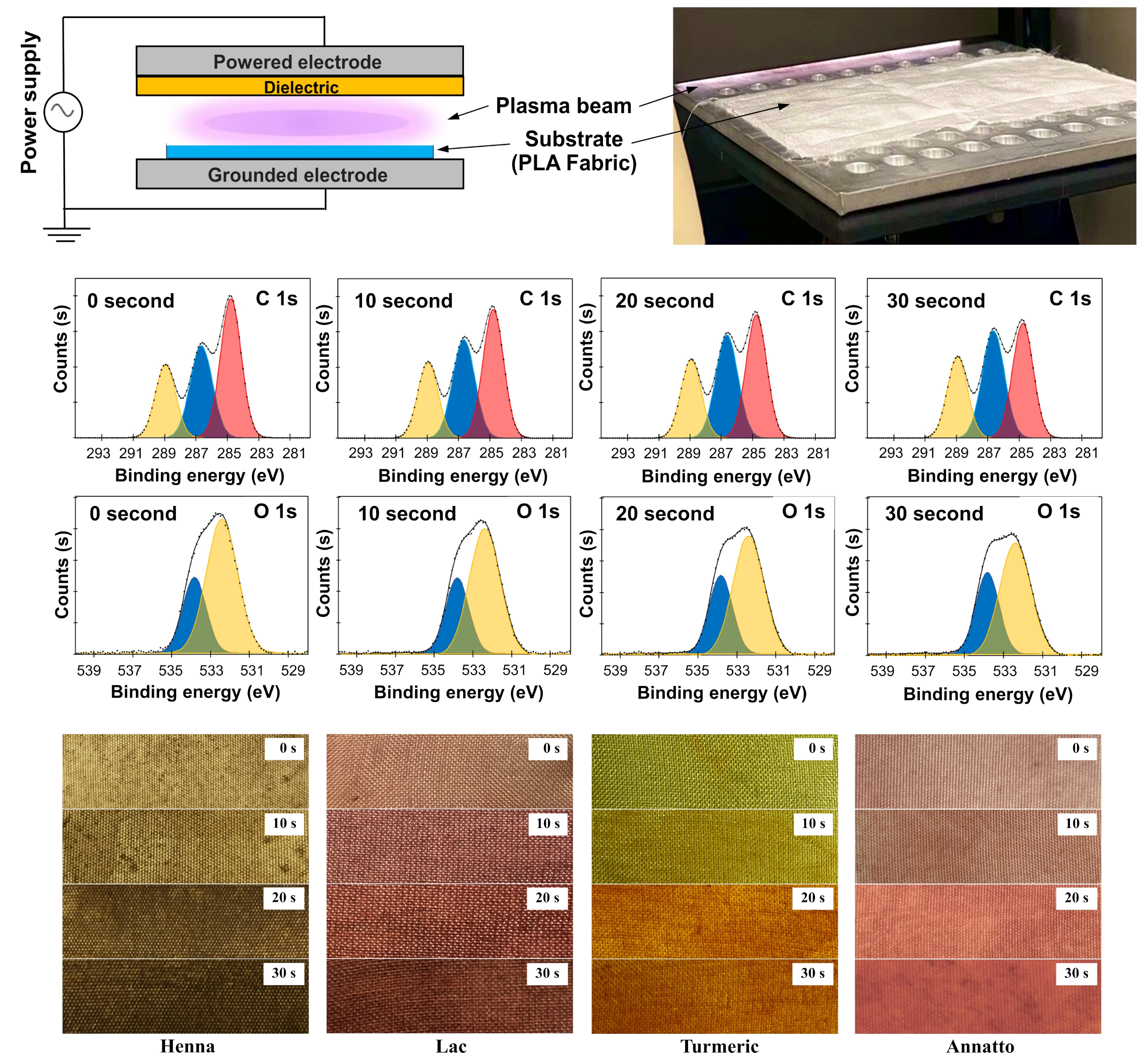
Poly(lactic acid) (PLA) is a biodegradable and environmentally sustainable material, although its ability for dyeing is limited, especially with natural dyes. This study examined the application of dielectric barrier discharge (DBD) plasma in atmospheric conditions to enhance the surface features of PLA fabrics without using wetting agents. Experiments utilized the response surface methodology (RSM) analysis for determining the proper condition, including power and plasma exposure time. X-ray photoelectron spectroscopy (XPS) analysis revealed an increase in the O/C ratio from ~0.42 to ~0.59 after 30 s of plasma exposure, while field emission scanning electron microscopy (FE-SEM) images expressed the appearance of nanoscale roughness over the entire fiber surface due to plasma etching. Furthermore, the water uptake increased about 2.5 times, indicating a change in the surface characteristics toward increased hydrophilicity. To analyze the dyeing performance, the Fickian model was used to evaluate the dye diffusion coefficient (D), along with calculating the color strength (K/S). It was found that relatively higher polar dyes like henna and lac exhibited significantly improved dye adhesion, while turmeric and annatto showed only minor changes. The washing fastness results supported this observation; henna and lac maintained stronger color adhesion after treatment, whereas turmeric and annatto showed only modest improvement. Mechanical property tests revealed a slight decrease in yarn strength with prolonged plasma treatment. In conclusion, the pretreatment of PLA fabric with DBD plasma is a clean, chemical-free, and effective method to enhance the dyeing properties of PLA fabric with natural dyes, especially those with relatively higher polarity, if exposure time is controlled within an appropriate range.
HIGHLIGHTS
- Atmospheric DBD plasma unlocked the inert surface of PLA, resulting in functional sites that allow natural dyes to penetrate and bond without the use of mordants.
- The treatment achieved a balance between nanoscale etching and oxidation, reaching a critical activation point where hydrophilicity and mechanical strength coexist.
- This work bridges the gap between green processing and performance, providing a scalable route for naturally dyed biobased textiles with long-term color stability.
GRAPHICAL ABSTRACT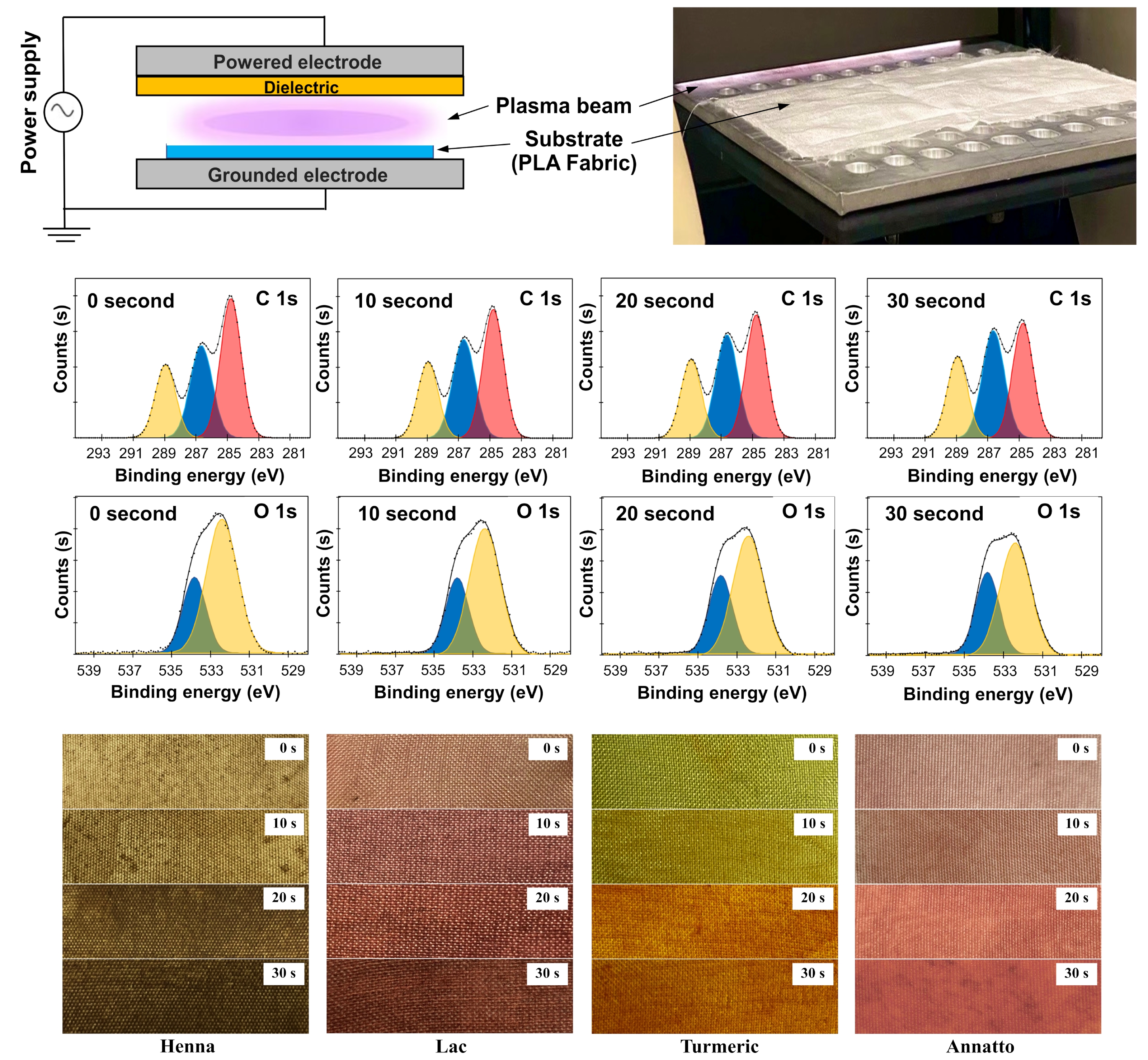
Downloads
References
T Hussain, M Tausif and M Ashraf. A review of progress in the dyeing of eco-friendly aliphatic polyester-based polylactic acid fabrics. Journal of Cleaner Production 2015; 108, 476.
R Sutthikitivorakul, P Phinyocheep and W Tessanan. Enhancing mechanical and thermal properties of recycled poly(lactic acid) with multi-branched polyethyleneimine for sustainable recycling applications. Trends in Sciences 2025; 22(5), 9459.
S Gołębiowska, M Voigt, T Arcos and G Grundmeier. In situ PM-IRRSA and XPS analysis of nitrogen plasma surface modification of polylactide thin films. Surface and Interface Analysis 2025; 57(7), 499.
G Baig. Coloration of poly(lactic acid) based textiles: A review. Polimery 2020; 65(6), 415.
N Reddy, D Nama and Y Yang. Polylactic acid/polypropylene polyblend fibers for better resistance to degradation. Polymer Degradation and Stability 2008; 93(1), 233.
O Avinc and A Khoddami. Overview of poly(lactic acid) (PLA) fibre: part II: Wet processing; pretreatment, dyeing, clearing, finishing, and washing properties of poly(lactic acid) fibres. Fibre Chemistry 2010; 42(1), 59.
U Tayfun and M Doğan. Improving the dyeability of poly (lactic acid) fiber using organoclay during melt spinning. Polymer Bulletin 2016; 73(6), 1581.
Z Ju, Y Yang, B Fei and H Hu. Enhancing dyeability of sustainable polylactic acid fabrics through cross-sectional modification of filaments. Textile Research Journal 2025; 95(15), 1814.
M Bertin, E Leitao, S Bickerton and C Verbeek. A review of polymer surface modification by cold plasmas toward bulk functionalization. Plasma Processes and Polymers 2024; 21(5), 2300208
S Sakti, P Arinda, T Zafirah, T Putro, N Khusnah and D Santjojo. Morphology and wettability of polystyrene film on QCM sensor caused by oxygen plasma with dc bias. Trends in Sciences 2024; 21(11), 8318.
T Kim, K Hong, N Thi, and H Manh. The effect of DBD plasma activation time on the dyeability of woven polyester fabric with disperse dye. Polymers 2021; 13(9), 1434.
S Mowafi, M Taleb and H El-Sayed. A review of plasma-assisted treatments of textiles for eco-friendlier water-less processing. Egyptian Journal of Chemistry 2022; 65(5), 737.
W Seerlarat, P Porjai, S Phasuk and P Nilsang. Influence of electric potential on dielectric barrier discharge (DBD) cold plasma treatment and its effect on the affinity of leaf printing on cotton fabric. Trends in Sciences 2025; 22(11), 10461.
J Wang, X Chen, R Reis, Z Chen, N Milne, B Winther-Jensen, L Kong and L Dumée. Plasma modification and synthesis of membrane materials: A mechanistic review. Membranes 2018; 8(3), 56.
L Phan, S Yoon and M Moon. Plasma-based nanostructuring of polymers: A review. Polymers 2017; 9(9), 417.
M Fleischer, Z Tuceková, O Galmiz, E Batková, T Plšek, T Kolárová, D Kovácik and J Kelar. Plasma treatment of large-area polymer substrates for the enhanced adhesion of UV-digital printing. Nanomaterials 2024; 14(5), 426.
V Serrano-Martínez, C Ruzafa-Silvestre, C Hernández-Fernández, E Bañón-Gil, F Arán-Ais and E Orgilés-Calpena. Improving cotton fabric dyeability by oxygen plasma surface activation. Surfaces 2024; 7(4), 1079.
E Carbone, M Verhoeven, W Keuning and J Mullen. PTFE treatment by remote atmospheric Ar/O₂ plasmas: A simple reaction scheme model proposal. Journal of Physics: Conference Series 2016; 715, 012011.
E Bozacı, K Sever, A Demir, Y Seki, M Sarikanat and E Özdoğan. Effect of the atmospheric plasma treatment parameters on surface and mechanical properties of jute fabric. Fibers and Polymers 2009; 10(6), 781.
E Bozacı, K Sever, M Sarikanat, Y Seki, A Demir, E Ozdogan and I Tavman. Effects of the atmospheric plasma treatments on surface and mechanical properties of flax fiber and adhesion between fiber-matrix for composite materials. Composites Part B: Engineering 2013; 45(1), 565.
S Palasakar, R Kale and R Deshmukh. Adhesion properties of DBD plasma-treated nylon 66 fabric - Optimization of plasma process parameters. International Journal of Adhesion and Adhesives 2020; 96, 102446.
S Manjula, O Shanmugasundaram and K Ponappa. Optimization of plasma process parameters for surface modification of bamboo spunlace nonwoven fabric using glow discharge oxygen plasma. Journal of Industrial Textiles 2021; 51(2), 225.
M Bhuiyan, A Ali, A Islam, M Hannan, S Kabir and M Islam. Coloration of polyester fiber with natural dye henna (Lawsonia inermis L.) without using mordant: A new approach towards a cleaner production. Fashion and Textiles 2018; 5(1), 4069.
J Chouytan, R Thirawat, D Khotradha, T Ruangteprat, I sittitanadol and S Udon. Enhancing the efficiency of hemp fiber dyeing with natural dyes: Indigo and lac. Journal of Metals, Materials and Minerals 2024; 34(2), 1873
D Hosen, F Rabbi, A Raihan and A Mamun. Effect of turmeric dye and biomordants on knitted cotton fabric coloration: A promising alternative to metallic mordanting. Cleaner Engineering and Technology 2021; 3, 100124.
P Naidis, S Lykidou, M Mischopoulou, E Vouvoudi and N Nikolaidis. Study of the dyeing properties of annatto and ultrafiltrated annatto as colourants for natural fibres. Journal of Natural Fibers 2021; 19(14), 7885-7895.
S Umbreen, S Ali, T Hussain, T Hussain and R Nawaz. Dyeing properties of natural dyes extracted from turmeric and their comparison with reactive dyeing. Research Journal of Textile and Apparel 2008; 12(4), 1-11.
A Haji and M Naebe. Cleaner dyeing of textiles using plasma treatment and natural dyes: A review. Journal of Cleaner Production 2020; 265, 121866.
M Naebe, P Cookson, J Rippon, R Brady, X Wang, N Brack and G Riessen. Effects of plasma treatment of wool on the uptake of sulfonated dyes with different hydrophobic properties. Textile Research Journal 2010; 80(4), 312.
G Primc. Hydrophilization of polypropylene by gaseous plasma treatments and hydrophobic recovery. Polymers 2025; 17(19), 2644.
J Crank. The mathematics of diffusion. 2nd ed. Oxford University Press, London, 1975, p. 44-68.
N Jiang, Y Li, Y Li, T Yu, Y Li, D Li, J Xu, C Wang and Y Shi. Effect of short jute fibers on the hydrolytic degradation behavior of poly(lactic acid). Polymer Degradation and Stability 2020; 178, 109198.
M Azka, S Sapuan, H Abral, E Zainudin and F Aziz. An examination of recent research of water absorption behavior of natural fiber reinforced polylactic acid (PLA) composites: A review. International Journal of Biological Macromolecules 2024; 268, 131845.
A Jorda-Vilaplana, V Fombuena, D Garcia-Garcia, M Samper and L Sanchez-Nacher. Surface modification of polylactic acid (PLA) by air atmospheric plasma treatment. European Polymer Journal 2014; 58, 23-33.
O Laput, I Vasenina, MC Salvadori, K Savkin, D Zuza and I Kurzina. Low-temperature plasma treatment of polylactic acid and PLA/HA composite material. Journal of Materials Science 2019; 54, 11726-11738.
Y Ren, L Xu, C Wang, X Wang, Z Ding and Y Chen. Effect of dielectric barrier discharge treatment on surface nanostructure and wettability of polylactic acid (PLA) nonwoven fabrics. Applied Surface Science 2017; 426, 612-621.
B Hergelová, A Zahoranová, D Kováčik, M Stupavská and M Černák. Polylactic acid surface activation by atmospheric pressure dielectric barrier discharge plasma. Open Chemistry 2015; 13, 564-569.
Z Krtouš, L Hanyková, I Krakovský, D Nikitin, P Pleskunov, O Kylián, J Sedlaříková and J Kousal. Structure of plasma (re)polymerized polylactic acid films fabricated by plasma-assisted vapour thermal deposition. Materials 2021; 14(2), 459.
M Zarei, S Sayedain, A Askarinya, M Sabbaghi and R Alizadeh. Improving physio-mechanical and biological properties of 3D-printed PLA scaffolds via in-situ argon cold plasma treatment. Scientific Reports 2023; 13, 14120.
M Hanwell, D Curtis, D Lonie, T Vandermeersch, E Zurek and G Hutchison. Avogadro: An advanced semantic chemical editor, visualization, and analysis platform. Journal of Cheminformatics 2012; 4, 17.
W Mortier, S Ghosh and S Shankar. Electronegativity-equalization method for the calculation of atomic charges in molecules. Journal of the American Chemical Society 1986; 108, 4315-4320.
Published
How to Cite
Issue
Section
License
Copyright (c) 2025 Walailak University

This work is licensed under a Creative Commons Attribution-NonCommercial-NoDerivatives 4.0 International License.





