
A Circular Economy Use of Durian Rind Waste for Cellulose Extraction and Its Application in Polylactic Acid (PLA) Biodegradable Composites
DOI:
https://doi.org/10.48048/tis.2025.10106Keywords:
Circular economy, Waste, Biodegradable polymer, Environmental sustainability, Cellulose, Durian rindAbstract
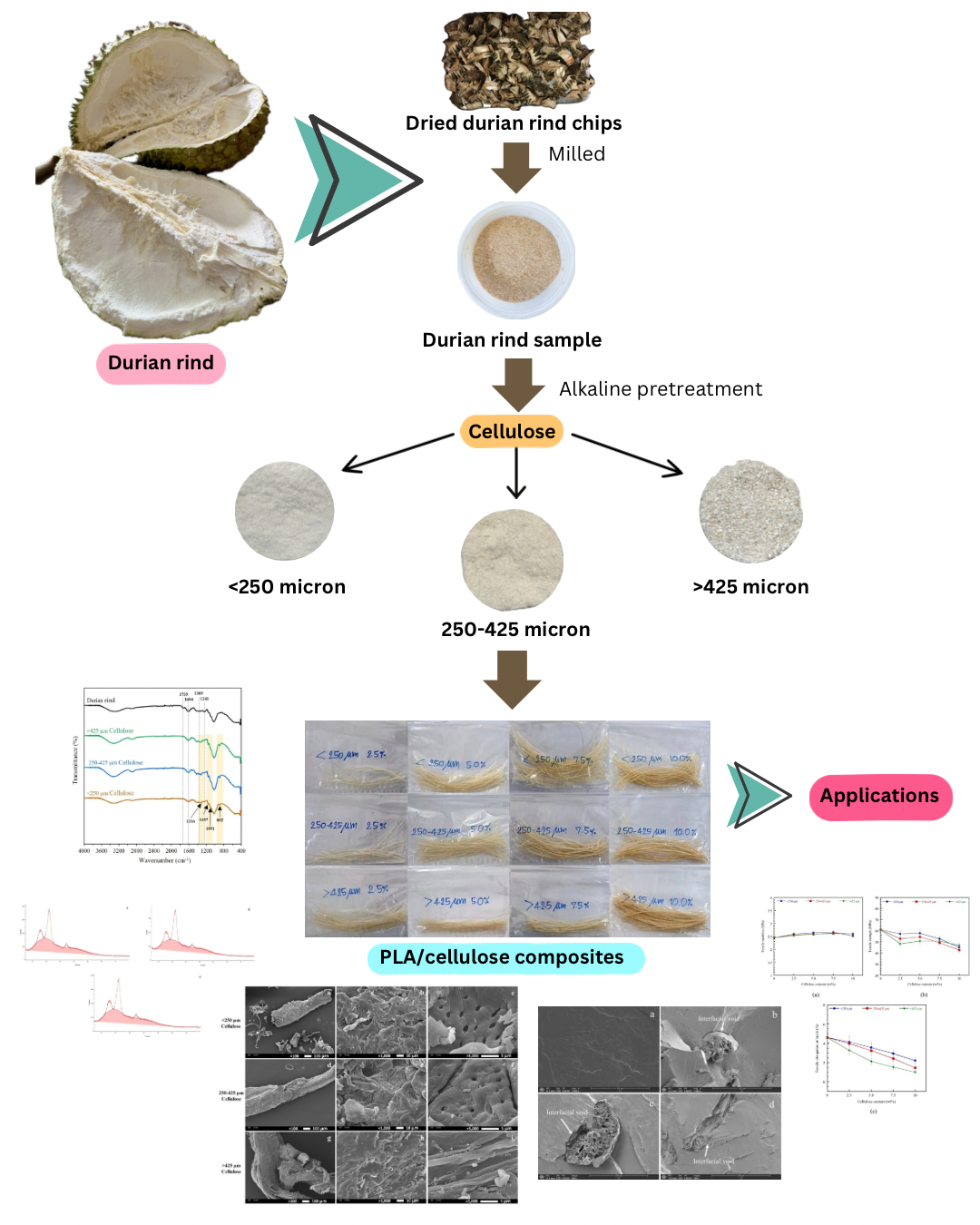
Durian rind is a food waste by-product left after consuming fruit flesh and can contribute to environmental pollution due to its slow decomposition and the large disposal area required because of its bulky shape. This study aims to evaluate the potential of durian rind as a cellulose source for producing biodegradable composites. Cellulose was extracted from the sample using a single-step alkali and hydrogen peroxide pretreatment under different conditions (temperature, residence time, and H2O2 concentration). The optimal condition for achieving the highest cellulose content with minimal lignin contamination was treatment with 5 % NaOH in 7.5 % H2O2 at 50 °C for 5 h. The extracted cellulose was milled and sieved to obtain 3 different particle sizes (< 250 µm (S), 250 - 425 µm (M), and > 425 µm (L)). All cellulose samples were characterized to determine their chemical and physical properties. FTIR spectra confirmed that most impurities in the raw material were removed after extraction. To evaluate the composite properties, polylactic acid (PLA)/cellulose composites with varying cellulose particle sizes and loadings were analyzed and compared to neat PLA. An increase in Young’s modulus was observed with the addition of cellulose, with the effect being more pronounced at lower cellulose loadings. Conversely, higher cellulose content negatively affected the composite properties, reducing tensile strength and elongation at break. This adverse effect was more significant with larger cellulose particles. FE-SEM analysis revealed that larger cellulose particles created larger interfacial voids, contributing to a decrease in tensile elongation at break. The incorporation of cellulose into PLA slightly elevated the glass transition temperature by approximately 1 - 2 °C. Moreover, the degree of crystallinity (Xc) significantly increased with the addition of cellulose, with smaller cellulose particles being more effective in enhancing Xc. PLA/cellulose composites may be suitable for applications as single-use plastics.
HIGHLIGHTS
- A single-step alkali and hydrogen peroxide pretreatment under relatively mild conditions effectively extracted cellulose from durian rind.
- Cellulose particle size and loading content significantly influenced the mechanical and thermal properties of PLA composites.
- Although incorporating larger cellulose particles reduced tensile strength and elongation, PLA/cellulose composites remain suitable for single-use applications with distinct advantages.
- Durian rind presents strong potential as a sustainable and abundant cellulose source for bio-based material development.
GRAPHICAL ABSTRACT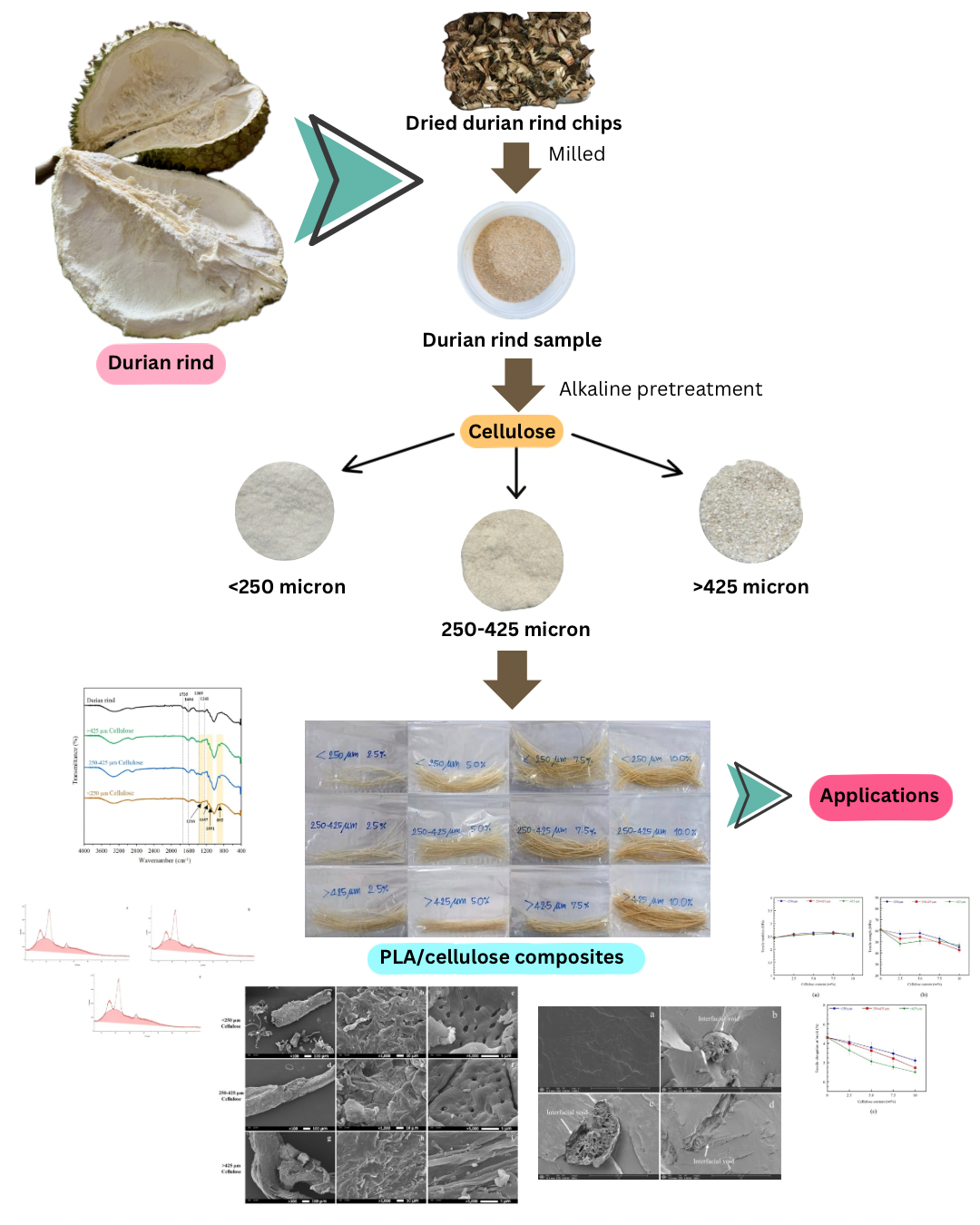
Downloads
References
G Cazacu and V Popa. Blends and composites based on cellulose material. In: S Dumitriu (Ed.). Polysaccharides structural diversity and functional versatility. 2nd eds. CRC Press, Boca Raton, 2004.
P Rai, S Mehrotra, S Priya, E Gnansounou and SK Sharma. Recent advances in the sustainable design and applications of biodegradable polymers. Bioresource Technology 2021; 325, 124739.
CG Silva, PAL Campini, DB Rocha and DS Rosa. The influence of treated eucalyptus microfibers on the properties of PLA biocomposites. Composites Science and Technology 2019; 179, 54-62.
H Ebadi-Dehaghani, HA Khonakdar, M Brarikani and SH Jafari. Experimental and theoretical analyses of mechanical properties of PP/PLA/clay nanocomposites. Composites: Part B: Engineering 2015; 69, 133-144.
JC Posada, LY Jaramillo, EM Cadena and LA Garcia. Bio-based composites from agricultural wastes: Polylactic acid and bamboo Guadua angustifolia. Journal of Composite Materials 2015; 50(23), 3229-3237.
HPSA Khalil, AH Bhat and AFI Yusra. Green composites from sustainable cellulose nanofibrils: A review. Carbohydrate Polymers 2012; 87(2), 963-979.
M Luddee, S Pivsa-Art, S Sirisansaneeyakul and C Pechyen. Particle size of ground bacterial cellulose affecting mechanical, thermal, and moisture barrier properties of PLA/BC biocomposites. Energy Procedia 2014; 56, 211-218.
AP Mathew, K Oksman and M Sain. The effect of morphology and chemical characteristics of cellulose reinforcements on the crystallinity of polylactic acid. Journal of Applied Polymer Science 2006; 101(1), 300-310.
K Halász and L Csóka. Plasticized biodegradable poly(lactic acid) based composites containing cellulose in micro- and nanosize. Journal of Engineering 2013; 2013, 329379.
U Saeed. Wood cellulose fibers reinforced polylactic acid composite: Mechanical, thermomechanical characteristics and orientation of fiber. AIMS Materials Science 2020; 7(1), 9-23.
ISMA Tawakkal, RA Talib, K Abdan and CN Ling. Mechanical and physical properties of kenaf-derived cellulose (KDC)-filled polylactic acid (PLA) composites. BioResources 2012; 7(2), 1643-1655.
MM Ali, N Hashim, SA Aziz and O Lasekan. Exploring the chemical composition, emerging applications, potential uses, and health benefits of durian: A review. Food Control 2020; 113, 107189.
MR Manshor, H Anuar, MNN Aimi, MIA Fitrie, WBW Nazri, SM Sapuan, YA El-Shekeil and MU Wahit. Mechanical, thermal and morphological properties of durian skin fibre reinforced PLA biocomposites. Materials and Design 2014; 59, 279-286.
R Jumaidin, LW Whang, RA Ilyas, KZ Hazrati, KZ Hafila, T Jamal and RA Alia. Effect of durian peel fiber on thermal, mechanical, and biodegradation characteristics of thermoplastic cassava starch composites. International Journal of Biological Macromolecules 2023; 250, 126295.
MC Lee, SC Koay, MY Chan, HL Choo, MM Pang, PM Chou and KY Tshai. Properties of poly(lactic acid)/durian husk fiber biocomposites: Effects of fiber content and processing aid. Journal of Thermoplastic Composite Materials 2020; 33(11), 1518-1532.
S Charoenvai. New insulating materials: Binderless particleboard from durian peel. In: SY Chang, SKA Bahar and J Zhao (Eds.). Advances in civil engineering and building materials. Taylor and Francis Group, London, 2013, p. 119-123.
P Penjumras, RA Rahman, RA Talib and K Abdan. Mechanical properties and water absorption behaviour of durian rind cellulose reinforced poly(lactic acid) biocomposites. International Journal on Advanced Science, Engineering and Information Technology 2015; 5(5), 343-349.
A Sluiter, B Hames, D Hyman, C Payne, R Ruiz, C Scarlata, J Sluiter, D Templeton and J Wolfe. Determination of total solids in biomass and total dissolved solids in liquid process samples: Laboratory Analytical Procedure (LAP), Technical Report NREL/TP-510-42621. National Renewable Energy Laboratory, Golden, Colorado, 2008.
A Sluiter, B Hames, R Ruiz, C Scarlata, J Sluiter and D Templeton. Determination of ash in biomass: Laboratory Analytical Procedure (LAP), Technical Report NREL/TP-510-42622. National Renewable Energy Laboratory, Golden, Colorado, 2008.
A Sluiter, R Ruiz, C Scarlata, J Sluiter and D Templeton. Determination of extractives in biomass: Laboratory Analytical Procedure (LAP), Technical Report NREL/TP-510-42619. National Renewable Energy Laboratory, Golden, Colorado, 2008.
A Sluiter, B Hames, R Ruiz, C Scarlata, J Sluiter, D Templeton and D Crocker. Determination of structural carbohydrates and lignin in biomass: Laboratory Analytical Procedure (LAP), Technical Report NREL/TP-510-42618. National Renewable Energy Laboratory, Golden, Colorado, 2012.
S Sophonputtanaphoca, P Chutong, K Cha-aim and P Nooeaid. Potential of Thai rice straw as a raw material for the synthesis of carboxymethylcellulose. International Food Research Journal 2019; 26(3), 969-978.
P Rachtanapun, S Luangkamin, K Tanprasert and R Suriyatem. Carboxymethyl cellulose film from durian rind. LWT - Food Science and Technology 2012; 48(1), 52-58.
N Haleem, M Arshad, M Shahid and MA Tahir. Synthesis of carboxymethyl cellulose from waste of cotton ginning industry. Carbohydrate Polymers 2014; 113, 249-255.
N Petchwattana, P Naknaen and B Narupai. Combination effects of reinforcing filler and impact modifier on the crystallization and toughening performances of poly(lactic acid). Express Polymer Letters 2020; 14(9), 848-859.
S Jia, Y Chen, J Bian, H Pan, X Wang, L Zhao, L Han, H Zhang, L Dong and H Zhang. Preparation and properties of poly(L-lactic acid) blends with excellent low-temperature toughness by blending acrylic ester-based impact resistance agent. International Journal of Biological Macromolecules 2021; 183, 1871-1880.
N Petchwattana and B Narupai. Synergistic effect of talc and titanium dioxide on poly(lactic acid) crystallization: An investigation on the injection molding cycle time reduction. Journal of Polymers and the Environment 2019; 27, 837-846.
SR Masrol, MHI Ibrahim and S Adnan. Chemi-mechanical pulping of durian rinds. Procedia Manufacturing 2015; 2, 171-180.
NH Hasem, SFZM Fuzi, F Kormin, MFA Bakar and SF Sabran. Extraction and partial characterization of durian rind pectin. IOP Conference Series: Earth and Environmental Science 2019; 269, 12019.
S Sophonputtanphoca, K Srigatmaneerat and K Kruakrut. Effect of low temperatures and residence times of pretreatment on glucan reactivity of sodium hydroxide-pretreated rice straw. Walailak Journal of Science and Technology 2018; 15(4), 313-323.
FM Giro, C Fonseca, F Carvalheiro, LC Duarte, S Marques and R Bogel-Lucasik. Hemicelluloses for fuel ethanol: A review. Bioresource Technology 2010; 101(13), 4775-4800.
Y Su, R Du, H Guo, M Cao, Q Wu, R Su, W Qi and Z He. Fractional pretreatment of lignocellulose by alkaline hydrogen peroxide: Characterization of its major components. Food and Bioproducts Processing 2015; 94, 322-330.
R Suriyatem, N Noikang, T Kankam, K Jantanasakulwong, N Leksawasdi, Y Phimolsiripol, C Insomphun, P Seesuriyachan, T Chaiyaso, P Jantrawut, SR Sommano, TMP Ngo and P Rachtanapun. Physical properties of carboxymethyl cellulose from palm bunch and bagasse agricultural wastes: Effect of delignification with hydrogen peroxide. Polymers 2020; 12(7), 1505.
CRG Torres, E Crastechini, FA Feitosa, CR Pucci and AB Borges. Influence of pH on the effectiveness of hydrogen peroxide whitening. Operative Dentistry 2014; 39(6), E261-E268.
EY Yazici and H Deveci. Factors affecting decomposition of hydrogen peroxide. In: Proceedings of the 12th International Mineral Processing Symposium, Cappadocia-Nevşehir, Turkey. 2010, p. 609-616.
R Hage, JWD Boer, F Gaulard and K Maaijen. Manganese and iron bleaching and oxidation catalysts. Advances in Inorganic Chemistry 2013; 65, 85-116.
E Trautmann, T Attin, D Mohn and M Zehnder. Hydrogen peroxide versus sodium hypochlorite: All a matter of pH? Journal of Endodontics 2021; 47(2), 297-302.
Q Cai, Z Fan, J Chen, W Guo, F Ma, S Sun, L Hu and Q Zhou. Dissolving process of bamboo powder analyzed by FT-IR spectroscopy. Journal of Molecular Structure 2018; 1171, 639-643.
M Chylińska, M Szymańska and A Zdunek. FT-IR and FT-Raman characterization of non-cellulosic polysaccharides fractions isolated from plant cell wall. Carbohydrate Polymers 2016; 154, 48-54.
RR Rizkiansyah, Y Mardiyati, A Hariyato, S Steven and T Dirgantara. Non-wood paper from coffee pulp waste: How its performance as coffee filter. Cleaner Materials 2024; 12, 100241.
BS Yew, M Muhamad, SB Mohamed and FH Wee. Effect of alkaline treatment on structural characterization, thermal degradation and water absorption ability of coir fibre polymer composites. Sains Malaysiana 2019; 43(3), 653-659.
RG Candido and AR Gonҫalves. Synthesis of cellulose acetate and carboxymethylcellulose from sugarcane straw. Carbohydrate Polymers 2016; 152, 679-686.
I Egüés, C Sanchez, I Mondragon and J Labidi. Effect of alkaline and autohydrolysis processes on the purity of obtained hemicelluloses from corn stalks. Bioresource Technology 2012; 103(1), 239-248.
RC Sun and J Tomkinson. Characterization of hemicelluloses obtained by classical and ultrasonically assisted extractions from wheat straw. Carbohydrate Polymers 2002; 50(3), 263-271.
M Li, LJ Wang, D Li, YL Cheng and B Adhikari. Preparation and characterization of cellulose nanofibers from de-pectinated sugar beet pulp. Carbohydrate Polymers 2014; 102, 136-143.
P Penjumras, RBA Rahman, RA Talib and K Abdan. Extraction and characterization of cellulose from durian rind. Agriculture and Agricultural Science Procedia 2014; 2, 237-243.
N Petchwattana, W Channuan, P Naknaen and B Narupai. 3D printing filaments prepared from modified poly (lactic acid)/teak wood flour composites: An investigation on the particle size effects and silane coupling agent compatibilisation. Journal of Physical Science 2019; 30(2), 169-188.
VU Siddiqui, J Yusuf, SM Sapuan, MZ Hasan, MMM Bistari and ZG Mohammadsalih. Mechanical properties and flammability analysis of wood fiber filled polylactic acid (PLA) composites using additive manufacturing. Journal of Natural Fibers 2024; 21(1), 2409868.
J Sanetuntikul, B Narupai and N Petchwattana. A circular economy use of post-consumer polypropylene packaging for low thermal conductive and fire-retardant building material applications. Journal of Renewable Materials 2023; 11(9), 3567-3582.
N Petchwattana, S Covavisaruch and S Chanakul. Mechanical properties, thermal degradation and natural weathering of high-density polyethylene/ rice hull composites compatibilized with maleic anhydride grafted polyethylene. Journal of Polymer Research 2012; 19, 9921.
M Jamshidian, EA Tehrany, M Imran, M Jacquot and S Desobry. Poly‐lactic acid: Production, applications, nanocomposites, and release studies. Comprehensive Reviews in Food Science and Food Safety 2010; 9(5), 552-571.
L Suryanegara, AN Nakagaito and H Yano. The effect of crystallization of PLA on the thermal and mechanical properties of microfibrillated cellulose -reinforced PLA composites. Composites Science and Technology 2009; 69(7-8), 1187-1192.
Y Huang, Y Jin, B Wang, H Tian, Y Weng and S Men. Compatibilization and toughening of biodegradable polylactic acid/cellulose acetate films by polyamide amine dendrimers. Journal of Polymers and the Environment 2022; 30, 1758-1771.
RS Araújo, LC Ferreira, CC Rezende, MFV Marques, ME Errico, R Avolio, M Avella, G Gentile and P Russo. Poly(lactic acid)/cellulose composites obtained from modified cotton fibers by successive acid hydrolysis. Journal of Polymers and the Environment 2018; 26, 3149-3158.
S Hua, F Chen, ZY Liu, W Yang and MB Yang. Preparation of cellulose-graft-polylactic acid via melt copolycondensation for use in polylactic acid based composites: Synthesis, characterization and properties. RSC Advances 2016; 6, 1973-1983.
EH Backes, LDN Pires, LC Costa, FR Passador and LA Pessan. Analysis of the degradation during melt processing of PLA/Biosilicate® composites. Journal of Composites Science 2019; 3(2), 52.
N Petchwattana, B Sukkaneewat, P Naknaen, J Sanetuntikul and E Jansri. Synergistic effects of bio‐plasticizer and core-shell rubber on poly(lactic acid) toughness for sustainable flexible packaging applications. Journal of Applied Polymer Science 2022; 139(14), 51894.
SS Shazleen, TAT Yasim-Anuar, NA Ibrahim, MA Hassan and H Ariffin. Functionality of cellulose nanofiber as bio-based nucleating agent and nano-reinforcement material to enhance crystallization and mechanical properties of polylactic acid nanocomposite. Polymers 2021; 13(3), 389.
H Chu, Z Chen, Y Chen, D Wei, Y Liu and H Zhao. Mechanical properties and crystallinity of specific PLA/cellulose composites by surface modification of nanofibrillated cellulose. Polymers 2024; 16(17), 2474.
Published
How to Cite
Issue
Section
License
Copyright (c) 2025 Walailak University

This work is licensed under a Creative Commons Attribution-NonCommercial-NoDerivatives 4.0 International License.





