
Enhancing Mechanical and Thermal Properties of Recycled Poly(Lactic Acid) with Multi-Branched Polyethyleneimine for Sustainable Recycling Applications
DOI:
https://doi.org/10.48048/tis.2025.9459Keywords:
Recycled poly(lactic acid), Biodegradable plastic, Sustainability, Recycling, Multi-branched polyethyleneimine, Mechanical properties, Impact strength, Thermal behaviorAbstract
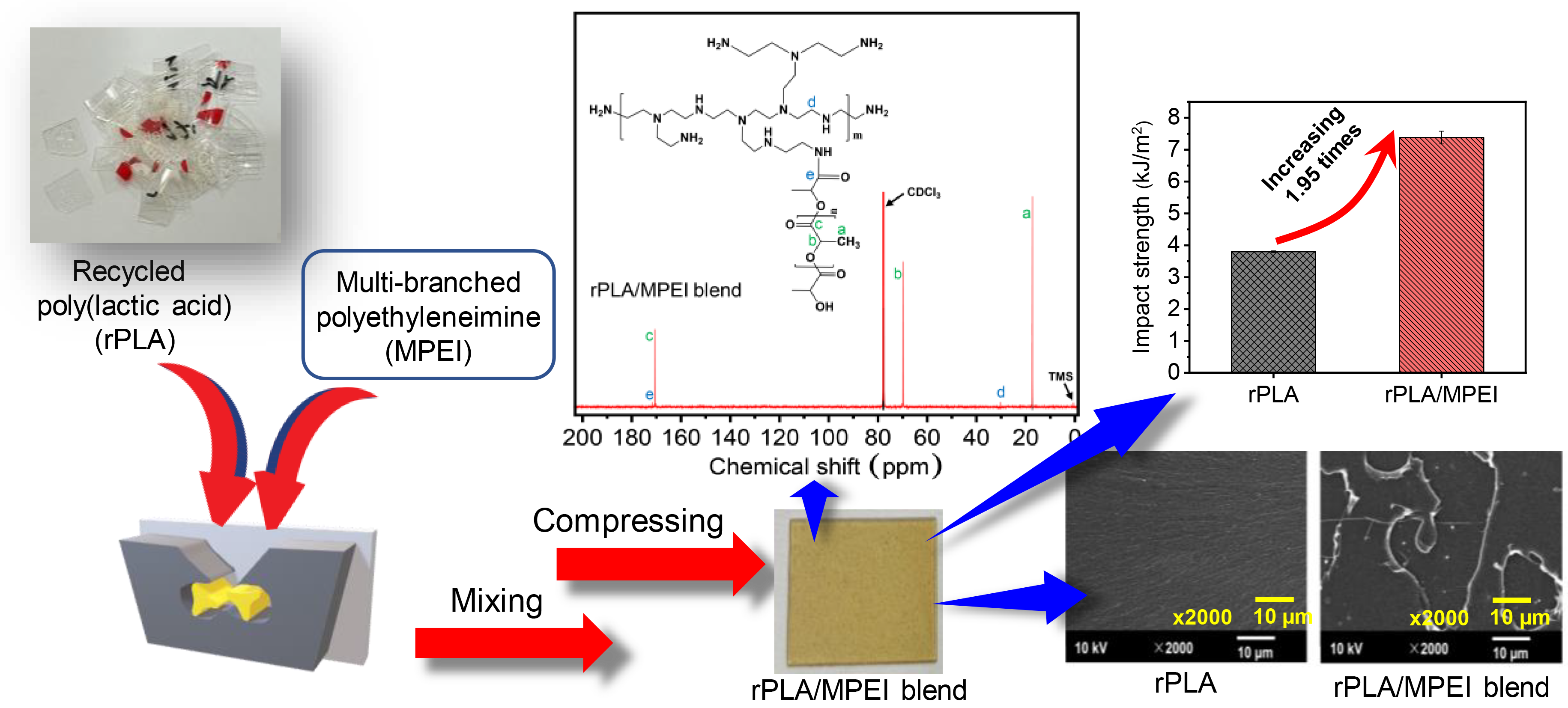
The single-use plastic coffee cup made from poly(lactic acid) (PLA) was modified for sustainable recycling to widen its applications by melt blending with multi-branched polyethyleneimine. Different concentrations (0.25 to 1 wt.%) and molecular weights (Mw of 2,000 and 25,000 g/mol) of the multi-branched polyethyleneimine (MPEI) were utilized as a mechanical modifier for the recycled poly(lactic acid) (rPLA). As a result, an attenuated total reflectance accessory equipped with Fourier transform infrared spectroscopy (ATR-FTIR) and carbon nuclear magnetic resonance spectroscopy (13C-NMR) indicated the formation of the amide linkage between the carboxylic acid group of rPLA and the amine group of MPEI under the given melt mixing condition. Incorporating 0.75 wt.% of MPEI, with a molecular weight of 25,000 g/mol, significantly enhances the properties of recycled PLA, increasing tensile strength by about 9 MPa and impact resistance by around 3.6 kJ/m² compared to the unmodified rPLA. The phase morphological property of rPLA/MPEI blend system exhibited a typical miscible blend and ductile microstructure aspect, characterized by uniform homogeneity and visible microfibrils on the impact-fractured surface. A slight decrease in the glass transition temperature (Tg) further indicated enhanced interfacial interactions, contributing to improved mechanical performance. Furthermore, the incorporation of MPEI notably increases the thermal decomposition temperature of the blends, demonstrating its effectiveness in enhancing the mechanical and thermal properties of recycled PLA. This advancement paves a promising strategy for expanding the material’s applicability while fostering sustainable recycling into high-value products.
HIGHLIGHTS
- Single-use coffee plastic waste from poly(lactic acid) was developed for recycling to broader applications through blending with multi-branched polyethyleneimine.
- Multi-branched polyethyleneimine was utilized to effectively optimize the mechanical and thermal properties of the polymeric blends.
- The addition of MPEI significantly improved the mechanical strength and fracture resistance of recycled poly(lactic acid).
- The blends exhibit a typical miscible microstructure with a ductile appearance, reflecting improved material compatibility and flexibility.
- Enhanced thermal stability of recycled poly(lactic acid) was achieved by incorporating multi-branched polyethyleneimine.
GRAPHICAL ABSTRACT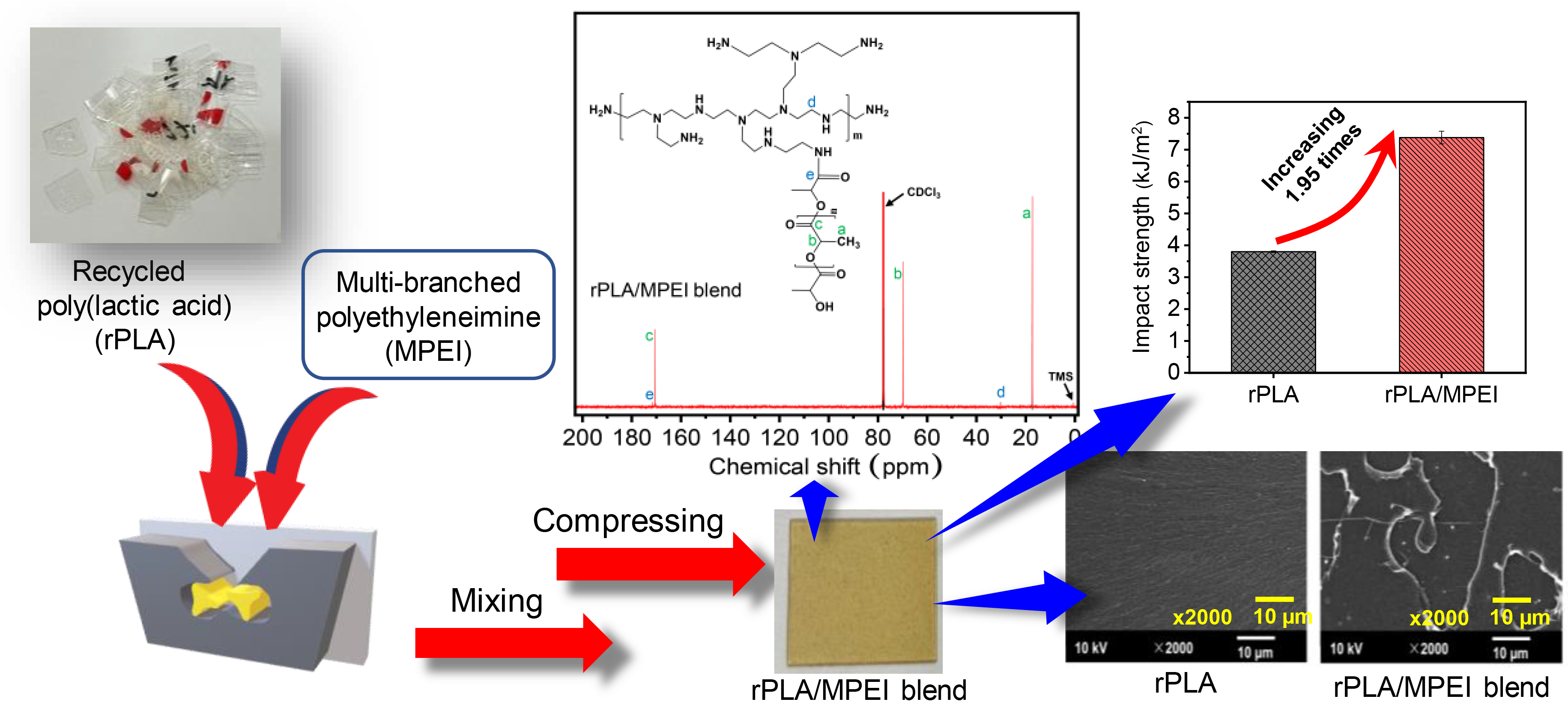
Downloads
References
X Luan, X Kou, X Cui, L Chen, W Xue, W Liu and Z Cui. Greenhouse gas emissions associated with plastics in China from 1950 to 2060. Resources, Conservation and Recycling 2023; 197(10), 107089.
S Yadav, A Samadhiya, A Kumar, A Majumdar, JA Garza-Reyes and S Luthra. Achieving the sustainable development goals through net zero emissions: Innovation-driven strategies for transitioning from incremental to radical lean, green and digital technologies. Resources, Conservation and Recycling 2023; 197(3), 107094.
Q Zhang, S Deng, H Yang, A Wang, J Wang, X Lai, P Sun and R Zhao. Life cycle assessment and carbon neutrality analysis of ‘waste plastics - upcycling plastics’ system based on adsorption carbon capture. Journal of Industrial and Engineering Chemistry 2024; 130, 600-611.
T Sokolova, A Krishna and T Döring. Paper meets plastic: The perceived environmental friendliness of product packaging. Journal of Consumer Research 2023; 50(2), 468-491.
PGC Nayanathara Thathsarani Pilapitiya and AS Ratnayake. The world of plastic waste: A review. Cleaner Materials 2024; 11, 100220.
B Wongprapinkul and S Vassanadumrongdee. A systems thinking approach towards single-use plastics reduction in food delivery business in Thailand. Sustainability 2022; 14(15), 9173.
OK Cakmak. Biodegradable polymers-a review on properties, processing, and degradation mechanism. Circular Economy and Sustainability 2024; 4(1), 339-362.
MS Kim, H Chang, L Zheng, Q Yan, BF Pfleger, J Klier, K Nelson, ELW Majumder and GW Huber. A review of biodegradable plastics: Chemistry, applications, properties, and future research needs. Chemical Reviews 2023; 123(16), 9915-9939.
L Ranakoti, B Gangil, SK Mishra, T Singh, S Sharma, RA Ilyas and S El-Khatib. Critical review on polylactic acid: Properties, structure, processing, biocomposites, and nanocomposites. Materials 2022; 15(12), 4312.
TA Swetha, V Ananthi, A Bora, N Sengottuvelan, K Ponnuchamy, G Muthusamy and A Arun. A review on biodegradable polylactic acid (PLA) production from fermentative food waste - Its applications and degradation. International Journal of Biological Macromolecules 2023; 234(6), 123703.
D Krapež Tomec, M Schwarzkopf, R Repič, J Žigon, B Gospodarič and M Kariž. Effect of thermal modification of wood particles for wood-PLA composites on properties of filaments, 3D-printed parts and injection moulded parts. European Journal of Wood and Wood Products 2024; 82(2), 403-416.
M Buddhakala and N Buddhakala. Physical, mechanical and antibacterial properties of biodegradable bioplastics from polylactic acid and corncob fibers with added nano titanium dioxide. Trends in Sciences 2023; 20(4), 6473.
C Botta, CM Grottola, D Amato and MR Acocella. Biochar as sustainable filler of recycled polylactic acid (PLA): A new generation of processable biocomposites. Polymers 2024; 16(23), 3347.
D Rahmadiawan, H Abral, MK Ilham, P Puspitasari, RA Nabawi, SC Shi, E Sugiarti, AN Muslimin, D Chandra, RA Ilyas and R Zainul. Enhanced UV blocking, tensile and thermal properties of bendable TEMPO-oxidized bacterial cellulose powder-based films immersed in PVA/Uncaria gambir/ZnO solution. Journal of Materials Research and Technology 2023; 26, 5566-5575.
T Khamsarn, R Supthanyakul, M Matsumoto, and S Chirachanchai. PLA with high elongation induced by multi-branched poly(ethylene imine) (mPEI) containing poly(l-lactic acid) (PLLA) terminals. Polymer 2017; 112, 87-91.
W Tessanan, P Phinyocheep and T Amornsakchai. Sustainable materials with improved biodegradability and toughness from blends of poly(lactic acid), pineapple stem starch and modified natural rubber. Polymers 2024; 16(2), 232.
J Cisar, P Drohsler, M Pummerova, V Sedlarik and D Skoda. Composite based on PLA with improved shape stability under high-temperature conditions. Polymer 2023; 276, 125943.
A Jeżo, F Poohphajai, R Herrera Diaz and G Kowaluk. Incorporation of nano-zinc oxide as a strategy to improve the barrier properties of biopolymer-suberinic acid residues films: A preliminary study. Materials 2024; 17(15), 3868.
FR Beltrán, C Infante, MUDL Orden and JM Urreaga. Mechanical recycling of poly(lactic acid): Evaluation of a chain extender and a peroxide as additives for upgrading the recycled plastic. Journal of Cleaner Production 2019; 219, 46-56.
S Samaimai, S Krajangsang, V Kitpreechavanich, J Borthong and T Lomthong. Degradation of poly(butylene succinate) and poly(butylene succinate)/poly(lactide) blends using serine protease produced from Laceyella sacchari LP175. Trends in Sciences 2021; 18(20), 37.
C Sun, S Wei, H Tan, Y Huang and Y Zhang. Progress in upcycling polylactic acid waste as an alternative carbon source: A review. Chemical Engineering Journal 2022; 446(11), 136881.
Z Chen, Z Lv, Y Sun, Z Chi and G Qing. Recent advancements in polyethyleneimine-based materials and their biomedical, biotechnology, and biomaterial applications. Journal of Materials Chemistry B 2020; 8(15), 2951-2973.
H Shi, J Yang, Z Ahmad, H Zhang and J Chen. Co-grafting of polyethyleneimine on mesocellular silica foam for highly efficient CO2 capture. Separation and Purification Technology 2023; 325, 124608.
J Ren, R Kong, Y Gao, L Zhang and J Zhu. Bioinspired adhesive coatings from polyethylenimine and tannic acid complexes exhibiting antifogging, self-cleaning, and antibacterial capabilities. Journal of Colloid and Interface Science 2021; 602(41), 406-414.
S Niyomsin, T Thongsima, S Phongtamrug and S Chirachanchai. Synergistic effects of a novel multi-branched polylactide ionomer on polylactide film. MRS Communications 2022; 12(2), 160-167.
W Tessanan, R Chanthateyanonth, M Yamaguchi and P Phinyocheep. Improvement of mechanical and impact performance of poly(lactic acid) by renewable modified natural rubber. Journal of Cleaner Production 2020; 276, 123800.
M Maroufkhani, A Katbab, W Liu and J Zhang. Polylactide (PLA) and acrylonitrile butadiene rubber (NBR) blends: The effect of ACN content on morphology, compatibility and mechanical properties. Polymer 2017; 115, 37-44.
D Garlotta. A literature review of poly(lactic acid). Journal of Polymers and the Environment 2001; 9(2), 63-84.
C Kaynak and Y Meyva. Use of maleic anhydride compatibilization to improve toughness and other properties of polylactide blended with thermoplastic elastomers. Polymers for Advanced Technologies 2014; 25(12), 1622-1632.
H Fang, L Zhang, A Chen and F Wu. Improvement of mechanical property for PLA/TPU blend by adding PLA-TPU copolymers prepared via in situ ring-opening polymerization. Polymers 2022; 14(8), 1530.
S Li, K Hu, W Cao, Y Sun, W Sheng, F Li, Y Wu and X-J Liang. pH-responsive biocompatible fluorescent polymer nanoparticles based on phenylboronic acid for intracellular imaging and drug delivery. Nanoscale 2014; 6(22), 13701-13709.
YR Dangi, X Lin, JW Choi, CR Lim, MH Song, M Han, JK Bediako, CW Cho and Y-S Yun. Polyethyleneimine functionalized alginate composite fiber for fast recovery of gold from acidic aqueous solutions. Environmental Technology and Innovation 2022; 28(221), 102605.
IP Gross, FSS Schneider, MSB Caro, TFD Conceição, GF Caramori and ATN Pires. Polylactic acid, maleic anhydride and dicumyl peroxide: NMR study of the free-radical melt reaction product. Polymer Degradation and Stability 2018; 155, 1-8.
N Tohluebaji, R Siri, N Muensit, C Putson, P Channuie, P Porrawatkul and J Yuennan. Hydrophobic and optical properties of P(VDF-HFP) nanofiber filled with nickel (II) chloride hexahydrate for dye-sensitized solar cells application. Trends in Sciences 2024; 21(9), 8762.
AM Pinilla-Torres, PY Carrión-García, CN Sánchez-Domínguez, H Gallardo-Blanco and M Sánchez-Domínguez. Modification of branched polyethyleneimine using mesquite gum for its improved hemocompatibility. Polymers 2021; 13(16), 2766.
HS Lim, S Chae, L Yan, G Li, R Feng, Y Shin, Z Nie, BM Sivakumar, X Zhang, Y Liang, DJ Bazak, V Shutthanandan, V Murugesan, S Kim and W Wang. Crosslinked polyethyleneimine gel polymer interface to improve cycling stability of RFBs. Energy Material Advances 2022; 2022, 9863679.
ZL He, JK Xu, L Zhang, HY Ren and SY Fu. Dramatically enhanced tensile strength and impact toughness of polydicyclopentadiene composites by covalent bond formation between phenyl-functionalized silica and dicyclopentadiene. Composites Part B: Engineering 2019; 170(21), 31-40.
K Chino. Multinetwork elastomer using covalent bond, hydrogen bond, and clay plane bond. ACS Omega 2021; 6(46), 31168-31176.
G Liu, H Ma, H Lee, H Xu, S Cheng, H Sun, T Chang, RP Quirk and SQ Wang. Long-chain branched polymers to prolong homogeneous stretching and to resist melt breakup. Polymer 2013; 54(24), 6608-6616.
C Xiang, Z Wang, C Yang, X Yao, Y Wang and Z Suo. Stretchable and fatigue-resistant materials. Materials Today 2020; 34, 7-16.
ZL He, JK Xu, L Zhang, HY Ren and SY Fu. Dramatically enhanced tensile strength and impact toughness of polydicyclopentadiene composites by covalent bond formation between phenyl-functionalized silica and dicyclopentadiene. Composites Part B: Engineering 2019; 170(21), 31-40.
BR Francis, K Watkins and J Kubelka. Double hydrogen bonding between side chain carboxyl groups in aqueous solutions of poly (β-L-malic acid): Implication for the evolutionary origin of nucleic acids. Life 2017; 7(3), 35.
L Fang, X Guo, M Todorović, P Rinke and X Chen. Exploring the conformers of an organic molecule on a metal cluster with bayesian optimization. Journal of Chemical Information and Modeling 2023; 63(3), 745-752.
K Copenhaver, T Smith, K Armstrong, D Kamath, M Rencheck, S Bhagia, M Korey, M Lamm and S Ozcan. Recyclability of additively manufactured bio-based composites. Composites Part B: Engineering 2023; 255(9), 110617.
W Tessanan and P Phinyocheep. Toughening modification of poly(lactic acid) using modified natural rubber. Iranian Polymer Journal 2022; 31(4), 455-469.
N Hongsriphan, J Subsanga, P Suebsai, S Sitthipong, and P Patanathabutr. Use of oil palm frond waste to reinforce poly(lactic acid) based composites with the improvement of interfacial adhesion by alkali treatment. Journal of Metals, Materials and Minerals 2022; 32(1), 134-143.
T Jamnongkan, O Jaroensuk, A Khankhuean, A Laobuthee, N Srisawat, A Pangon, R Mongkholrattanasit, P Phuengphai, A Wattanakornsiri and CF Huang. A comprehensive evaluation of mechanical, thermal, and antibacterial properties of PLA/ZnO nanoflower Biocomposite filaments for 3D printing application. Polymers 2022; 14(3), 600.
P Juntuek, C Ruksakulpiwat, P Chumsamrong and Y Ruksakulpiwat. Effect of glycidyl methacrylate-grafted natural rubber on physical properties of polylactic acid and natural rubber blends. Journal of Applied Polymer Science 2012; 125(1), 745-754.
NA Rosli, I Ahmad, FH Anuar and I Abdullah. Mechanical and thermal properties of natural rubber-modified poly(lactic acid) compatibilized with telechelic liquid natural rubber. Polymer Testing 2016; 54, 196-202.
J Mishra, SK Tiwari, MM Abolhasani, S Azimi and GC Nayak. 2-Fundamental of polymer blends and its thermodynamics. In: RK Mishra, S Thomas and N Kalarikkal (Eds.). Micro and nano fibrillar composites (MFCs and NFCs) from polymer blends. Woodhead Publishing, Delhi, India, 2017, p. 27-55.
M Romay, N Diban and A Urtiaga. Thermodynamic modeling and validation of the temperature influence in ternary phase polymer systems. Polymers 2021; 13(5), 678.
J Yin, Y Zhang, and Y Zhang. Fracture behavior and deformation mechanism of polypropylene/ ethylene–octene copolymer/magnesium hydroxide ternary phase composites. Journal of Applied Polymer Science 2005; 98(3), 957-967.
SB Mohd Yasin, JS Terry and AC Taylor. Fracture and mechanical properties of an impact toughened polypropylene composite: modification for automotive dashboard-airbag application. RSC Advances 2023; 13(39), 27461-27475.
SP Espíndola, B Norder, GJM Koper and SJ Picken. The glass transition temperature of heterogeneous biopolymer systems. Biomacromolecules 2023; 24(4), 1627-1637.
D Berne, G Tanguy, S Caillol, R Poli, V Ladmiral and E Leclerc. Transamidation vitrimers enabled by neighbouring fluorine atom activation. Polymer Chemistry 2023; 14(30), 3479-3492.
R Anastasio, W Peerbooms, R Cardinaels and LCAV Breemen. Characterization of ultraviolet-cured methacrylate networks: From photopolymerization to ultimate mechanical properties. Macromolecules 2019; 52(23), 9220-9231.
W Tessanan, P Daniel and P Phinyocheep. Mechanical properties’ strengthening of photosensitive 3D resin in lithography technology using acrylated natural rubber. Polymers 2023; 15(20), 4110.
J Zhang, R Zhang, H Chen, Y Li, YC Wu, R Suzuki, TC Sandreckski, T Ohdaira and YC Jean. Surface and interfacial effect on polymer glass transition temperature studied by positron annihilation. Radiation Physics and Chemistry 2003; 68(3-4), 535-539.
N Wu, H Zhang and G Fu. Super-tough poly(lactide) thermoplastic vulcanizates based on modified natural rubber. ACS Sustainable Chemistry & Engineering 2017; 5(1), 78-84.
T Tábi, IE Sajó, FJ Szabó, AS Luyt and JG Kovács. Crystalline structure of annealed polylactic acid and its relation to processing. Express Polymer Letters 2010; 4(10), 659-668.
L Benkraled, A Zennaki, L Zair, K Arabeche, A Berrayah, A Barrera, Z Bouberka and U Maschke. Effect of plasticization/annealing on thermal, dynamic mechanical, and rheological properties of poly(lactic acid). Polymers 2024; 16(7), 974.
N Dusunceli and OU Colak. Modelling effects of degree of crystallinity on mechanical behavior of semicrystalline polymers. International Journal of Plasticity 2008; 24(7), 1224-1242.
Published
How to Cite
Issue
Section
License
Copyright (c) 2025 Walailak University

This work is licensed under a Creative Commons Attribution-NonCommercial-NoDerivatives 4.0 International License.





