
Production of Nanocellulose-Based Biopolymer Scaffold for Liver Tissue Engineering
DOI:
https://doi.org/10.48048/tis.2025.10049Keywords:
Nanocellulose, Scaffold, Biopolymer, Tissue engineeringAbstract
Composite materials with tailored properties are increasingly sought after for tissue engineering applications. The aim of this work was to fabricate a nanocellulose-based biopolymer scaffold that was specifically designed for liver tissue engineering. Nanocellulose was extracted from natural sugarcane bagasse, which involved a synergistic approach that combined high-pressure homogenization (30,000 psi, 15 cycles) and enzymatic digestion (enzyme concentration: 7 %). The resulting nanocellulose exhibited an average size of 278.9 nm, a polydispersity index (PDI) of 0.752, and a crystallinity index of 50 %. This optimized nanocellulose was blended with biopolymers, polylactic acid (PLA), and polybutylene succinate (PBS) for scaffold production using film casting technique. The composite material proportions were optimized using response surface methodology (RSM), which led to an optimal composition of 65.00 wt% PLA, 26.81 wt% PBS, and 8.19 wt% nanocellulose. In vitro cytotoxicity evaluation of the optimized scaffold revealed a high average cell viability of 96.65 %. Human Wharton’s jelly (hWJ) mesenchymal stem cells (MSCs) were seeded onto the scaffold and exhibited the potential to differentiate towards a hepatocyte lineage for 17 days. This work could be a significant initial step towards the development of novel nanocellulose-based scaffolds for applications in liver tissue engineering.
HIGHLIGHTS
- Nanocellulose was produced through a combination of high-pressure homogenization and enzymatic digestion.
- The ratio of components in the nanocellulose-based biopolymer scaffold was optimized for production.
- The scaffold produced exhibited a high average cell viability.
- Hepatogenic differentiation of hWJ-MSCs was achieved on the bioscaffold.
GRAPHICAL ABSTRACT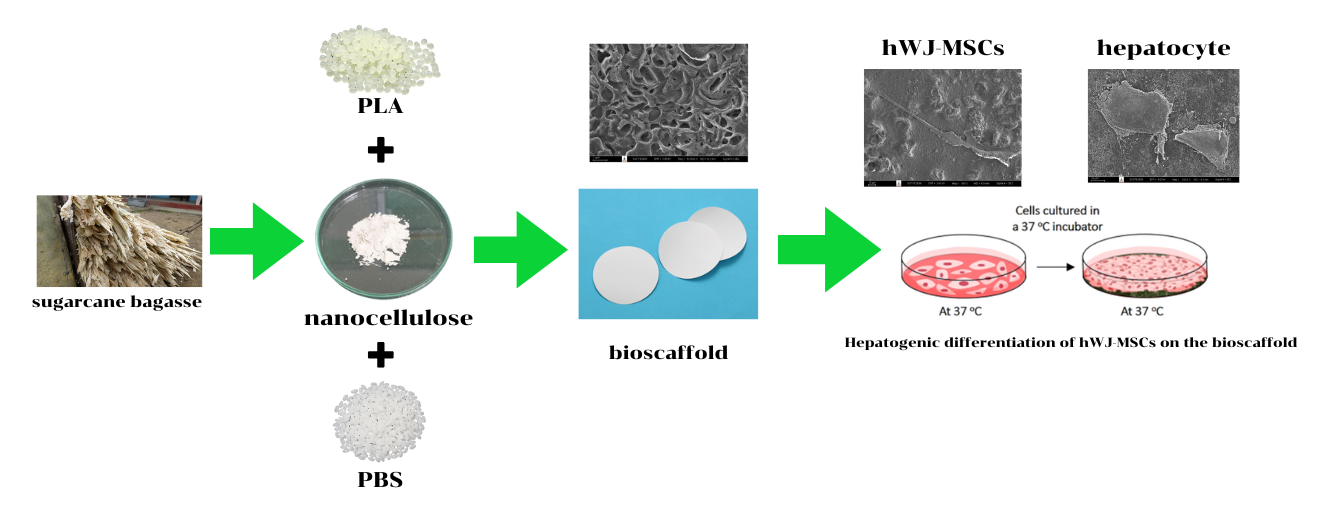
Downloads
References
H Devarbhavi, SK Asrani, JP Arab, YA Nartey, E Pose and PS Kamath. Global burden of liver disease: 2023 update. Journal of Hepatology 2023; 79(2), 516-537.
ML Dias, BA Paranhos and R Goldenberg. Liver scaffolds obtained by decellularization: A transplant perspective in liver bioengineering. Journal of Tissue Engineering 2022; 13, 20417314221105305.
S Castaneda-Rodriguez, M Gonzalez-Torres, RM Ribas-Aparicio, MLD Prado Audelo, G Leyva Gomez, ES Gurer and J Sharifi Rad. Recent advances in modified poly (lactic acid) as tissue engineering materials. Journal of Biological Engineering 2023; 17(1), 21.
L Aliotta, M Seggiani, A Lazzeri, V Gigante and P Cinelli. A Brief review of poly (butylene succinate) (PBS) and its main copolymers: Synthesis, blends, composites, biodegradability, and applications. Polymers 2022; 14(4), 844.
F Luzi, E Fortunati, A Jimenez, D Puglia, D Pezzolla, G Gigliotti, JM Kenny, A Chiralt and L Torre. Production and characterization of PLA_PBS biodegradable blends reinforced with cellulose nanocrystals extracted from hemp fibres. Industrial Crops and Products 2016; 93(4), 276-289.
P Phanthong, P Reubroycharoen, X Hao, G Xu, A Abudula and G Guan. Nanocellulose: Extraction and application. Carbon Resources Conversion 2018; 1(1), 32-43.
JD Aguiar, TJ Bondancia, PIC Claro, LHC Mattoso, CS Farinas and JM Marconcini. Enzymatic deconstruction of sugarcane bagasse and straw to obtain cellulose nanomaterials. ACS Sustainable Chemistry & Engineering 2020; 8(5), 2287-2299.
M Jonoobi, J Harun, AP Mathew and K Oksman. Mechanical properties of cellulose nanofiber (CNF) reinforced polylactic acid (PLA) prepared by twin screw extrusion. Composites Science and Technology 2010; 70(12), 1742-1747.
E Fortunati, I Armentano, Q Zhou, D Puglia, A Terenzi, LA Berglund and JM Kenny. Microstructure and nonisothermal cold crystallization of PLA composites based on silver nanoparticles and nanocrystalline cellulose. Polymer Degradation and Stability 2012; 97(10), 2027-2036.
B Wang and LT Drzal. Cellulose nanofiber-reinforced poly(lactic acid) composites prepared by a water-based approach. ACS Applied Materials & Interfaces 2012; 4(10), 5079-5085.
X Xu, F Liu, L Jiang, JY Zhu, D Haagenson and DP Wiesenborn. Cellulose nanocrystals vs. cellulose nanofibrils: A comparative study on their microstructures and effects as polymer reinforcing agents. ACS Applied Materials & Interfaces 2016; 8(4), 2349-2359.
N Lin, J Yu, P Chang, J Li and J Huang. Poly(butylene succinate)-based biocomposites filled with polysaccharide nanocrystals: Structure and properties. Polymer Composites 2011; 32(3), 472-482.
GM DeLoid, X Cao, RM Molina, DI Silva, K Bhattacharya, KW Ng, SCJ Loo, JD Brain and P Demokritou. Toxicological effects of ingested nanocellulose in in vitro intestinal epithelium and in vivo rat models. Environmental Science: Nano 2019; 6(7), 2105-2115.
MP Bernardo, BCRD Silva, AEI Hamouda, MASD Toledo, C Schalla, S Rutten, R Goetzke, LHC Mattoso, M Zenke and A Sechi. PLA/Hydroxyapatite scaffolds exhibit in vitro immunological inertness and promote robust osteogenic differentiation of human mesenchymal stem cells without osteogenic stimuli. Scientific Reports 2022; 12(1), 2333.
EM Hietala, US Salminen, A Stahls, T Valimaa, P Maasilta, P Tormala, MS Nieminen and ALJ Harjula. Biodegradation of the copolymeric polylactide stent: Long-term follow-up in a rabbit aorta model. Journal of Vascular Research 2001; 38(4), 361-369.
M Gigli, M Fabbri, N Lotti, R Gamberini, B Rimini and A Munari. Poly(butylene succinate)-based polyesters for biomedical applications: A review. European Polymer Journal 2016; 75, 431-460.
YS Maigari, M Yakubu, A Atta and M Bukhari. Extraction and characterization of nanocrystalline cellulose powder from corn cob. The Bangladesh Journal of Scientific Research 2016; 15(1), 50-55.
P Tanthaisong, S Imsoonthornruksa, A Ngernsoungnern, P Ngernsoungnern, M Ketudat-Cairns and R Parnpai. Enhanced chondrogenic differentiation of human umbilical cord wharton’s jelly derived mesenchymal stem Cells by GSK-3 inhibitors. PLoS One 2017; 12(1), e0168059.
W Panta, S Imsoonthornruksa, T Yoisungnern, S Suksaweang, M Ketudat-Cairns and R Parnpai. Enhanced hepatogenic differentiation of human wharton’s jelly–derived mesenchymal stem cells by using three-step protocol. International Journal of Molecular Sciences 2019; 20(12), 3016.
X Hu, T Su, P Li and Z Wang. Blending modification of PBS/PLA and its enzymatic degradation. Polymer Bulletin 2018; 75(2), 533-546.
N Lin, J Huang, PR Chang, J Feng and J Yu. Surface acetylation of cellulose nanocrystal and its reinforcing function in poly(lactic acid). Carbohydrate Polymers 2011; 83(4), 1834-1842.
C Endes, S Camarero-Espinosa, S Mueller, EJ Foster, A Petri-Fink, B Rothen-Rutishauser, C Weder and MJD Clift. A critical review of the current knowledge regarding the biological impact of nanocellulose. Journal of Nanobiotechnology 2016; 14(1), 78.
C Wu, DJ McClements, M He, L Zheng, T Tian, F Teng and Y Li. Preparation and characterization of okara nanocellulose fabricated using sonication or high-pressure homogenization treatments. Carbohydrate Polymers 2020; 255, 117364.
P Squinca, S Bilatto, AC Badino and CS Farinas. Nanocellulose production in future biorefineries: An Integrated approach using tailor-made enzymes. ACS Sustainable Chemistry & Engineering 2020; 8(5), 2277-2286.
AC O’Sullivan. Cellulose: The structure slowly unravels. Cellulose 1997; 4(3), 173-207.
RJ Moon, A Martini, J Nairn, J Simonsen and J Youngblood. Cellulose nanomaterials review: Structure, properties, and nanocomposites. Chemical Society Reviews 2011; 40(7), 3941-3994.
AD French. Idealized powder diffraction patterns for cellulose polymorphs. Cellulose 2014; 21(2), 885-896.
Y Hishikawa, E Togawa and T Kondo. Characterization of individual hydrogen bonds in crystalline regenerated cellulose using resolved polarized FTIR spectra. ACS Omega 2017; 2(4), 1469-1476.
M Makarem, CM Lee, K Kafle, S Huang, I Chae, H Yang, JD Kubicki and SH Kim. Probing cellulose structures with vibrational spectroscopy. Cellulose 2019; 26(1), 35-79.
A Boukir, I Mehyaoui, S Fellak, L Asia and P Doumenq. The effect of natural degradation process on the cellulose structure of moroccan hardwood fiber: A survey on spectroscopy and structural properties. Mediterranean Journal of Chemistry 2019; 8(3), 179-190.
R Javier-Astete and G Zolla. Determination of hemicellulose, cellulose, holocellulose and lignin content using FTIR in Calycophyllum spruceanum (Benth.) K. Schum. and Guazuma crinita Lam. PLoS One 2021; 16(10), e0256559.
RM Salim, J Asik and M Sarjadi. Chemical functional groups of extractives, cellulose and lignin extracted from native Leucaena leucocephala bark. Wood Science and Technology 2021; 55, 295-313.
MH Kudzin, Z Mrozinska and P Urbaniak. Vapor phosphorylation of cellulose by phosphorus trichlo-ride: Selective phosphorylation of 6-hydroxyl function—the synthesis of new antimicrobial cellulose 6-phosphate(III)-copper complexes. Antibiotics 2021; 10(2), 203.
AE Oudiani, S Msahli and F Sakli. In-depth study of agave fiber structure using Fourier transform infrared spectroscopy. Carbohydrate Polymers 2017; 164, 242-248.
A Parihar, J Vongsvivut and S Bhattacharya. Synchrotron-based infra-red spectroscopic insights on thermo-catalytic conversion of cellulosic feedstock to levoglucosenone and furans. ACS Omega 2019; 4(5), 8747-8757.
H Wang, M Zuo, N Ding, G Yan, X Zeng, X Tang, Y Sun, T Lei and L Lin. Preparation of nanocellulose with high-pressure homogenization from pretreated biomass with cooking with active oxygen and solid alkali. ACS Sustainable Chemistry & Engineering 2019; 7(10), 9378-9386.
D Klemm, B Heublein, HP Fink and A Boh. Cellulose: Fascinating biopolymer and sustainable raw material. Angewandte Chemie International Edition 2005; 44(22), 3358-3393.
D Trache, MH Hussin, MKM Haafiz and VK Thakur. Recent progress in cellulose nanocrystals: Sources and production. Nanoscale 2017; 9(5), 1763-1768.
G Cheng, X Zhang, B Simmons and S Singh. Theory, practice and prospects of x-ray and neutron scattering for lignocellulosic biomass characterization: Towards understanding biomass pretreatment. Energy & Environmental Science 2014; 8(2), 436-455.
F Lionetto, R Lopez-Munoz, C Espinoza-Gonzalez, R Mis-Fernandez, O Rodriguez-Fernandez and A Maffezzoli. A study on exfoliation of expanded graphite stacks in candelilla wax. Materials 2019; 12(16), 2530.
O Nechyporchuk, MN Belgacem and J Bras. Production of cellulose nanofibrils: A review of recent advances. Industrial Crops and Products 2016; 93(6), 2-25.
G Siqueira, J Bras and A Dufresne. Cellulosic bionanocomposites: A review of preparation, properties and applications. Polymers 2010; 2(4), 728-765.
A Peciulyte, K Karlstrom, PT Larsson and L Olsson. Impact of the supramolecular structure of cellulose on the efficiency of enzymatic hydrolysis. Biotechnology for Biofuels 2015; 8(1), 56.
A Tąta, K Sokołowska, J Swider, A Konieczna-Molenda, E Proniewicz and E Witek. Study of cellulolytic enzyme immobilization on copolymers of N-vinylformamide. Spectrochimica Acta Part A: Molecular and Biomolecular Spectroscopy 2015; 149, 494-504.
Y Peng, DJ Gardner and Y Han. Characterization of mechanical and morphological properties of cellulose reinforced polyamide 6 composites. Cellulose 2015; 22, 3199-3215.
L Chen, JY Zhu, C Baez, P Kitin and T Elder. Highly thermal-stable and functional cellulose nanocrystals and nanofibrils produced using fully recyclable organic acids. Green Chemistry 2016; 13(8), 3835-3843.
S Park, JO Baker, ME Himmel, PA Parilla and DK Johnson. Cellulose crystallinity index: Measurement techniques and their impact on interpreting cellulase performance. Biotechnology for Biofuels 2010; 3(1), 10.
G Lutzweiler, AN Halili and NE Vrana. The overview of porous, bioactive scaffolds as instructive biomaterials for tissue regeneration and their clinical translation. Pharmaceutics 2020; 12(7), 602.
L Jompang, S Thumsorn, J W On, P Surin, C Apawet, T Chaichalermwong, N Kaabbuathong, N O-Charoen and N Srisawat. Poly(lactic acid) and poly(butylene succinate) blend fibers prepared by melt spinning technique. Energy Procedia 2013; 34, 493-499.
Published
How to Cite
Issue
Section
License
Copyright (c) 2025 Walailak University

This work is licensed under a Creative Commons Attribution-NonCommercial-NoDerivatives 4.0 International License.





