
Synthesis of Betacyanin-Grafted Inulin as a Colon Cancer Therapeutic: In Silico Evaluation via Molecular Docking and Molecular Dynamics
DOI:
https://doi.org/10.48048/tis.2026.12535Keywords:
Betacyanin, Molecular Docking, Molecular Dynamic, ADMET, Cyclooxygenase-2 (COX-2), Betacyanin, Inulin, Colon cancer, Drug delivery, Molecular docking, Molecular dynamics, ADMET, Cyclooxygenase-2 (COX-2)Abstract
Inulin is a fructan polymer composed of β-2,1-linked fructose units, known for its resistance to digestion in the upper gastrointestinal tract and selective fermentation by probiotics in the colon. This property makes inulin a promising candidate for colon-targeted drug delivery. In this study, betacyanin-grafted inulin was synthesized and evaluated for its potential as a colon cancer therapeutic, targeting Cyclooxygenase-2 (COX-2), a key enzyme involved in inflammation and tumor progression. This study aims to synthesize betacyanin-grafted inulin, characterize its structural and optical properties using Fourier Transform Infrared (FTIR) and Ultraviolet-Visible (UV-Vis) spectroscopy, assess its antioxidant activity, and evaluate its interaction with the COX-2 receptor through in silico molecular docking and molecular dynamics analysis. The grafting process was conducted under inert conditions using betacyanin masses of 0.2, 0.4 and 0.6 g. The optimal formulation was identified at 0.4 g, yielding a bound betacyanin content of 582 mg BAE/g. Structural characterization using FTIR revealed absorption bands at 1,540 - 1,418 cm⁻¹ (C=C aromatic stretching) and 1,670 cm⁻¹ (N-H bending), confirming the presence of betalamic acid. UV-Vis spectroscopy showed a maximum absorption at 530 nm, consistent with betacyanin’s chromophore. Antioxidant assays demonstrated that the 0.4 g variation retained significant activity (35.08 mg/L), indicating that betacyanin remained bioactive post-grafting. In silico molecular docking and dynamics simulations revealed that betanin, the major betacyanin component, exhibited strong binding affinity (−8.6 kcal/mol) and favorable binding free energy (−20.3618 kcal/mol) at the COX-2 active site, suggesting stable interaction and potential inhibitory effects. ADMET analysis further supported the therapeutic viability of betacyanin, showing optimal absorption, wide distribution, and low predicted toxicity. These findings highlight the potential of betacyanin-grafted inulin as a natural, colon-targeted therapeutic strategy for COX-2-mediated colon cancer, combining targeted delivery with antioxidant and anti-inflammatory properties.
HIGHLIGHTS
- Betacyanin-grafted inulin was successfully synthesized as a targeted colon cancer therapeutic via a probiotic-responsive drug delivery system.
- FTIR and UV-Vis spectroscopy confirmed the structural integrity and stability of betacyanin post-grafting.
- Antioxidant assays showed that 0.4 g betacyanin variation retained high activity (35.08 mg/L), indicating that betacyanin remained active after grafting onto inulin
- Molecular docking and dynamics simulations demonstrated strong binding affinity and conformational stability of betacyanin at the COX-2 active site.
- ADMET profiling predicted favorable pharmacokinetics and low toxicity, supporting the therapeutic potential of betacyanin.
GRAPHICAL ABSTRACT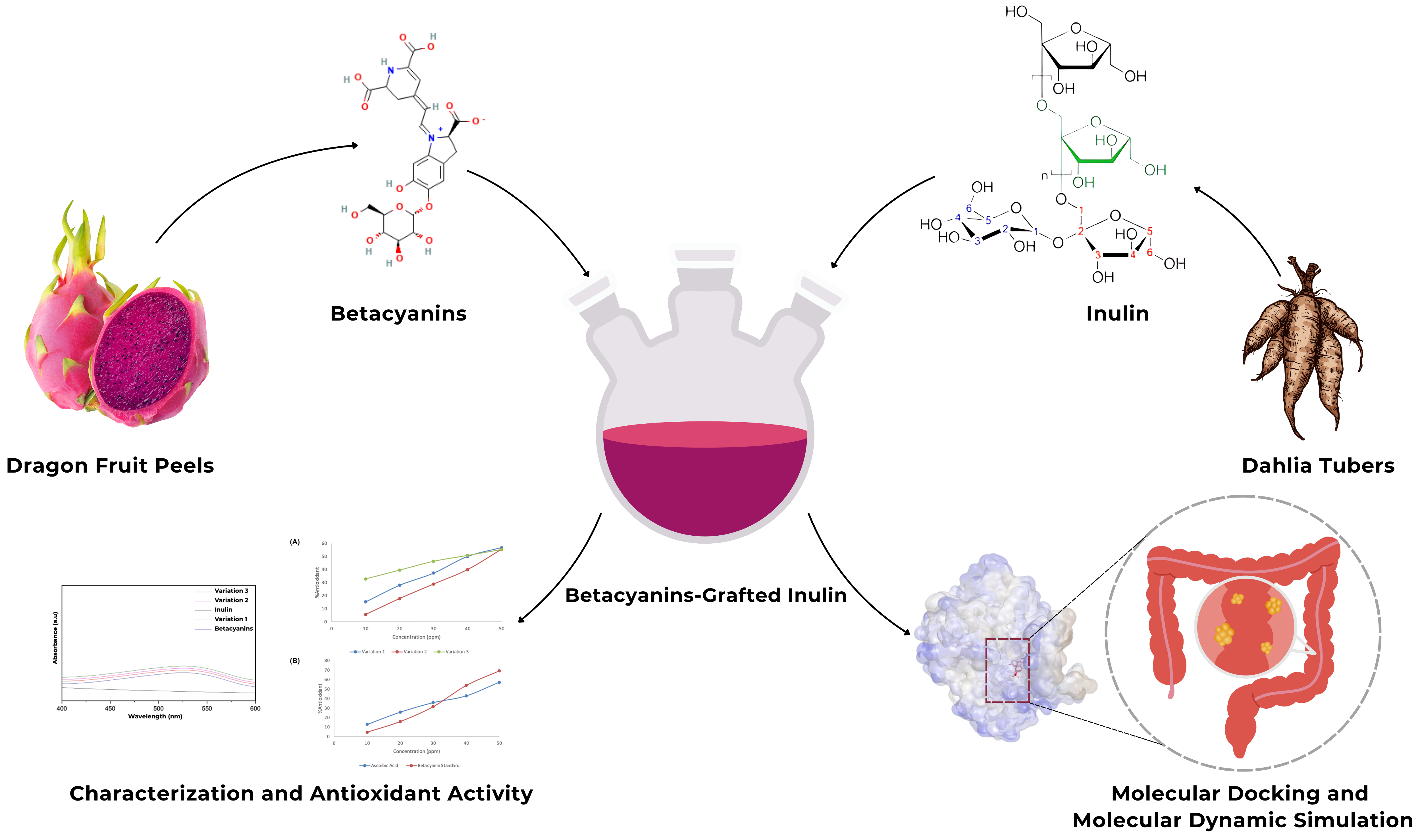
Downloads
References
IG Yanti, M Azhar, A Faridah and B Oktavia. Simple determination of inulin polymerization degre average from dahlia tuber using spectrophotometer. International Journal of Research and Review 2019; 6, 399-404.
F Afinjuomo, S Abdella, SH Youssef. Inulin and its application in drug delivery. Pharmaceuticals 2021; 14, 1-37.
PV Dangre, KS Kotkar, AD Pimple and SS Meshram. Chemistry, isolation, and pharmaceutical applications of inulin. Current Drug Therapy 2025; 20(1), 8-17.
BF Hinnebusch, S Meng, JT Wu, SY Archer and RA Hodin. The effects of short-chain fatty acids on human colon cancer cell phenotype are associated with histone hyperacetylation. Journal of Nutrition 2002; 132, 1012-1017.
Q Yang, J Ouyang, F Sun and J Yang. Short-chain fatty acids: A soldier fighting against inflammation and protecting from tumorigenesis in people with diabetes. Frontiers in Immunology 2020; 11, 590685.
G Liu, J Tang, J Zhou and M Dong. Short-chain fatty acids play a positive role in colorectal cancer. Discover Oncology 2024; 15(1), 425.
N Gupta, AK Jangid, D Pooja and H Kulhari. Inulin: A novel and stretchy polysaccharide tool for biomedical and nutritional applications. International Journal of Biological Macromolecules 2019; 132, 852-863.
S Imran, RB Gillis, MS Kok, SE Harding and GG Adams. Application and use of inulin as a tool for therapeutic drug delivery. Biotechnology and Genetic Engineering Reviews 2012; 28(1), 33-46.
J Sheng, H Sun, FB Yu, B Li, Y Zhang and YT Zhu. The role of cyclooxygenase-2 in colorectal cancer. International Journal of Medical Sciences 2020; 17(8), 1095-1101.
RR Negi, SV Rana, V Gupta, R Gupta, VD Chadha, KK Prasad and DK Dhawan. Over-expression of Cyclooxygenase-2 in colorectal cancer patients. Asian Pacific Journal of Cancer Prevention 2019; 20(6), 1675-1681.
Y Liu, H Sun, M Hu, Y Zhang, S Chen, S Tighe and Y Zhu. The role of cyclooxygenase-2 in colorectal carcinogenesis. Clinical Colorectal Cancer 2017; 16, 165-172.
J Liu, JF Lu, J Kan, XY Wen and CH Jin. Synthesis, characterization and in vitro anti-diabetic activity of catechin grafted inulin. International Journal of Biological Macromolecules 2014; 64, 76-83.
FH Pratama and M Azhar. Quercetin grafted inulin: Synthesis and characterization. AIP Conference Proceedings 2023; 2673, 030001.
HMC Azeredo. Betalains: Properties, sources, applications, and stability: A review. International Journal of Food Science and Technology 2009; 44, 2365-2376.
E Coy-Barrera. Analysis of betalains (betacyanins and betaxanthins). In: AS Silva, SF Nabavi and SM Nabavi. Recent advances in natural products analysis. Elsevier, Asterdam, Netherlands, 2020, p. 593-619.
HY Leong, CW Ooi, CL Law, AL Julkifle, T Katsuda and PL Show. Integration process for betacyanins extraction from peel and flesh of Hylocereus polyrhizus using liquid biphasic electric flotation system and antioxidant activity evaluation. Separation and Purification Technology 2019; 209, 193-201.
A Saber, N Abedimanesh, MH Somi, AY Khosroushahi and S Moradi. Anticancer properties of red beetroot hydro-alcoholic extract and its main constituent; betanin on colorectal cancer cell lines. BMC Complementary Medicine and Therapies 2023; 23(1), 246.
MI Khan. Stabilization of betalains: A review. Food Chemistry 2016; 197, 1280-1285.
Q Chen, J Huang, J Gou, Q Ren and L Yuan. Inulin as carriers for renal targeting delivery of ferulic acid. International Journal of Biological Macromolecules 2020; 154, 654-660.
F Afinjuomo, S Abdella, SH Youssef, Y Song and S Garg. Inulin and its application in drug delivery. Pharmaceuticals 2021; 14(9), 855.
AD Ergin, ZS Bayindir, M Gumustas, AT Ozcelikay and N Yuksel. A new strategy for enhancing S-Adenosyl-L-Methionine (SAMe) oral bioavailability: Preparation of SAMe loaded inulin nanoparticles for colon targeting with in vivo validation. International Journal of Biological Macromolecules 2025; 289, 138818.
W Akram, V Pandey, R Sharma, R Joshi, N Mishra, N Garud and T Haider. Inulin: Unveiling its potential as a multifaceted biopolymer in prebiotics, drug delivery, and therapeutics. International Journal of Biological Macromolecules 2024; 259, 129131.
B Hufnagel, V Muellner, K Hlatky, C Tallian, R Vielnascher, GM Guebitz, M Wirth and F Gabor. Chemically modified inulin for intestinal drug delivery - a new dual bioactivity concept for inflammatory bowel disease treatment. Carbohydrate Polymers 2021; 252, 117091.
F Fathordoobady, H Mirhosseini, J Selamat, M Yazid and A Manap. Effect of solvent type and ratio on betacyanins and antioxidant activity of extracts from Hylocereus polyrhizus flesh and peel by supercritical fluid extraction and solvent extraction. Food Chemistry 2016; 202, 70-80.
R Asra, RD Yetti, S Audina and N Nessa. Studi fisikokimia betasianin dalam kulit buah naga dan aplikasinya sebagai pewarna merah alami sediaan farmasi (in Indonesian). Jurnal Farmasi Galenika 2019; 5(2), 140-146.
J Liu, J Lu, J Kan, X Wen and C Jin. International Journal of Biological Macromolecules Synthesis, characterization and in vitro anti-diabetic activity of catechin grafted inulin. International Journal of Biological Macromolecules 2014; 64, 76-83.
IB Slimen, T Najar and M Abderrabba. Chemical and antioxidant properties of betalains. Journal of Agricultural and Food Chemistry 2017; 65(4), 675-689.
DB Rodriguez-amaya, S Paulo and F Sul. Update on natural food pigments - A mini-review on carotenoids, anthocyanins, and betalains. Food Research International 2018; 124, 200-205.
MI Khan and P Giridhar. Plant betalains: Chemistry and biochemistry. Phytochemistry 2015; 117, 267-295.
S Phongpaichit, J Nikom, N Rungjindamai, J Sakayaroj, N Hutadilok-Towatana, V Rukachaisirikul, & K Kirtikara. Biological activities of extracts from endophytic fungi isolated from Garcinia plants. FEMS Immunology & Medical Microbiology 2007; 51(3), 517-525.
H Shang, H Zhou, J Yang, R Li, H Song and H Wu. In vitro and in vivo antioxidant activities of inulin. PloS One 2018; 13(2), 1-12.
S Putri, R Maharani, I Maksum and T Siahaan. Peptide design for enhanced anti-melanogenesis: Optimizing molecular weight, polarity, and cyclization. Drug Design, Development and Therapy 2025; 19, 645-670.
N Gupta, AK Jangid, D Pooja and H Kulhari. Inulin: A novel and stretchy polysaccharide tool for biomedical and nutritional applications. International Journal of Biological Macromolecules 2019; 132, 852-863.
S Joseph, M Jadav, R Solanki, S Patel, D Pooja and H Kulhari. Synthesis, characterization, and application of honey stabilized inulin nanoparticles as colon targeting drug delivery carrier. International Journal of Biological Macromolecules 2024; 263, 130274.
RM Garavito, MG Malkowski and DL Dewitt. The structures of prostaglandin endoperoxide H synthases-1 and-2. Prostaglandins & Other Lipid Mediators 2002; 68, 129-152.
AJ Vecchio and MG Malkowski. The structure of NS-398 bound to cyclooxygenase-2. Journal of Structural Biology. 2011; 176(2), 254-258.
BJ Orlando and MG Malkowski. Substrate-selective inhibition of cyclooxygeanse-2 by fenamic acid derivatives is dependent on peroxide tone. Journal of Biological Chemistry 2016; 291, 15069-15081.
D Wang and RN Dubois. The role of COX-2 in intestinal inflammation and colorectal cancer. Oncogen 2010; 29, 781-788.
L Tesoriere, M Allegra, D Butera and MA Livrea. Absorption, excretion, and distribution of dietary antioxidant betalains in LDLs: potential health effects of betalains in humans. The American Journal of Clinical Nutrition 2004; 80(4), 941-945.
A Pangal and K Ahmed. Synthesis and biological evaluation of coumarin-quinone hybrids as multifunctional bioactive agents. ADMET and DMPK 2023; 11, 81-96.
AK Philip and B Philip. Colon targeted drug delivery systems: A review on primary and novel approaches. Oman Medical Journal 2010; 25, 70-78.
AH Teruel, I Gonzalez-Alvarez, M Bermejo, V Merino, MD Marcos, F Sancenon, M Gonzalez-Alvarez and R Martinez-Mañez. New insights of oral colonic drug delivery systems for inflammatory bowel disease therapy. International Journal of Molecular Sciences 2020; 21(18), 6502.
H Shao, M Liu, H Jiang and Y Zhang. Polysaccharide-based drug delivery targeted approach for colon cancer treatment: A comprehensive review. International Journal of Biological Macromolecules 2025; 302, 139177.
Published
How to Cite
Issue
Section
License
Copyright (c) 2025 Walailak University

This work is licensed under a Creative Commons Attribution-NonCommercial-NoDerivatives 4.0 International License.





