
Profile Expression and Validation of Plasma Exosomal miR-320a in Patients with Lung Adenocarcinoma as a Candidate Diagnostic Biomarker: A Study in the Indonesian Population
Keywords:
ExomiRS, Exosome miRNAs, Lung adenocarcinoma, Biomarker lung cancer, miR-320a, Profiling exomiRs, Validation exomiR-320aAbstract
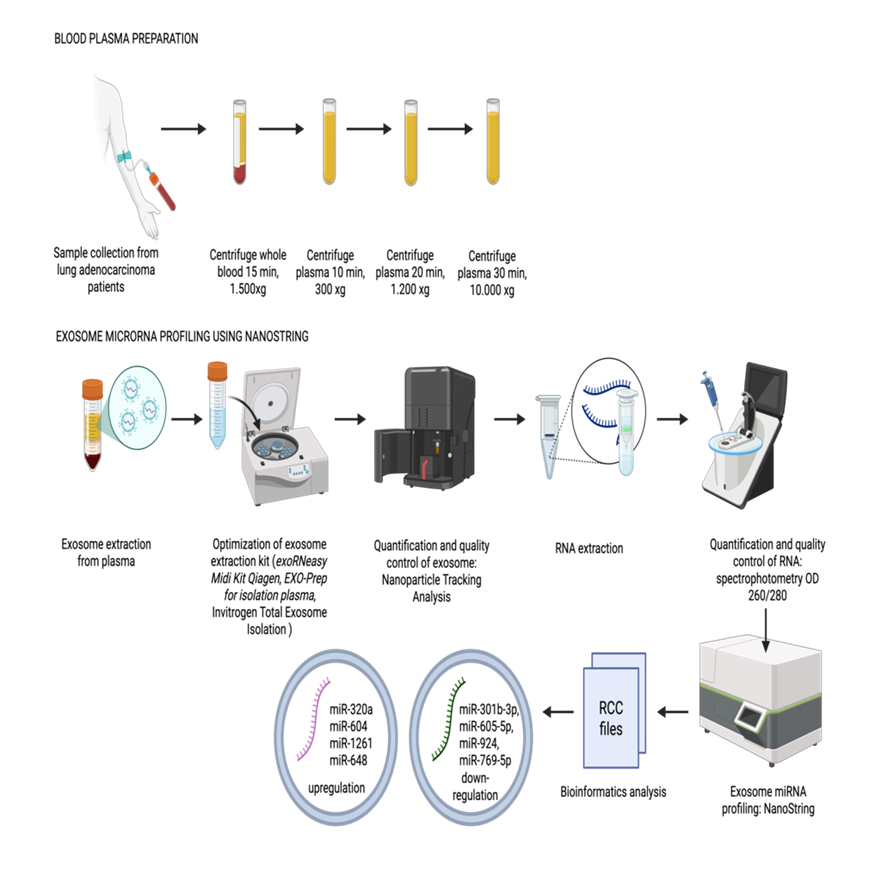
Lung cancer has the highest incidence rate in Indonesia, with a projected significant increase by 2040. Lung adenocarcinoma, the most common histological subtype, is often diagnosed at advanced stages due to the absence of early symptoms and reliance on invasive biopsy methods. Exosomal microRNAs (exomiRs), owing to their stability and ability to reflect tumor-specific changes, offer promise as non-invasive diagnostic biomarkers. This study aims to map the expression profile and validate exomiRs in Indonesian patients with lung adenocarcinoma so that it can be developed as a diagnostic biomarker. Plasma-derived exosomes were isolated from patients with lung adenocarcinoma and healthy controls. ExomiR profiles were first screened using NanoString analysis, followed by validation of candidate exomiRs with qRT-PCR. Differential expression was analyzed, and diagnostic performance was assessed using ROC curve analysis. The results indicate that in patients with locally advanced lung adenocarcinoma, there is upregulation of exosomal miR-320a, miR-604, miR-1261, and miR-648, as well as downregulation of exosomal miR-301b-3p, miR-605-5p, miR-924, miR-769-5p, miR-373-3p, miR-520h, miR-193a-5p, miR-3150b-3p, miR-3615, miR-4431, miR-6720-3p, miR-1909-3p, miR-574-3p, miR-382-5p, miR-593-3p, miR-572, miR-27a-3p, and miR-411-5p compared to healthy controls. In silico analysis showed that these regulated exomiRs play a role in chromatin structure formation and tumor immune cell infiltration pathways. Validation of exomiR-320a expression showed a 1.9-fold upregulation (p = 0.00032) in lung adenocarcinoma patients compared to healthy controls with an AUC value of 0.781, indicating that this miRNA has moderate potential as a diagnostic biomarker that requires further validation.
HIGHLIGHTS
- Distinct exosomal miRNA signatures were identified in Indonesia lung adenocarcinoma patients, demonstrating expression patterns that differ from previously reported global dataset.
- Four exomiRs were significantly upregulated (miR-320a, miR-604, miR-1261, miR-648) and 19 exomiRs were significantly downregulated, indicating a unique regulatory landscape in advanced lung adenocarcinoma.
- ExomiR-320a consistently demonstrated increased expression, with a 1.9-fold upregulation in lung adenocarcinoma versus healthy controls, confirmed by both NanoString profiling and qRT-PCR validation.
- Stage-wise expression differences showed progressive increases in exomiR-320a (1.358-fold in locally advanced compared with healthy control, and 1.948-fold in metastatic disease), supporting its relevance to disease progression.
- In silico analysis suggest exomiR-320a targets immune-related genes, indicating its role I modulating tumor-infiltrating immune cells and the tumor microenvironment, highlighting its potential as a diagnostic and immune-modulatory biomarker for lung adenocarcinoma in the Indonesian population.
GRAPHICAL ABSTRACT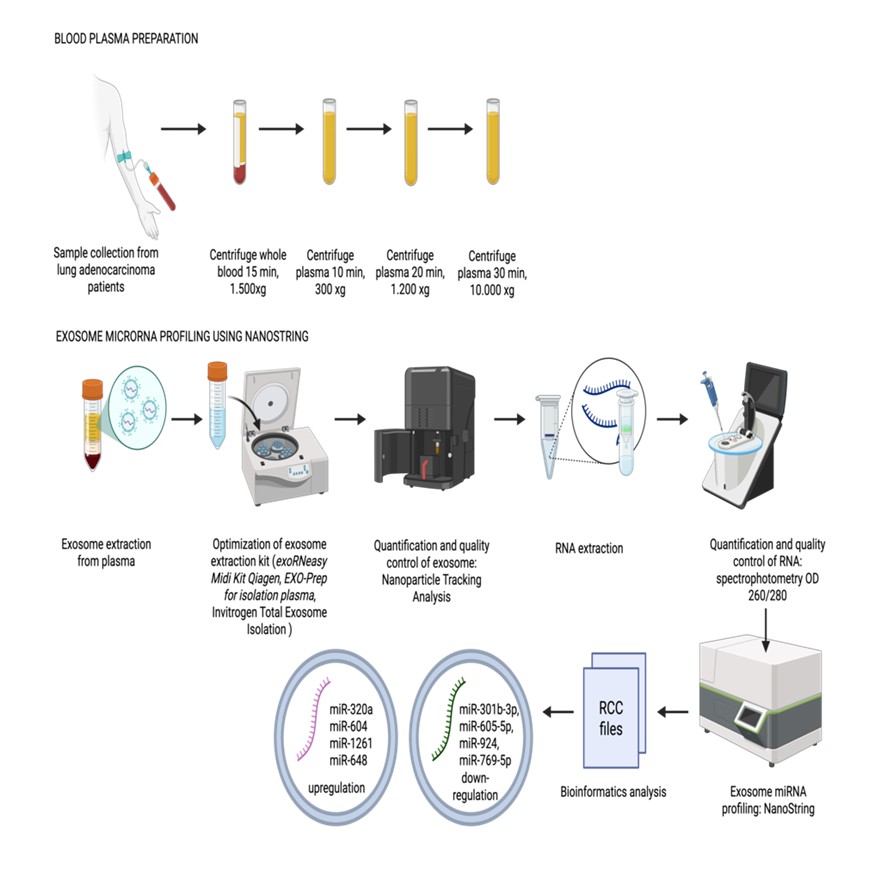
Downloads
References
L Guo, C Zhu, L Cai, X Zhang, Y Fang, H Chen and H Yang. Global burden of lung cancer in 2022 and projected burden in 2050. Chinese Medical Journal 2024; 137(21), 2577-2582.
S Andarini, E Syahruddin, N Aditya, J Zaini, FD Kurniawan, S Ermayanti, NN Soeroso, SM Munir, A Infianto, A Rima, UA Setyawan, L Wulandari, Haryati, IA Jasminarti and A Santoso. Indonesian Society of Respirology (ISR) consensus statement on lung cancer screening and early detection in Indonesia. Jurnal Respirologi Indonesia 2023; 43(2), 144-150.
GA Colditz. Lung cancer, non-small cell, Available from: http://dx.doi.org/10.4135/9781483345758.n338, accessed May 2025.
J Jin. Screening for lung cancer. Annals of Internal Medicine 1989; 325(10), 1016.
W Weichert and A Warth. Early lung cancer with lepidic pattern: Adenocarcinoma in situ, minimally invasive adenocarcinoma, and lepidic predominant adenocarcinoma. Current Opinion in Pulmonary Medicine 2014; 20(4), 309-316.
K Masai, H Sakurai, S Suzuki, K Asakura, K Nakagawa and SI Watanabe. Clinicopathological features of colloid adenocarcinoma of the lung: A report of 6 cases. Journal of Surgical Oncology 2016; 114(2), 211-215.
M Church, L Carter and F Blackhall. Liquid biopsy in small cell lung cancer - a route to improved clinical care? Cells 2020; 9(12), 2586.
B Rath, A Plangger and G Hamilton. Non-small cell lung cancer-small cell lung cancer transformation as mechanism of resistance to tyrosine kinase inhibitors in lung cancer. Cancer Drug Resistance 2020; 3(2), 171.
AR Hanafi, AM Jayusman, P Imelda, S Alfasunu, AH Sadewa, D Pramono, DS Heriyanto, SM Haryana and SB Kresno. Correlation of serum electrolytes with serial miRNA in advanced stage non-small cell lung cancer (NSCLC) in Indonesia. BMC Research Notes 2021; 14(1), 437.
CM Eckhardt, S Gambazza, TR Bloomquist, PD Hoff, A Vuppala, PS Vokonas, AA Litonjua, D Sparrow, F Parvez, LC Laurent, J Schwartz, AA Baccarelli, AA Baccarelli, H Wu and H Wu. Extracellular vesicle-encapsulated micrornas as novel biomarkers of lung health. American Journal of Respiratory and Critical Care Medicine 2023; 207(1), 50-59.
G Di Rocco, S Baldari and G Toietta. Exosomes and other extracellular vesicles-mediated microRNA delivery for cancer therapy. Translational Cancer Research 2017; 6(8), S1321-S1330.
C Hu, M Chen, R Jiang, Y Guo, M Wu and X Zhang. Exosome-related tumor microenvironment. Journal of Cancer 2018; 9(17), 3084-3092.
H Zhang, L Wang, C Li, Y Yu, Y Yi, J Wang and D Chen. Exosome-induced regulation in inflammatory bowel disease. Frontiers in Immunology 2019; 10, 1464.
J Heo abd H Kang. Exosome-based treatment for atherosclerosis. International Journal of Molecular Sciences 2022; 23(2), 1002.
M Alexander, R Hu, MC Runtsch, DA Kagele, TL Mosbruger, T Tolmachova, MC Seabra, JL Round, DM Ward and RM O’Connell. Exosome-delivered microRNAs modulate the inflammatory response to endotoxin. Nature Communications 2015; 6, 7321.
AI Kartika, M Dafip, N Wijayanti, DS Heriyanto, SM Haryana and KW Taroeno-Hariadi. Research trends in microRNA profiling as a biomarker for lung adenocarcinoma via liquid biopsy: A bibliometric analysis. Narra J 2025; 5(1), e1372.
F Liu, HB Qin, B Xu, H Zhou and DY Zhao. Profiling of miRNAs in pediatric asthma: Upregulation of miRNA-221 and miRNA-485-3p. Molecular Medicine Reports 2012; 6(5), 1178-1182.
HF Hetta, AM Zahran, EA Shafik, RI El-Mahdy, NA Mohamed, EE Nabil, HM Esmaeel, OA Alkady, A Elkady, M Azza, DA Mohareb, A hosni, MM Mostafa and A Elkady. Circulating miRNA-21 and miRNA-23a expression signature as potential biomarkers for early detection of non-small-cell lung cancer. MicroRNA 2019; 8(3), 206-215.
C Siriwardhana, VS Khadka, JJ Chen and Y Deng. Development of a miRNA-seq based prognostic signature in lung adenocarcinoma. BMC Cancer 2019; 19(1), 34.
OY Bang, EH Kim, MJ Oh, J Yoo, GS Oh, JW Chung, WK Seo, GM Kim, MJ Ahn and SW Yang. Circulating extracellular-vesicle-incorporated microRNAs as potential biomarkers for ischemic stroke in patients with cancer. Journal of Stroke 2023; 25(2), 251-265.
X He, S Park, Y Chen and H Lee. Extracellular vesicle-associated miRNAs as a biomarker for lung cancer in liquid biopsy. Frontiers in Molecular Biosciences 2021; 8, 630718.
I Karabegović, SCE Maas, Y Shuai, MA Ikram, B Stricker, L Lahousse, T Voortman and M Ghanbari. Smoking-related dysregulation of plasma circulating microRNAs: The Rotterdam study. Human Genomics 2023; 17(1), 61.
X Liu, B Chai, X Wang, Z Wu, H Zou, Y Liu, S Zheng, G Qian, Z Ma and J Lu. Environmentally persistent free radical promotes lung cancer progression by regulating the expression profile of miRNAs. Cancer Biother Radiopharm 2022; 39(8), 584-592.
A Vannan, GL Powell, M Dell'Orco, MA Wilson, NI Perrone-Bizzozero and JL Neisewander. MicroRNA regulation related to the protective effects of environmental enrichment against cocaine-seeking behavior. Drug and Alcohol Dependence 2021; 221, 108585.
IA Zaporozhchenko, ES Morozkin, AA Ponomaryova, EY Rykova, NV Cherdyntseva, AA Zheravin, OA Pashkovskaya, EA Pokushalov, VV Vlassov and PP Laktionov. Profiling of 179 miRNA expression in blood plasma of lung cancer patients and cancer-free individuals. Scientific Reports 2018; 8(1), 6348.
KI Egbuchulem. The basics of sample size estimations: An editor’s view. Annals of Ibadan Postgraduate Medicine 2023; 21(1), 5-10.
EI Yakubovich, AG Polischouk and VI Evtushenko. Principles and problems of exosome isolation from biological fluids. Biochemistry (Moscow) Supplement Series A: Membrane and Cell Biology 2022; 16(2), 115-126.
MJM Wells, JY Chen, J Bodycomb, D Wolgemuth, HA Stretz, GA Zacheis, M Bautista and KY Bell. Multi-laser nanoparticle tracking analysis (NTA): A unique method to visualize dynamic (shear) and dynamic (Brownian motion) light scattering and quantify nonliving natural organic matter (NNOM) in environmental water. Science of the Total Environment 2024; 949, 174985.
N Comfort, K Cai, TR Bloomquist, MD Strait, AW Ferrante and AA Baccarelli. Nanoparticle tracking analysis for the quantification and size determination of extracellular vesicles. Journal of Visualized Experiments 2021; 169, 10-3791.
A Rodríguez, H Duyvejonck, JD Van Belleghem, T Gryp, L Van Simaey, S Vermeulen, EV Mechelen and M Vaneechoutte. Comparison of procedures for RNA-extraction from peripheral blood mononuclear cells. PLoS One 2020; 15(2), e0229423.
H Wang, C Horbinski, H Wu, Y Liu, S Sheng, J Liu, H Weiss, AJ Stromberg and C Wang. NanoStringDiff: A novel statistical method for differential expression analysis based on NanoString nCounter data. Nucleic Acids Research 2016; 44(20), e151.
J Chilimoniuk, A Erol, S Rödiger and M Burdukiewicz. Challenges and opportunities in processing NanoString nCounter data. Computational and Structural Biotechnology Journal 2024; 23, 1951-1958.
P Yang, F Song, X Yang, X Yan, X Huang, Z Qiu, Z Wen, C Liang, X Xin, Z Lei, K Zhang, J Yang, H Liu, H Wang, S Xiang, L Li, B Zhang and H Wang. Exosomal MicroRNA signature acts as an efficient biomarker for non-invasive diagnosis of gallbladder carcinoma. iScience 2022; 25(9), 104816
. [34] Y Zhang, Q Yan, H Xia, J Yang, X Zeng, Z Li, X Cai, J Zou and H Chen. Validation of suitable reference microRNAs for qRT-PCR in Osmanthus fragrans under abiotic stress, hormone and metal ion treatments. Frontiers in Plant Science 2025; 16, 1517225.
A Want, K Staniak, W Grabowska-Pyrzewicz, A Fesiuk, A Barczak, T Gabryelewicz, A Kulczyńska-Przybik, B Mroczko and U Wojda. Optimized RT-qPCR and a novel normalization method for validating circulating miRNA biomarkers in ageing-related diseases. Scientific Reports 2023; 13(1), 20869.
E Ragni, A Colombini, P De Luca, F Libonati, M Viganò, CP Orfei, L Zagra and L Girolamo. miR-103a-3p and miR-22-5p are reliable reference genes in extracellular vesicles from cartilage, adipose tissue, and bone marrow cells. Frontiers in Bioengineering and Biotechnology 2021; 9, 632440.
YA Veryaskina, SE Titov and IF Zhimulev. Reference genes for qPCR-Based miRNA expression profiling in 14 human tissues. Medical Principles and Practice. 2022; 31(4), 322-332.
K Inada, Y Okoshi, Y Cho-Isoda, S Ishiguro, H Suzuki, A Oki, Y Tamaki, T Shimazui, H Saito, M Hori, T Iijima and H Kojima. Endogenous reference RNAs for microRNA quantitation in formalin-fixed, paraffin-embedded lymph node tissue. Scientific Reports 2018; 8(1), 5918.
KJ Livak and TD Schmittgen. Analysis of relative gene expression data using real-time quantitative PCR and the 2-ΔΔCT method. Methods 2001; 25(4), 402-408.
DS Heriyanto, I Trisnawati, L Rachmadi, JB Tenggara, V Lau, AN Gunawan, BN Halim, FS Yuliani, V Laiman, S Gondhowiardjo and HC Chuang. Spectrum of rare EGFR mutations in Indonesian lung adenocarcinoma: Findings from an 8-year analysis of 4,778 cases highlighting the need for advanced targeted therapies. Narra J 2025; 5(2), e1721.
JY Kim, WJ Lee, HY Park, A Kim, DH Shin and CH Lee. Differential MicroRNA expression between EGFR T790M and L858R mutated lung cancer. Journal of Pathology and Translational Medicine 2018; 52(5), 275-282.
JY Liu, SZ Wang, HQ Yuan, JL Li and PY Xing. Patients with non small cell lung cancer with the exon 21 L858R mutation: From distinct mechanisms to epidermal growth factor receptor tyrosine kinase inhibitor treatments. Oncology Letters 2025; 29(3), 1-11.
M Peng, YM Weng, HL Liu, GF Yang, Y Yao, G Han and QB Song. Clinical characteristics and survival outcomes for non-small-cell lung cancer patients with epidermal growth factor receptor double mutations. BioMed Research International 2018; 2018(1), 7181368.
Y Takahara, R Abe, S Nagae, T Tanaka, Y Ishige, I Shionoya, K Yamamura, M Nojiri and M Iguchi. Investigation of the efficacy of Epidermal Growth Factor Receptor (EGFR) - tyrosine kinase inhibitor in patients with EGFR Exon 21 L858R point mutation-positive non-small cell lung cancer. Cureus 2024; 16(7), 1-9.
MS Beg, AJ Brenner, J Sachdev, M Borad, YK Kang, J Stoudemire, S Smith, AG Bader, S Kim and DS Hong. Phase I study of MRX34, a liposomal miR-34a mimic, administered twice weekly in patients with advanced solid tumors. Investigational New Drugs 2017; 35(2), 180-188.
K Wadowska, I Bil-Lula, Ł Trembecki and M Śliwińska-Mossoń. Genetic markers in lung cancer diagnosis: A review. International Journal of Molecular Sciences 2020; 21(13), 4569.
F Cao, S Liu, Z Li, L Meng, M Sang and B Shan. Activation of circ_0072088/miR-1261/PIK3CA pathway accelerates lung adenocarcinoma progression. Thoracic Cancer 2022; 13(11), 1548-1557.
S Gao, W Guo, T Liu, N Liang, Q Ma, Y Gao, F Tan, Q Xue and J He. Plasma extracellular vesicle microRNA profiling and the identification of a diagnostic signature for stage I lung adenocarcinoma. Cancer Science 2022; 113(2), 648-659.
H Li, Q Zhao and Z Tang. LncRNA RP11-116G8.5 promotes the progression of lung squamous cell carcinoma through sponging miR-3150b-3p/miR-6870-5p to upregulate PHF12/FOXP4. Pathology-Research and Practice 2021; 226, 153566.
Y Yang, M Zhang and Y Wang. The roles of histone modifications in tumorigenesis and associated inhibitors in cancer therapy. Journal of the National Cancer Center 2022; 2(4), 277-290.
ALY Pang and OM Rennert. Modulation of microRNA expression in human lung cancer cells by the G9a histone methyltransferase inhibitor BIX01294. Oncology Letters 2014; 7(6), 1819-1825.
S Wang and Y Zhang. HMGB1 in inflammation and cancer. Journal of Hematology and Oncology 2020; 13(1), 116.
B Anderson, M Vue, N Gayluak, SJ Brown, LT Bemis and GE Simmons. Targeting HMGB1 in the treatment of non-small cell lung adenocarcinoma. Onco 2021; 1(1), 25-37.
C Chen, L Wen, G Chen, F Yang, Z Chen, J Ji and J Gu. Pan-cancer analysis of ITGB3 as a potential prognostic and immunological biomarker. Discover Oncology 2025; 16(1), 1-20.
Q Li, S Geng, H Luo, W Wang, YQ Mo, Q Luo, L Wang, GB Song, JP Sheng and B Xu. Signaling pathways involved in colorectal cancer: pathogenesis and targeted therapy. Signal Transduction and Targeted Therapy 2024; 9(1), 266.
S Zhang, X Xiao, Y Yi, X Wang, L Zhu, Y Shen, D Lin and C Wu. Tumor initiation and early tumorigenesis: Molecular mechanisms and interventional targets. Signal Transduction and Targeted Therapy 2024; 9(1), 149.
KE De Visser and JA Joyce. The evolving tumor microenvironment: From cancer initiation to metastatic outgrowth. Cancer Cell 2023; 41(3), 374-403.
U Khan, S Chowdhury, MM Billah, KMD Islam, H Thorlacius and M Rahman. Neutrophil extracellular traps in colorectal cancer progression and metastasis. International Journal of Molecular Sciences 2021; 22(14), 7260.
Y Chen, H Hu, S Tan, Q Dong, X Fan, Y Wang, H Zhang and J He. The role of neutrophil extracellular traps in cancer progression, metastasis and therapy. Experimental Hematology and Oncology 2022; 11(1), 99.
Y Zhang, Z Yang, Y Tang, C Guo, D Lin, L Cheng, X Hu, K Zhang and G Li. Hallmark guided identification and characterization of a novel immune-relevant signature for prognostication of recurrence in stage I-III lung adenocarcinoma. Genes & Diseases 2023; 10(4), 1657-1674.
N Li, J Wang and X Zhan. Identification of immune-related gene signatures in lung adenocarcinoma and lung squamous cell carcinoma. Frontiers in Immunology 2021; 12, 752643.
N Robichaud, N Sonenberg, D Ruggero and RJ Schneider. Translational control in cancer. Cold Spring Harbor Perspectives in Biology 2019; 11(7), a032896.
X Duan, Z Xing, L Qiao, S Qin, X Zhao, Y Gong and X Li. The role of histone post-translational modifications in cancer and cancer immunity: functions, mechanisms and therapeutic implications. Frontiers in Immunology 2024; 15, 1495221.
Q Lv, JX Hu, YJ Li, N Xie, DD Song, W Zhao, YF Yan, BS Li, PY Wang and SY Xie. MiR-320a effectively suppresses lung adenocarcinoma cell proliferation and metastasis by regulating STAT3 signals. Cancer Biology & Therapy 2017; 18(3), 142-151.
S Zhao, Y Wang, Y Lou, Y Wang, J Sun, M Luo, W Li and L Miao. MicroRNA-320a suppresses tumour cell proliferation and invasion of renal cancer cells by targeting FoxM1. Oncology Reports 2018; 40(4), 1917-1926.
Z Zhang, X Li, W Sun, S Yue, J Yang, J Li, B Ma, J Wang, X Yang, M Pu, B Ruan, G Zhao, Q Huang, L Wang, K Tao and K Dou. Loss of exosomal miR-320a from cancer-associated fibroblasts contributes to HCC proliferation and metastasis. Cancer Letters 2017; 397, 33-42.
A Khandelwal, U Sharma, TS Barwal, RK Seam, M Gupta, MK Rana, KM Vasquez and AJA Jain. Circulating miR-320a acts as a tumor suppressor and prognostic factor in non-small cell lung cancer. Frontiers in Oncology 2021; 11, 645475.
A Ghorbani Alvanegh, A Arpanaei, HEG Ghaleh and SM Ganji. MiR-320a upregulation contributes to the effectiveness of pemetrexed by inhibiting the growth and invasion of human lung cancer cell line (Calu-6). Molecular Biology Reports 2024; 51(1), 310.
J Wang, C Shi, J Wang, LI Cao, LI Zhong and D Wang. MicroRNA-320a is downregulated in non-small cell lung cancer and suppresses tumor cell growth and invasion by directly targeting insulin-like growth factor 1 receptor. Oncology Letters 2017; 13(5), 3247-3252.
K Hajian-Tilaki. Receiver Operating Characteristic (ROC) curve analysis for medical diagnostic test evaluation. Caspian Journal of Internal Medicine 2013; 4(2), 627.
M Shah, D Nandy and R Gupta. Genomic index of sensitivity to chemotherapy for triple negative breast cancer. Asian Pacific Journal of Cancer Prevention 2023; 24(6), 2043-2053.
L Liang and X He. A narrative review of microRNA therapeutics: understanding the future of microRNA research. Precision Cancer Medicine 2021; 4, 33.
R Rupaimoole and FJ Slack. MicroRNA therapeutics: Towards a new era for the management of cancer and other diseases. Nature Reviews Drug Discovery 2017; 16(3), 203-221.
J Hanna, GS Hossain and J Kocerha. The potential for microRNA therapeutics and clinical research. Frontiers in genetics 2019; 10, 478.
W Wang, L Zhao, X Wei, L Wang, S Liu, Y Yang, F Wang, G Sun, J Zhang, Y Ma, Y Zhao and J Yu. MicroRNA-320a promotes 5-FU resistance in human pancreatic cancer cells. Scientific Reports 2016; 6, 27641.
A Khandelwal, U Sharma, TS Barwal, RK Seam, M Gupta, MK Rana, KM Vasquez and A Jai. Circulating miR-320a acts as a tumor suppressor and prognostic factor in non-small cell lung cancer. Frontiers in Oncology 2021; 11, 645475.
P Singh, M Patel, D Bhowmik, N Kumari, SK Prajapati and R Gupta. Identification of common biomarkers affecting patient survival in cancers. World Academy of Sciences Journal 2024; 6(6), 53.
X Zhao, L Li, Y Li, Y Liu, H Wang, NS Tabrizi, Z Ye and Z Zhao. Bioinformatic prediction of miR-320a as a potential negative regulator of CDGSH iron-sulfur domain 2 (CISD2), involved in lung adenocarcinoma bone metastasis via MYC activation, and associated with tumor immune infiltration. Translational Cancer Research 2024; 13(8), 4485-4499.
L Zhang, H Chen, F He, S Zhang, A Li, A Zhang and A Zhang. MicroRNA-320a promotes epithelial ovarian cancer cell proliferation and invasion by targeting RASSF8. Frontiers in Oncology 2021; 11, 581932.
G Zhang, G Jiang, C Wang, K Zhong, J Zhang, Q Xue, X Li, H Jin and B Li. Decreased expression of microRNA-320a promotes proliferation and invasion of non-small cell lung cancer cells by increasing VDAC1 expression. Oncotarget 2016; 7(31), 49470.
Y Liang, S Li and L Tang. Microrna 320, an anti-oncogene target mirna for cancer therapy. Biomedicines 2021; 9(6), 591.
X Hao, R Xin and W Dong. Decreased serum exosomal miR-320a expression is an unfavorable prognostic factor in patients with hepatocellular carcinoma. Journal of International Medical Research 2020; 48(4), 0300060519896144.
X Gao, K Shen, C Wang, J Ling, H Wang, Y Fang, Y Shi, Y Hou, J Qin, Y Sun and X Qin. MiR-320a downregulation is associated with imatinib resistance in gastrointestinal stromal tumors. Acta Biochimica et Biophysica Sinica 2014; 46(1), 72-75.
M Lu, C Hu, F Wu, L Shu, Y Pan, X Liu, P Liu, F Ma, C Deng and M Huang. MiR-320a is associated with cisplatin resistance in lung adenocarcinoma and its clinical value in non-small cell lung cancer: A comprehensive analysis based on microarray data. Lung Cancer 20201; 147, 193-197.
AR Hanafi, AM Jayusman, S Alfasunu, AH Sadewa, D Pramono, DS Heriyanto and SM Haryana. Serum MiRNA as predictive and prognosis biomarker in advanced stage non-small cell lung cancer in Indonesia. Chinese Journal of Lung Cancer 2020; 23(5), 321-332.
Published
How to Cite
Issue
Section
License
Copyright (c) 2025 Walailak University

This work is licensed under a Creative Commons Attribution-NonCommercial-NoDerivatives 4.0 International License.





