
Investigation of Aluminum in Symplocaceae: Total Content, Histological Structure, and Enzyme Activities from Different Leaf Ages
DOI:
https://doi.org/10.48048/tis.2026.12293Keywords:
ICP OES, Oxidative Stress, SEM EDX, Histological Structure, Symplocos, Symplocos, ICP OES, Leaves histology, SEM-EDX mapping, Oxidative stressAbstract
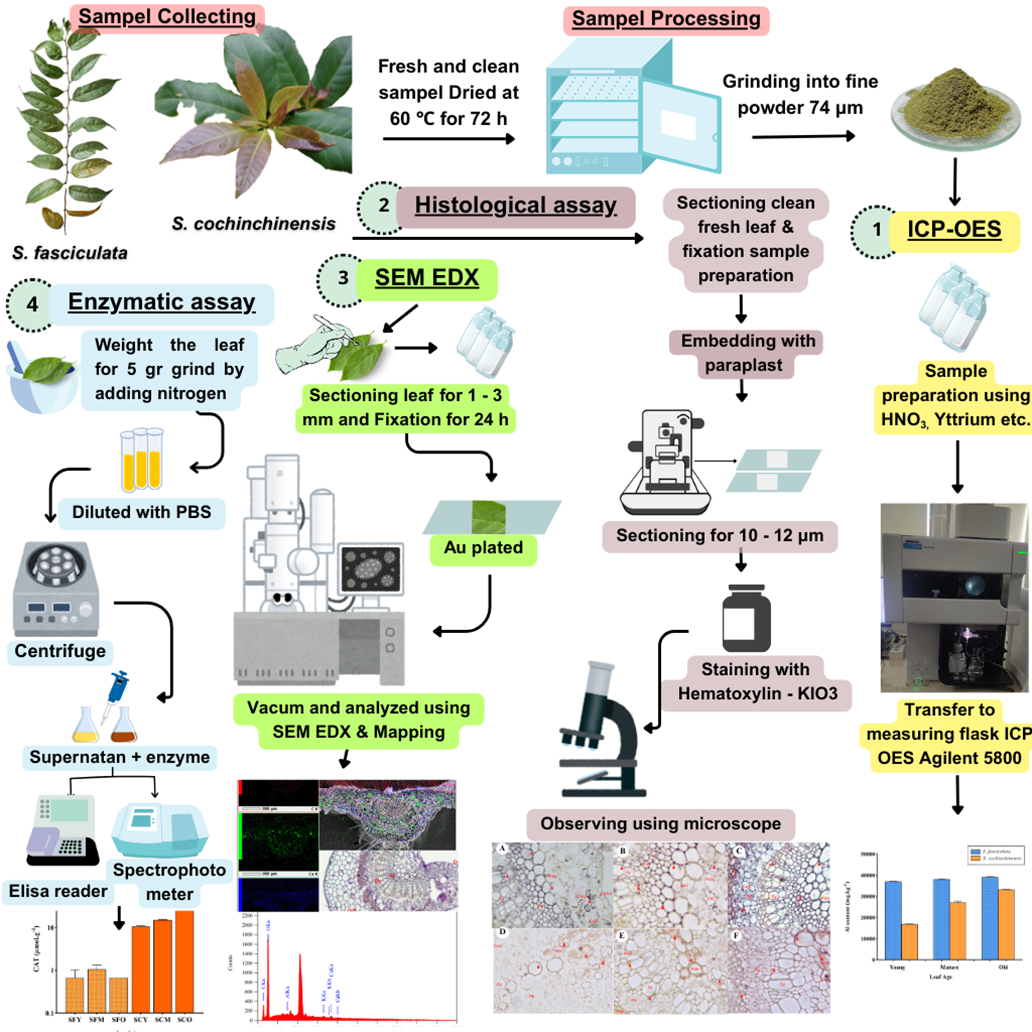
Since Symplocaceae is known to be a hyperaccumulator of Aluminum (Al), studies on its accumulation capacity and physiological responses have not been widely investigated. The objectives of this research are to investigate the Al content of different leaf ages of Symplocos fasciculata and Symplocos cochinchinensis using Inductively Coupled Plasma Optical Emission Spectrometry (ICP OES). Moreover, the Al localization within tissues was determined using hematoxylin staining, followed by Scanning Electron Microscopy coupled with Energy-Dispersive X-ray spectroscopy (SEM-EDX) mapping to address the ultrastructural form and determine elemental distribution in the cross-section of the leaf. Additionally, confirmation of the mechanism of Al toxicity in relation to stress-induced oxidative enzymes, including Catalase (CAT), Superoxide Dismutase (SOD), and Peroxidase (POD), as well as the lipid peroxidation product Malondialdehyde (MDA) and Hydrogen peroxide (H2O2), serves as stress markers. ICP OES assay reveals a significant influence of leaf age on Al content. S. fasciculata old leaves had the highest Al concentration (39,001 ± 343.48 mg kg−1), while S. cochinchinensis young leaves had the lowest (16,788 ± 187.98 mg kg−1). The histological and SEM-EDX mapping evidence shows Al accumulation in S. fasciculata and S. cochinchinensis increases significantly with leaf age. Al3+ accumulation is found in cell walls, epidermal tissue, and the palisade layer, with the highest Al distribution in the old leaf lamina. The leaf ages of both Symplocos species exhibit a significant influence on CAT, POD, MDA, and H2O2, whereas SOD activity shows no significant variation. A positive correlation is observed between SOD, POD, MDA, and H2O2 in S. fasciculata (r > 0.7), similar to S. cochinchinensis, except for MDA (r = −0.6). This research presents a valuable investigation into the Al accumulation strategies and physiological responses of 2 Symplocos species.
HIGHLIGHTS
- Investigate the total aluminium (Al) content of Symplocos fasciculata and Symplocos cochinchinensis across leaf ages using Inductively Coupled Plasma Optical Emission Spectrometry (ICP OES).
- Comparative histological analysis in leaf tissue from both Symplocos species in young, mature, and old leaf ages.
- Investigate the Al element and its distribution using Scanning Electron Microscopy with Energy Dispersive X-ray Spectroscopy (SEM-EDX) with mapping in three different age groups of leaves.
- Analyze the enzymatic activity of two Al- accumulating Symplocos species across leaf ages.
GRAPHICAL ABSTRACT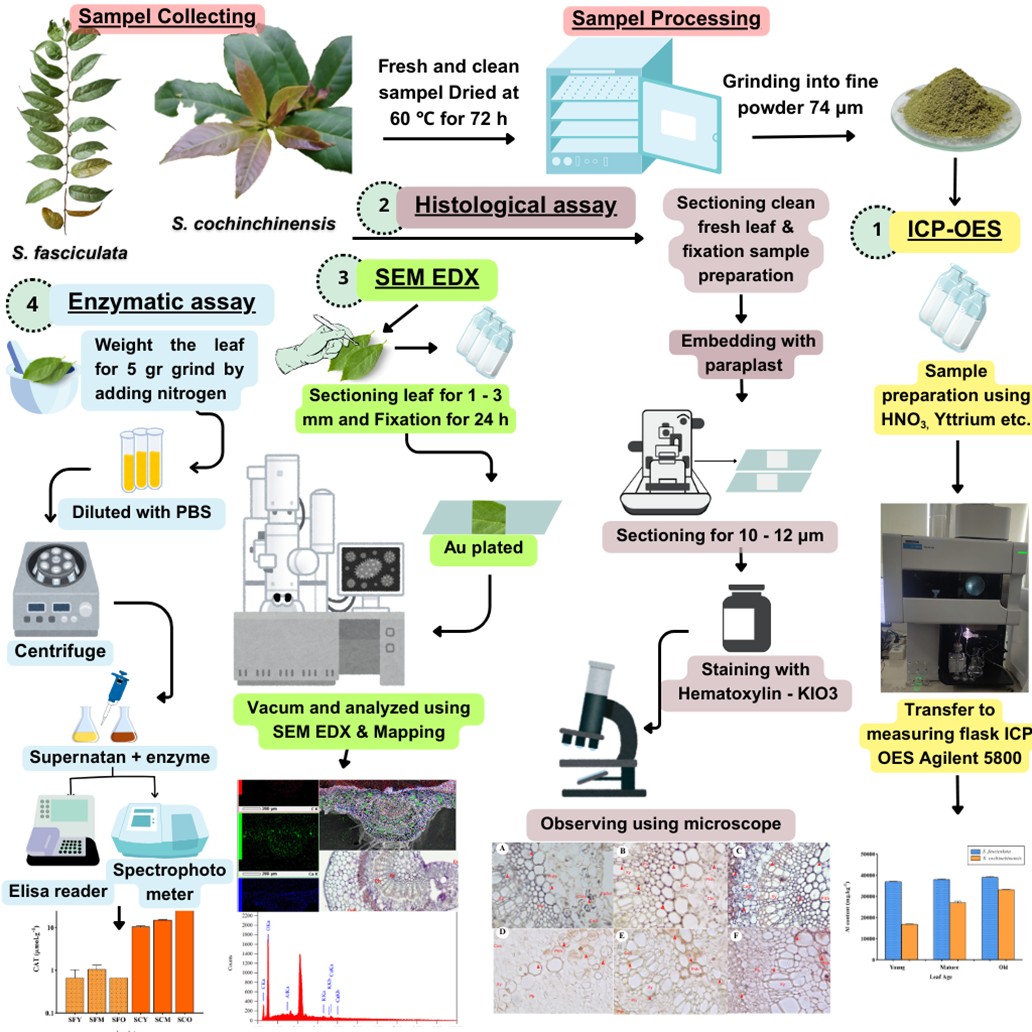
Downloads
References
R Ofoe, RH Thomas, SK Asiedu, G Wang-Pruski, B Fofana and L Abbey. Aluminum in plant: Benefits, toxicity and tolerance mechanisms. Frontiers in Plant Science 2023; 13, 1085998.
J Chandra and S Keshavkant. Mechanisms underlying the phytotoxicity and genotoxicity of aluminum and their alleviation strategies: A review. Chemosphere 2021; 278, 130384.
E Bojórquez-Quintal, C Escalante-Magaña, I Echevarría-Machado and M Martínez-Estévez. Aluminum, a friend or foe of higher plants in acid soils. Frontiers in Plant Science 2017; 8, 1767.
LV Kochian, OA Hoekenga and MA Pineros. How do crop plants tolerate acid soils? Mechanisms of aluminum tolerance and phosphorous efficiency. Annual Review of Plant Biology 2004; 55(1), 459-493.
E Maejima, S Hiradate, S Jansen, M Osaki and T Watanabe. Comparative analysis of aluminum accumulation in leaves of three angiosperm species. Botany 2014; 92(5), 327-331.
M Schmitt, S Boras, A Tjoa, T Watanabe and S Jansen. Aluminium Accumulation and intra-tree distribution patterns in three Arbor aluminosa (Symplocos) species from Central Sulawesi. PLoS One 2016; 11(2), e0149078.
M Zheng, M Zhou, H Liu, J Shen, Y Zhang and SX Zeng. Evaluation of extracts from Symplocos sumuntia leaves used as a natural coagulant for hakka tofu. Current Topics in Nutraceutical Research 2018; 1, 29-36.
L da Silva Rodrigues, DS Ferreira, ER Pereira-Filho and FMV Pereira. Mineral and trace element analysis of non-conventional food plants using ICP OES and chemometric techniques. Food Chemistry 2025; 472, 142854.
LC Werdemberg dos Santos, D Granja Arakaki, E Silva de Pádua Melo and VA Nascimento. Health hazard assessment due to slimming medicinal plant intake. Biological Trace Element Research 2022; 200, 1442-1154.
V D'Eusanio, E Frignani, A Marchetti, L Pigani, M Rivi and F Roncaglia. Long-term variability in the content of some metals and metalloids in aesculus flowers: A four-year study using ICP OES and PCA analysis. Molecules 2025; 30(4), 908.
P Boyd and DR Hyde. Iron contributes to photoreceptor degeneration and Müller glia proliferation in the zebrafish light-treated retina. Experimental Eye Research 2022; 216, 108947.
J Lu, X Qu, J Li, Z Li and J Yuan. Characteristics of aluminum accumulation and distribution in leaves of different ages in Camellia oleifera. Forests 2023; 14(12), 2322.
LRM De Andrade, LMG Barros, GF Echevarria, LIV Do Amaral, MG Cotta, DR Rossatto, M Haridasan and A Franco. Al-hyperaccumulator Vochysiaceae from the Brazilian Cerrado store aluminum in their chloroplasts without apparent damage. Environmental and Experimental Botany 2011; 70(1), 37-42.
NV Campos, TAR Pereira, MF Machado, MBB Guerra, GS Tolentino, JS Araujo, MQ Rezende, M Carolina, NA Da Silva and CEGR Schaefer. Evaluation of micro-energy dispersive X-ray fluorescence and histochemical tests for aluminium detection in plants from High Altitude Rocky Complexes, Southeast Brazil. Anais da Academia Brasileira de Ciencias 2014; 86(1), 285-296.
Y Haruyama, T Fujiwara, K Yasuda, M Saito and K Suzuki. Localization of aluminum in epidermal cells of mature tea leaves. Quantum Beam Science 2019; 3(2), 9.
IA Alaraidh, MM Ibrahim and GA El-Gaaly. Evaluation of green synthesis of Ag nanoparticles using Eruca sativa and Spinacia oleracea leaf extracts and their antimicrobial activity. Iranian Journal of Biotechnology 2014; 12(1), 8-13.
S Singh, DK Tripathi, S Singh, S Sharma, NK Dubey, DK Chauhan and M Vaculík. Toxicity of aluminium on various levels of plant cells and organism: A review. Environmental and Experimental Botany 2017; 137(1), 177-193.
JA Siqueira, JAS Barros, M Dal-Bianco, SCV Martins, PC Magalhães, DM Ribeiro, FM DaMatta, WL Araújo and C Ribeiro. Metabolic and physiological adjustments of maize leaves in response to aluminum stress. Theoretical and Experimental Plant Physiology 2020; 32(2), 133-145.
A Bizoń, J Chojdak-Łukasiewicz, S Budrewicz, A Pokryszko-Dragan and A Piwowar. Exploring the relationship between antioxidant enzymes, oxidative stress markers, and clinical profile in relapsing-remitting multiple sclerosis. Antioxidants 2023; 12(8), 1638.
M Haridasan. Nutritional adaptations of native plants of the cerrado biome in acid soils. Brazilian Journal of Plant Physiology 2008; 20(3), 183-195.
SU Rahman, JC Han, M Ahmad, MN Ashraf, MA Khaliq, M Yousaf, Y Wang, G Yasin, MF Nawaz, KA Khan and Z Du. Aluminum phytotoxicity in acidic environments: A comprehensive review of plant tolerance and adaptation strategies. Ecotoxicology and Environmental Safety 2024; 269, 115791.
BS dos Santos, TC Ferreira, PF Rosalem, MLG Olivio, VP Bossardi, AR Martins, LA Souza and LS de Camargos. Aluminum stress in Crotalaria spp.: anatomic changes, antioxidative response and nutrition. Plant Stress 2025; 17, 100967.
M Ozturk, M Metin, V Altay, T Kawano, A Gul, B ÜNAL, D Ünal, R Bhat, M Dervash, K Toderich, E Koç, PG Caparros and A Bukhari. Aluminum toxicity: A case study on tobacco (Nicotiana tabacum L.). Phyton-International Journal of Experimental Botany 2023; 92(1), 165-192.
A Choudhary, S Sharma, H Kaur, N Sharma, MM Gadewar, S Mehta and A Husen. Plant system, abiotic stress resilience, reactive oxygen species, and coordination of engineered nanomaterials: A review. South African Journal of Botany 2024; 171, 45-59.
MM Rahman, PK Ghosh, M Akter, MM Al Noor, A Rahman, SS Keya, S Roni, A Biswas and M Bulle. Green vanguards: Harnessing the power of plant antioxidants, signal catalysts, and genetic engineering to combat reactive oxygen species under multiple abiotic stresses. Plant Stress 2024; 13, 100547.
MC Romero-Puertas, LC Terron-Camero, MA Pelaez-Vico, A Olmedilla and LM Sandalio. Reactive oxygen and nitrogen species as key indicators of plant responses to Cd stress. Environmental and Experimental Botany 2019; 161, 107-119.
S Samanta, CS Seth and A Roychoudhury. The molecular paradigm of reactive oxygen species (ROS) and reactive nitrogen species (RNS) with different phytohormone signaling pathways during drought stress in plants. Plant Physiology and Biochemistry 2024; 206, 108259.
P Wang, WC Liu, C Han, S Wang, MY Bai and CP Song. Reactive oxygen species: Multidimensional regulators of plant adaptation to abiotic stress and development. Journal of Integrative Plant Biology 2024; 66(3), 30-67.
Q Xu, Y Wang, Z Ding, L Song, Y Li, D Ma, Y Wang, J Shen, S Jia, H Sun and H Zhang. Aluminum induced metabolic responses in two tea cultivars. Plant Physiology and Biochemistry 2016; 101, 162-172.
KAMA Rahman and D Ibrahim. Screening of antibacterial activity of endophytic fungi isolated from different leaf ages of Curcuma mangga using different growth media. International Journal of Research in Medical and Health Sciences 2015; 4, 1-10.
K Anwar, L Triyasmono and MI Rizki. The influence of leaf age on total phenolic, flavonoids, and free radical scavenging capacity of Aquilaria beccariana. Research Journal of Pharmaceutical Biological and Chemical Sciences 2017; 8, 129-133.
M Frankowski, A Zioła-Frankowska and J Siepak. From soil to leaves - Aluminum fractionation by single step extraction procedures in polluted and protected areas. Journal of Environmental Management 2013; 127, 1-9.
MJ Akhter, S Akhter, S Islam, MSH Sarker and SMK Hasan. Varietal influence on bioactive compounds and antioxidant activity in chilies during development stages. Heliyon 2024; 10, 37406.
S Marklund and G Marklund. Involvement of the superoxide anion radical in the autoxidation of pyrogallol and a convenient assay for superoxide dismutase. European Journal of Biochemistry 1974; 47(3), 469-474.
LM Ellerby and DE Bredesen. Measurement of cellular oxidation, reactive oxygen species, and antioxidant enzymes during apoptosis. Methods in Enzymology 2000; 322, 413-421.
EH Alici and G Arabaci. Determination of SOD, POD, PPO and cat enzyme activities in Rumex obtusifolius L. Annual Research and Review in Biology 2016; 11(3), 1-7.
Nurkhasanah, MS Bachri and S Yuliani. Antioksidan dan stres oksidatif (in Indonesian). UAD Press, Yogyakarta, Indonesia, 2023.
D Hadi and S Siswadi. Aluminum levels on leaves, bark, and root of two Loba species: Loba wawi (Symplocos fasciculata Zoll.) and Loba manu (Symplocos cochinchinensis). International Conference of Indonesia Forestry Reseacher 2011; 6, 72-74.
R Shen, J Ma and M Kyo. Compartmentation of aluminium in leaves of an Al-accumulator, Fagopyrum esculentum Moench. Planta 2002; 215(3), 394-398.
S Saberi, MIE Halmi, NA Ramle and K Mahmud. Metals accumulation of tropical shrub Melastoma malabathricum L. (Melastomataceae) populations and their relation to soil edaphic factor. Malaysian Applied Biology 2024; 53(1), 113-125.
D Li, Z Shu, X Ye, J Zhu, J Pan, W Wang, P Chang, C Cui, J Shen, W Fang, X Zhu and Y Wang. Cell wall pectin methyl-esterification and organic acids of root tips involve in aluminum tolerance in Camellia sinensis. Plant Physiology and Biochemistry 2017; 119(2), 65-74.
JR Baker. Experiments on the action of mordants 2. aluminum - haematein. Journal of Cell Science 1962; 103(4), 493-517.
QL Zeng, RF Chen, XQ Zhao, HY Wang and RF Shen. Aluminium uptake and accumulation in the hyperaccumulator Camellia oleifera abel. Pedosphere 2011; 21(3), 358-364.
R Hajiboland, CK Panda, O Lastochkina, MA Gavassi, G Habermann and JF Pereira. Aluminum toxicity in plants: Present and future. Journal of Plant Growth Regulation 2023; 42(7), 3967-3999.
R Tolrà, S Martos, R Hajiboland and C Poschenrieder. Aluminium alters mineral composition and polyphenol metabolism in leaves of tea plants (Camellia sinensis). Journal of Inorganic Biochemistry 2020; 204, 110956.
I Brunner and C Sperisen. Aluminum exclusion and aluminum tolerance in woody plants. Frontiers in Plant Science 2013; 4, 1-12.
MA Rahman, SH Lee, HC Ji, AH Kabir, CS Jones and KW Lee. Importance of mineral nutrition for mitigating aluminum toxicity in plants on acidic soils: Current status and opportunities. International Journal of Molecular Sciences 2018; 19(10), 3073.
V Munyaneza, W Zhang, S Haider, F Xu, C Wang and G Ding. Strategies for alleviating aluminum toxicity in soils and plants. Plant and Soil 2024; 504(1), 167-190.
GJ Ahammed, Z Li, J Chen, Y Dong, K Qu, T Guo, F Wang, A Liu, S Chen and X Li. Reactive oxygen species signaling in melatonin-mediated plant stress response. Plant Physiology and Biochemistry 2024; 207, 108398.
M Naz, MR Afzal, MA Raza, S Pandey, S Qi, Z Dai and D Du. Calcium (Ca2+) signaling in plants: A plant stress perspective. South African Journal of Botany 2024; 169(4), 464-485.
U Chowra, E Yanase, H Koyama and SK Panda. Aluminium-induced excessive ROS causes cellular damage and metabolic shifts in black gram Vigna mungo (L.) Hepper. Protoplasma 2017; 254(1), 293-302.
SK Jalmi, PK Bhagat, D Verma, S Noryang, S Tayyeba, K Singh, D Sharma and AK Sinha. Traversing the links between heavy metal stress and plant signaling. Frontiers in Plant Science 2018; 9, 12.
R Berni, M Luyckx, X Xu, S Legay, K Sergeant, JF Hausman, S Lutts, G Cai and G Guerriero. Reactive oxygen species and heavy metal stress in plants: Impact on the cell wall and secondary metabolism. Environmental and Experimental Botany 2019; 161, 98-106.
P García-Pérez, S Losada-Barreiro, C Bravo-Díaz, PP Gallego and L Lucini. Plant oxidative stress and specialized metabolites: a holistic physicochemical and metabolomics perspective. Plant Physiology and Biochemistry 2025; 227, 110093.
T Guo, G Zhang, M Zhou, F Wu and J Chen. Effects of aluminum and cadmium toxicity on growth and antioxidant enzyme activities of two barley genotypes with different Al resistance. Plant and Soil 2004; 258, 241-248.
R Kouki, I Bankaji, S Hidouri, H Bouzahouane, I Caçador, RM Pérez-Clemente and N Sleimi. Physiological behavior and antioxidant responses of Abelmoschus esculentus (L.) exposed to different concentrations of aluminum and barium. Horticulturae 2024; 10(12), 1338.
G Shahnaz, E Shekoofeh, D Kourosh and B Moohamadbagher. Interactive effects of silicon and aluminum on the malondialdehyde (MDA), proline, protein, and phenolic compounds in Borago officinalis L. Journal of Medicinal Plants Research 2011; 5(58), 18-27.
NG Nidhi Gupta, SS Gaurav and AK Ashwani Kumar. Molecular basis of aluminium toxicity in plants: A review. American Journal of Plant Sciences 2013; 4, 21-37.
Published
How to Cite
Issue
Section
License
Copyright (c) 2025 Walailak University

This work is licensed under a Creative Commons Attribution-NonCommercial-NoDerivatives 4.0 International License.





