
Ultrasound-Assisted Encapsulation of Curcumin: RSM Optimization and Release Kinetics
DOI:
https://doi.org/10.48048/tis.2026.11568Keywords:
Encapsulation, Curcumin, Alginate, Optimization, UltrasoundAbstract
Curcumin is a bioactive compound with strong antioxidant properties, yet its application is limited by low aqueous solubility and instability against chemical and metabolic degradation. To enhance its functional performance, curcumin was encapsulated using alginate-chitosan as wall materials assisted by ultrasonic homogenization. Process optimization was conducted through Response Surface Methodology (RSM) with Central Composite Design (CCD), considering sonication time (X1) and ultrasonic power (X2) as independent variables. The analysis of the optimization process demonstrated that the maximum encapsulation efficiency and swelling ratio were realized after 10 min of sonication at a power of 210 W. Compared to the non-ultrasonicated microcapsule, ultrasound treatment significantly enhanced encapsulation efficiency, reduced particle size, and improved homogeneity of the emulsion. Characterization using FTIR confirmed stronger molecular interactions between alginate, chitosan, and curcumin under ultrasound conditions, while SEM micrographs showed rougher surfaces with cracks that facilitated structural integrity. Particle size analysis (PSA) indicated a narrower and more uniform size distribution in the ultrasound-treated samples. Furthermore, the release kinetics analysis was well-fitted to the Peppas-Sahlin model, suggesting a dominant diffusion-controlled mechanism. These results indicate that ultrasonic treatment plays a role in influencing the encapsulation properties of curcumin, although further research is needed to fully understand its effect on the release profile of bioactive substances.
HIGHLIGHTS
- Ultrasonic time and power have a significant effect on curcumin encapsulation.
- Optimum condition was achieved at sonication time 10 min and power 210 W.
- Achieved 86.56% encapsulation efficiency and 1.781 swelling ratio.
- Release kinetics fit Peppas-Sahlin model with diffusion-dominant release.
GRAPHICAL ABSTRACT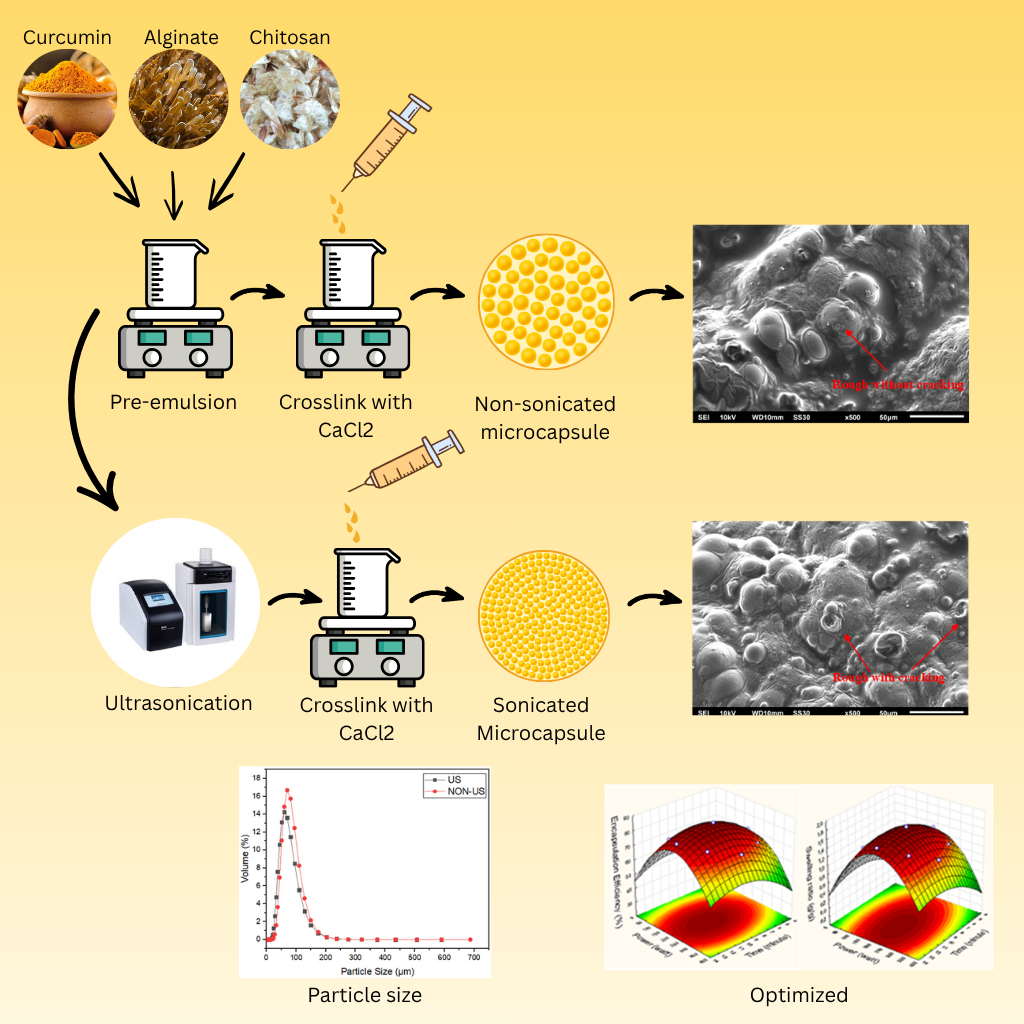
Downloads
References
V De Leo, AM Maurelli, L Giotta, V Daniello, S Di Gioia, M Conese, C Ingrosso, F Ciriaco and L Catucci. Polymer encapsulated liposomes for oral co-delivery of curcumin and hydroxytyrosol. International Journal of Molecular Sciences 2023; 24(1), 790.
D Carrozza, G Malavasi, E Ferrari and MC Menziani. Alginate beads containing cerium-doped mesoporous glass and curcumin: Delivery and stabilization of therapeutics. International Journal of Molecular Sciences 2023; 24, 880.
M Saifullah, MRI Shishir, R Ferdowsi, MRT Rahman and Q Van Vuong. Micro and nano encapsulation, retention and controlled release of flavor and aroma compounds: A critical review. Trends in Food Science and Technology 2019; 86, 230-251.
SS Patel, HA Pushpadass, MEE Franklin, SN Battula and P Vellingiri. Microencapsulation of curcumin by spray drying: Characterization and fortification of milk. Journal of Food Science and Technology 2021; 59(4), 1326-1340.
MV Traffano-Schiffo, M Castro-Giraldez, PJ Fito, M Perullini and PR Santagapita. Gums induced microstructure stability in Ca(II)-alginate beads containing lactase analyzed by SAXS. Carbohydrate Polymers 2018; 179, 402-407.
DU Kapoor, A Pareek, S Sharma, BG Prajapati, K Thanawuth and P Sriamornsak. Alginate gels: Chemistry, gelation mechanisms, and therapeutic applications with a focus on GERD treatment. International Journal of Pharmaceutics 2025; 675, 125570.
M Szekalska, K Sosnowska, A Czajkowska-Kośnik and K Winnicka. Calcium chloride modified alginate microparticles formulated by the spray drying process: A strategy to prolong the release of freely soluble drugs. Materials 2024; 11(9), 1522.
S Afzal, M Maswal and AA Dar. Rheological behavior of pH responsive composite hydrogels of chitosan and alginate: Characterization and its use in encapsulation of citral. Colloids and Surfaces B: Biointerfaces 2018; 169, 99-106.
D Thomas, M Latha and KK Thomas. Alginate/chitosan nanoparticles for improved oral delivery of rifampicin: Optimization, characterization and in vitro evaluation. Asian Journal of Chemistry 2018; 30(4), 736-740.
Y Chen, Y Lu, RJ Lee and G Xiang. Nano encapsulated curcumin: And its potential for biomedical applications. International Journal of Nanomedicine 2020; 15, 3099-3120.
N Choudhury, M Meghwal and K Das. Microencapsulation: An overview on concepts, methods, properties and applications in foods. Food Frontiers 2021; 2, 426-442.
E Gürbüz, B Keresteci, C Günneç and G Baysal. Encapsulation applications and production techniques in the food industry techniques in the food industry. Journal of Nutrition and Health Sciences 2020; 7(1), 106.
L Pudziuvelyte, M Marksa, K Sosnowska, K Winnicka, R Morkuniene and J Bernatoniene. Freeze-drying technique for microencapsulation of Elsholtzia ciliata ethanolic extract using different coating materials. Molecules 2020; 25, 2237.
I Buljeta, A Pichler, J Šimunović and M Kopjar. Polysaccharides as carriers of polyphenols: Comparison of freeze-drying and spray-drying as encapsulation techniques. Molecules 2022; 27, 5069.
R Rajam and P Subramanian. Encapsulation of probiotics: Past, present and future. Beni-Suef University Journal of Basic and Applied Sciences 2022; 11(1), 46.
P Sacco, S Pedroso-Santana, Y Kumar, N Joly, P Martin and P Bocchetta. Ionotropic gelation of chitosan flat structures and potential applications. Molecules 2021; 26(3), 660.
F Matter, AL Luna and M Niederberger. From colloidal dispersions to aerogels: How to master nanoparticle gelation. Nano Today 2020; 30, 100827.
N Omer, YM Choo, N Ahmad and NSM Yusof. Ultrasound-assisted encapsulation of pandan (Pandanus amaryllifolius) extract. Ultrasonics Sonochemistry 2021; 79, 105793.
L Perrin, S Desobry-Banon, G Gillet and S Desobry. Review of high-frequency ultrasounds emulsification methods and oil/water interfacial organization in absence of any kind of stabilizer. Foods 2022; 11, 2194.
N Mehta, JS, P Kumar, AK Verma, P Umaraw, SK Khatkar, AB Khatkar, D Pathak, U Kaka and AQ Sazili. Ultrasound-assisted extraction and the encapsulation of bioactive components for food applications. Foods 2022; 11(19), 192973.
J Su and A Cavaco-Paulo. Effect of ultrasound on protein functionality. Ultrasonics Sonochemistry 2021; 76, 105653.
F Zhao, X Liu, X Ding, H Dong and W Wang. Effects of high-intensity ultrasound pretreatment on structure, properties, and enzymolysis of soy protein isolate. Molecules 2019; 24, 3637.
X Wang, X Ni, C Duan, R Li, X Jiang, M Xu and R Yu. The effect of ultrasound treatment on the structural and functional properties of tenebrio molitor myofibrillar protein. Foods 2024; 13, 172817.
J Qiu, H Zhang and Z Wang. Ultrasonic degradation of polysaccharides from Auricularia auricula and the antioxidant activity of their degradation products. LWT - Food Science and Technology 2019; 113, 108266.
P Kour, S Afzal, A Gani, MI Zargar, UN Tak, S Rashid and AA Dar. Effect of nanoemulsion-loaded hybrid biopolymeric hydrogel beads on the release kinetics, antioxidant potential and antibacterial activity of encapsulated curcumin. Food Chemistry 2022; 376, 131925.
X Ren, T Hou, Q Liang, X Zhang, D Hu, B Xu, X Chen, M Chalamaiah and H Ma. Effects of frequency ultrasound on the properties of zein-chitosan complex coacervation for resveratrol encapsulation. Food Chemistry 2019; 279, 223-230.
H Liu, J Zhang, H Wang, Q Chen and B Kong. High-intensity ultrasound improves the physical stability of myofibrillar protein emulsion at low ionic strength by destroying and suppressing myosin molecular assembly. Ultrasonics Sonochemistry 2021; 74, 105554.
WF Huang, GCP Tsui, CY Tang and M Yang. Optimization strategy for encapsulation efficiency and size of drug loaded silica xerogel/polymer core-shell composite nanoparticles prepared by gelation-emulsion method. Polymer Engineering and Science 2018; 58, 742-751.
Y Liu, S Wang, W Lan and W Qin. Development of ultrasound treated polyvinyl alcohol/tea polyphenol composite films and their physicochemical properties. Ultrasonics Sonochemistry 2019; 51, 386-394.
Y Wang, C Ai, H Wang, C Chen, H Teng, J Xiao and L Chen. Emulsion and its application in the food field: An update review. eFood 2023; 4, 102.
AG Alvarado, M Arellano, M Rabelero, JE Puig and JC Sánchez-Díaz. Effect of particle size on the swelling and compression modulus of nanostructured polyacrylamide hydrogels. Journal of Macromolecular Science, Part A: Pure and Applied Chemistry 2015; 52(5), 381-386.
R Ebrahimi. The study of factors affecting the swelling of ultrasound-prepared hydrogel. Polymer Bulletin 2019; 76, 1023-1039.
A Prasetyaningrum, W Widayat, B Jos, R Ratnawati, T Riyanto, GR Prinanda, BU Le Monde and EE Susanto. Optimization of sequential microwave-ultrasonic-assisted extraction of flavonoid compounds from Moringa oleifera. Trends in Sciences 2023; 20(1), 6401.
EW Gibson. The role of p-values in judging the strength of evidence and realistic replication expectations. Statistics in Biopharmaceutical Research 2021; 13(1), 6-18.
N Zhao and M Wang. Research on parameter optimization of the express warehousing and distribution system based on the box-behnken response surface methodology. Advances in Civil Engineering 2021; 2021(1), 8723017.
Y Li, G Xu, W Li, L Lv and Q Zhang. The role of ultrasound in the preparation of zein nanoparticles/flaxseed gum complexes for the stabilization of pickering emulsion. Foods 2021; 10(9), 1990.
O Gul, FT Saricaoglu, I Atalar, LB Gul, F Tornuk and S Simsek. Structural characterization, technofunctional and rheological properties of sesame proteins treated by high-intensity ultrasound. Foods 2023; 12(9), 1791.
Q Ding, G Tian, X Wang, W Deng, K Mao and Y Sang. Effect of ultrasonic treatment on the structure and functional properties of mantle proteins from scallops (Patinopecten yessoensis). Ultrasonics Sonochemistry 2021; 79, 105770.
Y Liu, Q Liang, X Liu, H Raza, H Ma and X Ren. Treatment with ultrasound improves the encapsulation efficiency of resveratrol in zein-gum arabic complex coacervates. LWT - Food Science and Technology 2022; 153, 112331.
X Zhu, RS Das, ML Bhavya, M Garcia-Vaquero and BK Tiwari. Acoustic cavitation for agri-food applications: Mechanism of action, design of new systems, challenges and strategies for scale-up. Ultrasonics Sonochemistry 2024; 105, 106850.
X Zhu, RS Das, ML Bhavya, M Garcia-Vaquero and BK Tiwari. Effect of high-intensity ultrasound on the physicochemical properties, microstructure, and stability of soy protein isolate-pectin emulsion. Ultrasonics Sonochemistry 2021; 82, 105871.
W Qu, Y Feng, T Xiong, A Qayum and H Ma. Preparation, structural and functional characterization of corn peptide-chelated calcium microcapsules using synchronous dual frequency ultrasound. Ultrasonics Sonochemistry 2023; 102, 106732.
W Qu, T Guo, X Zhang, Y Jin, B Wang, H Wahia and H Ma. Preparation of tuna skin collagen-chitosan composite film improved by sweep frequency pulsed ultrasound technology. Ultrasonics Sonochemistry 2021; 82, 105880.
S Feng, X Zheng, D Luan, P Shao and P Sun. Preparation and characterization of zein-based phytosterol nanodispersions fabricated by ultrasonic assistant anti-solvent precipitation. LWT - Food Science and Technology 2019; 107, 138-144.
ABD Nandiyanto, R Oktiani and R Ragadhita. How to read and interpret FTIR spectroscope of organic material. Indonesian Journal of Science and Technology 2019; 4(1), 97-118.
N Pilipenko, OH Goncalves, E Bona, IP Fernandes, JA Pinto, GD Sorita, FV Leimann and MF Barreiro. Tailoring swelling of alginate-gelatin hydrogel microspheres by crosslinking with calcium chloride combined with transglutaminase. Carbohydrate Polymers 2019; 223, 115035.
Suryani, NHA Halid, NI Akib, Rahmanpiu and N Mutmainnah. Preparation of curcumin nanoparticle by using reinforcement ionic gelation technique. AIP Conference Proceedings 2017; 1838, 020013.
E Afzali, T Eslaminejad, SE Yazdi Rouholamini, M Shahrokhi-Farjah and M Ansari. Cytotoxicity effects of curcumin loaded on chitosan alginate nanospheres on the KMBC-10 spheroids cell line. International Journal of Nanomedicine 2021; 16, 579-589.
X Wang, X He and X Wang. FTIR analysis of the functional group composition of coal tar residue extracts and extractive residues. Applied Sciences 2023; 13(8), 5162.
ABD Nandiyanto, AS Wiryani, A Rusli, A Purnamasari, AG Abdullah, I Widiaty and R Hurriyati. Extraction of curcumin pigment from Indonesian local turmeric with its infrared spectra and thermal decomposition properties. IOP Conference Series: Materials Science and Engineering 2017; 180, 012136.
L Meena, NAN Gowda, CK Sunil, A Rawson and S Janghu. Effect of ultrasonication on food bioactive compounds and their bio-accessibility: A review. Journal of Food Composition and Analysis 2024; 126, 105899.
Q Liang, X Sun, H Raza, MA Khan, H Ma and X Ren. Fabrication and characterization of quercetin loaded casein phosphopeptides-chitosan composite nanoparticles by ultrasound treatment: Factor optimization, formation mechanism, physicochemical stability and antioxidant activity. Ultrasonics Sonochemistry 2021; 80, 105830.
SR Falsafi, Y Maghsoudlou, M Aalami, SM Jafari and M Raeisi. Physicochemical and morphological properties of resistant starch type 4 prepared under ultrasound and conventional conditions and their in-vitro and in-vivo digestibilities. Ultrasonics Sonochemistry 2019; 53, 110-119.
D Yonata, YNS Ulvie, E Soesanto, E Sulistyowati, B Pranata and A Rosidi. Stabilization and controlled release of curcumin from temulawak by spray-drying microencapsulation with composite wall materials. Trends in Sciences 2025; 22(2), 9125.
A Inui, A Honda, S Yamanaka, T Ikeno and K Yamamoto. Effect of ultrasonic frequency and surfactant addition on microcapsule destruction. Ultrasonics Sonochemistry 2020; 70, 105308.
A Prasetyaningrum, BS Wicaksono, A Hakiim, AD Ashianti, SFC Manalu, N Rokhati, DP Utomo and M Djaeni. Ultrasound-assisted encapsulation of citronella oil in alginate/carrageenan beads: characterization and kinetic models. ChemEngineering 2023; 7(1), 10.
H Thai, C Thuy Nguyen, L Thi Thach, M Thi Tran, HD Mai, TTT Nguyen, GD Le, M Van Can, LD Tran, GL Bach, K Ramadass, CI Sathish and QV Le. Characterization of chitosan/alginate/ lovastatin nanoparticles and investigation of their toxic effects in vitro and in vivo. Scientific Reports 2020; 10(1), 909.
DH Wardhani, FN Etnanta, HN Ulya and N Aryanti. Iron encapsulation by deacetylated glucomannan as an excipient using the gelation method: Characteristics and controlled release. Food Technology and Biotechnology 2022; 60(1), 41-51.
Published
How to Cite
Issue
Section
License
Copyright (c) 2025 Walailak University

This work is licensed under a Creative Commons Attribution-NonCommercial-NoDerivatives 4.0 International License.





