
Exploring the Potential of Biochar as Desiccant: Comparison of Sodium Hydroxide and Sulfuric Acid Impregnation Effect on Moisture Uptake
DOI:
https://doi.org/10.48048/tis.2026.12201Keywords:
Biochar, Desiccant, NaOH, H2SO4, Water vapor adsorption, Moisture, DesorptionAbstract
The development of sustainable and low-cost desiccants is imperative for advancing moisture control technologies. The present study investigated the effect of NaOH and H2SO4 impregnation at various concentrations and impregnation times on rice husk char (RHC) and coconut shell char (CSC). The samples were characterized using SEM-EDX, BET-BJH, and FTIR analyses, and their water vapor uptake was evaluated through adsorption–desorption experiments. NaOH impregnation, particularly at 6.0 N for 8 h, markedly enhanced adsorption by promoting pore development and introducing polar oxygenated groups. RHC exhibited the highest capacity of 0.515 g/g, while CSC demonstrated moderate improvement primarily through surface functionalization. In contrast, H2SO4 treatment generated oxygenated and sulfur-containing groups but suppressed pore formation, thereby lowering performance, particularly in CSC. Both adsorption and desorption kinetics followed the pseudo-second-order (PSO) model, while the sorption isotherms were best described by the Henderson model. Desorption analysis revealed activation energies for NaOH-impregnated RHC and CSC (123.8 and 94.9 kJ/mol). Overall, NaOH-treated RHC demonstrated superior adsorption and structural properties, indicating its potential as a renewable desiccant material requiring optimized regeneration efficiency.
HIGHLIGHTS
- NaOH impregnation (6.0 N, 8 h) markedly improved water vapor uptake of rice husk char (0.515 g/g) by promoting pore development and introducing polar oxygenated groups.
- H2SO4 impregnation functionalized the surface with oxygenated and sulphur groups but suppressed pore formation, resulting in lower adsorption capacity, especially in CSC.
- Adsorption-desorption kinetics followed the pseudo-second-order (PSO) model.
- Desorption analysis revealed high activation energies (123.8 kJ/mol for RHC, 94.9 kJ/mol for CSC).
GRAPHICAL ABSTRACT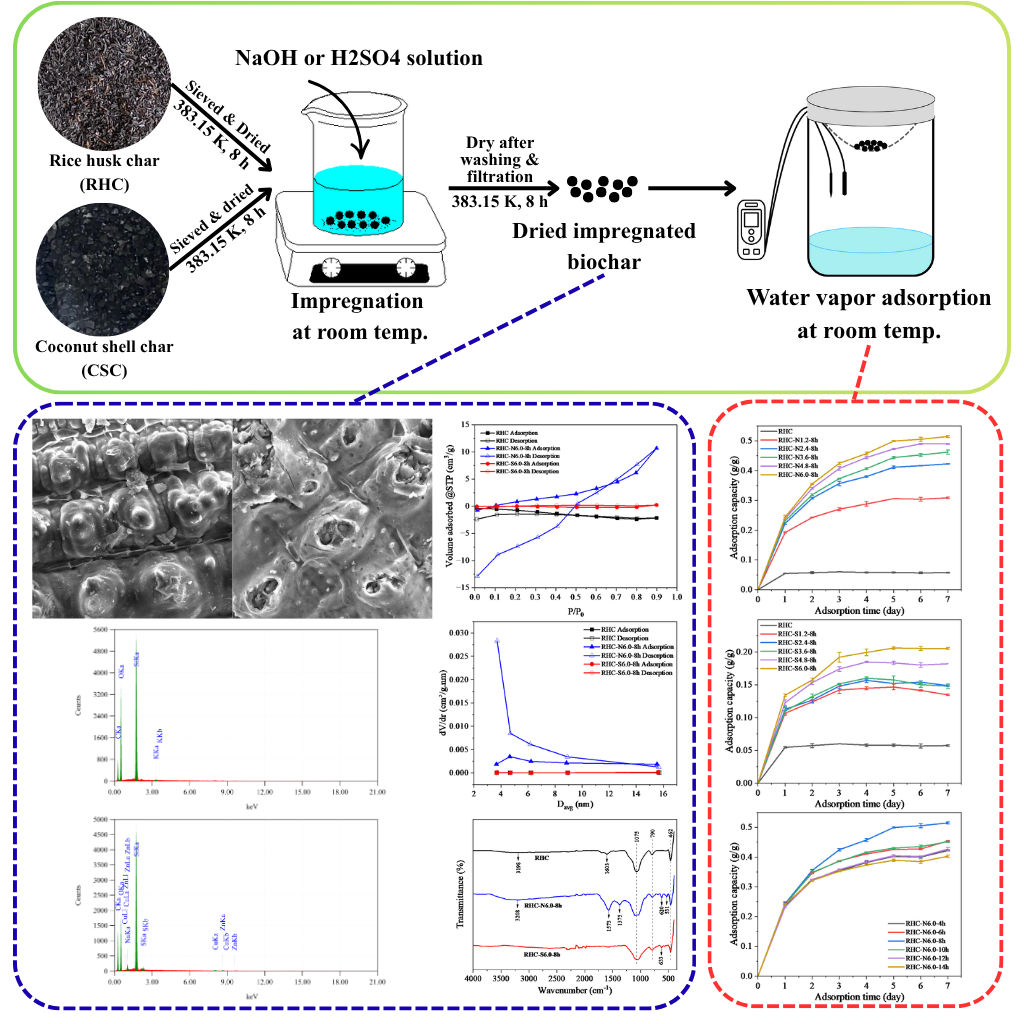
Downloads
References
M Ikram, S Ameer, F Kulsoom, M Sher, A Ahmad, A Zhid and Y Chang. Flexible temperature and humidity sensors of plants for precision agriculture: Current challenges and future roadmap. Computer and Electronic in Agriculture 2024; 226, 109449.
K Jiang, N Mahyuddin, H Yu, Y Ran and Z Zhao. Predictive modelling and multi-scenario validation of indoor micro-climate thermal-humidity conditions. Journal of Building Engineering 2025; 111, 113474.
N Veronica, PWS Heng and CV Liew. Relative Humidity Cycling: Implications on the Stability of Moisture-Sensitive Drugs in Solid Pharmaceutical Products. Molecular Pharmaceutics 2023; 20(2), 1072-1085.
SB Sasongko, H Hadiyanto, M Djaeni, AM Perdanianti and FD Utari. Effects of drying temperature and relative humidity on the quality of dried onion slice. Heliyon 2020; 6(7), e04338.
Z Yang, C Ma, Y Zhang, Z Du, P Zhou, Y Zhao, T Zhang and F Wang. Corrosion-life prediction model for 316L stainless steel under electronic special gases containing trace moisture employed in semiconductor manufacturing industry. Corrosion Science 2024; 241, 112510.
SA Asmarasari, N Azizah, S Sutikno, W Puastuti, A Amir, L Praharani, S Rusdiana, C Hidayat, A Hafid, DA Kusumaningrum, F Saputra, C Talib, A Herliatika, MI Shiddieqy and SY Hayanti. A review of dairy cattle heat stress mitigation in Indonesia. Veterinary World 2023; 16(5), 1098-1108.
M Djaeni, DQ A’yuni, M Alhanif, CL Hii and AC Kumoro, Air dehumidification with advance adsorptive materials for food drying: A critical assessment for future prospective. Drying Technology 2021; 39(11), 1648-1666.
C Shen, X Wei and Q Cheng. Theoretical and experimental research on the performance of new building environment control systems based on cooling dehumidification under positive pressure. Applied Thermal Engineering 2024; 247, 123009.
J Sonowal, BK Naik, DVN Lakshmi, P Muthukumar and R Anandalakshmi. Evolution of solar driven desiccant systems for energy-efficient air conditioning: A review. Solar Compass 2025; 14, 100115.
Y Zhang, F He, Y Wang, C Li, G Zhang and D Zhou. Recent advances, challenges and future prospects on frost-free air source heat pump technology with integrated solid desiccant dehumidification. Renewable and Sustainable Energy Reviews 2025; 219, 115877.
LKA Bharathi and S Kalaiselvam. Performance evaluation of low-temperature operated desiccant wheel integrated heat pump drying system for ponyfish (Leiognathus equula) drying. International Journal of Refrigeration 2025; 173, 55-67.
DQ A’yuni, H Hadiantono, V Velny, A Subagio, M Djaeni and N Mufti. Effect of potassium hydroxide concentration and activation time on rice husk-activated carbon for water vapor adsorption. Iranian Journal of Materials Science and Engineering 2024; 21(3), 82-91.
J Luo and H Yang. A state-of-the-art review on the liquid properties regarding energy and environmental performance in liquid desiccant air-conditioning systems. Applied Energy 2022; 325, 119853.
PD Ajay, HS Arunkumar, N Madhwesh and S Kumar. MgCl2-silica gel mixture as a sustainable liquid desiccant for humidity control. Energy Reports 2025; 14, 998-1007.
DQ A’yuni, A Subagio, H Hadiyanto, AC Kumoro and M Djaeni. Microstructure silica leached by NaOH from semi-burned rice husk ash for moisture adsorbent. Archives of Materials Science and Engineering 2021; 108(1), 5-15.
M Schoukens, M Gholami, R Joris, TV Assche, MJ Van Bael and JFM Denayer. Air drying using Fe3O4-silica gel composite laminates and hollow tubes with magnetic induction heating based adsorbent regeneration. Chemical Engineering Journal 2024; 502, 158095.
FDS Feudjio, CG Fotsop, DR Tchuifon, JN Ndi, RA Ntieche, HM Ngomo and M Yılmaz. Tunable water vapor adsorption properties on ion exchange microporous zeolite Na-X derived from natural kaolin. Inorganic Chemistry Communications 2025; 177, 114379.
R Ghasemzadeh, F Raouf and A Naghavi. Water vapor adsorption in microporous and mesoporous frameworks for atmospheric water harvesting: Isotherms, kinetics, and thermodynamics insights. Journal of Water Process Engineering 2025; 76, 108096.
P Liu, L Zhao, X Liu, C Yang, J Li, P Liu, W Wang, H Guo, G Huang, X Jin and Z Lei. Metal-organic framework-based polymer materials achieve efficient adsorption of water vapor and liquid water. Materials Today Communications 2025; 42, 111565.
M Islam, H Mittal, AA Alili, S Alhassan, V Kumar and M Islam. Activated carbon/superporous hydrogel composite-based polymer desiccants for capturing water vapor from humid air. Powder Technology 2025; 458, 121001.
Chairunnisa, F Miksik, T Miyazaki, K Thu, J Miyawaki, K Nakabayashi, AT Wijayanta and F Rahmawati. Development of biomass based-activated carbon for adsorption dehumidification. Energy Reports 2021; 7, 5871-5884.
C Wang, B Yang, X Ji, R Zhang and H Wu. Study on activated carbon/silica gel/lithium chloride composite desiccant for solid dehumidification. Energy 2022; 251, 123874.
J Srimuk, S Chirarattananon, P Chaiwiwatworakul, A Nathakaranakule, P Rakkwamsuk and S Chiarakorn. An experiment and simulation on a solar-regenerated dehumidifier fabricated from composite desiccant coated fin-tube heat exchanger. Applied Thermal Engineering 2024; 245, 122780.
H Bai, MGV Wee, A Chinnappan, J Li, R Shang and S Ramakrishna. Effect of polyvinylpyrrolidone and lithium chloride composite desiccant-coated heat exchangers on dehumidification studies. Applied Thermal Engineering 2024; 248, 123318.
JY Chung, MH Park, SH Hong, J Baek, C Han, S Lee, YT Kang and Y Kim. Comparative performance evaluation of multi-objective optimized desiccant wheels coated with MIL-100 (Fe) and silica gel composite. Energy 2023; 283, 128567.
Z Mo, M Li, S Sun, R Zhu, D Zhan, A Li, Y Li, Y Zhang and Q Yu. Modeling of activated carbon and multi-scale molecular simulation of its water vapor adsorption: A review. Journal of Environmental Chemical Engineering 2024; 12(5), 113732.
Y Huang, Q Yu, M Li, S Jin, J Fan, L Zhao and Z Yao. Surface modification of activated carbon fiber by low-temperature oxygen plasma: Textural property, surface chemistry, and the effect of water vapor adsorption. Chemical Engineering Journal 2021; 418, 129474.
M Bora, SM Benoy, J Tamuly and BK Saikia. Ultrasonic-assisted chemical synthesis of activated carbon from low-quality subbituminous coal and its preliminary evaluation towards supercapacitor applications. Journal Environmental Chemical Engineering 2021; 9(1), 104986.
F Yousefian, MA Babatabar, M Eshaghi, SM Poor and A Tavasoli. Pyrolysis of Rice husk, Coconut shell, and Cladophora glomerata algae and application of the produced biochars as support for cobalt catalyst in Fischer–Tropsch synthesis. Fuel Processing Technology 2023; 247, 107818.
S Neogi, V Sharma, N Khan, D Chaurasia, A Ahmad, S Chauhan, A Singh, S You, A Pandey and PC Bhargava. Sustainable biochar: A facile strategy for soil and environmental restoration, energy generation, mitigation of global climate change and circular bioeconomy. Chemosphere 2022; 293, 133474.
EC Emenike, S Ogunniyi, JO Ighalo, KO Iwuozor, HK Okoro and AG Adeniyi. Delonix regia biochar potential in removing phenol from industrial wastewater. Bioresource Technology Reports 2022; 19, 101195.
Chairunnisa, F Mikšík, T Miyazaki, K Thu, J Miyawaki, K Nakabayashi, AT Wijayanta and F Rahmawati. Enhancing water adsorption capacity of acorn nutshell based activated carbon for adsorption thermal energy storage application. Energy Reports 2020; 6, 255-263.
Y Gao, Q Yue, B Gao and A Li. Insight into activated carbon from different kinds of chemical activating agents: A review. Science of the Total Environment 2020; 746, 141094.
M Mirzaie, AR Talebizadeh and H Hashemipour. Mathematical modeling and experimental study of VOC adsorption by Pistachio shell-based activated carbon. Environmental Science and Pollution Research 2021; 28(3), 3737-3747.
H Tan, CT Lee, KY Wong, PY Ong, MHD Othman, KS Woon and GR Mong. Comparison between chemical modification of biochar for different environmental applications. Chemical Engineering Transactions 2024; 114, 535-540.
Y Chen, H Tian, T Lin, Y Liang, E Wang, W Li, J Huang, X Fang and W Zhang. Study on the properties of activated carbon based on activation process and NaOH modification. Advances in Bamboo Science 2025; 12, 100186.
KR Mamaghani and N Parvin. The measurement and improvement of tensile strength in cold-sintered zinc oxide. Materials Chemistry and Physics 2025; 339, 130753.
JE Linhoss, MK Mohammadi-Aragh and JD Evans. Influence of pine and miscanthus biochar on the water activity and moisture sorption isotherms of used broiler litter. Heliyon 2023; 9(12), e22618.
EA Kosasih, A Zikri and MI Dzaky. Water vapor desorption from silica gel in a combined drying and double-condenser compression refrigeration system. Heliyon 2022; 8(6), e09757.
G Kailas, AR Akash, S Dutta and V Madav. Novel adsorption-based upgradation of end-of-life polypropylene pyrolysis oil using carbonised rice husk. Energy Conversion and Management: X 2024; 25, 100824.
J Lugo-Arias, J González-Álvarez, A Maturana, J Villa-Parejo and C Barraza-Heras. Removal of nitrate and phosphate from aqueous solutions using bioadsorbents derived from agro-industrial wastes of rice husk and corn stalk. Biomass Conversion and Biorefinery 2025; 15, 19453-19475.
PU Nzereogu, AD Omah, FI Ezema, EI Iwuoha and AC Nwanya. Silica extraction from rice husk: Comprehensive review and applications. Hybrid Advances 2023; 4, 100111.
P Premchand, F Demichelis, C Galletti, D Chiaramonti, S Bensaid, E Antunes and D Fino. Enhancing biochar production: A technical analysis of the combined influence of chemical activation (KOH and NaOH) and pyrolysis atmospheres (N2/CO2) on yields and properties of rice husk-derived biochar. Journal of Environmental Management 2024; 370, 123034.
NAM Barakat, MS Mahmoud and HM Moustafa. Comparing specific capacitance in rice husk-derived activated carbon through phosphoric acid and potassium hydroxide activation order variations. Scientific Reports 2024; 14(1), 1460.
L Longo, D Baldassin, AD Michele, C Bittencourt, F Menegazzo and M Signoretto. Activation strategies for rice husk biochar: enhancing porosity and performance as a support for Pd catalysts in hydrogenation reactions. Catalysis Science & Technology 2025; 15(17), 5101-5115.
T Zelenka, T Horikawa and DD Do. Artifacts and misinterpretations in gas physisorption measurements and characterization of porous solids. Advances in Colloid and Interface Science 2023; 311, 102831.
P Maziarka, C Wurzer, PJ Arauzo, A Dieguez-Alonso, O Mašek and F Ronsse. Do you BET on routine? The reliability of N2 physisorption for the quantitative assessment of biochar’s surface area. Chemical Engineering Journal 2021; 418, 129234.
K Kaneko. Adsorption-biased characterization of porous solids. Adsorption 2024; 31(1), 27.
LS Blankenship, J Jagiello and R Mokaya. Confirmation of pore formation mechanisms in biochars and activated carbons by dual isotherm analysis. Materials Advances 2022; 3, 3961-3971.
J Xu, H Zhang, X Ji, Q Lan and Q Fan. Activated carbon modified by ester hydrolysis of ethyl acetate for water vapor adsorption enhancement. Processes 2022; 10(8), 1527.
HU Rahim, E Allevato and SR Stazi. Sulfur-functionalized biochar: Synthesis, characterization, and utilization for contaminated soil and water remediation - a review. Journal of Environmental Management 2024; 370, 122670.
H Hadiantono, M Djaeni, I Sumantri, S Suherman, H Hadiyanto and N Mufti. The influence of sodium silicate concentration and impregnation time on biochar activation for water adsorption. Chemical Engineering Transactions 2025; 118, 397-402.
A Nandiyanto, R Ragadhita, M Fiandini and I Ijost. Interpretation of Fourier Transform Infrared Spectra (FTIR): A practical approach in the polymer/plastic thermal decomposition. Indonesian Journal of Science and Technology 2023; 8, 113-126.
MAR Taheri, A Astaraei, A Lakzian and H Emami. The role of biochar and sulfur-modified biochar on soil water content, biochemical properties and millet crop under saline-sodic and calcareous soil. Plant and Soil 2023; 499, 221-236.
Y Guo and Q Wang. Exploring the adsorption potential of Na2SiO3-activated porous carbon materials from waste bamboo biomass for ciprofloxacin rapid removal in wastewater. Environmental Technology & Innovation 2023; 32, 103318.
V Frišták, D Bošanská, M Pipíška, L Ďuriška, SM Bell and G Soja. Physicochemical characterization of cherry pits-derived biochar. Materials 2022; 15(2), 408.
A Faggiano, A Cicatelli, F Guarino, S Castiglione, A Proto, A Fiorentino and O Motta. Optimizing CO2 capture: Effects of chemical functionalization on woodchip biochar adsorption performance. Journal of Environmental Management 2025; 380, 125059.
MMM Ahmed, C Liao, S Venkatesan, Y Liu, Y Tzou, S Jien, M Lin, Y Hsieh and AI Osman. Sulfur-functionalized sawdust biochar for enhanced cadmium adsorption and environmental remediation: A multidisciplinary approach and density functional theory insights. Journal of Environmental Management 2025; 373, 123586.
Z Zhang, X Li, H Jia and Y Liu. Moisture sorption isotherms and thermodynamic properties of tiger nuts: An oil-rich tuber. LWT 2022; 167, 113866.
M Djaeni, H Hadiantono and SB Sasongko. Comparison of moisture sorption isotherm models and desorption kinetics of silica-impregnated biochar composite desiccant. Journal of Physical Chemistry and Functional Materials 2025; 8(1), 72-81.
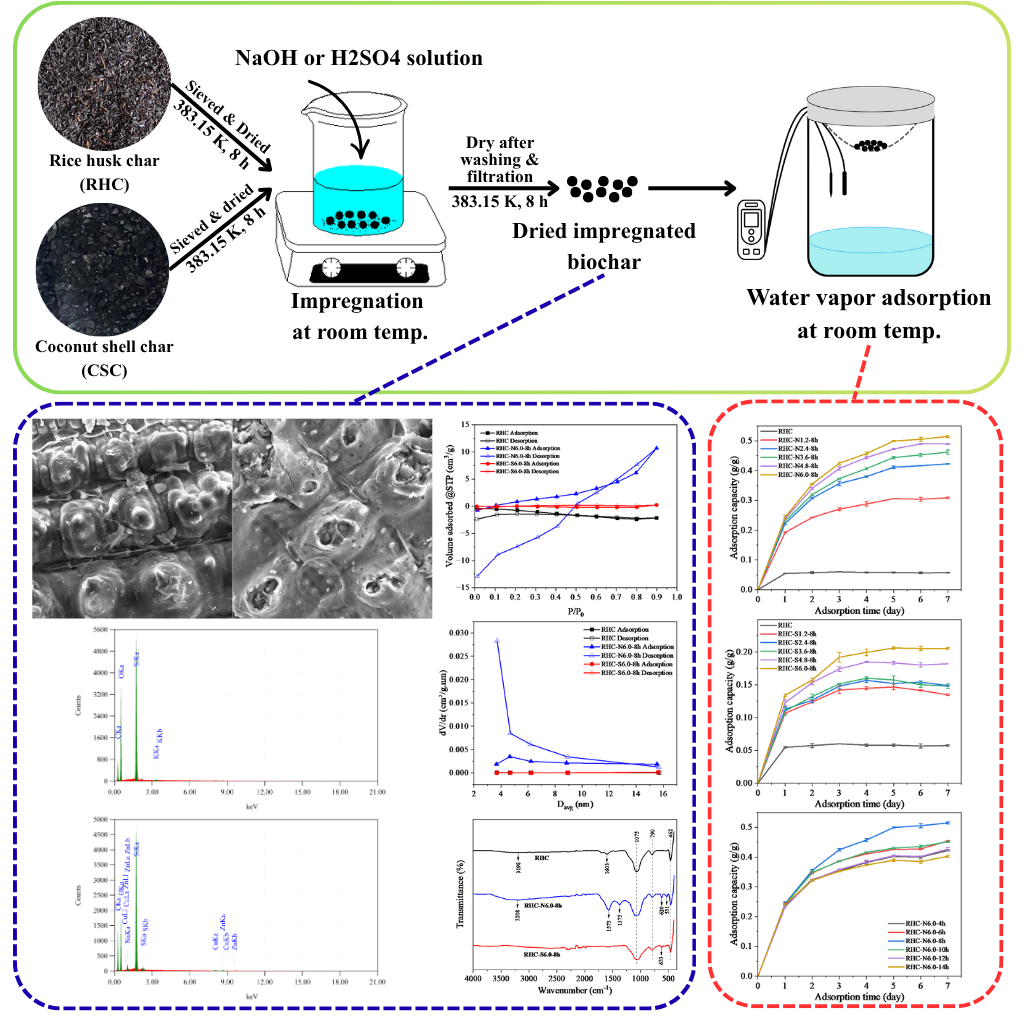
Published
How to Cite
Issue
Section
License
Copyright (c) 2025 Walailak University

This work is licensed under a Creative Commons Attribution-NonCommercial-NoDerivatives 4.0 International License.





