
Integrated In Silico and In Vivo Analysis of Vitamin D3 Supplementation in Obesity and Diabetes
DOI:
https://doi.org/10.48048/tis.2026.11600Keywords:
Pancreatic lipase, α-amylase, α-glucosidase, trbl, sod1, Drosophila melanogasterAbstract
Obesity and diabetes are interconnected metabolic disorders with a rising prevalence worldwide. Although vitamin D3 is known to regulate glucose metabolism and oxidative stress, its ability to inhibit digestive enzymes linked to adipogenesis has not been demonstrated. This study proposed that vitamin D3 possesses dual anti-obesity and antidiabetic activities by targeting pancreatic lipase, α-amylase, and α-glucosidase, and confirmed this hypothesis through in silico docking and in vivo experiments using Drosophila melanogaster. Docking simulations using AutoDock Vina showed that vitamin D3 had a stronger affinity for pancreatic lipase (−7.5 kcal/mol) than orlistat (−6.8 kcal/mol), with stable hydrophobic interactions at the catalytic sites. The D. melanogaster w1118 strain was reared on a high-fat diet (2% virgin coconut oil) supplemented with vitamin D3 (10 or 100 mM). The experimental groups (n = 20 flies per group, 5 replicates) were assessed for hemolymph glucose, locomotor activity, oxidative stress (NBT assay), and gene expression <trbl and sod1>. Data were analyzed using 1-way ANOVA with Tukey’s post-hoc test (p < 0.05). Vitamin D3 supplementation significantly reduced hemolymph glucose and ROS levels, improved crawling performance, and restored trbl and sod1 expression in HFD-fed flies. These effects were consistent with docking predictions, indicating that enzyme inhibition may underlie the observed metabolic benefits. In conclusion, vitamin D3 shows promising antiobesity and antidiabetic effects in a D. melanogaster model, supporting its role as a potential modulatory supplement. However, limitations such as the use of an invertebrate model, high compound concentrations, and the absence of mammalian or clinical validation highlight the need for further studies in higher organisms.
HIGHLIGHTS
- Vitamin D3 exhibits strong in silico binding affinity to lipase and α-amylase.
- In vivo exposure to Vitamin D3 reduces cholesterol and glucose levels in Drosophila larvae
- Vitamin D3 promotes larval growth and locomotor activity under high-fat diet conditions
- Vitamin D3 upregulates the expression of trbl, sod1, and cat genes
- Vitamin D3 shows potential as a low-cost adjunctive therapy for obesity management
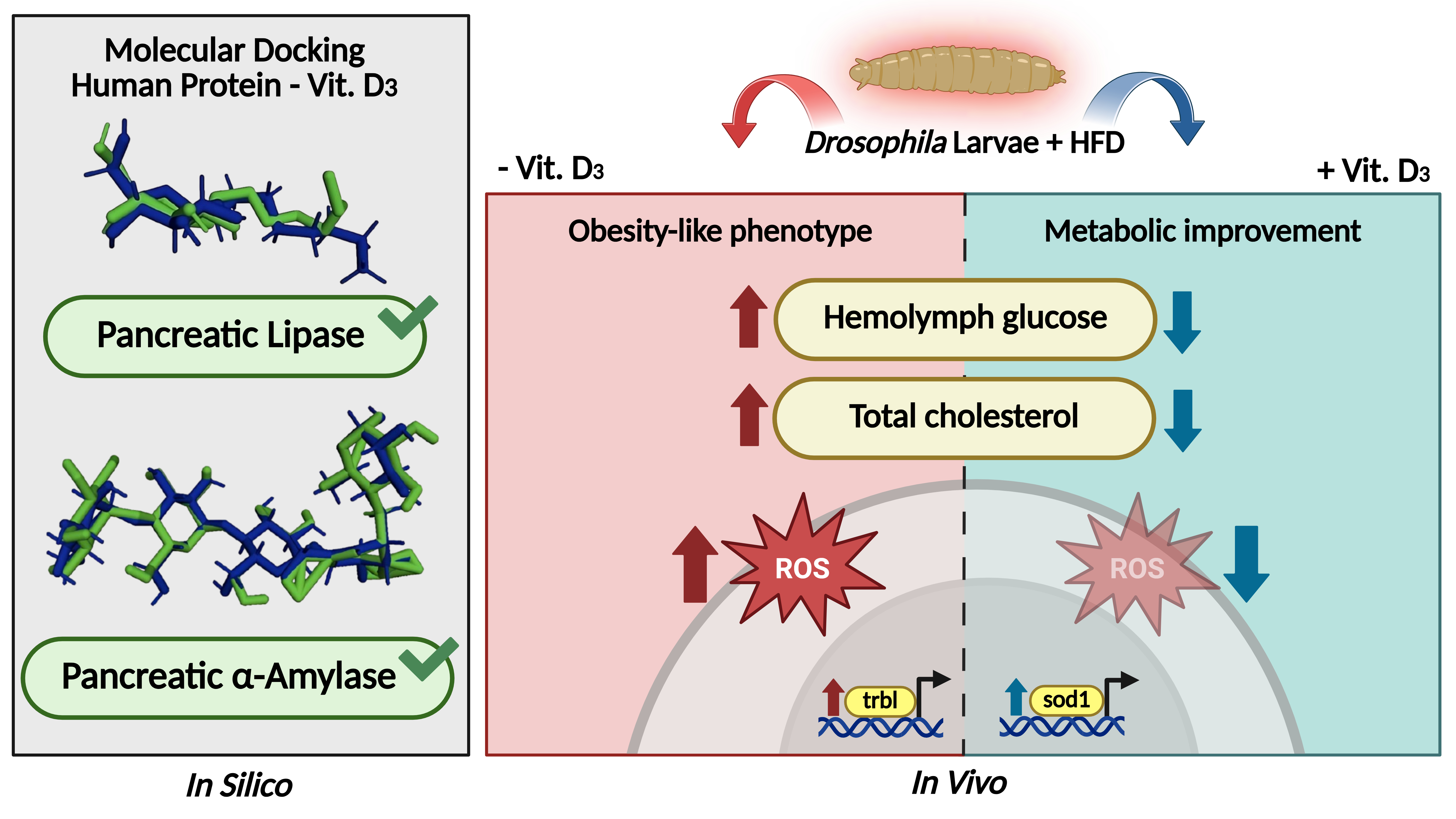
GRAPHICAL ABSTRACT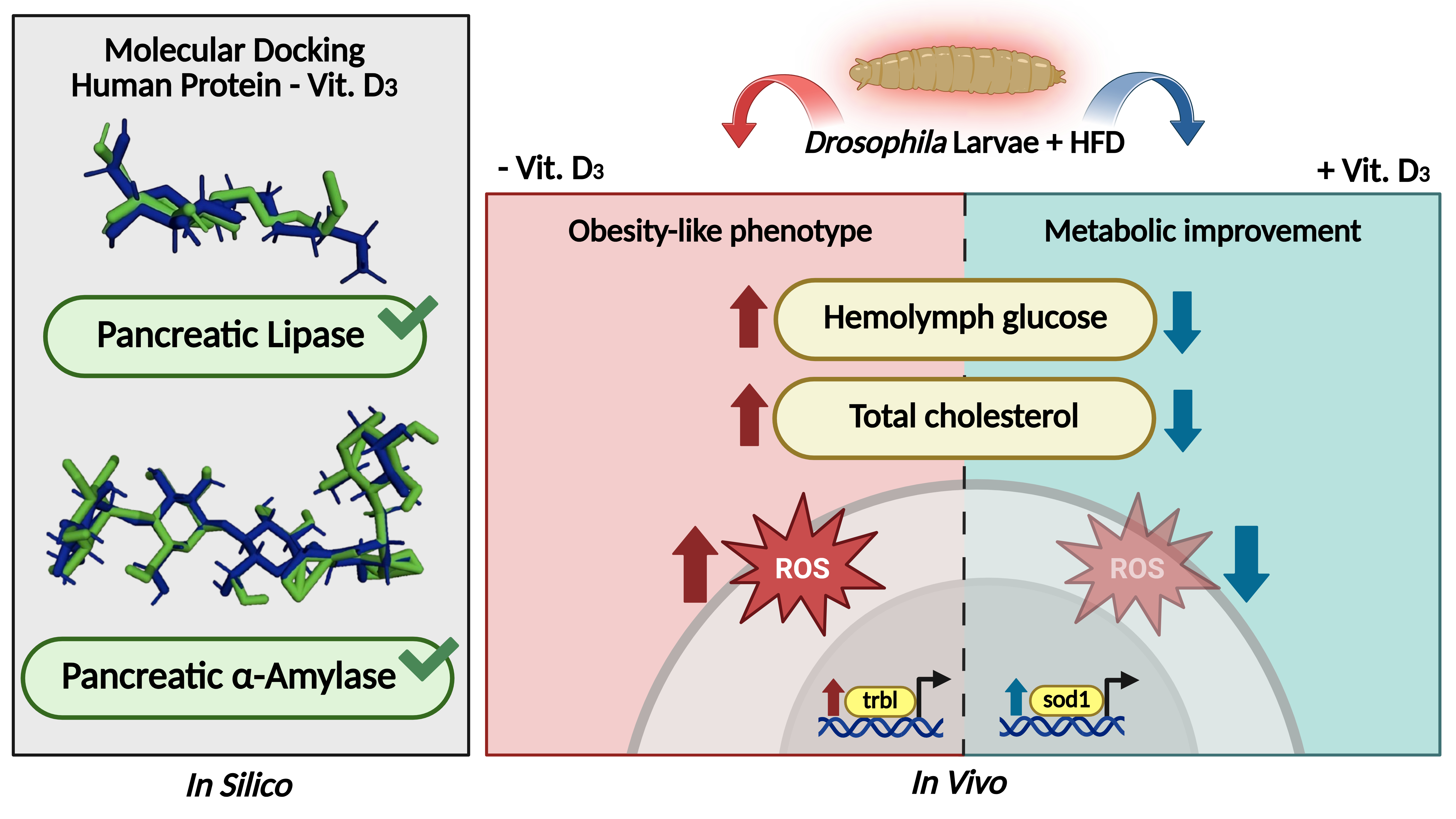
Downloads
References
XD Zhou, QF Chen, W Yang, M Zuluaga, G Targher, CD Byrne, L Valenti, F Luo, CS Katsouras, O Thaher, A Misra, K Ataya, RJ Oviedo, APS Kong, K Alswat, A Lonardo, YJ Wong, A Abu-Abeid, H Al Momani, …, MH Zheng. Burden of disease attributable to high body mass index: An analysis of data from the Global Burden of Disease Study 2021. EClinicalMedicine 2024; 76, 102848.
SM Jeong, JH Jung, YS Yang, W Kim, IY Cho, YB Lee, KY Park, GE Nam and K Han. 2023 Obesity fact sheet: Prevalence of obesity and abdominal obesity in adults, adolescents, and children in Korea from 2012 to 2021. Journal of Obesity & Metabolic Syndrome 2024; 33(1), 27-35.
P Chandrasekaran and R Weiskirchen. The role of obesity in type 2 diabetes mellitus - an overview. International Journal of Molecular Sciences 2024; 25(3), 1882.
T Lobstein and J Jewell. What is a “high” prevalence of obesity? Two rapid reviews and a proposed set of thresholds for classifying prevalence levels. Obesity Reviews 2022; 23(2), e13363.
AR Ferdina, PP Arfines and NK Aryastami. Obesity in urban Indonesia: Evidence from the 2007 and 2018 Basic Health Research. Medical Journal of Indonesia 2024; 33(2), 119-127.
JV Siswanto, B Mutiara, F Austin, J Susanto, CT Tan, RU Kresnadi and K Irene. Ancestry-adjusted polygenic risk scores for predicting obesity risk in the Indonesian population. arXiv 2025; 2505, 13503.
ME Piché, A Tchernof and JP Després. Obesity phenotypes, diabetes, and cardiovascular diseases. Circulation Research 2020; 126(11), 1477-1500.
H Hardinsyah, WB Gunawan, F Nurkolis, D Alisaputra, R Kurniawan, N Mayulu, NA Taslim and TE Tallei. Antiobesity potential of major metabolites from Clitoria ternatea kombucha: Untargeted metabolomic profiling and molecular docking simulations. Current Research in Food Science 2023; 6, 100464.
P Rathinavelusamy, PM Mazumder, D Sasmal and V Jayaprakash. Evaluation of in silico, in vitro alpha-amylase inhibition potential and antidiabetic activity of Pterospermum acerifolium bark. Pharmaceutical Biology 2014; 52(2), 199-207.
F Zhang, S Xu, L Tang, X Pan and N Tong. Acarbose with comparable glucose-lowering but superior weight-loss efficacy to dipeptidyl peptidase-4 inhibitors: A systematic review and network meta-analysis of randomized controlled trials. Frontiers in Endocrinology 2020; 11, 288.
Z Gao, M Huang, J Wang, H Jia, P Lv, J Zeng and G Ti. Efficacy and safety of orlistat in controlling the progression of prediabetes to diabetes: A meta-analysis and systematic review. Medicine 2024; 103(21), e38354.
M Yousefi, ST Fateh, M Nikbaf-Shandiz, F Gholami, S Rastgoo, R Bagher, A Khadem, F Shiraseb and O Asbaghi. The effect of acarbose on lipid profiles in adults: A systematic review and meta-analysis of randomized clinical trials. BMC Pharmacology and Toxicology 2023; 24(1), 65.
R Khera, MH Murad, AK Chandar, PS Dulai, Z Wang, LJ Prokop, R Loomba, M Camilleri and S Singh. Association of pharmacological treatments for obesity with weight loss and adverse events: A systematic review and meta-analysis. Jama 2016; 315(22), 2424-2434.
TD Müller, M Blüher, MH Tschöp and RD DiMarchi. Anti-obesity drug discovery: Advances and challenges. Nature Reviews Drug Discovery 2022; 21(3), 201-223.
C Argano, L Mirarchi, S Amodeo, V Orlando, A Torres and S Corrao. The role of vitamin D and its molecular bases in insulin resistance, diabetes, metabolic syndrome, and cardiovascular disease: State of the art. International Journal of Molecular Sciences 2023; 24(20), 15485.
I Szymczak-Pajor, J Drzewoski and A Śliwińska. The molecular mechanisms by which vitamin D prevents insulin resistance and associated disorders. International Journal of Molecular Sciences 2020; 21(18), 6644.
SJ Wimalawansa. Vitamin D deficiency: Effects on oxidative stress, epigenetics, gene regulation, and aging. Biology 2019; 8(2), 30.
S Furukawa, T Fujita, M Shimabukuro, M Iwaki, Y Yamada, Y Nakajima, O Nakayama, M Makishima, M Matsuda and I Shimomura. Increased oxidative stress in obesity and its impact on metabolic syndrome. Journal of Clinical Investigation 2004; 114(12), 1752-1761.
SK Masenga, LS Kabwe, M Chakulya and A Kirabo. Mechanisms of oxidative stress in metabolic syndrome. International Journal of Molecular Sciences 2023; 24(9), 7898.
R Popovic, Y Yu, NS Leal, G Fedele, SHY Loh and M Martins. Upregulation of Tribbles decreases body weight and increases sleep duration. Disease Models & Mechanisms 2023; 16(4), dmm049942.
M Hernández-Quiles, R Baak, A Borgman, S den Haan, PS Alcaraz, R van Es, E Kiss-Toth, H Vos and E Kalkhoven. Comprehensive profiling of mammalian tribbles interactomes implicates TRIB3 in gene repression. Cancers 2021; 13(24), 6318.
BN Hughson. The glucagon-like adipokinetic hormone in drosophila melanogaster - biosynthesis and secretion. Frontiers in Physiology 2021; 12, 710652.
DI Mohamed, DA Abou-Bakr, SF Ezzat, HFA El-Kareem, HHA Nahas, HA Saad, AE Mehana and EM Saied. Vitamin D3 prevents the deleterious effects of testicular torsion on testis by targeting miRNA-145 and ADAM17: In silico and in vivo study. Pharmaceuticals 2021; 14(12), 1222.
NO Shoier, SA Ghareib, H Kothayer, AE Alsemeh and SS El-Sayed. Vitamin D3 mitigates myopathy and metabolic dysfunction in rats with metabolic syndrome: the potential role of dipeptidyl peptidase-4. Naunyn-Schmiedeberg's Archives of Pharmacology 2025; 398(4), 3697-3715.
S Casas-Tintó. Drosophila as a model for human disease: insights into rare and ultra-rare diseases. Insects 2024; 15(11), 870.
UB Pandey and CD Nichols. Human disease models in Drosophila melanogaster and the role of the fly in therapeutic drug discovery. Pharmacological Reviews 2011; 63(2), 411-436.
I Trinh and GL Boulianne. Modeling obesity and its associated disorders in Drosophila. Physiology 2013; 28(2), 117-124.
LP Musselman and RP Kühnlein. Drosophila as a model to study obesity and metabolic disease. Journal of Experimental Biology 2018; 221(S1), jeb163881.
MR Azmin, H Habibie, F Filmaharani, A Roosevelt, A Nurhidayah, MR Pratama, W Hardiyanti, NP Latada, M Mudjahid, D Yuliana and F Nainu. Aspirin-mediated reduction of glucose level and inflammation in Drosophila melanogaster. ACS Omega 2025; 10(18), 18622-18628.
R Ratnawati, M Aswad, J Jumriani, A Nurhidayah, MR Azmin, F Filmaharani, A Roosevelt, W Hardiyanti, NP Latada, M Mudjahid and F Nainu. In silico and in vivo investigation of the anti-hyperglycemic effects of caffeic acid. ACS Omega 2025; 10(14), 14052-14062.
F Nainu, MA Bahar, H Habibie, A Najib, MS Zubair, M Arba, A Asbah, M Mudjahid, NP Latada, F Filmaharani and AA Putri. Exploring the antidiabetic potential of Sulawesi ethnomedicines: A study of Cordia myxa and Syzygium malaccense in a Drosophila model of hyperglycemia. Narra J 2025; 5(1), e1712.
F Nainu, S Sartini, S Subehan, DK Sari, MA Bahar, M Mudjahid, NP Latada, A Asbah, W Hardiyanti, MR Pratama and S Suhenro. Dual effects of Camellia sinensis and Andrographis paniculata on hyperglycemia and infection in Drosophila. Narra J 2025; 5(1), e1972.
C Merigliano, E Mascolo, M La Torre, I Saggio and F Vernì. Protective role of vitamin B6 (PLP) against DNA damage in Drosophila models of type 2 diabetes. Scientific Reports 2018; 8(1), 11432.
AA Neamtu, R Szoke-Kovacs, E Mihok, C Georgescu, V Turcus, NK Olah, A Frum, O Tita, C Neamtu, Z Szoke-Kovacs, Z Cziaky and E Mathe. Bilberry (Vaccinium myrtillus L.) extracts comparative analysis regarding their phytonutrient profiles, antioxidant capacity along with the in vivo rescue effects tested on a drosophila melanogaster high-sugar diet model. Antioxidants 2020; 9(11), 1067.
N Baenas and AE Wagner. Drosophila melanogaster as a model organism for obesity and type-2 diabetes mellitus by applying high-sugar and high-fat diets. Biomolecules 2022; 12(2), 307.
W Hardiyanti, YY Djabir, D Fatiah, MR Pratama, TZAD Putrim, R Chaeratunnisa, NP Latada, M Mudjahid, RM Asri and F Nainu. Evaluating the impact of vitamin D(3) on NF-kappaB and JAK/STAT signaling pathways in drosophila melanogaster. ACS Omega 2024; 9(18), 20135-20141.
F Lourido, D Quenti, D Salgado-Canales and N Tobar. Domeless receptor loss in fat body tissue reverts insulin resistance induced by a high-sugar diet in Drosophila melanogaster. Scientific Reports 2021; 11(1), 3263.
N Nayak and M Mishra. High fat diet induced abnormalities in metabolism, growth, behavior, and circadian clock in Drosophila melanogaster. Life Sciences 2021; 281, 119758.
J Abdulazeez, M Zainab and A Muhammad. Probiotic (protexin) modulates glucose level in sucrose-induced hyperglycaemia in Harwich strain Drosophila melanogaster. Bulletin of the National Research Centre 2022; 46(1), 221.
M Doulberis, A Papaefthymiou, SA Polyzos, P Katsinelos, N Grigoriadis, DS Srivastava and J Kountouras. Rodent models of obesity. Minerva Endocrinologica 2020; 45(3), 243-263.
IK Cerk, L Wechselberger and M Oberer. Adipose triglyceride lipase regulation: An overview. Current Protein and Peptide Science 2018; 19(2), 221-233.
X Feng, Y Lin, S Zhuo, Z Dong, C Shao, J Ye and B Zhong. Treatment of obesity and metabolic-associated fatty liver disease with a diet or orlistat: A randomized controlled trial. The American Journal of Clinical Nutrition 2023; 117(4), 691-700.
O Lui, L Dridi, E Gonzalez, S Yasmine, R Kubinski, H Billings, J Bohlmann, SG Withers, C Maurice and B Castagner. Characterizing the effect of amylase inhibitors on maltodextrin metabolism by gut bacteria using fluorescent glycan labeling. ACS Chemical Biology 2023; 18(2), 356-366.
M Crespo-Masip, A Perez-Gomez, A Garcia-Carrasco, R Jover, C Guzmán, X Dolcet, M Ibarz, C Martínez, À Eritja, JM Diaz-Tocados and JM Valdivielso. Elimination of vitamin D signaling causes increased mortality in a model of overactivation of the insulin receptor: Role of lipid metabolism. Nutrients 2022; 14(7), 1516.
T Peng, M Ding, H Yan, Q Li, P Zhang, R Tian and L Zheng. Exercise training upregulates cardiac mtp expression in drosophila melanogaster with HFD to improve cardiac dysfunction and abnormal lipid metabolism. Biology 2022; 11(12), 1745.
K Noguchi, K Yokozeki, Y Tanaka, Y Suzuki, K Nakajima, T Nishimura and N Goda. Sima, a drosophila homolog of HIF-1alpha, in fat body tissue inhibits larval body growth by inducing Tribbles gene expression. Genes to Cells 2022; 27(2), 145-151.
C Zhang, G Wang, X Yin, L Gou, M Guo, F Suo, T Zhuang, Z Yuan, Y Liu, M Gu and R Yao. Hepatic protein phosphatase 1 regulatory subunit 3G alleviates obesity and liver steatosis by regulating the gut microbiota and bile acid metabolism. Journal of Pharmaceutical Analysis 2024; 14(8), 100976.
LP Musselman, JL Fink, K Narzinski, PV Ramachandran, SS Hathiramani, RL Cagan and TJ Baranski. A high-sugar diet produces obesity and insulin resistance in wild-type Drosophila. Disease Models & Mechanisms 2011; 4(6), 842-849.
SB Diop, RT Birse and R Bodmer. High fat diet feeding and high throughput triacylglyceride assay in drosophila melanogaster. Journal of Visualized Experiments 2017; 127, e56029.
JN Schultzhaus, CJ Bennett, H Iftikhar, JY Yew, J Mallett and GE Carney. High fat diet alters Drosophila melanogaster sexual behavior and traits: decreased attractiveness and changes in pheromone profiles. Scientific Reports 2018; 8(1), 5387.
MM Bayliak, OB Abrat, JM Storey, KB Storey and VI Lushchak. Interplay between diet-induced obesity and oxidative stress: Comparison between Drosophila and mammals. Comparative Biochemistry and Physiology Part A: Molecular & Integrative Physiology 2019; 228, 18-28.
RPJ Cormier, CM Champigny, CJ Simard, PD St-Coeur and N Pichaud. Dynamic mitochondrial responses to a high-fat diet in Drosophila melanogaster. Scientific Reports 2019; 9(1), 4531.
KE Bernard, TL Parkes and TJS Merritt. A model of oxidative stress management: Moderation of carbohydrate metabolizing enzymes in SOD1-null Drosophila melanogaster. PLoS One 2011; 6(9), e24518.
Y Nojima, K Ito, H Ono, T Nakazato, H Bono, T Yokoyama, R Sato, Y Suetsugu and Y Nakamura. Superoxide dismutases, SOD1 and SOD2, play a distinct role in the fat body during pupation in silkworm Bombyx mori. PLoS One 2015; 10(2), e0116007.
O Strilbytska, T Strutynska, U Semaniuk, N Burdyliyk, V Bubalo and O Lushchak. Dietary sucrose determines stress resistance, oxidative damages, and antioxidant defense system in drosophila. Scientifica 2022; 2022, 7262342.
Published
How to Cite
Issue
Section
License
Copyright (c) 2025 Walailak University

This work is licensed under a Creative Commons Attribution-NonCommercial-NoDerivatives 4.0 International License.





