
Anticancer Activity of Garcinia xanthochymus Crude Extracts Against Human Cancer Cells: In Vitro Evaluation in MDA-MB-231, Huh-7, A549, and SW480 Cell Lines
DOI:
https://doi.org/10.48048/tis.2026.10842Keywords:
Garcinia xanthochymus, Anticancer activity, Cytotoxicity, Apoptosis, Colony-forming capability, Garcinia xanthochymus, Anticancer activity, Cytotoxicity, Apoptosis, Colony-forming capabilityAbstract
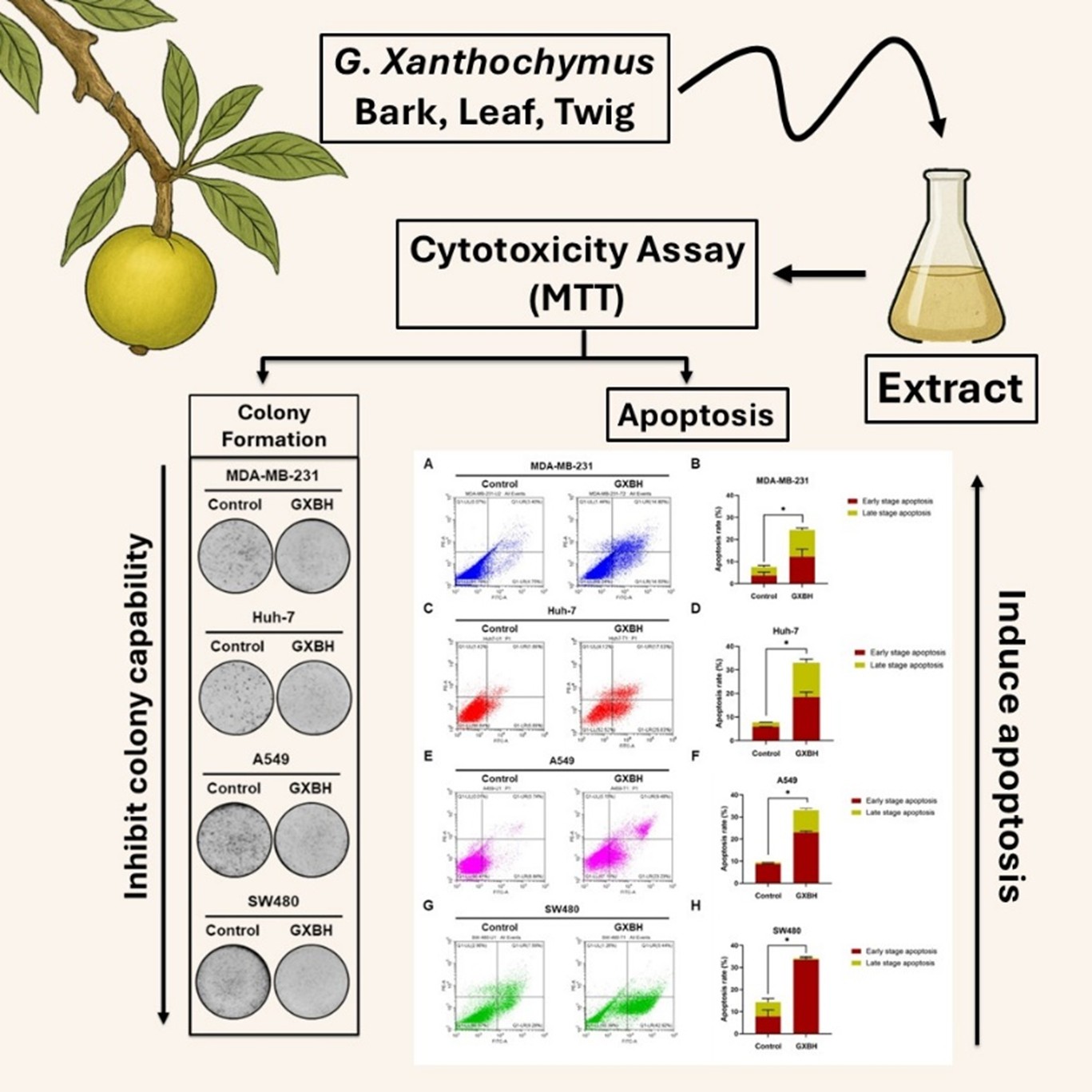
Garcinia xanthochymus is a medicinal plant known for its rich content of xanthones and flavonoids, and has gained attention for its potential therapeutic properties, including anticancer effects. This study evaluated the in vitro anticancer activity of crude extract from G. xanthochymus against 4 human cancer cell lines: MDA-MB-231 (breast), Huh-7 (liver), A549 (lung), and SW480 (colon). Extracts from barks, leaves, and twigs were prepared by maceration using 4 different organic solvents: hexanes, dichloromethane, acetone, and methanol. The metabolite profiles of the extracts were characterized using UHPLC-QTOF mass spectrometry. The effects of the extracts on cytotoxicity, apoptosis, and colony-forming capability were assessed using MTT, annexin V-FITC/PI staining, and colony formation assays, respectively. The results showed that the different extracts exhibited distinct cytotoxicity profiles. Among all tested extracts, the hexane extract (GXBH) exhibited the highest cytotoxic activity, with IC50 values of 66.9 ± 5.1 µg/mL (MDA-MB-231), 64.7 ± 14.9 µg/mL (Huh-7), 80.0 ± 11.9 µg/mL (A549), and 65.4 ± 7.8 µg/mL (SW480). In addition, GXBH significantly induced apoptosis and inhibited the colony-forming capability in all 4 cell lines. These findings highlight the potential of G. xanthochymus as a promising natural candidate for the development of alternative anticancer therapies.
HIGHLIGHTS
- Hexane extract showed strongest cytotoxicity in four cancer cell lines.
- xanthochymus extract induced apoptosis in four cancer cell types.
- Colony formation was significantly reduced by hexane extract.
- UHPLC-QTOF profiled metabolites from bark, leaf, and twig extracts.
GRAPHICAL ABSTRACT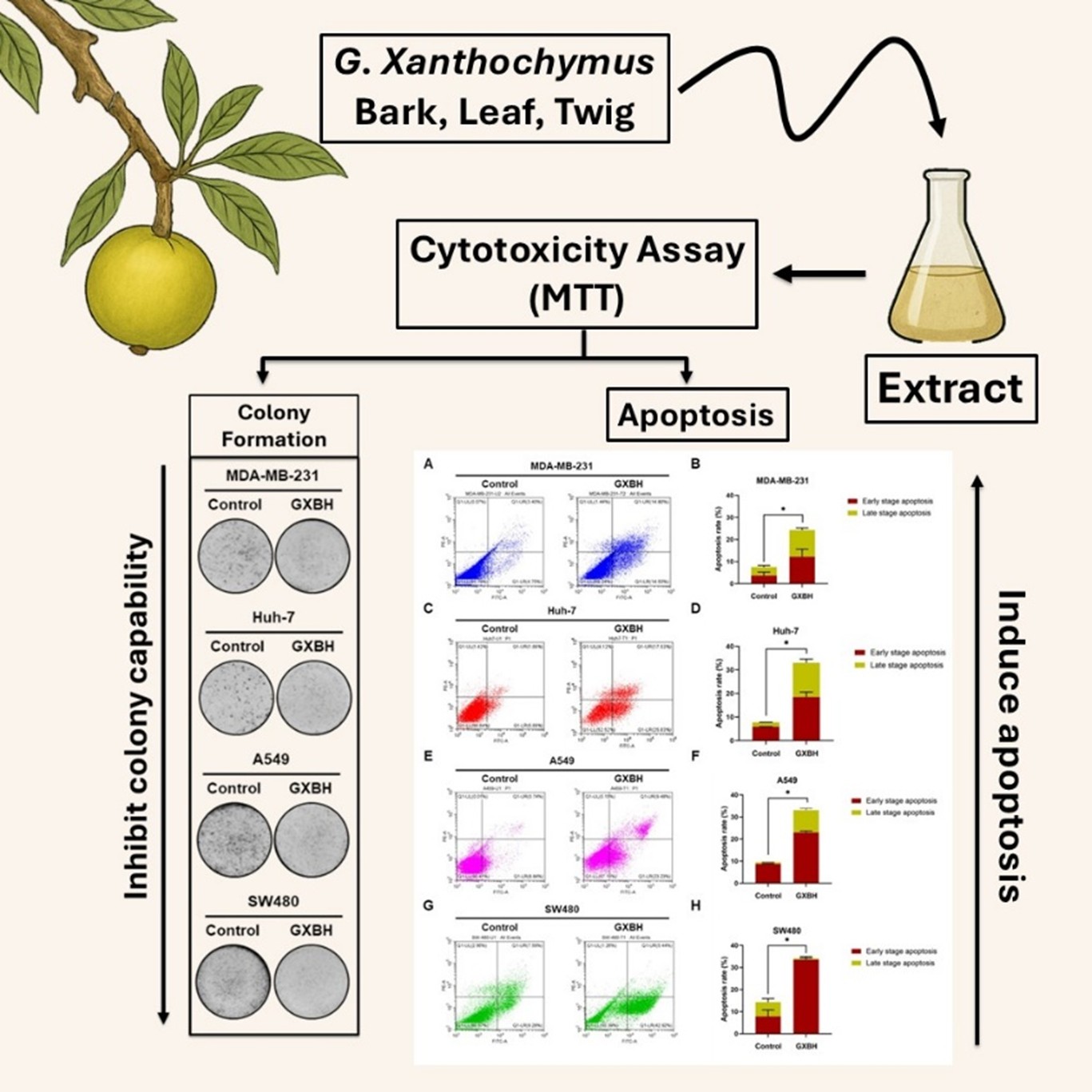
Downloads
References
F Ji, Z Li, G Liu, S Niu, N Zhao, X Liu and H Hua. Xanthones with antiproliferative effects on prostate cancer cells from the stem bark of Garcinia xanthochymus. Natural Product Communications 2012; 7(1), 53-56.
NKN Che Hassan, M Taher and D Susanti. Phytochemical constituents and pharmacological properties of Garcinia xanthochymus - A review. Biomedicine and Pharmacotherapy 2018; 106, 1378-1389.
J Prakash, S Sallaram, A Martin, RP Veeranna and MS Peddha. Phytochemical and functional characterization of different parts of the Garcinia xanthochymus fruit. ACS Omega 2022; 7(24), 21172-21182.
X He, F Yang and X Huang. Proceedings of chemistry, pharmacology, pharmacokinetics and synthesis of biflavonoids. Molecules 2021; 26(19), 6088.
M Hemshekhar, K Sunitha, MS Santhosh, S Devaraja, K Kemparaju, BS Vishwanath, SR Niranjana and KS Girish. An overview on genus garcinia: Phytochemical and therapeutical aspects. Phytochemistry Reviews 2011; 10(3), 325-351.
S Baggett, P Protiva, EP Mazzola, H Yang, ET Ressler, MJ Basile, IB Weinstein and EJ Kennelly. Bioactive benzophenones from Garcinia xanthochymus fruits. Journal of Natural Products 2005; 68(3), 354-360.
Y Chen, F Zhong, H He, Y Hu, D Zhu and G Yang. Structure elucidation and NMR spectral assignment of five new xanthones from the bark of Garcinia xanthochymus. Magnetic Resonance in Chemistry 2008; 46(12), 1180-1184.
MC García, LM Rossen, K Matthews, G Guy, KF Trivers, CC Thomas, L Schieb and MF Iademarco. Preventable premature deaths from the five leading causes of death in nonmetropolitan and metropolitan counties, united states, 2010 - 2022. MMWR Surveillance Summaries 2024; 73(2), 1-11.
RR Tourinho-Barbosa, ACL Pompeo and S Glina. Prostate cancer in Brazil and Latin America: Epidemiology and screening. International Brazilian Journal of Urology 2016; 42(6), 1081-1090.
HM Bizuayehu, KY Ahmed, GD Kibret, AF Dadi, SA Belachew, T Bagade, TK Tegegne, RLVenchiarutti, KT Kibret, AH Hailegebireal, Y Assefa, MN Khan, A Abajobir, KA Alene, Z Mengesha, D Erku, DA Enquobahrie, TZ Minas, E Misgan and AG Ross. Global disparities of cancer and its projected burden in 2050. JAMA Network Open 2024; 7(11), e2443198.
World Health Organization (WHO), Available at: https://www.who.int/news/item/01-02-2024-global-cancer-burden-growing--amidst-mounting-need-for-services, accessed March 2025.
RL Siegel, AN Giaquinto and A Jemal. Cancer statistics, 2024. CA: A Cancer Journal for Clinicians 2024; 74(1), 12-49.
AG Atanasov, SB Zotchev, VM Dirsch and CT Supuran. Natural products in drug discovery: Advances and opportunities. Nature Reviews Drug Discovery 2021; 20(3), 200-216.
JV Meerloo, GJL Kaspers and J Cloos. Cell sensitivity assays: The MTT assay. Methods in Molecular Biology 2011; 731, 237-245.
S Aluksanasuwan, K Somsuan, W Chiangjong, A Rongjumnong, W Jaidee, N Rujanapun, S Chutipongtanate, S Laphookhieo and R Charoensup. SWATH-proteomics reveals Mathurameha, a traditional anti-diabetic herbal formula, attenuates high glucose-induced endothelial dysfunction through the EGF/NO/IL-1β regulatory axis. Journal of Proteomics 2024; 306, 105263.
S Aluksanasuwan, K Somsuan, J Ngoenkam, W Chiangjong, A Rongjumnong, A Morchang, S Chutipongtanate and S Pongcharoen. Knockdown of heat shock protein family D member 1 (HSPD1) in lung cancer cell altered secretome profile and cancer-associated fibroblast induction. BBA Molecular Cell Research 2024; 1871(5), 119736.
JM Kumatso and G Sigge. Nutritional benefits, phytoconstituents, and pharmacological properties of Garcinia fruits: A review. Biointerface Research in Applied Chemistry 2024; 14(5), 102.
P Pailee, T Kruahong, S Hongthong, C Kuhakarn, T Jaipetch, M Pohmakotr, S Jariyawat, K Suksen, R Akkarawongsapat, J Limthongkul, A Panthong, P Kongsaeree, S Prabpai, P Tuchinda and V Reutrakul. Cytotoxic, anti-HIV-1 and anti-inflammatory activities of lanostanes from fruits of Garcinia speciosa. Phytochemistry Letters 2017; 20, 111-118.
V Reutrakul, N Anantachoke, M Pohmakotr, T Jaipetch, S Sophasan, C Yoosook, J Kasisit, C Napaswat, T Santisuk and P Tuchinda. Cytotoxic and anti-HIV-1 caged xanthones from the resin and fruits of Garcinia hanburyi. Planta Medica 2006; 73(1), 33-40.
P Janhavi, S Sindhoora and SP Muthukumar. Bioaccessibility and bioavailability of polyphenols from sour mangosteen (Garcinia xanthochymus) fruit. Journal of Food Measurement and Characterization 2020; 14(7), 2414-2423.
S Elmore. Apoptosis: A review of programmed cell death. Toxicologic Pathology 2007; 35(4), 495-516.
V Papaliagkas, A Anogianaki, G Anogianakis and G Ilonidis. The proteins and the mechanisms of apoptosis: A mini-review of the fundamentals. Hippokratia 2007; 11(3), 108-113.
S Qian, Z Wei, W Yang, J Huang, Y Yang and J Wang. The role of BCL-2 family proteins in regulating apoptosis and cancer therapy. Frontiers in Oncology 2022; 12, 985363.
YS Kurniawan, KTA Priyangga, Jumina, HD Pranow, EN Sholikhah, AK Zulkarnain, HA Fatimi and J Julianus. An update on the anticancer activity of xanthone derivatives: A review. Pharmaceuticals 2021; 14(11), 1144.
T Shan, Q Ma, K Guo, J Liu, W Li, F Wang and E Wu. Xanthones from mangosteen extracts as natural chemopreventive agents: Potential anticancer drugs. Current Molecular Medicine 2011; 11(8), 666-677.
D Hanahan and RA Weinberg. Hallmarks of cancer: The next generation. Cell 2011; 144(5), 646-674.
J Zhang, G Su, Y Lin, W Meng, JKL Lai, L Qiao, X Li and X Xie. Targeting cyclin-dependent kinases in gastrointestinal cancer therapy. Discovery Medicine 2019; 27(146), 27-36.
J Patel, HY Wong, W Wang, J Alexis, A Shafiee, AJ Stevenson, B Gabrielli, NM Fisk and K Khosrotehrani. Self-renewal and high proliferative colony forming capacity of late-outgrowth endothelial progenitors is regulated by cyclin-dependent kinase inhibitors driven by notch signaling. Stem Cells 2016; 34(4), 902-912.
J Xu, S Jin, F Gan, H Xiong, Z Mei, Y Chen and G Yang. Polycyclic polyprenylated acylphloroglucinols from Garcinia xanthochymus fruits exhibit antitumor effects through inhibition of the STAT3 signaling pathway. Food and Function 2020; 11(12), 10568-10579.
MM Patil and KAK Appaiah. Garcinia: Bioactive compounds and health benefits. Food Science Publisher, Dallas, 2015, p. 110-125.
A Paul and MK Zaman. A comprehensive review on ethnobotany, nutritional values, phytochemistry and pharmacological attributes of ten Garcinia species of South-east Asia. South African Journal of Botany 2022; 148, 39-59.
Additional Files
Published
How to Cite
Issue
Section
License
Copyright (c) 2025 Walailak University

This work is licensed under a Creative Commons Attribution-NonCommercial-NoDerivatives 4.0 International License.





