
Antimicrobial Activity of Compounds Isolated from Uvaria wrayi (King) L.L. Zhou, Y.C.F. Su & R.M.K. Saunders Leaves and Twigs
DOI:
https://doi.org/10.48048/tis.2024.8306Keywords:
Uvaria wrayi, Anonaceae, Antibacterial activity, Aristolactam alkaloids, Highly oxygenated cyclohexenesAbstract
Antimicrobial resistance (AMR) refers to the capacity of bacteria to resist the impact of antibiotics, emerging as a significant global health concern. To discover novel antibacterial agents, the isolation and elucidation of compounds from leaf and twig extracts of Uvaria wrayi (King) L.L. Zhou, Y.C.F. Su & R.M.K. Saunders were investigated for the first time. 9 known compounds were performed and categorized as polyoxygenated cyclohexenes (1-3), seco-cyclohexenes (4), acrylamide derivatives (5,6), and aristolactam alkaloids (7-9). All isolated compounds were evaluated for their antimicrobial activities against 5 Gram-positive bacteria, including Staphylococcus aureus (TISTR 746), Staphylococcus epidermidis (DMST 15505), Methicillin-resistant Staphylococcus aureus (MRSA) (NPRC 001R), Cutibacterium acnes (formerly Propionibacterium acnes) (DMST 14916), and Streptococcus mutans (DMST 18777/ATCC 25175T). 2 Gram-negative bacteria, Shigella flexneri (DMST 4423) and Salmonella enterica ser. typhimurium (TISTR 2519) were evaluated. Most of the isolated compounds displayed moderate antimicrobial activity with a MIC value of 64 µg/mL, except compounds 1,9 showed antibacterial against MRSA with a MIC value of 128 µg/mL. Compounds 2-9 exhibited antimicrobial activity against C. acnes (DMST 14916) with a MIC value of 32 µg/mL. Compounds 1-3, 6, and 7 also responded to inhibit C. acnes with the same MBC value of 128 µg/mL. This exploration holds promise for advancing our understanding of potential antibacterial compounds within U. wrayi and addressing the challenges posed by antimicrobial resistance.
HIGHLIGHTS
- The first phytochemical investigation of U. wrayi resulted in the isolation and identification of nine antibactiral compounds.
- Compounds 2-9 exhibited antimicrobial activity against Cutibacterium acnes (DMST 14916) with a MIC value of 32 µg/mL.
- Most of the isolated compounds displayed moderate antimicrobial activity with a MIC value of 64 µg/mL.
GRAPHICAL ABSTRACT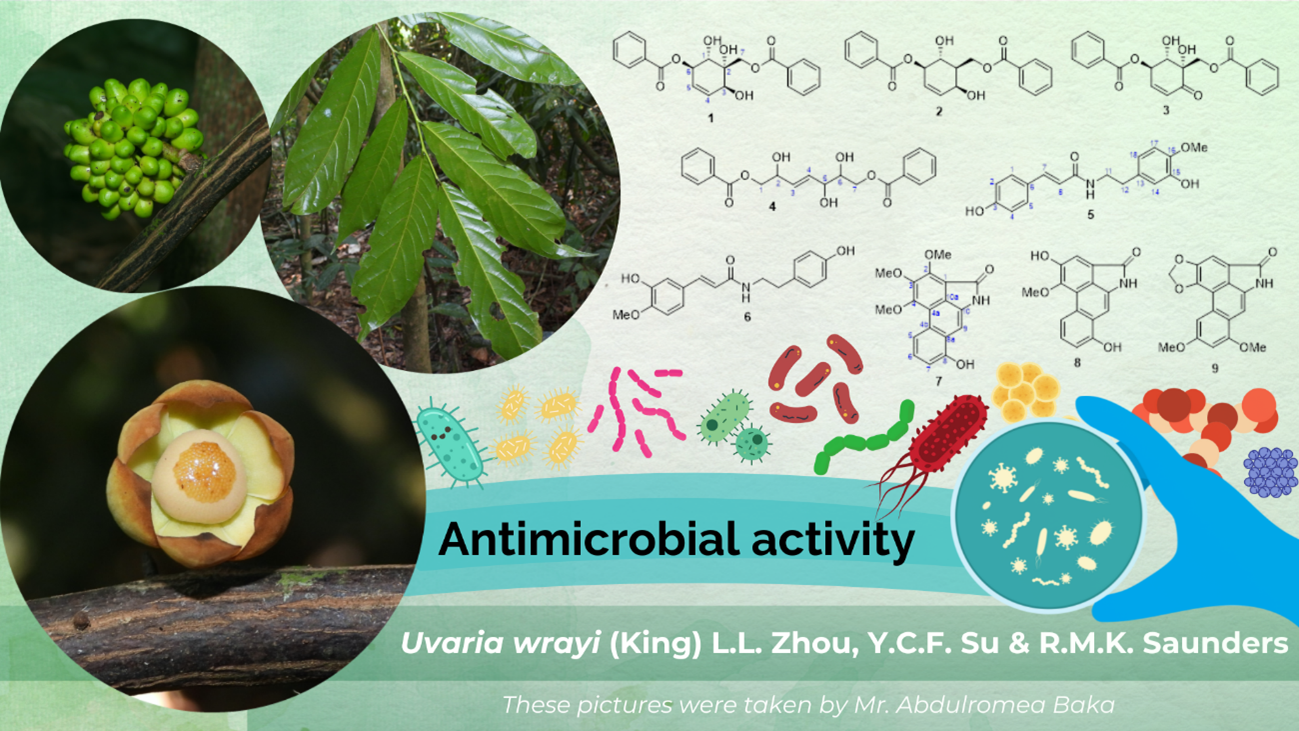
Downloads
References
WC Reygaert. An overview of the antimicrobial resistance mechanisms of bacteria. AIMS Microbiol. 2018; 4, 482-501.
RI Aminov. A brief history of the antibiotic era: Lessons learned and challenges for the future. Front. Microbiol. 2010; 1, 134.
CJ Murray, KS Ikuta, F Sharara, L Swetschinski, GR Aguilar, A Gray and N Tasak. Global burden of bacterial antimicrobial resistance in 2019: A systematic analysis. Lancet 2022; 399, 629-55.
MS Morehead and C Scarbrough. Emergence of global antibiotic resistance. Prim. Care. 2018; 45, 467-84.
A Mourenza, JA Gil, LM Mateos and M Letek. Oxidative stress-generating antimicrobials, a novel strategy to overcome antibacterial resistance. Antioxidants 2024; 9, 361.
RR Uchil, GS Kohli, VM KateKhaye and OC Swami. Strategies to combat antimicrobial resistance. J. Clin. Diagn. Res. 2014; 8, ME01-ME04.
DJ Newman and GM Cragg. Natural products as sources of new drugs over the nearly four decades from 01/1981 to 09/2019. J. Nat. Prod. 2020; 83, 770-803.
FJ Álvarez-Martínez, E Barrajón-Catalán, M Herranz-Lópe and V Micol. Antibacterial plant compounds, extracts and essential oils: an updated review on their effects and putative mechanisms of action. Phytomedicine 2021; 90, 153626.
R Christopher. Plant species of the genus Uvaria: Ethnobotanical uses, biological activities and phytochemistry. Nat. Prod. Res. 2022; 36, 2946-61.
AS Okoli and CU Iroegbu. Evaluation of extracts of Anthocleista djalonensis, Nauclea latifolia and Uvaria afzelii for activity against bacterial isolates from cases of non-gonococcal urethritis. J. Ethnopharmacol. 2004; 92, 135-44.
RB Mulaudzi, AR Ndhlala, MG Kulkarni and JV Staden. Pharmacological properties and protein binding capacity of phenolic extracts of some Venda medicinal plants used against cough and fever. J Ethnopharmacol. 2012; 143, 185-93.
H Koudokpon, N Armstrong, TV Dougnon, L Fah, E Hounsa, HS Bankolé, F Loko, E Chabrière and JM Rolain. Antibacterial activity of chalcone and dihydrochalcone compounds from Uvaria chamae roots against multidrug-resistant bacteria. Biomed. Res. Int. 2018; 27, 1453173.
M Elshikh, S Ahmed, S Funston, P Dunlop, M McGaw, R Marchant and IM Banat. Resazurin-based 96-well plate microdilution method for the determination of minimum inhibitory concentration of biosurfactants. Biotechnol. Lett. 2016; 38, 1015-9.
Clinical and Laboratory Standards Institute. Method for dilution antimicrobial susceptibility test for bacteria that grow aerobically. Approved standard, M07-A9. Clinical and Laboratory Standards Institute, Wayne, Pennsylvania, 2012.
SD Jolad, JJ Hoffmann, KH Schram, JR Cole, MS Tempesta and RB Bates. Structures of zeylenol and zeylena, constituents of Uvaria zeylanica (annonaceae). J. Org. Chem. 1981; 46, 4267-72.
A Kijjoa, J Bessa, MM Pinto, C Anatachoke, AMS Silva, G Eaton and W Herz. Polyoxygenated cyclohexene derivatives from Ellipeiopsis cherrevensis. Phytochemistry 2002; 59, 543-9.
Y Liao, L Xu, S Yang, J Dai, Y Zhen, M Zhu and N Sun. Three cyclohexene oxides from Uvaria grandiflora. Phytochemistry 1997; 45, 729-32.
APG Macabeo, FA Tudla, GJD Alejandro, SF Kouam, H Hussain and K Krohn. Benzoylated derivatives from Uvaria rufa. Biochem. Systemat. Ecol. 2010; 38, 857-60.
V Suthiphasilp, W Maneerat, RJ Andersen, BO Patrick, P Phukhatmuen, SG Pyne and S Laphookhieo. Uvarialuridols A-C, three new polyoxygenated cyclohexenes from the twig and leaf extracts of Uvaria lurida. Fitoterapia 2019; 138, 104340.
S Wang, JH Suh, X Zheng, Y Wang and CT Ho. Identification and quantification of potential anti-inflammatory hydroxycinnamic acid amides from wolfberry. J. Agr. Food Chem. 2017; 65, 364-72.
Y Zhang, X Zhong, Z Zheng, X Hu, J Zuo and L Hu. Discovery and synthesis of new immunosuppressive alkaloids from the stem of Fissistigma oldhamii (Hemsl.) Merr. Bioorg. Med. Chem. 2007; 15, 988-96.
Y Wang, W Chen, X Song and C Han. Aristololactam alkaloids from the roots of Dasymaschalon rostratum. Nat. Prod. Res. 2021; 35, 1084-9.
DB Mix, H Guinaudeau and M Shamma. The aristolochic acids and aristolactams. J. Nat. Prod. 2004; 45, 657-66.
T Jaipetch, S Hongthong, C Kuhakarn, P Pailee, P Piyachaturawat, K Suksen, P Koongsaeree, S Prabpai, N Nuntasaen and V Reutrakul. Cytotoxic polyoxygenated cyclohexene derivatives from the aerial parts of Uvaria cherrevensis. Fitoterapia 2019; 137, 104182.
P Seangphakdee, W Pompimon, P Meepowpan, A Panthong, N Chiranthanut, R Banjerdpongchai, B Wudtiwai, N Nuntasaen and S Pitchuanchom. Anti-inflammatory and anticancer activities of (-)-zeylenol from stems of Uvaria grandiflora. Sci. Asia 2013; 39, 610-4.
J He, M Dou, J Xie, S Hou, Q Liu, Z Hu, B Zhang, S Zheng, F Yin, M Zhang, C Xie, D Lu, X Ding, C Zhu and R Sun. Discovery of zeylenone from Uvaria grandiflora as a potential botanical fungicide. Pest Manag. Sci. 2021; 77, 5407-17.
YP Lu, Q Mu, HL Zheng and CM Li. Two new constituents from Uvaria microcarpa. Chin. Chem. Lett. 1995; 6, 775-8.
Z Yu, Z Niu, X Li, C Zheng, X Song, G Chen, X Song, C Han and SX Wu. New phenylpropanoid and 6H-dibenzo [b, d] pyran-6-one derivatives from the stems of Dasymaschalon rostratum. Fitoterapia 2017; 118, 27-31.
X Zhou, J WU, J Bai, X Hu, E Li, N Shi and Y Pei. A new aristolactam alkaloid from the stems of Dasymaschalon trichophorum. Chin. J. Nat. Med. 2013; 11, 81-3.
Y Zhong, T Yin-Feng, X Zhou, G Yan and G Chen. Aristolactam derivatives from Fissistigma glaucescens. Biochem. Systemat. Ecol. 2021; 94, 104209.
AG Pacheco, TM Silva, RM Manfrini, WS Sallum, LP Duarte, D Pilo-Veloso, AFDC Alcantara and VF Knupp. Chemical study and antibacterial activity of stem of Aristolochia esperanzae Kuntze (Aristolochiaceae). Quim. Nova 2010; 33, 1649-52.
SM Kupchan and JJ Merianos. The isolation and structural elucidation of novel derivatives of aristolochic acid from Aristolochia indica. J. Org. Chem. 1968; 33, 3735-8.
M Moshi, C Joseph, E Innocent and M Nkunya. In vitro antibacterial and antifungal activities of extracts and compounds from Uvaria scheffleri. Pharm. Biol. 2004; 42, 269-73.
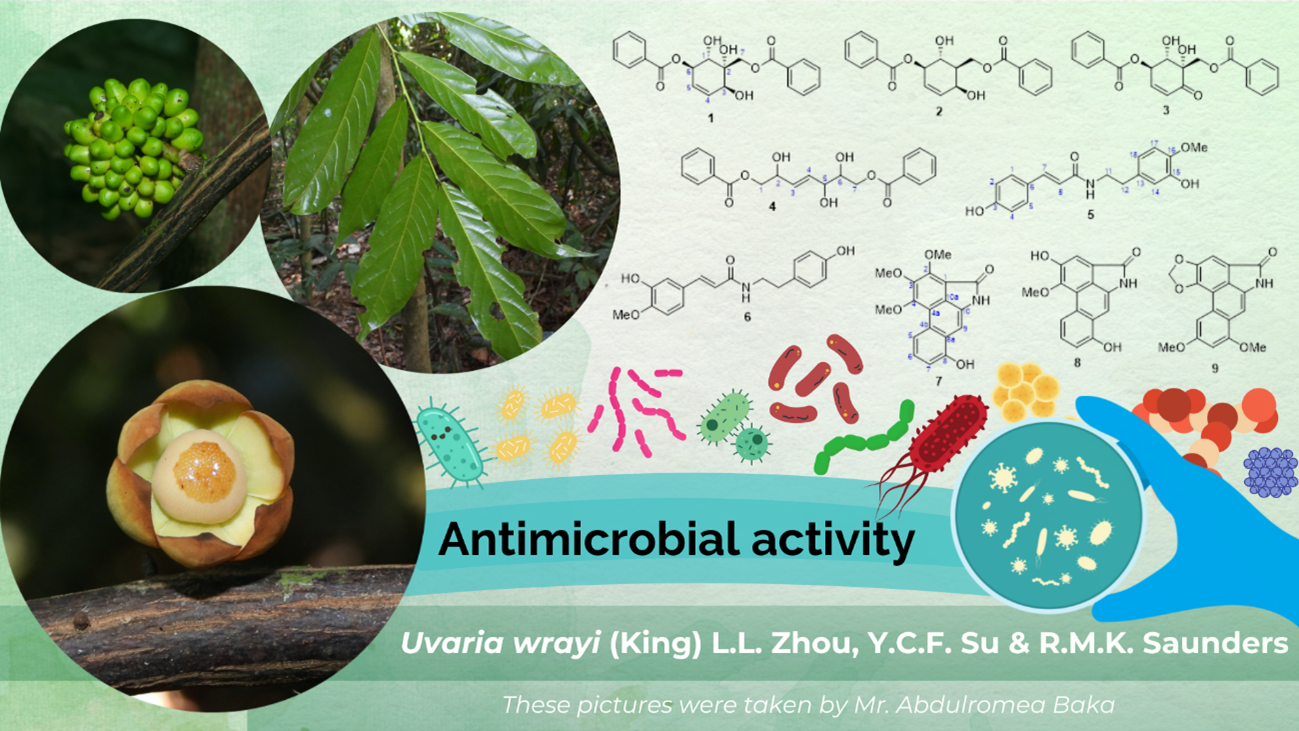
Downloads
Published
How to Cite
Issue
Section
License
Copyright (c) 2024 Walailak University

This work is licensed under a Creative Commons Attribution-NonCommercial-NoDerivatives 4.0 International License.





