
Optimization of Medium Components for Enhancing Antibacterial Activity of Marine Streptomyces aureofaciens A3 through Response Surface Methodology
DOI:
https://doi.org/10.48048/tis.2025.9144Keywords:
Streptomyces, Antibacterial, Pathogens, Seawater, BBD, ISP4, Metabolites, OptimizationAbstract
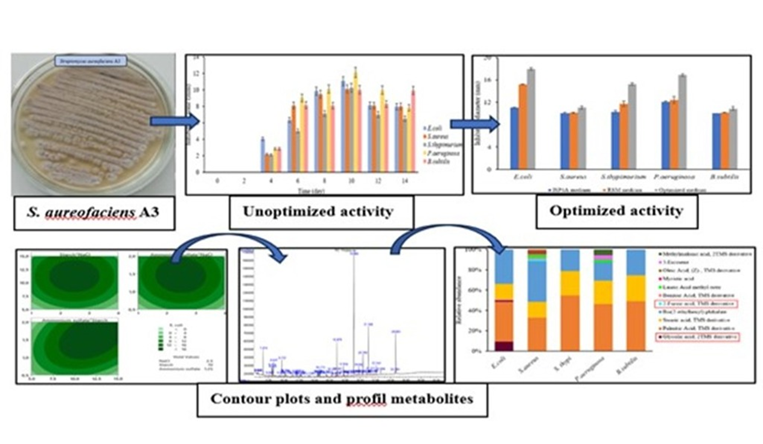
This study is the first to report on the statistical optimization of an antibacterial production medium for the marine bacterium Streptomyces aureofaciens A3. Glycolic and furoic acids have not been previously documented as metabolites produced by Streptomyces, especially by S. aureofaciens A3. The antibacterial metabolites were generated in an ISP4 medium enriched with artificial seawater with different concentrations of starch, NaCl, and ammonium sulfate. Media components were optimized through the Response Surface Method (RSM) using the Box-Behnken design (BBD) in submerged fermentation. Antibacterial metabolites produced during fermentation were extracted with ethyl acetate (EA) to obtain EA extracts. The extract activities were tested using the Kirby-Bauer method, and the extract compounds were annotated using GC/MS. The results showed that the specific concentrations of starch, ammonium sulfate, and NaCl enhanced the antibacterial activity for each tested bacteria were 11.06 - 12.07 g/L for starch and 1.39 - 1.56 g/L for ammonium sulfate and 1.76 - 2.45 g/L for NaCl. The media increased higher antibacterial activity against pathogens with rising percentages of inhibition zones of E. coli (62.33 %), S. aureus (9.41 %), S. typhimurium (48.69 %), P. aeruginosa (39.16 %) and B. subtilis (8.58 %), respectively. The inhibition zones of each test bacteria were 10.88 - 17.97 mm and categorized as strong antibacterial activity. GC/MS derivatization results showed that the annotated compounds in EA extracts consisted of primary metabolites such as glycolic acid, palmitic acid, stearic acid, lauric acid, myristic acid, oleic acid and secondary metabolites were furoic acid, phthalate acid, benzoic acid, methylmalonic acid. This study showed that the RSM method is efficient and effective for improving the activity of broad-spectrum antibacterial agents produced by S. aureofaciens A3. The application of RSM to optimize ISP4 medium enables the large-scale production of antibacterial metabolites for the pharmaceutical industry.
HIGHLIGHTS
- The antibacterial activity of marine Streptomyces aureofaciens A3 was first optimized using the Response Surface Method with ISP4-modified media.
- Broad-spectrum antibacterial activity increases against all pathogenic bacteria with a media composition similar to seawater.
- The low ammonium sulfate concentration induces higher antibacterial activity against bacterial pathogens.
GRAPHICAL ABSTRACT
Downloads
References
EA Barka, P Vatsa, L Sanchez, N Gaveau-Vaillant, C Jacquard, HP Klenk, C Clément, Y Ouhdouch and GP Wezel. Taxonomy, physiology, and natural products of actinobacteria. Microbiology and Molecular Biology Reviews 2016; 80(1), 1-43.
PK Maiti, S Das, P Sahoo and S Mandal. Streptomyces sp SM01 isolated from Indian soil produces a novel antibiotic picolinamycin effective against multi-drug-resistant bacterial strains. Scientific Reports 2020; 10(1), 10092.
K Alam, A Mazumder, S Sikdar, Y Zhao, J Hao, C Song, Y Wang, R Sarkar, S Islam, Y Zhang and A Li. Streptomyces: The biofactory of secondary metabolites. Frontiers in Microbiology 2022; 13, 968053.
GA Quinn, AM Banat, AM Abdelhameed and IM Banat. Streptomyces from traditional medicine: Sources of new innovations in antibiotic discovery. Journal of Medical Microbiology 2020; 69(8), 1040-1048.
D Manoharan, S Srinivasan, NR Vignesh and A Senthilvel. Tetracyclines: The old, the new and the improved a short review. Biomedical & Pharmacology Journal 2023; 16(3), 1441-1450.
A Rusu and EL Buta. The development of third-generation tetracycline antibiotics and new perspectives. Pharmaceutics 2021; 13(12), 2085.
JN Selvaraj, U Ganapathi, SGP Vincent, S Ramamoorthy and C Thavasimuthu. Statistical optimization of media components for antibiotic production in Streptomyces sp. CMSTAAHAL-3. Electronic Journal of Biotechnology 2023; 65, 1-13.
J Jacob, RU Rajendran, SH Priya, J Purushothaman and DKBNS Amma. Enhanced antibacterial metabolite production through the application of statistical methodologies by a Streptomyces nogalater NIIST A30 isolated from Western Ghats forest soil. PLoS One 2017; 12(4), e0175919.
P Kalyani, SM Botsa, KVD Laxmi and S Anil. Optimization of cultural conditions for biomass and antibacterial metabolite production by Aspergillus fumigatus strain MF1. Hybrid Advances 2023; 2, 100016.
M Bonnet, JC Lagier, D Raoult and S Khelaifia. Bacterial culture through selective and non-selective conditions: the evolution of culture media in clinical microbiology. New Microbes and New Infections 2020; 34, 100622.
TY Yun, RJ Feng, DB Zhou, YY Pan, YF Chen, F Wang, LY Yin, YD Zhang and JH Xie. Optimization of fermentation conditions through response surface methodology for enhanced antibacterial metabolite production by Streptomyces sp. 1-14 from Cassava rhizosphere. Plos One 2018; 13(11), e0206497.
MH Kalaba, GM El-Sherbiny, OM Darwes and SA Moghannem. A statistical approach to enhance the productivity of Streptomyces baarensis MH-133 for bioactive compounds. Synthetic and Systems Biotechnology 2024; 9(2), 196-208.
J Chen, X Lan, R Jia, L Hu and Y Wang. Response Surface Methodology (RSM) mediated optimization of medium components for mycelial growth and metabolites production of Streptomyces alfalfae XN-04. Microorganisms 2022; 10(9), 1854.
ARA Al-Tekreeti and KJK Luti. Statistical design based on response surface methodology to optimize the production of a yellow pigment by Streptomyces thinghirensis AF7. International Journal of Drug Discovery and Technology 2023; 64(9), 4415-4426.
U Managamuri, M Vijayalakshmi, VSRRK Ganduri, SB Rajulapati and S Poda. Improvement of antimicrobial metabolites by Saccharothrix flava VSM-3 using full factorial design and chemotype analysis. Journal of Applied Pharmaceutical Science 2020; 10(1), 016-025.
MS Ahmad, AO El-Gendy, RR Ahmed, HM Hassan, HM El-Kabbany and AG Merdash. Exploring the antimicrobial and antitumor potentials of Streptomyces sp. AGM12-1 isolated from egyptian soil. Frontiers in Microbiology 2017; 8, 438.
M Sebak, AE Saafan, S Abdelghani, W Bakeer, AS Moawad and AO El-Gendy. Isolation and optimized production of putative antimicrobial compounds from Egyptian soil isolate Streptomyces sp. MS. 10. Beni-Suef University Journal of Basic and Applied Sciences 2021; 10, 8.
S Yang, M Wang, J Gao, J Liu, R Jin, R Lin, W Weng and JJ Aweya. Sodium chloride augments the antibacterial activity of a novel penaeid shrimp-derived peptide (GPCR10) against halotolerant Staphylococcus aureus. Lebensmittel-Wissenschaft & Technologie 2023; 184, 115096.
K Khadayat, DD Sherpa, KP Malla, S Shrestha, N Rana, BP Marasini, S Khanal, B Rayamajhee, BR Bhattarai and N Parajuli. Molecular identification and antimicrobial potential of Streptomyces species from Nepalese soil. International Journal of Microbiology 2020; 2020, 817467.
JF Guerrero-Garzón, M Zehl, O schneider, C Rückert, T Busche, J Kalinowski, H Bredholt and SB Zotchev. Streptomyces spp. From the marine sponge Antho dichotoma: Analyses of secondary metabolite biosynthesis gene clusters and some of their products. Frontiers in Microbiology 2020; 11, 437.
A Ambarwati, S Wahyuono, S Moeljopawiro and T Yuwono. Antimicrobial activity of ethyl acetate extracts of Streptomyces sp. CRB46 and the prediction of their bioactive compounds' chemical structure. Biodiversitas 2020; 21(7), 3380-3390.
D Truong, DH Nguyen, NTA Ta, AV Bui, TH Do and HC Nguyen. Evaluation of the use of different solvents for phytochemical constituents, antioxidants, and in vitro anti-inflammatory activities of Severinia buxifolia. Journal of Food Quality 2019; 2019, 8178294.
M Balouiri, M Sadiki and SK Ibnsouda. Methods for in vitro evaluating antimicrobial activity: A review. Journal of Pharmaceutical Analysis 2016; 6(2), 71-79.
MCD Hoz-Romo, L Díaz and L Villamil. Marine actinobacteria a new source of antibacterial metabolites to treat acne vulgaris disease - a systematic literature review. Antibiotics 2022; 11(7), 965.
WW Davis and TR Stout. Disc plate method of microbiological antibiotic assay. II. Novel procedure offering improved accuracy. Applied Microbiology 1971; 22(4), 666.
D Chicco, MJ Warrens and G Jurman. The coefficient of determination R-squared is more informative than SMAPE, MAE, MAPE, MSE and RMSE in regression analysis evaluation. PeerJ Computer Science 2021; 7, e623.
C Andrade. The p-value and statistical significance: Misunderstandings, explanations, challenges, and alternatives. Indian Journal of Psychological Medicine 2019; 41(3), 210-215.
NN Nasir, M Sekar, S Ravi, LS Wong, SP Sisinthy, SH Gan, V Subramaniyan, K Chidambaram, NNIM Rani, MY Begum, M Ramar, SZ Safi, S Selvaraj, SKC Maruthu, S Fuloria, NK Fuloria, PT Lum and S Djearamane. Chemistry, biosynthesis and pharmacology of streptonigrin: An old molecule with future prospects for new drug design, development and therapy. Drug Design, Development and Therapy 2023; 17, 1065-1078.
S Krysenko and W Wohlleben. Role of carbon, nitrogen, phosphate and sulfur metabolism in secondary metabolism precursor supply in Streptomyces spp. Microorganisms 2024; 12(8), 1571.
E Jonsbu, M McIntyre and J Nielsen. The influence of carbon sources and morphology on nystatin production by Streptomyces noursei. Journal of Biotechnology 2002; 95(2), 133-144.
X Yan, Y Dong, Y Gu and H Cui. Effect of precursors and their regulators on the biosynthesis of antibiotics in actinomycetes. Molecules 2024; 29(5), 1132.
A Jankovic, G Chaudhary and F Goia. Designing the design of experiments (DOE) - an investigation on the influence of different factorial designs on the characterization of complex systems. Energy and Buildings 2021; 250, 111298.
DM Pott, S Osorio and JG Vallarino. From central to specialized metabolism: An overview of some secondary compounds derived from the primary metabolism for their role in conferring nutritional and organoleptic characteristics to fruit. Frontiers of Plant Sciences 2019; 10, 835.
L Huang, X Zhu, S Zhou, Z Cheng, K Shi, C Zhang and H Shao. Phthalic acid esters: Natural sources and biological activities. Toxins 2021; 13(7), 495.
MR Javed, M Salman, ATariq, A Tawab, MK Zahoor, S Naheed, M Shahid, A Ijaz and H Ali.The antibacterial and larvicidal potential of bis-(2-ethylhexyl) phthalate from Lactiplantibacillus plantarum. Molecules 2022; 27(21), 7220.
MA Davoodbasha, B Edachery, T Nooruddin, SY Lee and JW Kim. An evidence of C16 fatty acid methyl esters extracted from microalga for effective antimicrobial and antioxidant property. Microbial Pathogenesis 2017; 115, 233-238.
T Ganesan, M Subban, DBC Leslee, SB Kuppannan and P Seedevi. Structural characterization of n-hexadecanoic acid from the leaves of Ipomoea eriocarpa and its antioxidant and antibacterial activities. Biomass Conversion and Biorefinery 2022; 14(13), 14547-14558.
ER Valle-González, JA Jackman, BK Yoon, N Mokrzecka and NJ Cho. pH-dependent antibacterial activity of glycolic acid: Implications for anti-acne formulations. Scientific Reports 2020; 10(1), 7491.
M Ye, H Feng, J Hu, Q Yu and S Liu. Managing tomato bacterial wilt by suppressing Ralstonia solanacearum population in soil and enhancing host resistance through fungus-derived furoic acid compound. Frontiers in Plant Science 2022; 13, 1064797.
NM Tran-Cong, A Mándi, SB Király, T Kurtán, W Lin, Z Liu and P Proksch. Furoic acid derivatives from the endophytic fungus Coniothyrium sp. Chirality 2020; 32(5), 605-610.
A Synowiec, K Zyła, M Gniewosz and M Kieliszek. An effect of positional isomerism of benzoic acid derivatives on antibacterial activity against Escherichia coli. Open Life Sciences 2021; 16(1), 594-601.
FO Nitbani, PJP Tjitda, F Nitti, J Jumina and AIR Detha. Antimicrobial properties of lauric acid and monolaurin in virgin coconut oil: A review. ChemBioEng Reviews 2022; 9(5), 442-461.
X Chen, X Zhao, Y Deng, X Bu, H Ye and N Guo. Antimicrobial potential of myristic acid against Listeria monocytogenes in milk. The Journal of Antibiotics 2019; 72(5), 298-305.
F Dilika, PD Bremner and JJM Meyer. Antibacterial activity of linoleic and oleic acids isolated from Helichrysum pedunculatum: A plant used during circumcision rites. Fitoterapia 2000; 71(4), 450-452.
S Vennila and M Krishnaveni. Bioactive compound produced from Streptomyces aureofaciens KF532950 and its antimicrobial activity. International Journal of Chemical and Analytical Science 2013; 4(3), 153-155.

Downloads
Published
How to Cite
Issue
Section
License
Copyright (c) 2024 Walailak University

This work is licensed under a Creative Commons Attribution-NonCommercial-NoDerivatives 4.0 International License.





