
Anticancer Activity and Apoptosis Induction of Alkaloid Fraction of Kratom Leaves (Mitragyna speciosa) on Breast Cancer Cells: In Vitro and In Silico Studies
DOI:
https://doi.org/10.48048/tis.2025.10665Keywords:
Alkaloid, Apoptosis, Breast cancer, Docking, Kratom, LC-MS/MSAbstract
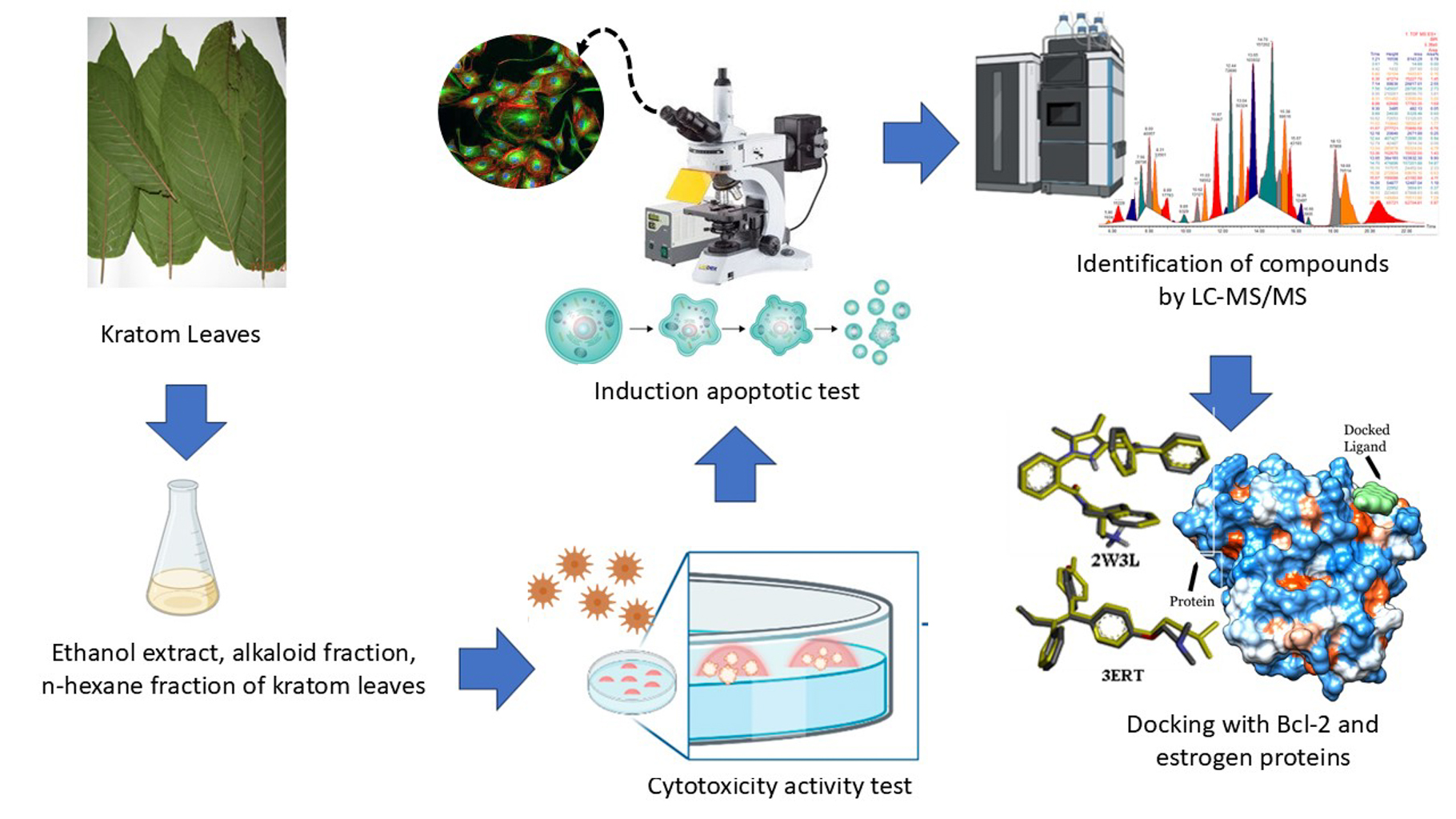
Breast cancer is one of the highest causes of death in women. However, cancer therapy drugs have weaknesses, low selectivity, which results in reduced efficacy. Kratom contains alkaloid group compounds that have a cytotoxic effect. This study aimed to evaluate the cytotoxic effects and apoptosis mechanisms on the alkaloid fraction of Kratom Leaves. Additionally, identify their metabolite with LC-MS/MS and molecular docking to predict its apoptotic activity. Fractionation was carried out by liquid-liquid extraction and acid-base methods. The cytotoxic test was carried out using the MTT assay method on extract and alkaloid fractions on T47D breast cancer cells. Apoptosis mechanism testing was performed using AO/EB staining. Identification of the chemical composition of alkaloid fractions with LC-MS/MS as a ligand to perform molecular docking. The proteins used as molecular docking targets are the 3ERT protein (estrogen receptor) and the 2W3L protein (Bcl-2 receptor). The alkaloid fraction of kratom leaves can provide moderate cytotoxic activity with an IC50 of 96.23 µg/mL against T47D cells compared to kratom leaf extract, which has weak potential with an IC50 value of 419.21 µg/mL. Research finds that the alkaloid fraction of kratom leaves exhibits superior cytotoxic activity in T47D cells compared to kratom leaf extract samples. The alkaloid component significantly promoted apoptotic induction compared with untreated control cells. The alkaloid fraction was found to contain 8 alkaloid compounds: 7-Hydroxymitragynine, Corynantheidine, Isorhynchophylline, Mitragynine, Pholcodine, Polyneuridinealdehyde, Rotundifolone, and Yohimbine. Moreover, polyneuridinealdehyde exhibits the greatest potential in silico against estrogen receptors, while yohimbine demonstrates significant efficacy against Bcl-2 receptors.
HIGHLIGHTS
- The alkaloid fraction of kratom leaves can provide cytotoxic activity against T47D breast cancer cells.
- The alkaloid fraction of kratom leaves shows superior cytotoxic activity and can induce apoptosis in T47D breast cancer cells.
- The active alkaloid fraction of kratom leaves contains 8 compounds, including 7-hydroxymitragynine, corynantheidine, isorhynchophylline, mitragynine, pholcodine, polyneuridinealdehyde, rotundifolone, and yohimbine.
- Polyneuridinealdehyde shows the greatest potential in silico against estrogen receptors, while yohimbine shows significant efficacy against Bcl-2 receptors.
GRAPHICAL ABSTRACT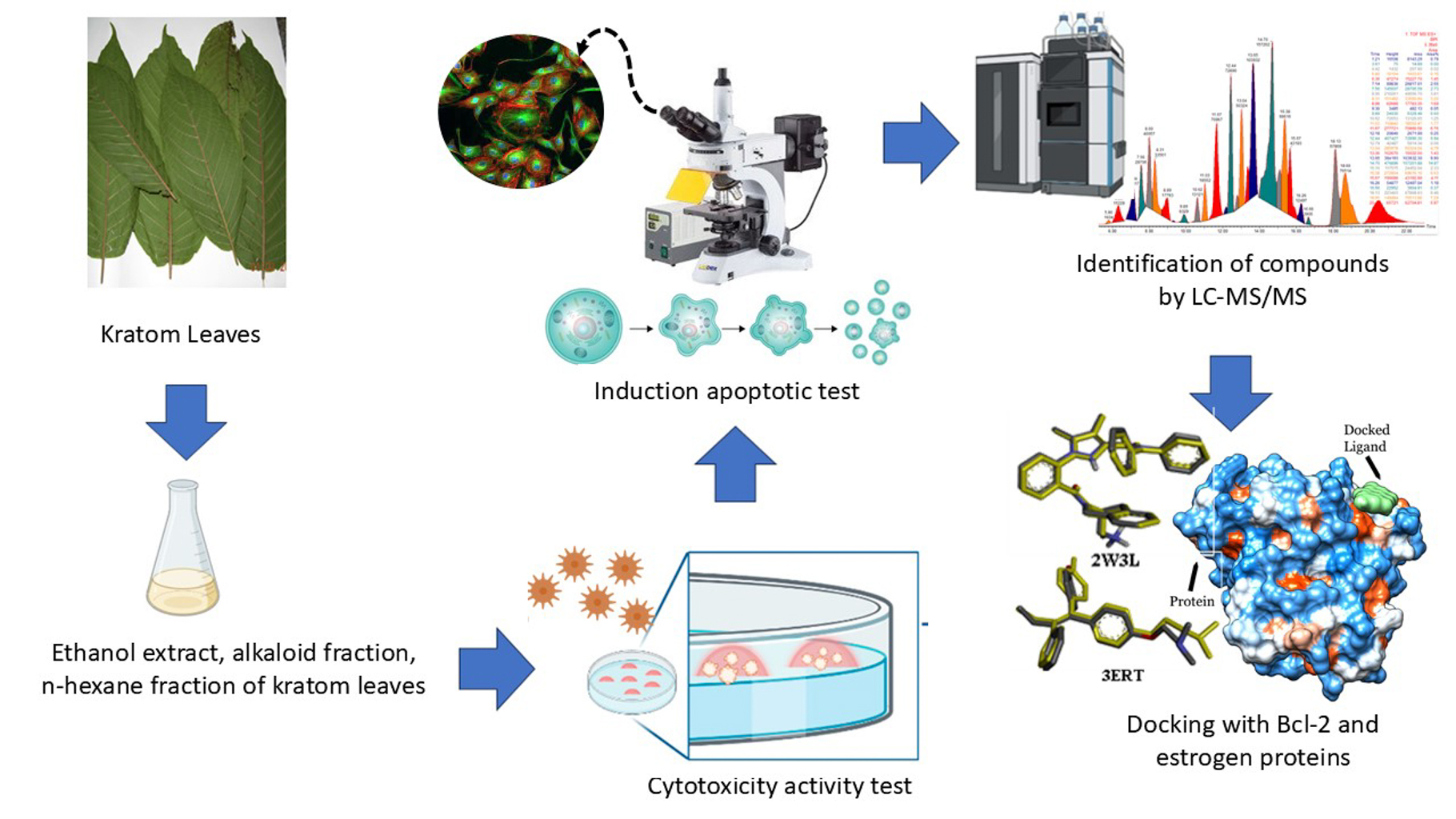
Downloads
References
H Sung, J Ferlay, RL Siegel, M Laversanne, I Soerjomataram, A Jemal and F Bray. Global cancer statistics 2020: GLOBOCAN estimates of incidence and mortality worldwide for 36 cancers in 185 countries. CA: A Cancer Journal for Clinicians 2021; 71(3), 209- 249.
MT Chanu and AS Singh. Different types of Cancer treatment, its advancement, benefits, and side effects. World Journal of Advanced Research and Reviews 2024; 24(1), 571-580.
U Anand, A Dey, AKS Chandel, R Sanyal, A Mishra, DK Pandey, VD Falco, A Upadhyay, R Kandimalla, A Chaudhary, JK Dhanjal, S Dewanjee, J Vallamkondu and JMPDL Lastra. Cancer chemotherapy and beyond: Current status, drug candidates, associated risks and progress in targeted therapeutics. Genes & Diseases 2023; 10(4), 1367-1401.
D Conze, L Weiss, PS Regen, A Bhushan, D Weaver, P Johnson and M Rincon. Autocrine production of interleukin 6 causes multidrug resistance in breast cancer cells. Cancer Research 2001; 61(24), 8851-8858.
ST Asma, U Acaroz, K Imre, A Morar, SR A Shah, SZ Hussain, D Arslan-Acaroz, H Demirbas, Z Hajrulai-Musliu, FR Istanbullugil, A Soleimanzadeh, D Morozov, K Zhu, V Herman, A Ayad, C Athanassiou and S Ince. Natural products/bioactive compounds as a source of anticancer drugs. Cancers 2022; 14(24), 6203.
AL Harvey. Medicines from nature: Are natural products still relevant to drug discovery. Trends in Pharmacological Sciences 1999; 20(5), 196-198.
M Ervina and Sukardiman. A review: Melia azedarach L. as a potent anticancer drug. Pharmacognosy Reviews 2018; 12(23), 94-102.
NA Saidin, E Holmes, H Takayama and NJ Gooderham. The cellular toxicology of mitragynine, the dominant alkaloid of the narcotic-like herb, Mitragyna speciosa Korth. Toxicology Research 2015; 4(5), 1173-1183.
L Flores-Bocanegra, HA Raja, TN Graf, M Augustinović, ED Wallace, S Hematian, JJ Kellogg, DA Todd, NBCech and NH Oberlies. The chemistry of kratom (mitragyna speciosa): Updated characterization data and methods to elucidate indole and oxindole alkaloids. Journal of Natural Products 2020; 83(7), 2165-2177.
NA Saidin and NJ Gooderham. In vitro toxicology of extract of Mitragyna speciosa Korth, a malaysian phyto-pharmaceutical of abuse. Toxicology 2007; 240(3), 166-167.
A Bayu, SI Rahmawati, F Karim, JA Panggabean, DP Nuswantari, DW Indriani, P Ahmadi, R Witular, NLPI Dharmayati and MY Putra. An in vitro examination of whether kratom extracts enhance the cytotoxicity of low-dose doxorubicin against A549 human lung cancer cells. Molecules 2024; 29(6), 1404.
RS Wong. Apoptosis in cancer: From pathogenesis to treatment. Journal of Experimental & Clinical Cancer Research 2011; 30, 87.
A Susanty, D Dachriyanus, Y Yanwirasti, FS Wahyuni, P Amelia, F Frengk, I Ikhtiarudin, Y Hirasawa, T Kaneda and H Morita. Cytotoxic activity, and molecular docking of indole alkaloid voacangine and bisindole alkaloid vobtusine, vobtusine lactone from the indonesian plant: voacanga foetida (blume) rolfe. Indonesian Journal of Pharmacy 2021; 32(4), 442-443.
TB Goh, KR Yian, MN Mordi and SM Mansor. Antioxidant value and antiproliferative efficacy of mitragynine and a silane reduced analogue. Asian Pacific Journal of Cancer Prevention 2014; 15(14), 5659-5665.
G Domnic, NJ Chear, A Rahman, S Ramanathan, K Lo, D Singh and N Mohana-Kumaran. Combinations of indole based alkaloids from Mitragyna speciosa (Kratom) and cisplatin inhibit cell proliferation and migration of nasopharyngeal carcinoma cell lines. Journal Ethnopharmacology 2021; 279, 114391.
PA Priatna, R Widyowati and Sukardiman. Cytotoxic potential of mitragyna speciosa as anticancer - a review. Pharmacognosy Journal 2024; 16(6), 1418-1423.
K Liu, P Liu, R Liu and X Wu. Dual AO/EB staining to detect apoptosis in osteosarcoma cells compared with flow cytometry. Medical Science Monitor Basic Research 2015; 9(21), 15-20.
M Pan, Q Lei, N Zang and H Zhang. A strategy based on GC-MS/MS, UPLC-MS/MS and virtual molecular docking for analysis and prediction of bioactive compounds in Eucalyptus globulus Leaves. International Journal of Molecular Sciences 2019; 20(16), 3875.
MS Zubair, S Maulana, A Widodo, R Pitopang, M Arba and M Hariono. GC-MS, LC-MS/MS, docking and molecular dynamics approaches to identify potential SARS-CoV-2 3-chymotrypsin-like protease inhibitors from Zingiber officinale roscoe. Molecules 2021; 26(17), 5230.
RR Pratama, I Sholikhah, Sukardiman, RK Sahu and R Widyowati. Phytochemical compounds identification from 70% ethanol extract of arcangelesia flava (L.) merr stems using LC-MS/MS and in silico molecular docking approach as inhibitor interleukin-1β. Pharmacognosy Journal 2023; 15(4), 528-534.
PA Priatna, S Rahmah, R Widyowati and Sukardiman. Identification of LC-MS/MS and docking analysis of topoisomerase IIα inhibition from kratom leaves (mitragyna speciosa) as potential anticancer agents. International Journal of Applied Pharmaceutics 2025; 17(1), 119-125.
A Sharma, SH Kamble, F Leon, NJY Chear, TI King, EC Berthold, S Ramanathan, CR McCurdy and BA Avery. Simultaneous quantification of ten key Kratom alkaloids in Mitragyna speciosa leaf extracts and commercial products by ultra-performance liquid chromatography−tandem mass spectrometry. Drug Testing and Analysis 2019; 11(8), 1162-1171.
FS Wahyuni, S Febria and D Arisanty. Apoptosis induction of cervical carcinoma hela cells line by dichloromethane fraction of the rinds of garcinia cowa roxb. Pharmacognosy Journal 2017; 9(4), 475-478.
N Sreevidya and S Mehrotra. Spectrophotometric method for estimation of alkaloids precipitable with dragendorff's reagent in plant materials. Journal of AOAC International 2003; 86(6), 1124-1127.
B Thanuja, R Parimalavalli, S Vijayanan, RM Alharbi, N Abdel-Raouf, IBM. Ibraheem, EN Sholkamy, K Durairaj and KM Hadish. Anticancer and cytotoxicity activity of native and modified black rice flour on colon cancer cell lines. Evidence-Based Complementary and Alternative Medicine 2022; 2022(1), 8575026.
R Lifiani, U Harahap, PAZ Hasibuan and D Satria. Anticancer effect of african leaves (Vernonia amygdalina del.) to T47D cell resistant. Asian Journal of Pharmaceutical and Clinical Research 2018; 11(13), 4-7.
R Qin, F You, Q Zhao, X Xie, C Peng, G Zhan and B Han. Naturally derived indole alkaloids targeting regulated cell death (RCD) for cancer therapy: from molecular mechanisms to potential therapeutic targets. Journal of Hematology & Oncology 2022; 15, 133.
Z Hassan, M Muzaimi, V Navaratnam, NHM Yusoff, FW Suhaimi, R Vadivelu, BK Vicknasingam, D Amato, SV Horsten, NIW Ismail, N Jayabalan, AI Hazim, SM Mansor and CP Muller. From Kratom to mitragynine and its derivatives: physiological and behavioural effects related to use, abuse, and addiction. Neuroscience & Biobehavioral Reviews 2013; 37(2), 138-151.
FZ Karadayi, M Yaman, MM Kisla, AG Keskus, O Konu and Z Ates-Alagoz. Design, synthesis and anticancer/antiestrogenic activities of novel indole-benzimidazoles. Bioorganic Chemistry 2020; 100, 103929.
S Zaman, R Wang and V Gandhi. Targeting the apoptosis pathway in hematologic malignancies. Leukemioa & Lymphoma 2014; 55(9), 1980-1992.
J Lopez and SWG Tait. Mitochondrial apoptosis: Killing cancer using the enemy within. British Journal of Cancer volume 2015; 112(6), 957-692.
JL Nelsen, J Lapoint, MJ Hodgman and KM Aldous. Seizure and coma following kratom (Mitragynina speciosa Korth) exposure. Jounal of Medical Toxicology 2010; 6(4), 424-426.
AK Shiau, D Barstad, PM Loria, L Cheng, PJ Kushner, DA Agard and GL Greene. The structural basis of estrogen receptor/coactivator recognition and the antagonism of this interaction by tamoxifen. Cell 1998; 95(7), 927-937.
NR Jabir, MS Khan, NO Alafaleq, H Naz and BA Ahmed. Anticancer potential of yohimbine in drug-resistant oral cancer KB-ChR-8-5 cells. Molecular Biology Reports 2022; 49(10), 9565-9573.
M Jairaj, DG Watson, MH Grant and GG Skellern. The toxicity of opiates and their metabolites in HepG2 cells. Chemico-Biological Interactions 2003; 146(2), 121-129.
FZ Karadayi, M Yaman, MM Kisla, AG Keskus, O Konu and Z Ates-Alagoz. Design, synthesis and anticancer/antiestrogenic activities of novel indole-benzimidazoles. Bioorganic Chemistry 2020; 100, 103929.
PA Priatna, RR Pratama, R Widyowati and Sukardiman. Molecular docking estrogen receptor alpha antagonist and P53-MDM2 inhibitor, ADMET prediction of alkaloid compound from mitragyna speciosa for breast cancer therapy. Pharmacognosy Journal 2022; 14(6), 912-916.
R Veeramohan, KA Azizan, WM Aizat, Metabolomics data of Mitragyna speciosa leaf using LC-ESI-TOF-MS. Data Brief 2018; 18, 1212-1216.
B Avula, S Sagi and YH Wang. Identification and characterization of indole and oxindole alkaloids from leaves of Mitragyna speciosa Korth using liquid chromatography-accurate QToF mass spectrometry. Journal of AOAC International 2015; 98(1), 13-21.
Published
How to Cite
Issue
Section
License
Copyright (c) 2025 Walailak University

This work is licensed under a Creative Commons Attribution-NonCommercial-NoDerivatives 4.0 International License.





