
Formulation and Physicochemical Evaluation of Nanoemulgel Star Anise Essential Oil (Illicium verum Hook. f.) and Butterfly Pea Extract (Clitoria ternatea L.) as Antioxidant Cosmetics
DOI:
https://doi.org/10.48048/tis.2025.10166Keywords:
Illicium verum, Clitoria ternatea, Nanoemulgel, Characteristics, Stability, Anti-oxidant, Anti-aging, Illicium verum, Clitoria ternatea, Nanoemulgel, Physicochemical, AntioxidantAbstract
Oxidative stress from reactive oxygen species (ROS) is a major factor in various skin issues, including inflammation, dullness, uneven tone, and impaired barrier function. Illicium verum essential oil and Clitoria ternatea extract are natural antioxidants with complementary properties—one is oil-based, effective in skip lipid layers, while the other is water-based, active in hydrophilic environments. Their combination offers broader antioxidant protection, but different solubility properties—one is oil-based and the other is water-based—which makes it challenging to combine them in one stable product. This study developed a nanoemulgel combining these actives using varying emulsifier ratios of Tween 80 and Span 80 to optimize the hydrophilic-lipophilic balance (HLB). High-shear homogenization was used to produce nanoemulsions, which were then gelled with Carbopol 940. Four formulations (F1 - F4) were characterized for organoleptic properties, pH, viscosity, spreadability, droplet size, polydispersity index (PDI), zeta potential, and antioxidant activity via DPPH assay. Among all formulations, F3 (HLB 11.79) exhibited the smallest droplet size (134.7 ± 2.1 nm), lowest PDI (0.183), and zeta potential ( 32.1 ± 1.3 mV), indicating superior nanoemulsion stability. F3 also showed optimal pH (5.79), moderate viscosity, and good spreadability. Antioxidant activity analysis revealed that F3 had the highest scavenging capacity, with an IC₅₀ of 98.53 µg/mL. Statistical analysis confirmed significant differences between formulations (p < 0.05), with F3 being significantly superior. F3 was identified as the optimal nanoemulgel formulation, combining physical stability and strong antioxidant activity. These findings support the potential of nanoemulgel systems as effective carriers for delivering plant-based actives in cosmetic formulations. Future research should focus on evaluating their in vivo efficacy and assessing formulation stability under real-time storage conditions.
HIGHLIGHTS
- This study developed a novel nanoemulgel combining Illicium verum essential oil and Clitoria ternatea extract, targeting antioxidant applications.
- F1 - F4 differ in emulsifier ratios, affecting HLB values. The optimal nanoemulgel formulation, F3, exhibited excellent characteristics: A pH of 5.79 (skin-compatible), high viscosity (16,100 cP), good spreadability (5.12 cm), the smallest droplet size (134.7 nm), the lowest PDI (0.183), and the most stable zeta potential (−1 mV).
- Antioxidant activity measured by DPPH assay showed IC₅₀ values of 98.53 - 192.84 µg/mL across formulations, significantly lower than the placebo (421.38 µg/mL) and approaching that of ascorbic acid (2.59 µg/mL).
- Additionally, a combination of anise essential oil and butterfly pea extract showed strong antioxidant activity, with a synergistic effect (IC₅₀ = 2.47 ± 0.48 µg/mL), which is comparable to that of ascorbic acid (2.59 ± 0.28 µg/mL).
- The synergistic combination of plant-based flavonoids and essential oils demonstrates promising potential for the development of natural, effective, and stable cosmeceutical products.
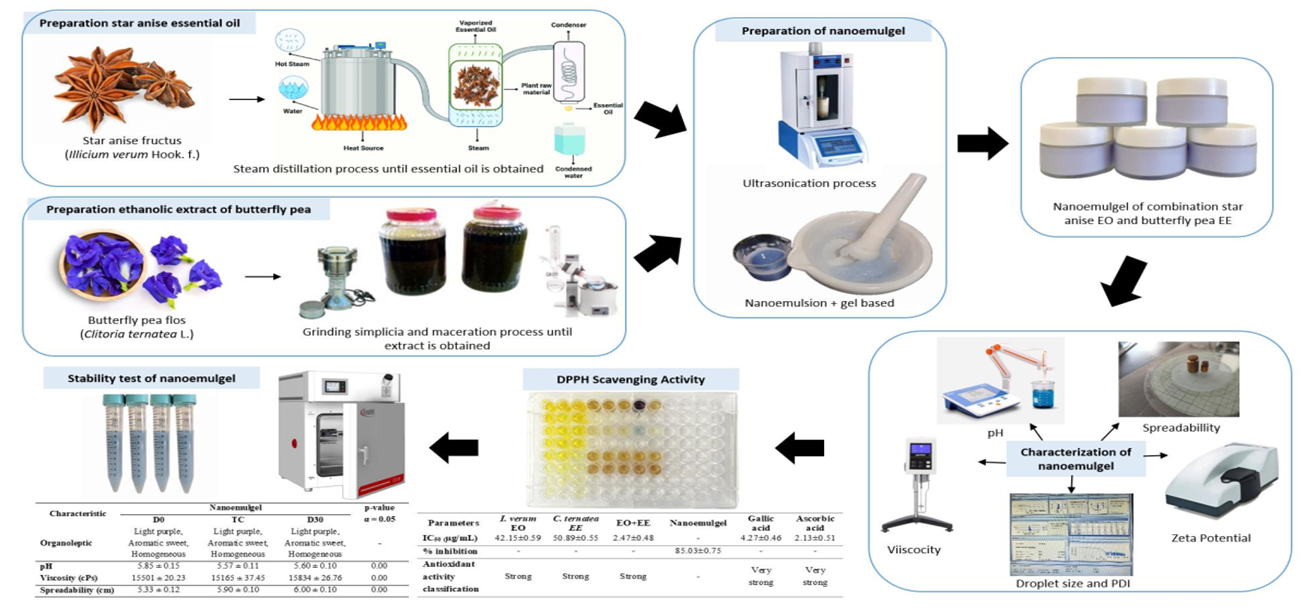
GRAPHICAL ABSTRACT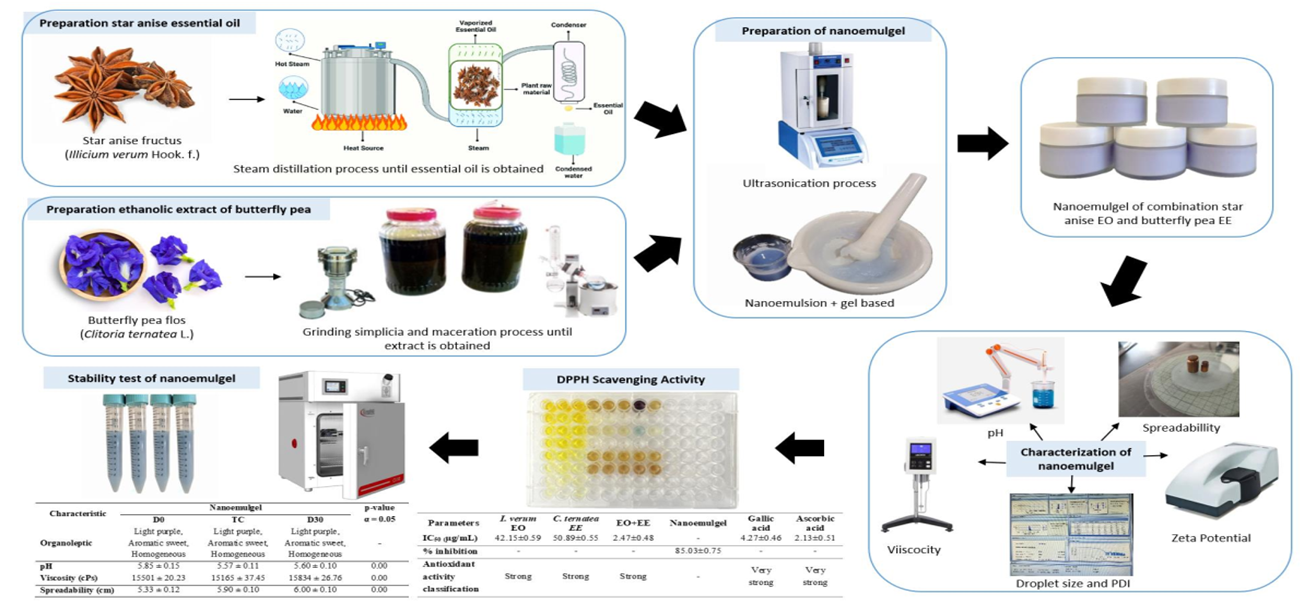
Downloads
References
HS Kalasariya, CE Maya-Ramirez, J Cotas and L Pereira. Cosmeceutical significance of seaweed: A focus on carbohydrates and peptides in skin applications. Phycology 2024; 4(2), 276-313.
A Budzianowska, K Banas, J Budzianowski and M Kikowska. Antioxidants to defend healthy and youthful skin—current trends and future directions in cosmetology. Applied Sciences 2025; 15(5), 2571.
H Liu, M Cheng, M Xun, Z Zhao, Y Zhang, W Tang, J Cheng, J Ni and W Wang. Possible mechanisms of oxidative stress-induced skin cellular senescence, inflammation, and cancer and the therapeutic potential of plant polyphenols. International Journal of Molecular Sciences 2023; 24(4), 3755.
A Elbouzidi, M Haddou, A Baraich, M Taibi, NE Hachlafi, A Pareek, F Mesnard and M Addi. Biochemical insights into specialized plant metabolites: Advancing cosmeceutical applications for skin benefits. Journal of Agriculture and Food Research 2025; 19, 101651.
B Couceiro, H Hameed, ACF Vieira, SK Singh, K Dua, F Veiga, PC Pires, L Ferreira and AC Paiva-Santos. Promoting health and sustainability: Exploring safer alternatives in cosmetics and regulatory perspectives. Sustainable Chemistry and Pharmacy 2025; 43, 101901.
HT Hoang, JY Moon and YC Lee. Natural antioxidants from plant extracts in skincare cosmetics: Recent applications, challenges and perspectives. Cosmetics 2021; 8(4), 106.
JK Patra, G Das, S Bose, S Banerjee, CN Vishnuprasad, MDP Rodriguez-Torres and HS Shin. Star anise (Illicium verum): Chemical compounds, antiviral properties, and clinical relevance. Phytotherapy Research 2020; 34(6), 1248-1267.
AC Aprotosoaie, I Costache and A Miron. Anethole and its role in chronic diseases. Advances in Experimental Medicine and Biology 2016; 929, 247-267.
M Sharafan, K Jafernik, H Ekiert, P Kubica, R Kocjan, E Blicharska and A Szopa. Illicium verum (star anise) and trans-anethole as valuable raw materials for medicinal and cosmetic applications. Molecules 2022; 27(3), 650.
Cosmetic Ingredient Database, Available at: https://ec.europa.eu, accessed April 2025.
S Nurwaini S and MN Fatimah. Formulation and characterization of gels of telang flower extract (clitoria Ternatea L) with variations of carbopol concentration and antioxidant activity test using DPPH methods. Pharmacon Jurnal Farmasi Indonesia 2024; 21(1), 145-151.
D Andriani and L Murtisiwi. Antioxidant activity test of 70% ethanol extract of telang flower (Clitoria ternatea L) from sleman area with DPPH method. Journal of Pharmaceutical and Sciences 2020; 17(1), 70-76.
RN Nursyafillah, B Puruhito, L Afriliana, H Istiadi and GS Damayanti. Potential of butterfly pea cream (Clitoria ternatea) in skin regeneration by increasing the number of fibroblasts and collagen thickness. Diponegoro Medical Journal 2025; 14(1), 44-49.
A Fatmawati, G Ariskha, APR Dewi, IR Rahman and T Yanuarto. Formulation and stability test of emulgel extract of butterfly pea flower (Clitoria ternatea L) as lotion. Journal of Pharmaceutical and Sciences 2023; 6(2), 616-625.
K Ashraf, NF Adlin, AN Basri, W Ahmad and S Sultan. The traditional uses, phytochemistry, and pharmacological effects of Clitoria ternatea: A review. Indian Journal of Pharmaceutical Education and Research 2023; 58(1), 1-14.
R Nurhayati, F Shoviantari, MT Erawati and M Yuwono. Butterfly pea (Clitoria ternatea L.) flower water and ethanol extract: Phytochemical screening, FTIR analysis, and antioxidant activity estimation using comparison of ABTS, DPPH, and FRAP assays. Research Journal of Pharmacy and Technology 2024; 17(5), 1973-1982.
GS Chakraborthy, V Kumar, S Gupta, A Kumar, N Gautam and L Kumari. Phytochemical and pharmacological aspects of Clitoria ternatea - A review. Journal of Applied Pharmaceutical Sciences and Research 2018; 1(2), 3-9.
P Chellapa, AT Mohamed, EI Keleb, A Elmahgoubi, AM Eid, YS Issa and NA Elmarzugi. Nanoemulsion and nanoemulgel as a topical formulation. IOSR Journal of Pharmacy 2015; 5(10), 43-47.
M Danaei, M Dehghankhold, S Ataei, FH Davarani, R Javanmard, A Dokhani, S Khorasani and MR Mozafari. Impact of particle size and polydispersity index on the clinical applications of lipidic nanocarrier systems. Pharmaceutics 2018; 10(2), 57.
T Erawati, DA Putri, AS Maharani, N Rosita and W Soeratri. Characteristics and stability of nanostructured lipid carrier (NLC) Aleurites moluccana seed oil (ams oil) using various combinations of beeswax and oleum cacao. International Journal of Drug Delivery Technology 2019; 9(1), 94-97.
W Qin, J Lin and W Qibiao. Effect of three extraction methods on the volatile component of Illicium verum Hook. f. analyzed by GC-MS. Wuhan Univsity Journal of Natural Sciences 2007; 12(2), 529-534.
R Widyowati, RP Sari, D Retnowati, I Sholikhah and RR Pratama. Physical and chemical characterization of granules from 70% ethanol extract of ganitri leaves (Eleocarpus serratus L.) using wet granulation method as an anti-osteoporosis. Trends in Sciences 2024; 21(5), 7478.
HS Sabri, WK Alia, BH Abdullah and WM Al-Anic. Formulation design and evaluation of anti-microbial activity of emulgel containing essential oil of Myrtus communis L. International Journal of Pharmaceutical Sciences Review and Research 2016; 40(2), 271-277.
T Erawati, E Hendradi and W Soeratri. Para methoxycinnamic acid (PMCA) in nanoemulsion drug delivery systems using soybean oil, corn oil, and virgin coconut oil (VCO). International Journal of Pharmacy and Pharmaceutical Sciences 2014; 6(2), 99-101.
N Ullah, A Amin, RA Alamoudi, SA Rasheed, RA Alamoudi, A Nawaz, M Raza, T Nawaz, S Ishtiaq and SS Abbas. Fabrication and optimisation of essential-oil loaded nanoemulsion using box–behnken design against staphylococcus aureus and staphylococcus epidermidis isolated from oral cavity. Pharmaceutics 2022; 14(8), 1640.
M Singh, J Kanoujia, P Parashar, M Arya, CB Tripathi, VR Sinha, SK Saraf and SA Saraf. Assessment of improved buccal permeation and bioavailability of felodipine microemulsion-based cross-linked polycarbophil gel. Drug Delivery and Translational Research 2018; 8(3), 591-601.
VAJ Yusuf, W Soeratri and T Erawati. The effect of surfactant combination on the characteristics, stability, irritability, and effectivity of astaxanthin nanoemulsion as anti-ageing cosmetics. Tropical Journal of Natural Product Research 2023; 7(12), 5509-5518.
NMS Moubayed, HJ Houri, MM Khulaifi and DA Farraj. Antimicrobial, antioxidant properties and chemical composition of seaweeds collected from saudi arabia (red sea and arabian gulf). Saudi Journal of Biological Sciences 2017; 24(1), 162-169.
U Ahmad, Z Ahmad, AA Khan, J Akhtar, SP Singh and FJ Ahmad. Strategies in development and delivery of nanotechnology based cosmetic products. Drug Research 2018; 68(10), 545-552.
YM Navarro-Perez, E Cedeno-Linares, ON Montenegro, V Ruz-Sanjuan, Y Mondeja-Rivera, AM Hernandez-Monzon and MM Gonzales-Bedia. Prediction of the physical stability and quality of O/W cosmetic emulsions using full factorial design. Journal of Pharmacy & Pharmacognosy 2021; 9(1), 98-112.
VK Rai, N Mishra, KS Yadav and NP Yadav. Nanoemulsion as pharmaceutical carrier for dermal and transdermal drug delivery: Formulation development, stability issues, basic considerations and applications. Journal of Controlled Release 2018; 270, 203-225.
R Su, W Fan, Q Yu, X Dong, J Qi, Q Zhu, W Zhao, W Wu, Z Chen,Y Li and Y Lu. Size-dependent penetration of nanoemulsions into epidermis and hair follicles: Implications for transdermal delivery and immunization. Oncotarget 2017; 8(24), 38214-38226.
H Bayat, M Rastgo, MM Zadeh and H Vereecken. Particle size distribution models, their characteristics and fitting capability. Journal of Hydrology 2015; 529(3), 872-889.
X Li, A Zhou and L Wang. Inhibitory effects of anethole on collagenase activity and MMP-1 expression: Potential for anti-aging applications. Journal of Cosmetic Dermatology. 2019; 18(4), 1234-1241.
FD Mayangsari, T Erawati, W Soeratri and N Rosita. Characteristics and physical stability of NLC-Coenzyme Q10 in sleeping mask with patchouli oil. Journal Farmasi Dan Ilmu Kefarmasian Indonesia 2021; 8(2), 178-186.
X He, F Wan, W Su and W Xie. Research progress on skin aging and active ingredients. Molecules 2023; 28(14), 5556.
RJ Wilson, Y Li, G Yang and C Zhao. Nanoemulsions for drug delivery. Particuology 2022; 64, 85-97.
J Shin, S Kwon, J Choi, J Na, C Huh, H Choi and K Park. Molecular mechanisms of dermal aging and antiaging approaches. International Journal of Molecular Sciences 2019; 20(9), 2126.
P Anantaworasakul, W Chaiyana, BB Michniak-Kohn, W Rungseevijitprapa and C Ampasavate. Enhanced transdermal delivery of concentrated capsaicin from chili extract-loaded lipid nanoparticles with reduced skin irritation. Pharmaceutics 2020; 12(5), 463.
BDD Silva, DKAD Rosario, LT Neto, CA Lelis and CA Conte-Junior. Antioxidant, antibacterial and antibiofilm activity of nanoemulsion-based natural compound delivery systems compared with non-nanoemulsified versions. Foods 2023; 12(9), 1901.
Published
How to Cite
Issue
Section
License
Copyright (c) 2025 Walailak University

This work is licensed under a Creative Commons Attribution-NonCommercial-NoDerivatives 4.0 International License.





