
A Review of Essential Oils in Edible Films and Coatings for Seafood Preservation: Functional Roles, Safety, and Regulatory Considerations
DOI:
https://doi.org/10.48048/tis.2025.10415Keywords:
Essential oil, Edible films, Coatings, Fish and seafood, Antimicrobial activities, Antioxidant activities, Nanoemulsion, Food packaging regulationsAbstract
Seafood deteriorates rapidly after harvest, leading to significant economic losses and driving the need for advanced, natural preservation strategies. This review explores the incorporation of essential oils (EOs) into edible films and coatings (EFCs) for seafood applications, focusing on their functional roles, antimicrobial efficacy, and regulatory considerations. Biopolymers such as chitosan, gelatin, soy protein isolate, and starch are evaluated as carriers for EOs including clove, cinnamon, oregano, garlic, and pomelo. These systems exhibit potent antimicrobial and antioxidant activities against spoilage microorganisms such as Pseudomonas spp., Listeria monocytogenes, and Shewanella spp. Specific formulations, such as chitosan-gelatin films with 1% clove oil, successfully extended the shelf life of shrimp and salmon by inhibiting microbial growth and oxidative degradation. The review also compares EO concentrations (0.3-2%) relative to their minimal inhibitory concentrations (MICs), discusses performance variations among EFC types, and addresses challenges like EO volatility and sensory alterations. Regulatory frameworks in the EU and USA, including GRAS designation and migration limits, are critically reviewed. Overall, EO-enriched EFCs represent a sustainable and commercially promising alternative to synthetic preservatives, aligning with the global demand for cleaner and greener food packaging solutions.
HIGHLIGHTS
- Clove, oregano, cinnamon, thyme, and garlic are essential oils that exhibit strong antimicrobial and antioxidant activities in seafood preservation.
- Incorporating essential oils into chitosan and gelatin matrices enhances their ability to suppress microbial growth and inhibit lipid oxidation in fish and shrimp.
- Nanoemulsion and encapsulation techniques improve essential oil stability, bioavailability, and sensory compatibility.
- Regulatory compliance for essential oil use in food packaging is addressed under the EU, FDA, and Codex frameworks.
- Sensory alteration and volatility of essential oils remain key challenges, with controlled-release systems offering potential solutions.
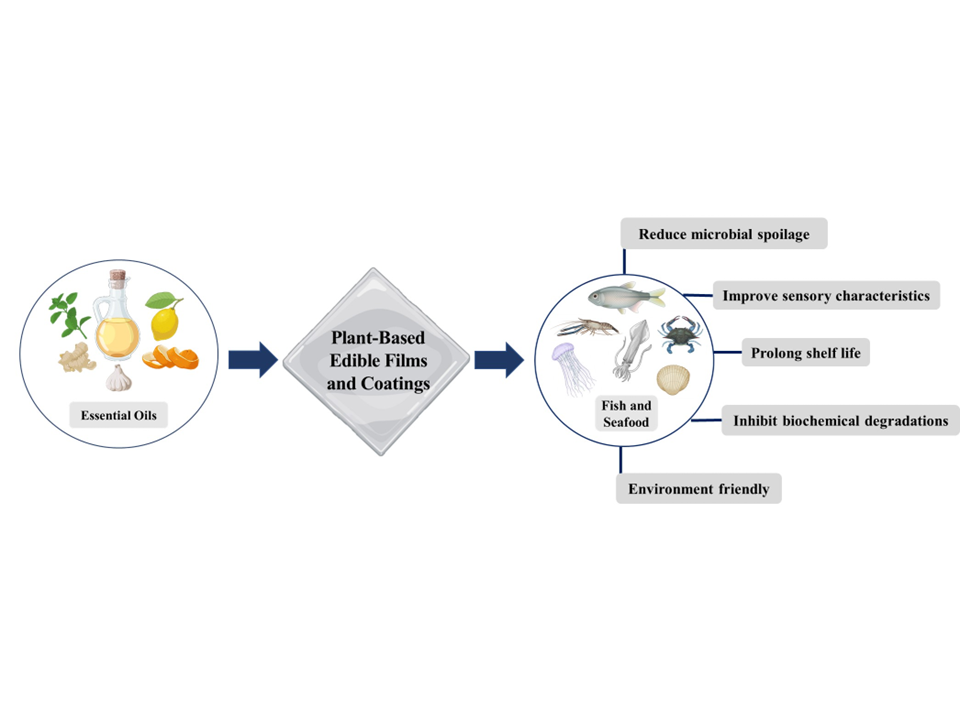
GRAPHICAL ABSTRACT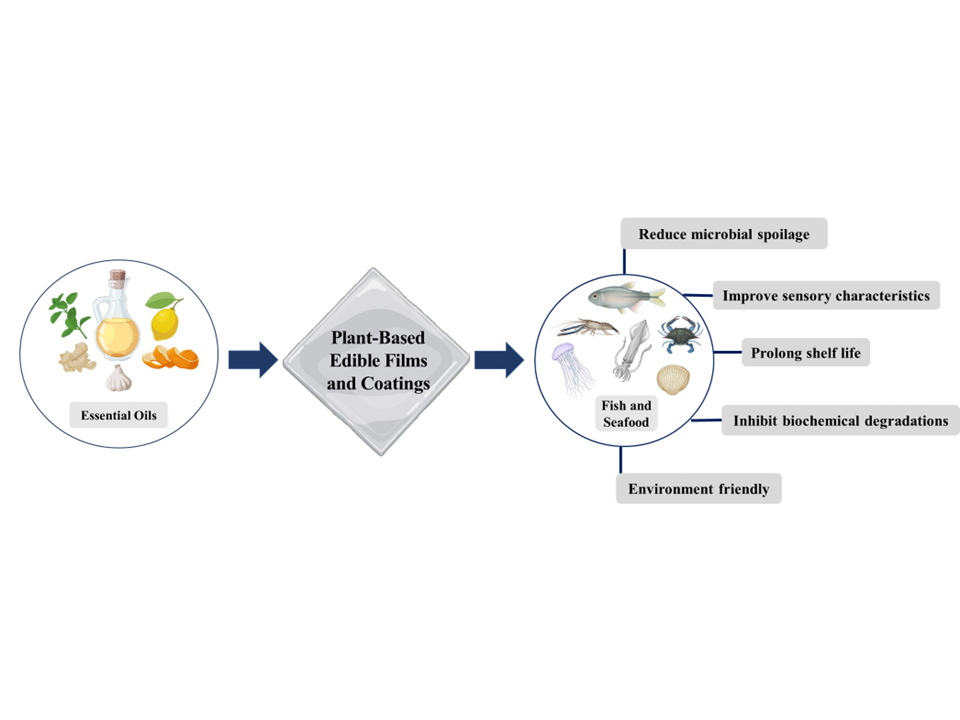
Downloads
References
Y Özogul, F Özogul and P Kulawik. The antimicrobial effect of grapefruit peel essential oil and its nanoemulsion on fish spoilage bacteria and foodborne pathogens. LWT - Food Science and Technology 2021; 136, 110362.
T Rialita, H Radiani and D Alfiah. Antimicrobial activity of the combination of red galangal (Alpinia purpurata K. Schum) and cinnamon (Cinnamomum burmanii) essential oils on Escherichia coli and Staphylococcus aureus bacteria. Journal of Physics: Conference Series 2019; 1217(ss1), 012132.
X Wang, Y Shen, K Thakur, J Han, JG Zhang, F Hu and ZJ Wei. Antibacterial activity and mechanism of ginger essential oil against Escherichia coli and Staphylococcus aureus. Molecules 2020; 25(17), 3955.
A Abdullah, MS Asghar, M Butt, M Shahid and Q Huang. Evaluating the antimicrobial potential of green cardamom essential oil focusing on quorum sensing inhibition of Chromobacterium violaceum. Journal of Food Science and Technology 2017; 54(8), 2306-2315.
Y Özogul, F Özogul and S Alagoz. Fatty acid profiles and fat contents of commercially important seawater and freshwater fish species of Turkey: A comparative study. Food Chemistry 2007; 103(1), 217-223.
TL Madigan, NJ Bott, VA Torok, NJ Percy, JF Carragher, MA de Barros Lopes and A Kiermeier. A microbial spoilage profile of half shell Pacific oysters (Crassostrea gigas) and Sydney rock oysters (Saccostrea glomerata). Food Microbiology 2014; 38, 219-227.
E Jaffrès, H Prévost, A Rossero, JJ Joffraud and X Dousset. Vagococcus penaei sp. nov., isolated from spoilage microbiota of cooked shrimp (Penaeus vannamei). International Journal of Systematic and Evolutionary Microbiology 2010; 60(9), 2159-2164.
R Zhao, W Guan, X Zhou, M Lao and L Cai. The physiochemical and preservation properties of anthocyanidin/chitosan nanocomposite-based edible films containing cinnamon-perilla essential oil pickering nanoemulsions. LWT - Food Science and Technology 2022; 153, 112506.
R Iseppi, S Camellini, C Zurlini, IM Cigognini, M Cannavacciuolo and P Messi. Essential oils and bacteriocin-based active edible coating: An innovative, natural and sustainable approach for the control of Listeria monocytogenes in seafoods. Applied Sciences 2023; 13(4), 2562.
S Kunová, E Sendra, P Haščík, NL Vukovic, M Vukic and M Kačániová. Influence of essential oils on the microbiological quality of fish meat during storage. Animals 2021; 11(11), 3145.
A Mehraie, S Khanzadi, M Hashemi and M Azizzadeh. New coating containing chitosan and Hyssopus officinalis essential oil (emulsion and nanoemulsion) to protect shrimp (Litopenaeus vannamei) against chemical, microbial and sensory changes. Food Chemistry: X 2023; 19, 100801.
BB Vieira, JF Mafra, AS da Rocha Bispo, MA Ferreira, F de Lima Silva, AVN Rodrigues and NS Evangelista-Barreto. Combination of chitosan coating and clove essential oil reduces lipid oxidation and microbial growth in frozen stored tambaqui (Colossoma macropomum) fillets. LWT - Food Science and Technology 2019; 116, 108546.
TT Thi Le, QT Tran, P Velansky, TD Dam, LG Bach and LQ Pham. Lipid composition and molecular species of phospholipid in oyster Crassostrea lugubris (Sowerby, 1871) from Lang Co Beach, Hue Province, Vietnam. Journal of Food Science and Nutrition 2021; 9(8), 4199-4210.
R Loganathan, AHA Tarmizi, SR Vethakkan and KT Teng. A review on lipid oxidation in edible oils. Malaysian Journal of Analytical Sciences 2022; 26(6), 1378-1393.
B Tufan. Changes in the biochemical and fatty acids composition of different body parts of warty crab (Eriphia verrucosa, Forsskål, 1775) caught from the southeastern Black Sea and their relationship to seasons and sex. Turkish Journal of Fisheries and Aquatic Sciences 2022; 23(5), 22160.
IA Harahap, MMC Sobral, S Casal, SC Pinho, MA Faria, J Suliburska and IM Ferreira. Fat oxidation of fatty fish vs. meat meal diets under in vitro standardized semi-dynamic gastric digestion. Frontiers in Nutrition 2022; 9, 901006.
G Secci and G Parisi. From farm to fork: Lipid oxidation in fish products. A review. Italian Journal of Animal Science 2016; 15(1), 124-136.
H Wu, B Forghani, M Abdollahi and I Undeland. Lipid oxidation in sorted herring (Clupea harengus) filleting co-products from 2 seasons and its relationship to composition. Food Chemistry 2022; 373, 131523.
L Wang, M Zang, X Zhao, X Cheng, X Li and J Bai. Lipid oxidation and free radical formation of shrimp (Penaeus vannamei) during hot air drying. Journal of Food Measurement and Characterization 2023; 17(4), 3493-3504.
DAN Apituley, CRM Loppies and E Tentua. Fatty acid profiles of paper squid (Loligo edulis, Hoyle). IOP Conference Series: Earth and Environmental Science 2020; 564(1), 012044.
P Yerlikaya, OK Topuz, HA Buyukbenli and N Gokoglu. Fatty acid profiles of different shrimp species: Effects of depth of catching. Journal of Aquatic Food Product Technology 2013; 22(3), 290-297.
W Mao, X Li, M Fukuoka, S Liu, H Ji and N Sakai. Study of Ca2+-ATPase activity and solubility in the whole Kuruma prawn (Marsupenaeus japonicus) meat during heating: Based on the kinetics analysis of myofibril protein thermal denaturation. Food and Bioprocess Technology 2016; 9, 1511-1520.
CS Tucker and KK Schrader. Off-flavors in pond-grown ictalurid catfish: Causes and management options. Journal of the World Aquaculture Society 2020; 51(1), 7-92.
JA Moretto, PNN Freitas, JP Souza, TM Oliveira, I Brites and E Pinto. Off-flavors in aquacultured fish: Origins and implications for consumers. Fishes 2022; 7(1), 34.
N Whangchai, T Pimpimon, U Sompong, S Suwanpakdee, R Gutierrez and T Itayama. Study of geosmin and 2-methylisoborneol (MIB) producers in Phayao Lake, Thailand. International Journal of Bioscience, Biochemistry and Bioinformatics 2017; 7(3), 177-184.
M Mohammadi, A Mirza Alizadeh and N Mollakhalili. Off-flavors in fish: A review of potential development mechanisms, identification and prevention methods. Journal of Education and Health Promotion 2021; 7, 120-128.
ME Yue, J Xu, QQ Li and WG Hou. Separation and determination of bromophenols in Trachypenaeus curvirostris and Lepidotrigla microptera by capillary zone electrophoresis. Journal of Food and Drug Analysis 2020; 20(1), 88-93.
MT Velasquez, A Ramezani, A Manal and DS Raj. Trimethylamine N-oxide: The good, the bad and the unknown. Toxins 2016; 8(11), 326.
ZJ Teng, QL Qin, W Zhang, J Li, HH Fu, P Wang, M Lan, GLJ He, A McMinn, M Wang, XL Chen, YZ Zhang, Y Chen and CY Li. Biogeographic traits of dimethyl sulfide and dimethylsulfoniopropionate cycling in polar oceans. Microbiome 2021; 9(1), 207.
R Carneiro, C James, T Aung and S O’Keefe. Challenges for flavoring fish products from cellular agriculture. Current Opinion in Food Science 2022; 47, 100902.
T Wu, M Wang, P Wang, H Tian and P Zhan. Advances in the formation and control methods of undesirable flavors in fish. Foods 2022; 11(16), 2504.
P Visciano, M Schirone and A Paparella. An overview of histamine and other biogenic amines in fish and fish products. Foods 2020; 9(12), 1795.
MR García, JA Ferez-Rubio and C Vilas. Assessment and prediction of fish freshness using mathematical modelling: A review. Foods 2022; 11(15), 2312.
AA Agyekum, FYH Kutsanedzie, V Annavaram, BK Mintah, EK Asare and B Wang. FT-NIR coupled chemometric methods rapid prediction of K-value in fish. Vibrational Spectroscopy 2020; 108, 103044.
J Mehri, MS Mehrgan, L Roomiani and HR Eslami. Post-mortem quality changes in rainbow trout (Oncorhynchus mykiss) during live storage. Iranian Journal of Fisheries Sciences 2022; 21(6), 1539-1557.
Y Wu, K Kunihiko and S Chen. Changes of ATP and ATP-related compounds contents and K value in Sebastes sthompsoni in different storage temperatures. Atlantis Press, United States, 2015, p. 2145-2150.
Y Liu, S Zhao, F Guan and Y Yuan. Establishment of a model for evaluating shelf life of Pseudosciaena crocea in simulated logistics and storage. Journal of Food Protection 2021; 84(7), 1188-1193.
SH Kim, EJ Jung, DL Hong, SE Lee, YB Lee, SM Cho and SB Kim. Quality assessment and acceptability of whiteleg shrimp (Litopenaeus vannamei) using biochemical parameters. Fisheries and Aquatic Science 2020; 23(1), 21.
F Calliauw, T De Mulder, K Broekaert, G Vlaemynck, C Michiels and M Heyndrickx. Assessment throughout a whole fishing year of the dominant microbiota of peeled brown shrimp (Crangon crangon) stored for 7 days under modified atmosphere packaging at 4 °C without preservatives. Food Microbiology 2016; 54, 60-71.
MB Hovda, BT Lunestad, M Sivertsvik and JT Rosnes. Characterisation of the bacterial flora of modified atmosphere packaged farmed Atlantic cod (Gadus morhua) by PCR-DGGE of conserved 16S rRNA gene regions. International Journal of Food Microbiology 2007; 117(1), 68-75.
K Bekaert, L Devriese, S Maes and J Robbens. Characterization of the dominant bacterial communities during storage of Norway lobster and Norway lobster tails (Nephrops norvegicus) based on 16S rDNA analysis by PCR-DGGE. Food Microbiology 2015; 46, 132-138.
N Walayat, W Tang, X Wang, M Yi, L Guo, Y Ding, J Liu, I Ahmad and MM Ranjha. Quality evaluation of frozen and chilled fish: A review. eFood 2023; 4(1), e67.
T Muthulakshmi, S Uthandi, R Nadella, V Murugadas, M Prasad and S Greeshma. Study on melanized shrimp reveals Bacillus sp and Acinetobacter sp as potential sources for bacterial tyrosinase. International Journal of Current Microbiology and Applied Sciences 2019; 8, 1430-1438.
FF Parlapani. Microbial diversity of seafood. Current Opinion in Food Science 2021; 37, 45-51.
L Sheng and L Wang. The microbial safety of fish and fish products: Recent advances in understanding its significance, contamination sources, and control strategies. Comprehensive Reviews in Food Science and Food Safety 2021; 20(1), 738-786.
M Jérôme, S Macé, X Dousset, B Pot and JJ Joffraud. Genetic diversity analysis of isolates belonging to the Photobacterium phosphoreum species group collected from salmon products using AFLP fingerprinting. International Journal of Food Microbiology 2016; 217, 101-109.
H Jaeger, A Janositz and D Knorr. The Maillard reaction and its control during food processing. The potential of emerging technologies. Pathologie Biologie 2010; 58(3), 207-213.
Q Hong, YL Chen, D Lin, RQ Yang, KY Cao, LJ Zhang, YM Liu, LC Sun and MJ Cao. Expression of polyphenol oxidase of Litopenaeus vannamei and its characterization. Food Chemistry 2024; 432, 137258.
C Benchaar. Feeding oregano oil and its main component carvacrol does not affect ruminal fermentation, nutrient utilization, methane emissions, milk production, or milk fatty acid composition of dairy cows. Journal of Dairy Science 2020; 103(2), 1516-1527.
E Husni, F Ismed and D Afriyandi. Standardization study of simplicia and extract of calamondin (Citrus microcarpa Bunge) peel, quantification of hesperidin and antibacterial assay. Pharmacognosy Journal 2020; 12(4), 777-783.
M Yumnam, PR Marak, AK Gupta, MA Rather and P Mishra. Effect of pomelo peel essential oil on the storage stability of a few selected varieties of freshwater fish. Journal of Agriculture and Food Research 2023; 11, 100472.
M Öz. Effects of garlic (Allium sativum) supplemented fish diet on sensory, chemical and microbiological properties of rainbow trout during storage at −18 °C. LWT - Food Science and Technology 2018; 92, 155-160.
P Chuesiang, R Sanguandeekul and U Siripatrawan. Enhancing effect of nanoemulsion on antimicrobial activity of cinnamon essential oil against foodborne pathogens in refrigerated Asian seabass (Lates calcarifer) fillets. Food Control 2021; 122, 107782.
ADT Phan, G Netzel, P Chhim, ME Netzel and Y Sultanbawa. Phytochemical characteristics and antimicrobial activity of Australian grown garlic (Allium sativum L.) cultivars. Foods 2019; 8(9), 358.
J Bai, J Li, Z Chen, X Bai, Z Yang, Z Wang and Y Yang. Antibacterial activity and mechanism of clove essential oil against foodborne pathogens. LWT - Food Science and Technology 2023; 173, 114249.
S Gao, G Liu, J Li, J Chen, L Li, Z Li, X Zhangand and S Zhang. Antimicrobial activity of lemongrass essential oil (Cymbopogon flexuosus) and its active component citral against dual-species biofilms of Staphylococcus aureus and Candida species. Frontiers in Cellular and Infection Microbiology 2020; 10, 603858.
S Srifuengfung, N Bunyapraphatsara, V Satitpatipan, C Tribuddharat, VB Junyaprasert, W Tungrugsasut and V Srisukh. Antibacterial oral sprays from kaffir lime (Citrus hystrix DC.) fruit peel oil and leaf oil and their activities against respiratory tract pathogens. Journal of Traditional and Complementary Medicine 2020; 10(6), 594-598.
Y Wu, H Wu and L Hu. Recent advances of proteins, polysaccharides and lipids-based edible films/coatings for food packaging applications: A review. Food Biophysics 2024; 19(1), 29-45.
N Kumar, J Pratibha, A Prasad, A Yadav, Neeraj Upadhyay, S Shukla, AT Petkoska, Heena, S Suri, M Gniewosz and M Kieliszek. Recent trends in edible packaging for food applications - perspective for the future. Food Engineering Reviews 2023; 15(4), 718-747.
M Janowicz, S Galus, A Ciurzyńska and M Nowacka. The potential of edible films, sheets, and coatings based on fruits and vegetables in the context of sustainable food packaging development. Polymers 2023; 15(21), 4231.
H Onyeaka, K Obileke, G Makaka and N Nwokolo. Current research and applications of starch-based biodegradable films for food packaging. Polymers 2022; 14(6), 1126.
JM Milani and A Nemati. Lipid-based edible films and coatings: A review of recent advances and applications. Journal of Packaging Technology and Research 2022; 6(1), 11-22.
M Ramos, A Valdés, A Beltrán and MC Garrigós. Gelatin-based films and coatings for food packaging applications. Coatings 2016; 6(4), 41.
HX Gao, Z He, Q Sun, Q He and WC Zeng. A functional polysaccharide film forming by pectin, chitosan, and tea polyphenols. Carbohydrate Polymers 2019; 215, 1-7.
N Morakot, S Vatanyoopaisarn, B Thumthanaruk, J Wongsa, C Puttanlek, D Uttapap, BP Lamsal and V Rungsardthong. Effect of glucomannan and potassium sorbate on quality and shelf life of fresh-cut cantaloupe. Science, Engineering and Health Studies 2020; 14(2), 123-131.
A Nešić, G Cabrera-Barjas, S Dimitrijević-Branković, S Davidović, N Radovanović and C Delattre. Prospect of polysaccharide-based materials as advanced food packaging. Molecules 2019; 25(1), 135.
FS Mostafavi and D Zaeim. Agar-based edible films for food packaging applications: A review. International Journal of Biological Macromolecules 2020; 159, 1165-1176.
AM Khalid, B Niaz, F Saeed, M Afzaal, F Islam, M Hussain, Mahwish, HMS Khalid, A Siddeeg and A Al-Farga. Edible coatings for enhancing safety and quality attributes of fresh produce: A comprehensive review. International Journal of Food Properties 2022; 25(1), 1817-1847.
B Yousuf, Y Sun and S Wu. Lipid and lipid-containing composite edible coatings and films. Food Reviews International 2022; 38(sup1), 574-597.
S Zhu, S Huang, X Lin, X Wan, Q Zhang, J Peng, D Luo, Y Zhang and X Dong. The relationships between waxes and storage quality indexes of fruits of 3 plum cultivars. Foods 2023; 12(8), 1717.
E Athanasopoulou, F Bigi, E Maurizzi, EIE Karellou, CS Pappas, A Quartieri and T Tsironi. Synthesis and characterization of polysaccharide- and protein-based edible films and application as packaging materials for fresh fish fillets. Scientific Reports 2024; 14(1), 517.
L Atarés and A Chiralt. Essential oils as additives in biodegradable films and coatings for active food packaging. Trends in Food Science & Technology 2016; 48, 51-62.
AA Mohamed and BM Alotaibi. Essential oils of some medicinal plants and their biological activities: A mini review. Journal of Umm Al-Qura University for Applied Sciences 2023; 9(1), 40-49.
B Teixeira, A Marques, C Pires, C Ramos, I Batista, JA Saraiva and ML Nunes. Characterization of fish protein films incorporated with essential oils of clove, garlic and origanum: Physical, antioxidant and antibacterial properties. LWT - Food Science and Technology 2014; 59(1), 533-539.
J Gómez-Estaca, A López de Lacey, MC Gómez-Guillén, ME López-Caballero and P Montero. Antimicrobial activity of composite edible films based on fish gelatin and chitosan incorporated with clove essential oil. Journal of Aquatic Food Product Technology 2009; 18(1-2), 46-52.
I Echeverría, ME López-Caballero, MC Gómez-Guillén, AN Mauri and MP Montero. Active nanocomposite films based on soy proteins-montmorillonite-clove essential oil for the preservation of refrigerated bluefin tuna (Thunnus thynnus) fillets. International Journal of Food Microbiology 2018; 266, 142-149.
J Gómez-Estaca, A López de Lacey, ME López-Caballero, MC Gómez-Guillén and P Montero. Biodegradable gelatin-chitosan films incorporated with essential oils as antimicrobial agents for fish preservation. Food Microbiology 2010; 27(7), 889-896.
A Ehsani, M Hashemi, A Afshari, M Aminzare, M Raeisi and T Zeinali. Effect of different types of active biodegradable films containing lactoperoxidase system or sage essential oil on the shelf life of fish burger during refrigerated storage. LWT - Food Science and Technology 2020; 117, 108633.
B Li, X Wang, X Gao, X Ma, L Zhang, J Mei and J Xie. Shelf-life extension of large yellow croaker (Larimichthys crocea) using active coatings containing lemon verbena (Lippa citriodora Kunth.) essential oil. Frontiers in Nutrition 2021; 8, 678643.
Y Alparslan, HH Yapıcı, C Metin, T Baygar, A Günlü and T Baygar. Quality assessment of shrimps preserved with orange leaf essential oil incorporated gelatin. LWT - Food Science and Technology 2016; 72, 457-466.
E Mohebi and Y Shahbazi. Application of chitosan and gelatin based active packaging films for peeled shrimp preservation: A novel functional wrapping design. LWT - Food Science and Technology 2017; 76, 108-116.
TL Cao and KB Song. Development of bioactive Bombacaceae gum films containing cinnamon leaf essential oil and their application in packaging of fresh salmon fillets. LWT - Food Science and Technology 2020; 131, 109647.
X Liu, C Zhang, S Liu, J Gao, SW Cui and W Xia. Coating white shrimp (Litopenaeus vannamei) with edible fully deacetylated chitosan incorporated with clove essential oil and kojic acid improves preservation during cold storage. International Journal of Biological Macromolecules 2020; 162, 1276-1282.
PC Martins, DC Bagatini and VG Martins. Oregano essential oil addition in rice starch films and its effects on the chilled fish storage. Journal of Food Science and Technology 2021; 58(4), 1562-1573.
S Bahram, M Rezaie, M Soltani, A Kamali, M Abdollahi, M Khezri Ahmadabad and M Nemati. Effect of whey protein concentrate coating cinnamon oil on quality and shelf life of refrigerated beluga sturgeon (Huso huso). Journal of Food Quality 2016; 39(6), 743-749.
Y Laorenza and N Harnkarnsujarit. Carvacrol, citral and α-terpineol essential oil incorporated biodegradable films for functional active packaging of pacific white shrimp. Food Chemistry 2021; 363, 130252.
YF Qian, T Lin, X Liu, J Pan, J Xie and SP Yang. In-vitro study on the antibacterial and antioxidant activity of 4 commercial essential oils and in-situ evaluation of their effect on quality deterioration of pacific white shrimp (Litopenaeus vannamei) during cold storage. Foods 2022; 11(16), 2475.
A Perez-Vazquez, P Barciela, M Carpena and MA Prieto. Edible coatings as a natural packaging system to improve fruit and vegetable shelf life and quality. Foods 2023; 12(19), 3570.
H Yohanes, CY Chu, H Pranamuda, MF Lai and W Handayani. Application of edible coating and active packaging to extend shelf life of mango under atmosphere temperature. Maejo International Journal of Energy and Environmental Communication 2020; 2(3), 1-5.
A Matloob, H Ayub, M Mohsin, S Ambreen, FA Khan, S Oranab, MA Rahim, W Khalid, GA Nayik, S Ramniwas and S Ercisli. A review on edible coatings and films: Advances, composition, production methods, and safety concerns. ACS Omega 2023; 8(32), 28932-28944.
A Silva-Weiss, V Bifani, M Ihl, PJA Sobral and MC Gómez-Guillén. Natural additives in bioactive edible films and coatings: Functionality and applications in foods. Food Engineering Reviews 2018; 10(3), 191-207.
W Rhim and LF Wang. Preparation and characterization of carrageenan-based nanocomposite films reinforced with clay mineral and silver nanoparticles. Applied Clay Science 2013; 85, 68-77.
F Donsì and G Ferrari. Essential oil nanoemulsions as antimicrobial agents in food. Journal of Biotechnology 2016; 233, 106-120.
S Shojaee-Aliabadi, H Hosseini, MA Mohammadifar, A Mohammadi, M Ghasemlou, SM Hosseini and R Khaksar. Characterization of antioxidant-antimicrobial κ-carrageenan films containing Satureja hortensis essential oil. International Journal of Biological Macromolecules 2013; 52(1), 116-124.
N Muñoz-Tebar, JA Pérez-Álvarez, J Fernández-López and M Viuda-Martos. Chitosan edible films and coatings with added bioactive compounds: Antibacterial and antioxidant properties and their application to food products: A review. Polymers 2023; 15(2), 396.
N Basavegowda and KH Baek. Synergistic antioxidant and antibacterial advantages of essential oils for food packaging applications. Biomolecules 2021; 11(9), 1267.
VK Pandey, A Tripathi, S Srivastava, AH Dar, R Singh, A Farooqui and S Pandey. Exploiting the bioactive properties of essential oils and their potential applications in food industry. Food Science and Biotechnology 2023; 32(7), 885-902.
European Commission. Regulation (EC) No 1935/2004 of the European Parliament and of the Council of 27 October 2004 on materials and articles intended to come into contact with food. Official Journal of the European Union 2004; L338, 4-17.
European Commission. Commission Regulation (EC) No 450/2009 of 29 May 2009 on active and intelligent materials and articles intended to come into contact with food. Official Journal of the European Union 2009; L135, 3-11.
United States Food and Drug Administration (FDA). Title 21 -food and drugs, Code of federal regulations, parts 170, 172, and 182. U.S. Government Publishing Office, Available at: https://www.ecfr.gov, accessed April 2025.
Codex Alimentarius. General Standard for Food Additives (GSFA), Available at: https://www.fao.org/fao-who-codexalimentarius, accessed April 2025.
Published
How to Cite
Issue
Section
License
Copyright (c) 2025 Walailak University

This work is licensed under a Creative Commons Attribution-NonCommercial-NoDerivatives 4.0 International License.





