
Optimization of Soymilk Fermentation Supplemented with Coconut Protein by Lactobacillus plantarum TISTR2084
DOI:
https://doi.org/10.48048/tis.2025.9122Keywords:
Lactobacillus plantarum, Soymilk, Plant based yogurt, Coconut protein, Probiotic, FermentationAbstract
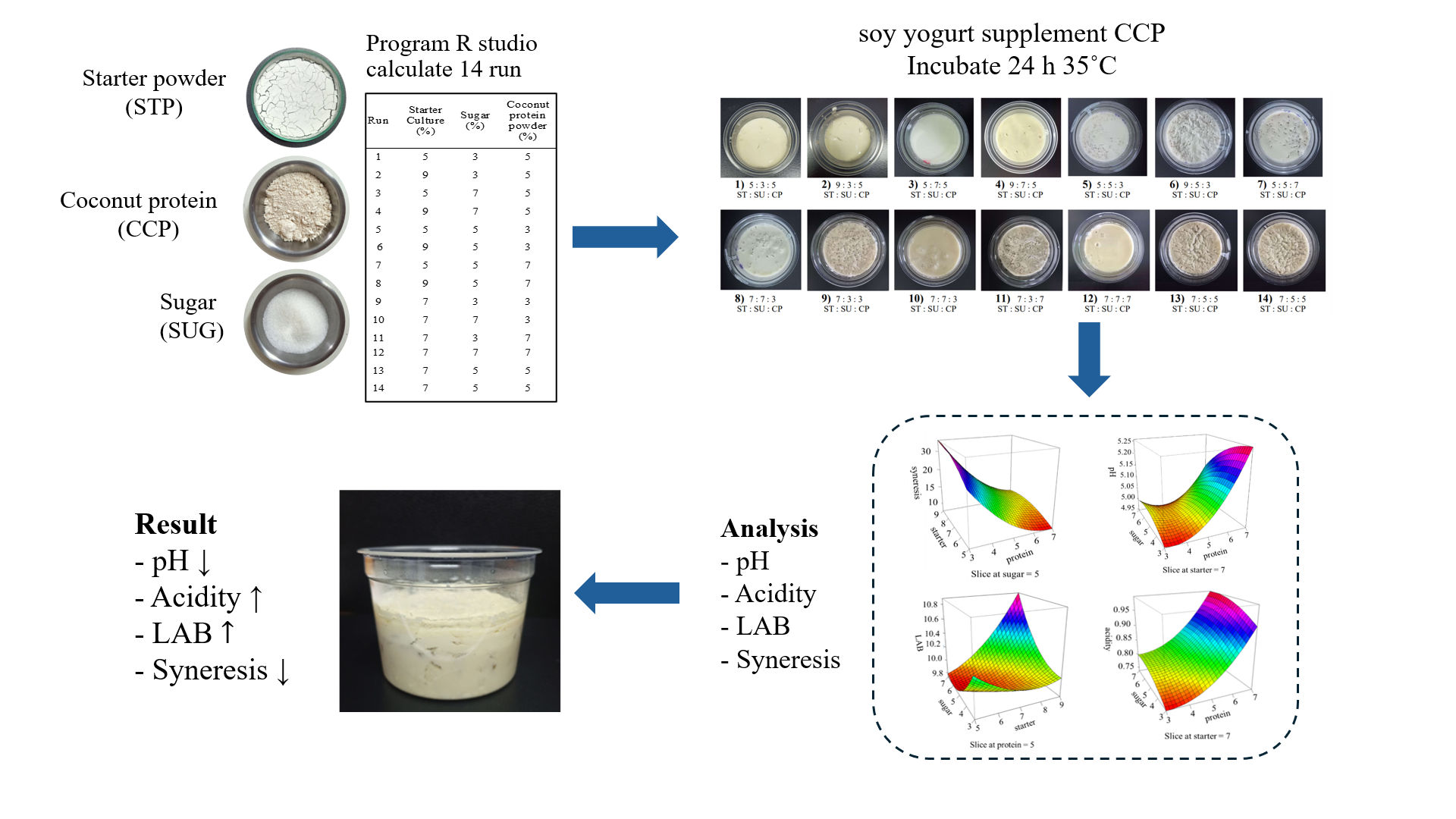
Currently, there is an increasing demand for milk alternatives due to allergies to milk protein and lactose intolerance. Other milk alternatives such as soy milk, oat milk and corn milk, necessitating the development of plant-based yogurt. Additionally, plant-based protein substitutes have been used to improve the texture of yogurt. This research work aimed to optimize the levels of coconut protein concentration (CCP), Lactobacillus plantarum TISTR 2084 starter powder (STP) and sugar concentration (SUG) through incubation at 35 °C for 24 h, resulting in improved product characteristics. A response surface methodology (RSM) was used to determine the optimization of soy yogurt with the combined effects of STP (5 - 9 % w/v), SUG (3 - 7 % w/v), and CCP (3 - 7 % w/v). There were evaluated in terms of some quality criteria of plant-based yogurt namely: pH, titratable acidity (TA), lactic acid bacteria (LAB), and syneresis. The results revealed that soymilk yogurt exhibited average bio-physical-chemical properties. The experimental variables significantly affected TA and syneresis. The models of research were high value of R2 for TA (0.9859) and syneresis (0.9760) which demonstrate the adequacy of RSM. When raising the CCP to an increase TA, decrease syneresis relative to other samples. It was possible to obtain high-quality yogurt. This product is in high demand for increasing protein level of regular yogurts. Soymilk yogurt products with 5 % CCP showed in higher LAB (11 log CFU/mL) and decreased syneresis, while 7 % CCP resulted in lower LAB (9 log CFU/mL) and increased syneresis. According to the optimal contents of 9 % STP, 7 % SUG and 5 % CCP were determined, with a desirability of 86.3 %. These STP and CCP findings provide critical information for future research into innovative plant-based yogurt substitutes.
HIGHLIGHTS
- Soy yogurt fortified with commercial CCP can be a functional product.
- STP from Lactobacillus plantarum can produce yogurt from soy milk fortified with coconut protein powder.
- CCP at a 5 % (w/v) increases acidity and reduces syneresis.
GRAPHICAL ABSTRACT
Downloads
References
N Popović, E Brdarić, J Đokić, M Dinić, K Veljović, N Golić and A Terzić-Vidojević. Yogurt produced by novel natural starter cultures improves gut epithelial barrier in vitro. Microorganisms 2020; 8(10), 1586.
MP Arena, G Caggianiello, P Russo, M Albenzio, S Massa, D Fiocco, V Capozzi and G Spano. Functional starters for functional yogurt. Foods 2015; 4(1), 15-33.
M Araya, P Gopal, SE Lindgren, R Lodi, G Oliver, ML Saxelin, AL Severin and C Stanton. Probiotics in food: Health and nutritional properties and guidelines for evaluation. FAO, Rome, Italy, 2006, p. 2-3.
J Maneesri, P Masniyom and M Liming. Survival of Candida tropicalis and Lactobacillus plantarum starter culture after using protective agent and drying. International Food Research Journal 2018; 25(4), 1655-1660.
AM Estévez, J Mejía, F Figuerola and B Escobar. Effect of solid content and sugar combinations on the quality of soymilk-based yogurt. Journal of Food Processing and Preservation 2010; 34(S1), 87-97.
DMD Dissanayake, JK Vidanarachchi, RS Rocha, CF Balthazar, AG Cruz, AS Sant’Ana and CS Ranadheera. Plant-based milk substitutes as emerging probiotic carriers. Current Opinion in Food Science 2021; 38, 8-20.
X Wang, X Kong, C Zhang, Y Hua, Y Chen and X Li. Comparison of physicochemical properties and volatile flavor compounds of plant-based yoghurt and dairy yoghurt. Food Research International 2023; 164, 112375.
J Naibaho, E Jonuzi, N Butula, M Korzeniowska and B Yang. Soy-based yogurt-alternatives enriched with brewers’ spent grain flour and protein hydrolysates: Microstructural evaluation and physico-chemical properties during the storage. LWT 2023; 178, 114626.
MA Drake, XQ Chen, S Tamarapu and B Leenanon. Soy protein fortification affects sensory, chemical, and microbiological properties of dairy yogurts. Journal of Food Science 2000; 65, 1244-1247.
S Vij, S Hati and D Yadav. Biofunctionality of probiotic soy yoghurt. Food and Nutrition Sciences 2011; 2(5), 502-509.
AE D’Andrea, AJ Kinchla and AA Nolden. A comparison of the nutritional profile and nutrient density of commercially available plant-based and dairy yogurts in the United States. Frontiers in Nutrition 2023; 10, 1195045.
X Kong, Z Xiao, M Du, K Wang, W Yu, Y Chen, Z Liu, Y Cheng and J Gan. Physicochemical, textural, and sensorial properties of soy yogurt as affected by addition of low acyl gellan gum. Gels 2022; 8(7), 453.
T Boeck, AW Sahin, E Zannini and EK Arendt. Nutritional properties and health aspects of pulses and their use in plant-based yogurt alternatives. Comprehensive Reviews in Food Science and Food Safety 2021; 20(4), 3858-3880.
U Pachekrepapol, Y Kokhuenkhan and J Ongsawat. Formulation of yogurt-like product from coconut milk and evaluation of physicochemical, rheological, and sensory properties. International Journal of Gastronomy and Food Science 2021; 25, 100393.
J Xu, X Xu, Z Yuan, D Hua, Y Yan, M Bai, H Song, L Yang, D Zhu, D Hua, Y Yan, M Bai, H Song, L Yang, D Zhu, J Liu, D Huo and H Liu. Effect of hemp protein on the physicochemical properties and flavor components of plant-based yogurt. LWT 2022; 172, 114145.
AH Ali, M Alsalmi, R Alshamsi, M Tarique, G Bamigbade, I Zahid, MH Nazir, M Waseem, B Abu-Jdayil, A Kamal-Eldin, T Huppertz and M Ayyash. Effect of whey protein isolate addition on set-type camel milk yogurt: Rheological properties and biological activities of the bioaccessible fraction. Journal of Dairy Science 2023; 106(12), 8221-8238.
P Mitra, K Nepal and P Tavade. Effect of whey and soy proteins fortification on the textural and rheological properties of value-added yogurts. Applied Food Research 2022; 2(2), 100195.
X Rui, Q Zhang, J Huang, W Li, X Chen, M Jiang and M Dong. Does lactic fermentation influence soy yogurt protein digestibility: A comparative study between soymilk and soy yogurt at different pH. Journal of the Science of Food and Agriculture 2019; 99(2), 861-867.
OF Oludahunsi, D Amosu and BOT Ifesan. Quality evaluation and acceptability of soy-yoghurt with different colours and fruit flavours. American Journal of Food Science and Technology 2007; 2, 273-280.
T Daszkiewicz, M Michalak and K Śmiecińska. A comparison of the quality of plain yogurt and its analog made from coconut flesh extract. Journal of Dairy Science 2024; 107(6), 3389-3399.
K Mat, ZA Kari, ND Rusli, HC Harun, LS Wei, MM Rahman, HNM Khalid, MHMA Hanafiah, SAM Sukri, RIAR Khalif, ZM Zin, MKM Zainol, M Panadi, MFM Nor and KW Goh. Coconut palm: Food, feed, and nutraceutical properties. Animals 2022; 12(16), 2107.
P Rodsamran and R Sothornvit. Bioactive coconut protein concentrate films incorporated with antioxidant extract of mature coconut water. Food Hydrocolloids 2018; 79, 243-250.
Y Li, Y Zheng, Y Zhang, J Xu and G Gao. Antioxidant activity of coconut (Cocos nucifera L.) protein fractions. Molecular 2018; 23(3), 707.
K Kotecka-Majchrzak, A Sumara, E Fornal and M Montowska. Oilseed proteins - Properties and application as a food ingredient. Trends in Sciences 2020; 106, 160-170.
P Ferranti and S Velotto. Coconut and oil palm based ingredients. In: Sustainable food science - A comprehensive approach. Elsevier, Amsterdam, The Netherlands, 2023, p. 229-241.
J Ma, C Pan, H Chen, W Chen, J Pei, M Zhang, Q Zhong, W Chen and G Zeng. Effects of protein concentration, ionic strength, and heat treatment on the interfacial and emulsifying properties of coconut (Cocos nucifera L.) globulins. Food Chemistry: X 2023; 20, 100984.
A Dabija, GG Codină, AM Gâtlan, ET Sănduleac and L Rusu. Effects of some vegetable proteins addition on yogurt quality. Scientific Study and Research: Chemical Engineering Journal 2018; 19(2), 181-192.
P Mitra, K Nepal and P Tavade. Effect of whey and soy proteins fortification on the textural and rheological properties of value-added yogurts. Applied Food Research 2022; 2(2), 100195.
TU Zahan, MZ Islam, MN Islam, R Habib and M Harun-Ur-Rashid. Optimization of sugar reduction in the formulation of set-type yogurt using pure lactic acid bacterial culture. Asian Journal of Dairy and Food Research 2020; 39(3), 201-206.
RY Jumah, B Abu-Jdayil and RR Shaker. Effect of type and level of starter culture on the rheological properties of set yogurt during gelation process. International Journal of Food Properties 2001; 4(3), 531-544.
JS Shin, BH Kim, HS Kim and MY Baik. Optimization of pea protein and citrus fiber contents for plant based stirred soymilk yogurt using response surface methodology. Food Science and Biotechnology 2022; 31(13), 1691-1701.
F Benmeziane and I Belleili. An innovative approach: Formulation and evaluation of fermented oat milk using native yoghurt cultures. Measurement: Food 2023; 12, 100113.
N Boontim, K Unban, W Pathom-aree, P Niamsup, C Khanongnuch and S Lumyong. L-lactic acid production by Lactobacillus salivarius L105 in optimized medium and effects of sugar concentration. Chiang Mai Journal of Science 2020; 47(5), 887-898.
MC Mesquita, SL Eliana, RA Ernandes and BAB Raquel. Fermentation of chickpea (Cicer arietinum L.) and coconut (Coccus nucifera L.) beverages by Lactobacillus paracasei subsp paracasei LBC 81: The influence of sugar content on growth and stability during storage. LWT 2020; 132, 109834.
M DebMandal and S Mandal. Coconut (Cocos nucifera L.: Arecaceae): In health promotion and disease prevention. Asian Pacific Journal of Tropical Medicine 2011; 4(3), 241-247.
S Bansal, M Mangal, SK Sharma, DN Yadav and RK Gupta. Optimization of process conditions for developing yoghurt like probiotic product from peanut. LWT 2016; 73, 6-12.
P Meinlschmidt, E Ueberham, J Lehmann, U Schweiggert-Weisz and P Eisner. Immunoreactivity, sensory and physicochemical properties of fermented soy protein isolate. Food Chemistry 2016; 205, 229-238.
AR Harper, RCJ Dobson, VK Morris and GJ Moggré. Fermentation of plant-based dairy alternatives by lactic acid bacteria. Microbial Biotechnology 2022; 15(5), 1404-1421.
TM Darby and RM Jones. Beneficial influences of Lactobacillus plantarum on human health and disease. In: MH Floch, Y Ringel and WA Walker (Eds.). The microbiota in gastrointestinal pathophysiology. Academic Press, Cambridge, 2017, p. 109-117.
JS Shin, BH Kim and MY Baik. Applicable plant proteins and dietary fibers for simulate plant‐based yogurts. Foods 2021; 10(10), 2305.
CE Hwang, SC Kim, DH Kim, HY Lee, HK Suh, KM Cho and JH Lee. Enhancement of isoflavone aglycone, amino acid, and CLA contents in fermented soybean yogurts using different strains: Screening of antioxidant and digestive enzyme inhibition properties. Food Chemistry 2021; 340, 128199.
D Charalampopoulos, JA Vázquez and SS Pandiella. Modelling and validation of Lactobacillus plantarum fermentations in cereal-based media with different sugar concentrations and buffering capacities. Biochemical Engineering Journal 2009; 44(2-3), 96-105.
H Li, L Yan, J Wang, Q Zhang, Q Zhou, T Sun, W Chen and H Zhang. Fermentation characteristics of six probiotic strains in soymilk. Annals of Microbiology 2012; 62, 1473-1483.
AW Schepers, J Thibault and C Lacroix. Lactobacillus helveticus growth and lactic acid production during pH-controlled batch cultures in whey permeate/yeast extract medium. Part I. Multiple factor kinetic analysis. Enzyme and Microbial Technology 2002; 30(2), 176-186.
FM Mehaya, AI El-Shazly, AN El-Dein and MA Farid. Evaluation of nutritional and physicochemical characteristics of soy yogurt by Lactobacillus plantarum KU985432 and Saccharomyces boulardii CNCMI-745. Scientific Reports 2023; 13, 13026.
MA Gantumur, N Sukhbaatar, Q Jiang, E Enkhtuya, J Hu, C Gao, Z Jiang and A Li. Effect of modified fermented whey protein fortification on the functional, physical, microstructural, and sensory properties of low-fat yogurt. Food Control 2024; 155, 110032.
CE Jørgensen, RK Abrahamsen, EO Rukke, TK Hoffmann, AG Johansen and SB Skeie. Processing of high-protein yoghurt - A review. International Dairy Journal 2019; 88, 42-59.
Q Zhu, W Chen, L Wang, W Chen, M Zhang, Q Zhong, J Pei and H Chen. Development of high internal phase emulsions using coconut protein isolates modified by pulsed light: Relationship of interfacial behavior and emulsifying stability. Food Hydrocolloids 2024; 148, 109495.
M Arab, M Yousefi, E Khanniri, M Azari, V Ghasemzadeh-Mohammadi and N Mollakhalili-Meybodi. A comprehensive review on yogurt syneresis: Effect of processing conditions and added additives. Journal of Food Science and Technology 2023; 60(6), 1656-1665.
CI Vénica, IV Wolf, MJ Spotti, ML Capra, DJ Mercanti and MC Perotti. Impact of protein-providing milk ingredients on volatile compounds, microstructure, microbiology and physicochemical characteristics of yogurts. Food Bioscience 2023; 53, 102588.
X Zhang, T Qun and R Fei. Manuscript title: Influence of glucose, sucrose and trehalose on the Freeze-Thaw stability of Tapioca Starch gels. Advance Journal of Food Science and Technology 2012; 4(4), 225-230.
Downloads
Published
How to Cite
Issue
Section
License
Copyright (c) 2024 Walailak University

This work is licensed under a Creative Commons Attribution-NonCommercial-NoDerivatives 4.0 International License.





