
A Review of Post-Harvest Management Practices and Quality Optimization Strategies for Indian Gooseberry (Phyllanthus emblica L.)
DOI:
https://doi.org/10.48048/tis.2026.11546Keywords:
Phyllanthus emblica L., Post-harvest management, Shelf-life extension, Fungal spoilage, Edible coatings, Value additionAbstract
Indian gooseberry (IG), also known as amla, is a nutritionally and therapeutically important fruit with extraordinary levels of vitamin C, polyphenolic content, and a wide range of therapeutic properties. Despite these benefits, commercial applications of fresh IG fruit have been limited, largely because of rapid post-harvest decay. It is estimated that one-third of the harvested crops are lost to mechanical injury, microbial decay, and physiological disorders. This review synthesizes the existing literature on integrated post-harvest management practices that can maintain the quality and prolong the marketability of IG. A structured search of Google Scholar, Semantic Scholar, ScienceDirect, Scopus, and PubMed databases was conducted to identify studies on the integrated post-harvest management of IG fruit. The retrieved evidence was synthesized and used in this review to assess practices that sustain quality and extend marketability. It discusses the effects of cultivar selection, nutrient and irrigation management, pest and disease management, and harvest maturity on post-harvest outcomes in the context of the pre-harvest to post-harvest continuum. Post-harvest handling (sorting, grading, pre-cooling, and sanitation), chemical (calcium salts and fungicides), physical (UV-C irradiation and hot-water dip), and biologically derived methods (chitosan coating and edible film) to control storability are discussed. Permeable packages, such as perforated polyethylene films, corrugated fiberboard cartons, and modified atmosphere packaging, are reviewed for their contribution to preserving IG fruit quality during shipping and storage. Storage conditions were optimized for controlled temperatures (8 °C), high relative humidity, and adequate ventilation to reduce ripening and deterioration. Integrated disease control through sanitation, temperature management, targeted use of fungicides, and emerging biological agents are key to minimizing spoilage. The potential for waste reduction and functional product development using various traditional and modern processing methods, including non-thermal preservation technologies, is explored for their ability to support waste reduction and functional product development in a global market valued at over USD 1.2 billion. The combined application of these measures is critical for extending shelf life, nutrition quality, and economic returns; enhancing the value chain of IG (both domestic and international markets); and sustaining the livelihoods of producers.
HIGHLIGHTS
- Pre-harvest factors (cultivar, nutrition, timing) are key for post-harvest management.
- Post-harvest handling (sorting, grading, pre-cooling, sanitation) boosts IG fruit value.
- A primary concern of IG fruit is spoilage from Penicillium islandicum.
- Innovative packaging and controlled storage delay ripening and preserve nutrition of IG fruits.
- Value-added processing (traditional/non-thermal) reduces waste and creates new markets.
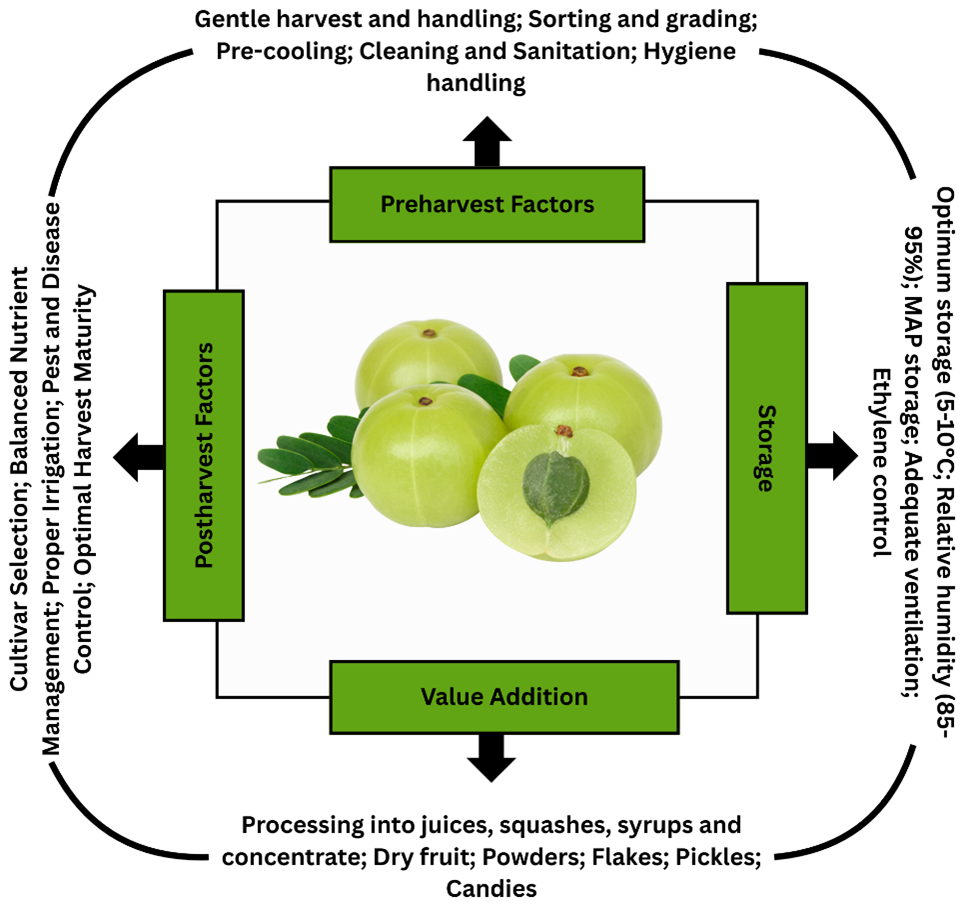
GRAPHICAL ABSTRACT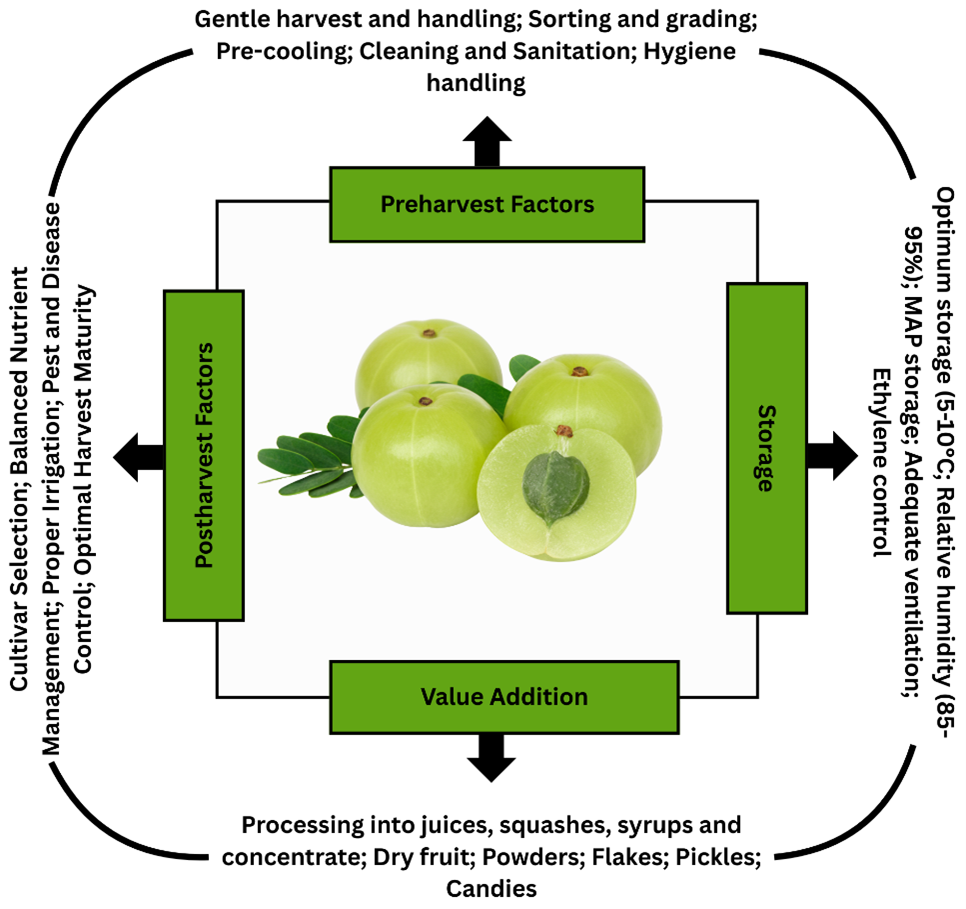
Downloads
References
M Krishnaveni and S Mirunalini. Therapeutic potential of Phyllanthus emblica (Amla): The ayurvedic wonder. Journal of Basic and Clinical Physiology and Pharmacology 2010; 21(1), 93-105.
Masfria, A Dalimunthe, N Suci and H Syahputra. Phytochemical constituent analysis of Phyllanthus emblica L. fruit nanoherbals by LC-HRMS and their antimutagenic activity and teratogenic effects. Molecules 2024; 29(7), 1642.
ASP Pandey, S Karmakar and W Raja. Emblica officinalis (Amla): A review for its phytochemistry, ethnomedicinal uses and medicinal potentials. Journal of Advanced in Pharmacognosy 2023; 4(1), 1-7.
PG Avinash, Hamid, R Shams, KK Dash, AM Shaikh, D Ungai, E Harsányi, T Suthar and B Kovács. Recent insights into the morphological, nutritional and phytochemical properties of Indian gooseberry (Phyllanthus emblica) for the development of functional foods. Plants 2024; 13(5), 574.
S Ghosal, VK Tripathi and S Chauchan. Active constituents of Emblica officinalis: Part I. The chemistry and antioxidative effects of two new hydrolysable tannins, Emblicanin A and B. Indian Journal of Chemistry 1996; 35(9), 941-948.
AT Prananda, A Dalimunthe, U Harahap, Y Simanjuntak, E Peronika, NE Karosekali, PAZ Hasibuan, RA Syahputra, PC Situmorang and F Nurkolis. Phyllanthus emblica: A comprehensive review of its phytochemical composition and phar-macological properties. Frontiers in Pharmacology 2023; 14, 1288618.
L Anila and NR Vijayalakshmi. Antioxidant action of flavonoids from Mangifera indica and Emblica officinalis in hypercholesterolemic rats. Food Chemistry 2003; 83(4), 569-574.
MS Baliga and JJ Dsouza. Amla (Emblica officinalis Gaertn), a wonder berry in the treatment and prevention of cancer. European Journal of Cancer Prevention 2011; 20(3), 225-239.
B Rani, U Singh and RK Maheshwari. Natural antioxidants and their intrinsic worth for wellbeing. Global Journal of Medical Research 2013; 13(B7), 53-69.
A Bhattacharya, A Chatterjee, S Ghosal and SK Bhattacharya. Antioxidant activity of active tannoid principles of Emblica officinalis (Amla). Indian Journal of Experimental Biology 1999; 37(7), 676-680.
P Sengupta, S Sen, K Mukherjee and K Acharya. Post-harvest diseases of Indian gooseberry and their management: A review. International Journal of Fruit Science 2020; 20(2), 178-190.
R Tewari, VK Kumar and H Sharma. Thermal and nonthermal processing of an underutilized fruit Emblica officinalis (Amla): A sustainable approach. Sustainable Food Technology 2023; 1(5), 658-680.
S Gantait, M Mahanta, S Bera and SK Verma. Advances in biotechnology of Emblica officinalis Gaertn. syn. Phyllanthus emblica L.: A nutraceuticals-rich fruit tree with multifaceted ethnomedicinal uses. 3 Biotech 2021; 11(2), 62.
PK Pathak, P Dwivedi and S Kumar. Effect of post-harvest treatments on shelf-life of aonla (Emblica officinalis) fruits damaged during harvesting. Food Science and Technology 2009; 46(3), 283-285.
VT Kore, HL Devi and J Kabir. Packaging, storage and value addition of aonla, an underutilized fruit, in India. Fruits 2013; 68, 255-266.
X Long, R Li, J Gu, L Zhang, S Guo, Y Fan, Y Fan and P Zhu. Changes in phenolic compounds of Phyllanthus emblica juice during different storage temperature and pH conditions. Journal of Food Science 2024; 89(7), 4312-4330.
P Kumari, A Brar and J Kumar. Evaluation of shelf-life of aonla (Emblica officinalis G.) cultivars during storage at room temperature. Journal of Applied and Natural Science 2017; 9(1), 573-576.
R Kumari, N Sinha, S Sharma and K Dhiman. Biochemical characterization and antioxidant potential of Phyllanthus emblica L. International Journal of Advanced Biochemistry Research 2024; 8(5), 901-906.
RS Khedikar and VM Chaudhari. Review on cultivation practices of amla (Phyllanthus emblica). International Journal of Ayurveda and Pharma Research 2024; 12(9), 62-66.
V Singh, A Thakur, SK Jawandha and SP Singh. Harvest maturity and storage temperature affect fruit colour, chilling injury and quality of Indian gooseberry fruit (Emblica officinalis gaertner). Fruits, The International Journal of Theoretical and Subtropical Horticulture 2019; 74, 259-271.
R Tewari, V Kumar, and HK Sharma. Physical and chemical characteristics of different cultivars of Indian gooseberry (Emblica officinalis). Journal of Food Science and Technology 2019; 56(3), 1641-1648.
P Sirichai, S Kittibunchakul, S Thangsiri, N On-Nom, C Chupeerach, P Temviriyanukul, W Inthachat, O Nuchuchua, A Aursalung, Y Sahasakul, S Charoenkiatkul and U Suttisansanee. Impact of drying processes on phenolics and in vitro health-related activities of indigenous plants in Thailand. Plants 2022; 11(3), 294.
G Li, Y Jiang, D Zhang, L Han, T Mo, S Fan, H Huang and J Lin. Phyllanthi Fructus: A modal medicinal and food homologous item in quality evaluation. Chinese Herbal Medicines 2023; 15(3), 360-368.
B Halim, RA Syahputra, I Adenin, HP Lubis, F Mendrofa, S Lie and SE Nugraha. Determination of phytochemical constituent, antioxidant activity, total phenol and total flavonoid of extract ethanol Phyllanthus emblica fruit. Pharmacognosy Journal 2022; 14(1), 63-67.
M Halcomb. Disinfectants for pruning tools, Available from: https://plantsciences.tennessee.edu/wp-content/uploads/sites/25/2021/10/Disinfectants_for_Pruning_Tools.pdf, accessed May 2012.
K Muzaffar, SA Sofi, HA Makroo, D Majid and BN Dar. Insight about the biochemical composition, post-harvest processing, therapeutic potential of Indian gooseberry (amla), and its utilization in development of functional foods - a comprehensive review. Journal of Food Biochemistry 2022; 46(6), e14132.
Small Farmers’ Agri-Business Consortium. Post-harvest handling protocol for fruits & vegetables. Government of India, ministry of agriculture and farmers welfare, Available from: https://sfacindia.com/UploadFile/ Statistics/Draft-PHM-SOP-Fruits-and-Vegetables-24-May-2022.pdf, accessed May 2022.
AK Saini, RS Chauhan, A Kumar, N Singh and S Kumar. Effect of inoculum load on disease initiation, threshold point and population build up of post harvest pathogen (Penicillium islandicum Spp.) of Indian gooseberry (Emblica officinalis Goerth). International Journal of Current Microbiology and Applied Sciences 2019; 8(9), 2082-2085.
MS Ahmad and MW Siddiqui. Commercial quality assessment of important fruits. In: Post-harvest quality assurance of fruits: Practical approaches for developing countries. Springer International Publishing, Cham, Switzerland, 2015, p. 225-237.
AK Saini, J Singh, K Raj, R Kumar and S Chander. Incidence of post-harvest blue mould rot disease of Indian gooseberry (Emblica officinalis Goerth.) incited by Penicillium islandicum Sopp. Indian Journal of Agricultural Research 2025; 59(3), 417-420.
S Singh, AK Singh, HK Joshi, BG Bagle and TA More. Effect of zero energy cool chamber and post-harvest treatments on shelf-life of fruits under semi-arid environment of Western India. Part 2. Indian gooseberry fruits. Journal of Food Science and Technology 2010; 47, 450-453.
S Mandliya, J Majumdar, S Misra, M Pattnaik and HN Mishra. Evaluation of dry microwave and hot water blanching on physicochemical, textural, functional and organoleptic properties of Indian gooseberry (Phyllanthus emblica). Journal of Food Measurement and Characterization 2023; 17, 2881-2891.
VK Tripathi, SS Pandey, A Kumar, V Dubey and P Tiwari. Influence of foliar application of gibberellic acid, calcium and boron on fruit drop, yield and quality attributes of aonla (Emblica officinalis) cv. NA 7. Indian Journal of Agricultural Sciences 2018; 88(11), 1784-1788.
VK Gupta and D Mukherjee. The influence of wax emulsion, morphactin and gibberellic acid on the storage behaviour of Indian gooseberry fruits. Scientia Horticulturae 1982; 16(2), 155-162.
N Govindarajan, R Kumarasamy, S Arumugam, SK Jeyaprakash and NVK Senthilkumar. Development of regression models to study the effect of osmotic dehydration process in Amla (Emblica officinalis) pieces with spices during processing and stability studies. International Journal of Nutrition, Pharmacology, Neurological Diseases 2023; 13, 104-112.
M Yan, B Yuan, Y Xie, S Cheng, H Huang, W Zhang, J Chen and C Cao. Improvement of post-harvest quality, enzymes activity and polyphenoloxidase structure of post-harvest Agaricus bisporus in response to high voltage electric field. Postharvest Biology and Technology 2020; 166, 111230.
P Liu, M Liu, Y Wu and J Ouyang. Chitosan-pullulan-zein incorporating Artemisia argyi essential oil and TiO2 for the preser-vation of Phyllanthus emblica fruits: A comparative analysis of coating and film effects. Food Packaging and Shelf Life 2025; 49, 101518.
A Singh, Deepika, AK Chaudhari, S Das, VK Singh, AK Dwivedy, RK Shivalingam and NK Dubey. Assessment of pre-servative potential of Bunium persicum (Boiss) essential oil against fungal and aflatoxin contamination of stored masticatories and improvement in efficacy through encapsulation into chitosan nanomatrix. Environmental Science and Pollution Research 2020; 27(22), 27635-27650.
DP Singh and G Packirisamy. Biopolymer based edible coating for enhancing the shelf life of horticulture products. Food Chemistry: Molecular Sciences 2022; 4, 100085.
R Suhag, N Kumar, AT Petkoska and A Upadhya. Film formation and deposition methods of edible coating on food products: A review. Food Research International 2020; 136, 109582.
VK Prajapati, PK Nema and SS Rathore. Effect of pretreatment and drying methods on quality of value-added dried aonla (Emblica officinalis Gaertn) shreds. Journal of Food Science and Technology 2011; 48(1), 45-52.
AK Saini, SK Sharma, A Kumar and P Kumar. Efficacy of bio-agents and chemicals against Penicillium islandicum inflicting blue mould rot in Indian gooseberry. Plant Disease Research 2017; 32(2), 177-181.
S Singh, AK Singh and HK Joshi. Prolonging storability of Indian gooseberry (Emblica officinalis) under semi-arid ecosystem of Gujarat. The Indian Journal of Agricultural Sciences 2005; 75(10), 647-650.
V Singh, S Pathak, K Pandey and J Singh. Effect of low-density polyethylene on shelf-life and fruit quality of Indian gooseberry (Emblica officinalis Gaertn.). International Journal of Plant and Soil Science 2023; 35(18), 704-715.
R Lufu, A Ambaw and UL Opara. The influence of internal packaging (Liners) on moisture dynamics and physical and physi-ological quality of pomegranate fruit during cold storage. Foods 2021; 10, 1388.
KY Herrera, JC Jaramillo, C Riaño, C Suarez, CA Sierra, CM Zuluaga and DA Castellanos. Evaluation of perforation-mediated modified atmosphere packaging for the commercialization of bulk purple passion fruit under refrigeration. Journal of Food Science 2024; 89(12), 8673-8688.
NS Thakur, N Thakur, A Thakur and P Kumar. Effect of packaging and storage temperature on storage behaviour of appetizer (spiced squash) prepared from wild aonla (Phyllanthus emblica L.) fruits. Chemical Science Review and Letters 2018; 7(25), 310-316.
A Shukla and Ramchandra. Value addition, packaging and storage of aonla in India. International Journal of Advanced and Applied Sciences 2021; 8, 128-141.
B Killadi, R Chaurasia and DK Shukla. Use of calcium compound and modified atmospheric packaging of Indian gooseberry (Emblica officinalis Gaertn.) for shelf-life enhancement. Journal of Pharmacognosy and Phytochemistry 2018; 7(2), 886-889.
R Li, S Guo, W Wu, A Lin, Z Xia, X Long, T Liu, Y Fan and Z Chen. Determination of the content of phenolic compounds and the changes of polyphenol oxidase and each index during browning of Phyllanthus emblica at different storage temperatures. Journal of Food Quality 2022; 2022, 3472725.
K Kusum, O Singh, AK Singh, R Rai, NC Shahi and G Bains. Effect of composite edible coatings and modified atmospheric packaging on physical quality characteristics of ber (Ziziphus mauritiana Lamk.) cv. Umran. Emergent Life Sciences Research 2024; 10(1), 41-47.
L Kumar, D Ramakanth, K Akhila and KK Gaikwad. Edible films and coatings for food packaging applications: A review. Environmental Chemistry Letters 2022; 20(1), 875-900.
H Hassanzadeh, SA Ahmed and NSH Qadir. Application of the active edible film reinforced with nanoparticles and nanoemulsions as the coating systems to improve the quality and shelf-life of fruits and vegetables. Journal of Nanotechnology 2025; 2025, 7036931.
FP Zhang, HM Wang, DX Zheng, CA Zhan and WH Lin. Effects of storage temperature on sensory and nutritional quality of Phyllanthus emblica fruit during storage. Journal of Southern Agriculture 2014; 45(7), 1248-1252.
RG Jat, SK Goyal and S Choudhary. Management of Aspergillus and blue mould rot of anola fruits. Asian Journal of Bio Science 2013; 8(1), 91-93.
MA Begum, R Hossain, D Jain, Y Murti, KK Agrawal, P Janmeda, ICP Neto, HDM Coutinho, A Raposo, A Saraiva, H Han, B Romão, P Lisboa, P Moreira and MT Islam. Recent insights into the antimicrobial properties of Phyllanthus emblica L.: A comprehensive review of wonder berry. Chemistry and Biodiversity 2024; 21(9), e202400747.
AK Saini, SK Sharma, A Kumar, P Kumar and D Singh. Analysis of biochemical basis of resistance mechanism of aonla (Emblica officinalis) varieties against blue mould rot disease (Penicillium islandicum). Indian Journal of Agricultural Sciences 2018; 88(11), 1770-1778.
AK Saini, SK Sharma, A Kumar and P Kumar. Effect of temperature and relative humidity on the development of blue mould rot (Penicillium islandicum Sopp.) on Indian gooseberry (Emblica officinalis Goerth.). International Journal of Current Microbiology and Applied Sciences 2018; 7(7), 1889-1893.
N Sharma and S Srivastava. Hot water and UV-C as methods of physical control in post-harvest losses of Emblica officinalis Gaertn. International Journal of Current Microbiology and Applied Sciences 2014; 3(1), 487-493.
JP Bishnoi, R Gehlot, S Siddiqui and I Kaushik. Processing and utilization of Satavari roots for preparation of herbal Aonla Ladoo. International Journal of Current Microbiology and Applied Sciences 2018; 7(3), 2698-2706.
P Cheekham, J Kaewsritong and K Srikaeo. Utilization of Indian gooseberry (Phyllanthus emblica L.) as foods. Journal of Food Technology Research 2024; 11(3), 82-95.
S Jafari, KA Shiekh, DK Mishra, I Kijpatanasilp and K Assatarakul. Combined effects of clarifying agents improve physico-chemical, microbial and sensorial qualities of fresh Indian gooseberry (Phyllanthus emblica L.) juice during refrigerated storage. Foods 2024; 13(2), 290.
G Yadav, S Pathak, N Gurudev, S Tiwari and L Panday. Effect of pre-harvest spray of PGRs, calcium and cow urine on yield and quality of aonla fruit (Emblica officinalis Gaertn.). Emergent Life Sciences Research 2023; 9(2), 131-136.
AS Raj, S Chakraborty and PS Rao. Thermal assisted high-pressure processing of Indian gooseberry (Embilica officinalis L.) juice - impact on colour and nutritional attributes. LWT 2019; 99, 119-127.
W Huang, D Huang, Y Chen, G Gong, F Zhou, S Huang, M Auwal and L Li. Ultrasound-assisted medium-wave infrared drying performance of Phyllanthus emblica and artificial neural network modeling. International Communications in Heat and Mass Transfer 2024; 159, 108028.
X Weng, Y Luo, F Pan, H Pan, Z Lao, Z Lin, X Huang, J Xu and X Liu. Optimization by artificial neural network and modeling of ultrasound-assisted flavonoid extraction from Phyllanthus emblica L. based on deep eutectic solvents. Food Bioscience 2025; 63, 105819.
VS Meena, JS Gora, A Singh, C Ram, NK Meena, Y Rouphael, B Basile and P Kumar. Underutilized fruit crops of Indian arid and semi-arid regions: Importance, conservation and utilization strategies. Horticulturae 2022; 8(2), 171.
V Agrawal, S Verma, and SS Dhakad. Potential of arid fruits cultivation in Madhya Pradesh, India: A comprehensive review. Journal of Scientific Research and Reports 2025; 31(1), 372-379.
S Gomez, C Anjali, B Kuruvila, PK Maneesha and M Joseph. Phytochemical constitution and antioxidant activity of functional herbal drink from Indian gooseberry (Emblica officinalis Gaertn.) fruits containing spices and condiments. Food Production, Processing and Nutrition 2023; 5(1), 12.
Published
How to Cite
Issue
Section
License
Copyright (c) 2025 Walailak University

This work is licensed under a Creative Commons Attribution-NonCommercial-NoDerivatives 4.0 International License.





