
The Effects of A Short Period of A Ketogenic Diet on Blood Biochemistry and Immunological Status in Overweight Thai Subjects
DOI:
https://doi.org/10.48048/tis.2022.824Keywords:
Ketogenic diet, Blood biochemistry, Immunological status, Overweight, ObesityAbstract
Being overweight and obese is a fundamental health problem worldwide and is associated with many diseases. The ketogenic diet (KD) includes high fat and moderate protein, with the daily consumption of carbohydrates amounting to less than 10 % daily intake. KD is a popular choice for weight loss but has benefited many diseases, such as metabolic diseases and neurodegenerative disorders. Nonetheless, the effect of KD on overweight but healthy individuals is limited. Therefore, the objectives of the present study were to evaluate the effects of the KD program on the physical, blood biochemistry, hematological and immunological status of overweight, healthy individuals. The 9 overweight Thai women with body mass index (BMI) values over 25 kg/m2 participated in a self-conduct KD program for 28 days. The mean age of the group was 28.44 years. With 28-days of KD, a significant (p < 0.01) increase in blood ketone confirmed the ketosis status of participants. The mean blood ketone concentration increased from 0.41 ± 0.061 to 1.22 ± 0.267 mmol/L. Most of the participants’ physical parameters, such as body mass index (BMI), body weight, chest circumferences, hip circumferences, and arm circumferences, significantly decreased after 28-days of KD. Furthermore, the biochemistry indices (total cholesterol, triglyceride, LDL-C, and HDL-C) did not significantly differ from the baseline. However, fasting blood sugar decreased (p < 0.01) from 88.00 ± 1.014 to 83.78 ± 1.289 mg/dL. KD did not influence all hematological and immunological indices such as nitric oxide (NO) production (unstimulated and in 2.5 µg/mL PHA stimulation) and T cell subpopulations. Nonetheless, it increased NO production in 5 µg/mL PHA stimulation and mononuclear cell proliferation capacity (proliferation index). The data revealed that short-term KD in this study decreased participants’ physical body compositions and blood glucose levels. Moreover, the immune status after KD proved the immunomodulation effect of KD.
HIGHLIGHTS
- Thai overweight subjects whose self-conducted 28-days ketogenic diet demonstrated
- Significantly decreased the bodyweight
- Significantly decreased the body compositions
- Significantly decreased blood sugar level.
- Significantly affected immune systems by increasing immune cell proliferation capacity and responding to the non-specific stimulator
GRAPHICAL ABSTRACT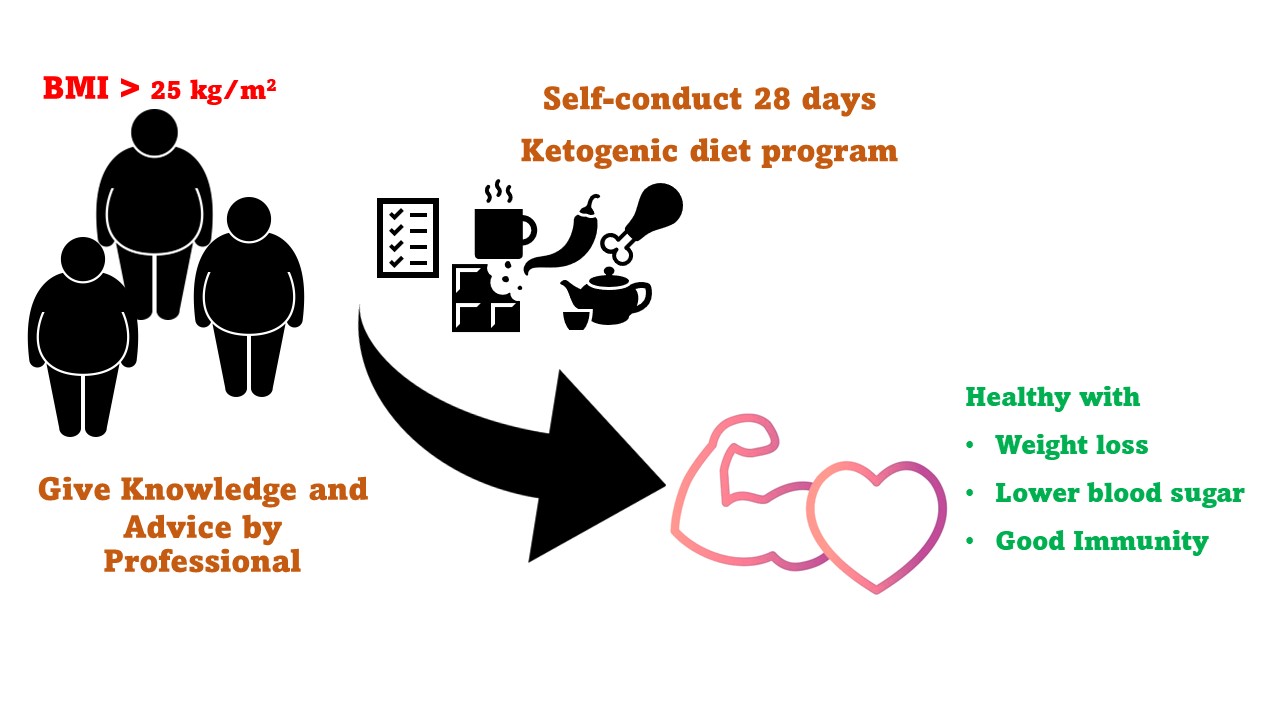
Downloads
References
A Ruban, K Stoenchev, H Ashrafian and J Teare. Current treatments for obesity. Clin. Med. 2019; 19, 205-12.
T Omer. The causes of obesity: An in-depth review. Adv. Obes. Weight Manag. Contr. 2020; 10, 90-4.
M Safaei, EA Sundararajan, M Driss, W Boulila and A Shapi'i. A systematic literature review on obesity: Understanding the causes & consequences of obesity and reviewing various machine learning approaches used to predict obesity. Comput. Biol. Med. 2021; 136, 104754.
J Cawley, A Biener, C Meyerhoefer, Y Ding, T Zvenyach, BG Smolarz and A Ramasamy. Direct medical costs of obesity in the united states and the most populous states. J. Manag. Care Specialty Pharm. 2021; 27, 354-66.
E Bellini, MP Grieco and E Raposio. A journey through liposuction and liposculture: Review. Ann. Med. Surg. 2017; 24, 53-60.
GA Bray, WE Heisel, A Afshin, MD Jensen, WH Dietz, M Long, RF Kushner, SR Daniels, TA Wadden, AG Tsai, FB Hu, JM Jakicic, DH Ryan, BM Wolfe and TH Inge.The science of obesity management: An endocrine society scientific statement. Endocr. Rev. 2018; 39, 79-132.
T Okawa, M Nagai and K Hase. Dietary intervention impacts immune cell functions and dynamics by inducing metabolic rewiring. Front. Immunol. 2020; 11, 623989.
O Robert, G Brian and RU Kalyan. Low carbohydrate diet. Olympia, 2021.
J Moini, R Ahangari, C Miller and M Samsam. Chapter 17 - obesity therapy. Global Health Complications Obes. 2020; 2020, 387-410.
A Ellerbroek. The effect of ketogenic diets on the gut microbiota. J. Exerc. Nutr. 2018; 1, 1-5.
N Kentaro, T Hidekazu, S Akina and A Kinya. A ketogenic formula prevents tumor progression and cancer cachexia by attenuating systemic inflammation in colon 26 tumor-bearing mice. Nutrients 2018; 10, 206.
C Moreno, M Poplawski, J Mastaitis and C Mobbs. Mechanisms by which the ketogenic diet reverses obesity and diabetes. Endocrinol. Metabol. Int. J. 2017; 4, 157-63.
DN Ruskin, MI Murphy, SL Slade and SA Masino. Ketogenic diet improves behaviors in a maternal immune activation model of autism spectrum disorder. PLoS One 2017; 12, e0171643.
C Kosinski and FR Jornayvaz. Effects of ketogenic diets on cardiovascular risk factors: Evidence from animal and human studies. Nutrients 2017; 9, 517.
KW Barañano and AL Hartman. The ketogenic diet: Uses in epilepsy and other neurologic illnesses. Curr. Treat. Options Neurol. 2008; 10, 410-9.
ML Tsai, KM Chou, CK Chang and SH Fang. Changes of mucosal immunity and antioxidation activity in elite male taiwanese taekwondo athletes associated with intensive training and rapid weight loss. Br. J. Sports. Med. 2011; 45, 729-34.
M Bock, M Karber and H Kuhn. Ketogenic diets attenuate cyclooxygenase and lipoxygenase gene expression in multiple sclerosis. EBioMedicine 2018; 36, 293-303.
EL Goldberg, JL Asher, RD Molony, AC Shaw, CJ Zeiss, C Wang, LA Morozova-Roche, RI Herzog, A Iwasaki and VD Dixit. β-hydroxybutyrate deactivates neutrophil NLRP3 inflammasome to relieve gout flares. Cell Rep. 2017; 18, 2077-87.
L Soldati, L Di Renzo, E Jirillo, PA Ascierto, FM Marincola and AD Lorenzo. The influence of diet on anti-cancer immune responsiveness. J. Translational Med. 2018; 16, 75.
A Böyum. Isolation of mononuclear cells and granulocytes from human blood. Isolation of monuclear cells by one centrifugation, and of granulocytes by combining centrifugation and sedimentation at 1 g. Scand. J. clin. Lab. Investig. Suppl. 1968; 97, 77-89.
R Hyun-seung and C Su-Youn. The effect of weight loss by ketogenic diet on the body composition, performance-related physical fitness factors and cytokines of taekwondo athletes. J. Exerc. Rehabil. 2014; 10, 326-31.
S Fedorovich, P Voronina and T Waseem. Ketogenic diet versus ketoacidosis: What determines the influence of ketone bodies on neurons? Neural Regen. Res. 2018; 13, 2060-3.
R Diana and D Atmaka. Ketogenic diet for weight loss and its implication on health: A literature study. Media Gizi Indonesia 2020; 15, 184.
SL Kesl, AM Poff, NP Ward, TN Fiorelli, C Ari, AJV Putten, JW Sherwood, P Arnold and DPD Agostino. Effects of exogenous ketone supplementation on blood ketone, glucose, triglyceride, and lipoprotein levels in sprague-dawley rats. Nutr. Metabol. 2016; 13, 9.
E Berry-Kravis, G Booth, A Taylor and L Valentino. Bruising and the ketogenic diet: Evidence for diet-induced changes in platelet function. Ann. Neurol. 2001; 49, 98-103.
HS Noh, DW Kim, GJ Cho, WS Choi and SS Kang. Increased nitric oxide caused by the ketogenic diet reduces the onset time of kainic acid-induced seizures in icr mice. Brain Res. 2006; 1075, 193-200.
S Hirschberger, G Strauss, D Effinger, X Marstaller, A Ferstl, MB Müller, T Wu, M Hübner, T Rahmel, H Mascolo, N Exner, J Hess, FW Kreth, K Unger and S Kreth. Very-low-carbohydrate diet enhances human t-cell immunity through immunometabolic reprogramming. EMBO Mol. Med. 2021; 13, e14323.
Downloads
Published
How to Cite
Issue
Section
License
Copyright (c) 2022 Walailak University

This work is licensed under a Creative Commons Attribution-NonCommercial-NoDerivatives 4.0 International License.





