In Silico and In Vivo Evaluation of Topical Preparations of Red Betel Extract Nanoliposome (Piper Crocatum) for the Treatment of Cut Wounds in Mice
DOI:
https://doi.org/10.48048/tis.2027.14282Keywords:
Piper crocatum, Liposomes, Topical ointments, Incisions, Wound healingAbstract
This study aims to develop topical red betel extract (Piper crocatum) nanoliposomes as a wound-healing agent in mice (Mus musculus). An in-silico study demonstrated the potential of red betel compound to inhibit cyclooxygenase-2 and estrogen receptors, which modulate the inflammatory response. Furthermore, red betel ethanol extract was obtained by percolation using 70% ethanol, then formulated into liposomes through thi-layer hydration with phospholipids, cholesterol, and phosphate buffer (pH 7.4). Red betel extract liposomes ointment (LPC) was prepared at concentration of 6%, 9%, and 12% using a lanolin-petroleum base. Physical evaluation included organoleptic, pH, dispersibility, viscosity, and stability test during 28 days of storage. In vivo tests were performed on male mice with 1×1 cm stab wounds, which received topical treatment once daily for 14 days. The evaluation results showed that all ointments had a stable semi-solid texture, a pH within the skinʼs normal range (4.5 - 6.5), and spreadability in the ideal range (5 - 7 cm). The liposome formula demonstrated physical stability without a rancid odor and exhibited emollient-occlusive properties. Increasing liposome levels affected the color of the preparation and enhanced anti-inflammatory activity by modulating inflammatory mediators and reducing oxidative stress. From the test results, LPC9 showed the best physical stability, while LPC12 showed the most optimal wound-healing effects and blood profile improvement. Thus, topical preparations of red betel extract nanoliposome have the potential to be developed as phytopharmaceutical agents for the treatment of incision wounds.
HIGHLIGHTS
- Piper crocatum nanoliposomes were formulated into a stable topical ointment with favorable physicochemical properties and stability.
- In vivo evaluations showed higher liposome concentrations improved anti-inflammatory and antioxidant activity, accelerating wound healing.
- LPC12 had the best wound-healing effect, while LPC9 was the most physically stable, showing strong potential as a phytopharmaceutical wound therapy.
GRAPHICAL ABSTRACT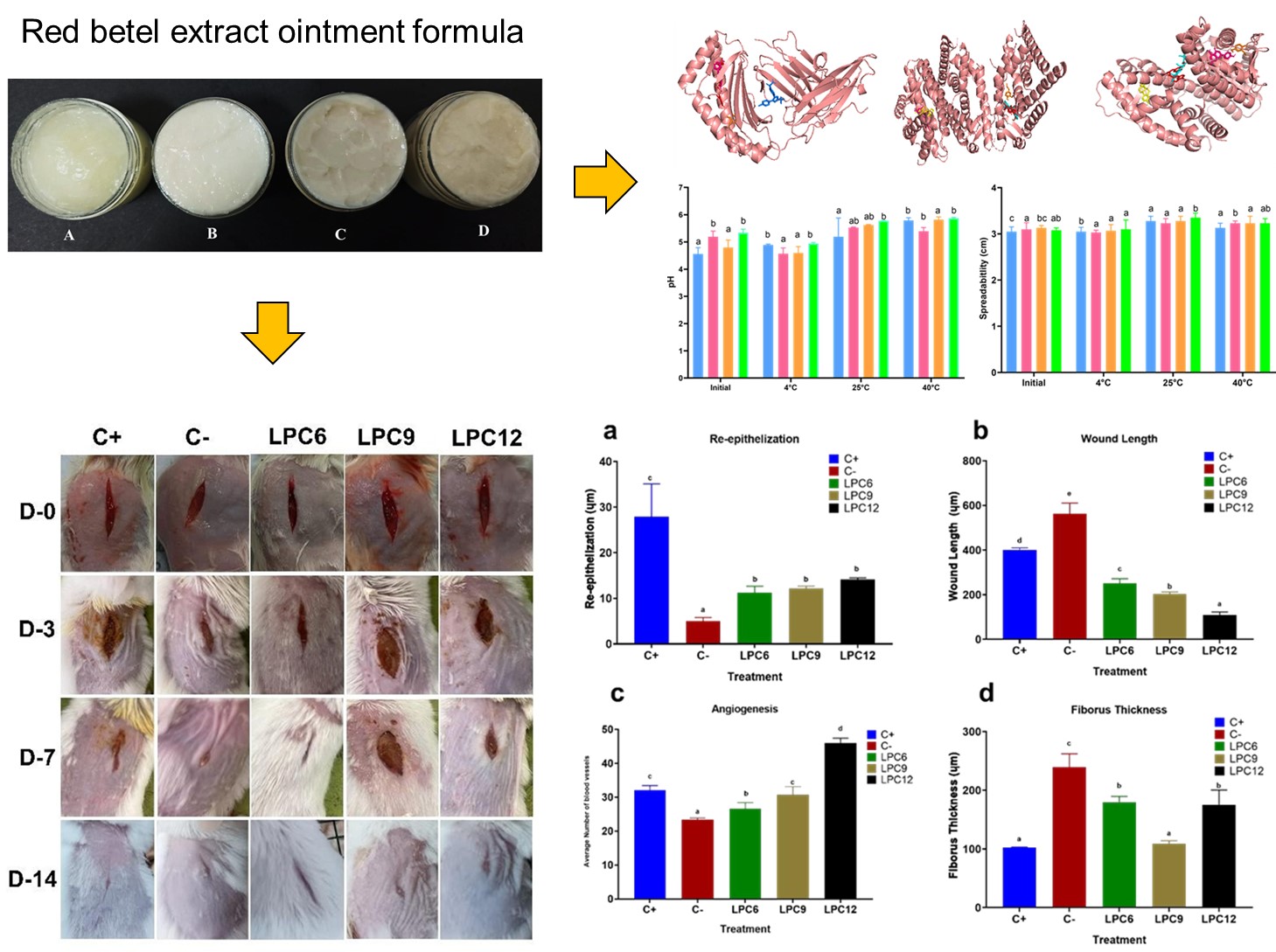
Downloads
References
Naziyah, R Hidayat and Maulidya. Penyuluhan manajemen luka terkini dalam situasi pandemic Covid -19 melalui kegiatan pesantren luka dengan menggunakan media zoom meeting bagi mahasiswa prodi keperawatan & profesi ners fakultas ilmu kesehatan Universitas Nasional Jakarta. Jurnal Kreativitas Pengabdian Kepada Masyarakat (PKM) 2022; 5(7), 2061-2070.
MN Djuddawi and ANH Kholidha. Test effectiveness of genegrass (Cymbopogon citratus) against the healing of wounds in white mice. Journal of Professional Care Research 2019; 5(1), 13-21.
M Al-Musawi, SH Turki, H Al-Naymi, SS Al-Salman, VV Boroujeni, M Alizadeh, M Sattar, F Sharifianjazi, L Bazli, AMD Pajooh, M Shahriari-Khalaji, A Najafinezhad, FM Moghadam, M Mirhaj and M Tavakoli. Localized delivery of healing stimulator medicines for enhanced wound treatment. Journal of Drug Delivery Science and Technology 2024; 101, 106212.
W Wang, KJ Lu, CH Yu, QL Huang and Y Du. Nano-drug delivery systems in wound treatment and skin regeneration. Journal of Nanobiotechnology 2019; 17, 82.
DL Gbian and A Omri. Lipid-based drug delivery systems for disease managements. Biomedicines 2022; 10(9), 2137.
S Hallaj-Nezhadi and M Hassan. Nanoliposome-based antibacterial drug delivery. Drug Delivery 2015; 22(5), 581-589.
E Wardani and RA Rachmania. Activity test of ethanol extract and ethyl acetate extract of red betel leaf (Piper cf. fragile) on the healing of open wounds in rats. Pharmaceutical Media: Journal of Pharmaceutical Sciences 2017; 14(1), 43.
F Ulviani, Y Yusriadi and K Khaerati. Effect of red betel leaf extract gel (Piper crocatum Ruiz & Pav) on burn healing in rabbits (Oryctolagus cuniculus). Galenika Journal of Pharmacy 2016; 2(2), 103-110.
Febriyenti, DP Putra, EI Wicaksanti and CD Hamami. Formulasi liposom ekstrak terpurifikasi centella asiatica menggunakan fosfatidilkolin dan kolesterol. Jurnal Sains Farmasi & Klinis 2018; 5(2), 78-82.
Amrianto, Mukarramah, DD Sukmana, N Nahda and AD Permana. Formulasi ekstrak buah mengkudu (Morinda citrifolia) dalam bentuk sediaan transdermal liposome cream. Proceedings of the National Seminar on Biology for Life Gowa 2017; 3(1), 19-25.
AD Rizkita, E Cahyono and S Mursiti. Isolasi dan uji antibakteri minyak daun sirih hijau dan merah terhadap Streptococcus mutans. Indonesian Journal of Chemical Science 2017; 6(3), 279-286.
P Barazesh, H Hajihassani, F Motalebi, SMH Neiresi, R Hajihassani and AR Mehrabian. Unlocking the healing potential: A comprehensive review of ecology and biology of medical-grade honey in wound management and tissue regeneration. Health Science Reports 2025; 8, e70240.
RAZ Aziz and ER Purnama. In silico analysis of the potential of red betel (Piper crocatum) active compounds as anti-inflammatory drug candidate. Journal of Universitas Negeri Surabaya 2024; 13(3), 382-392.
SI Maslikah and WE Putra. Molecular dynamics simulation of various bioactive compounds of red betel (Piper crocatum) as anti-inflammatory drug-like candidates in rheumatoid arthritis treatment. Trends in Sciences 2024; 21(3), 7334.
AB Umar, A Uzairu, GA Shallangwa and S Uba. In silico evaluation of some 4-(quinolin-2-yl)pyrimidin-2-amine derivatives as potent V600E-BRAF inhibitors with pharmacokinetics, ADMET, and drug-likeness predictions. Future Journal of Pharmaceutical Sciences 2020; 6, 61.
HTT Trang, NX Ha, CH Le, TTT Nhung, DTT Giang, NTD Hang and PT Thuy. In silico molecular docking, DFT, and toxicity studies of potential inhibitors derived from Millettia dielsiana against human inducible nitric oxide synthase. Journal of Chemical Research 2024. https://doi.org/10.1177/17475198241263837
FB Lopes, MM Sarandy, RD Novaes, G Valacchi and RV Gonçalves. OxInflammatory responses in the wound healing process: A systematic review. Antioxidants 2024; 13(7), 823.
MM Guardado, V Lutz, M Hengstschläger and H Dolznig. The role of prostaglandins as major inflammatory mediators in colorectal cancer. International Journal of Molecular Sciences 2025; 26(24), 12191.
F Akbari, M Azadbakht, A Bagheri and L Vahedi. In silico, in vitro, and in vivo wound healing activity of Astragalus microcephalus willd. Advances in Pharmacological and Pharmaceutical Sciences 2022; 2022, 2156629.
MI Ahamed, SI Mim and MMI Emu. In silico functional annotation of E2102 hypothetical protein from Aeromonas veronii. Genetics of Aquatic Organisms 2025; 9(2), GA884.
W Masocha and MA Khedr. Correlation between in silico docking/simulation results and in vitro MAGL inhibition potency of selected triterpenes. Current Issues in Molecular Biology 2025; 47(9), 691.
Fatimawali, MJ Kalalo, SB Simanjuntak, TA Hebber, BJ Kepel and TE Tallei. Immunomodulatory potential of bioactive compounds of betel leaf extract targeting COVID-19 immunological human host proteins: An in silico study. Journal of Applied Pharmaceutical Science 2022; 12(2), 75-88.
M Khalil. Simulasi Molecular docking senyawa coumestrol dengan protein kapsid virus hepatitis B: Studi in silico potensi senyawa alami. Jurnal Jeumpa 2023; 10(1), 138-148.
K Gabriel, NN Hidayat, FA Khaerani and PE Gaharani. Studi in silico senyawa metabolit sekunder daun kenikir (Cosmos Caudatus Kunth.) sebagai antikanker ovarium terhadap ESR-1. Indonesian Journal of Mathematics and Natural Sciences 2024; 47(2), 85-98.
SR Rena, Nurhidayah and Rustan. Analisis molecular docking senyawa Garcinia mangostana L. sebagai kandidat anti SARS-CoV-2. Jurnal Fisika Unand 2022; 11(1), 82-88.
KA Nofianti, L Hakim, Suzana and F Ifadotunikamah. Prediction of the potential of benzoxazinone, 2-phenyl-4H-benzo[1,3]oxazin-4-one, and 2-[2-(4-methoxyphenyl)vinyl]-3,1-benzoxazin-4-one as new anti-tuberculosis agents. Berkala Ilmiah Kimia Farmasi 2024; 11(1), 26-32.
ASH Hoseini, A Mohebshahedin, S Ghiabi, M KhalatbariLimaki, M Arastonejad, S Hassani, M Alem and ER Basmenj. ADMET, QSAR and docking studies to predict the activity of tyrosinase-derived medication inhibitors based on computational techniques. Current Research in Structural Biology 2025; 10, 100174.
A Pramudiyawati, DE Putri, Nurfadilah and A Wilapangga. Skrining studi in silico potensi farmakokinetika dan toksisitas senyawa 6,10,14-trimetil-2-pentadekanon dari ekstrak daun ekaliptus. Indonesian Journal of Pharmaceutical Education 2024; 4(1), 39-46.
A Wilapangga, B Sutyono, T Permadi and ER Noordam. Potensi farmakokinetika dan toksisitas Benzyl β-D-Glucoside dari Piper crocatum: Studi in silico. Journal Syifa Sciences and Clinical Research 2024; 6(2), 173-180.
N Mukhopadhyay, A Shukla, PN Makhal and VR Kaki. Natural product-driven dual COX-LOX inhibitors: Overview of recent studies on the development of novel anti-inflammatory agents. Heliyon 2023; 9(3), e14569.
IM Comino-Sanz, MD López-Franco, B Castro and PL Pancorbo-Hidalgo. The role of antioxidants on wound healing: A review of the current evidence. Journal of Clinical Medicine 2021; 10(16), 3558.
CC Voda, IA Stefanopol, G Gurau, MA Hîncu, GV Popa, OG Mateescu, L Baroiu and MC Mehedinti. Update on the study of angiogenesis in surgical wounds in patients with childhood obesity. Biomedicines 2025; 13(2), 375.
SO Oselusi, NRS Sibuyi, DR Martin, M Meyer and AM Madiehe. Potential matrix metalloproteinase 2 and 9 inhibitors identified from Ehretia species for the treatment of chronic wounds: Computational drug discovery approaches. Computers in Biology and Medicine 2025; 185, 109487.
ZFK Al-Zubaidy and MT Naqi. The effect lanolin extract and vaseline with glycerine mixture to treatment by affecting of IL-4 and IL-13 level in induced eczema in rats. International Journal of Health Sciences 2022; 6, 1606-1612.
YC Cheng, TS Li, HL Su, PC Lee and HMD Wang. Transdermal delivery systems of natural products applied to skin therapy and care. Molecules 2020; 25(21), 5051.
L Farias, CB Pereira, G Machado, C Schmidt and AC de Vargas. Stability evaluation of propolis topical bases for veterinary use. Brazilian Archives of Biology and Technology 2013; 56(6), 942-947.
L Coderch, L Ricci, M Martí, S Bagherpour, L Pérez-García and C Alonso. Liposomal formulations for waterproofing mucosal membranes. European Journal of Pharmaceutics and Biopharmaceutics 2025; 213, 114757.
N Lely, Dachriyanus, Y Aldi, Almahdy and FS Wahyuni. Anti-inflammatory effect of isolate compounds from ethyl acetate fraction of Piper crocatum Ruiz and Pav leaves on lipopolysaccharide-induced RAW 264.7 cells. HAYATI Journal of Biosciences 2023; 30(1), 28-34.
NM Aisyiyah, KAAK Siregar and PM Kustiawan. Review: Potential of red betel leaves (Piper crocatum) as anti-inflammatory in Rheumatoid arthritis. Jurnal Farmasi Sains dan Praktis 2021; 7(2), 197-206.
P Ghosha, NK Brogdena and AL Stinchcomb. Effect of formulation pH on transport of naltrexone species and pore closure in microneedle-enhanced transdermal drug delivery. Molecular Pharmaceutics 2013; 10(6), 2331-2339.
S Megawati. Formulation and effectiveness of wound healing of methanol extract of Thevetia peruviana on New Zealand white male rabbits. Udayana Pharmacy Journal 2020; 9(3), 180.
JY Hernawan, H Kurniawan and AP Lestari. Stability test of salep extract white garlic (Alliumsativum) with vaselin album base. Journal Permata Indonesia 2020; 11(1), 11-15.
VH Damanik, L Pratiwi and B Wijianto. Formulasi NLC-Stick ekstrak bunga telang (Clitoria ternatea L.) dengan variasi konsentrasi shea butter dan asam stearat. Indonesian Journal of Pharmaceutical and Clinical Research 2024; 7(1), 16-21.
JS Buratto, CHDS Fernandes, JCG Rosa, ATDF Vanzo and JH Caviglione. Use of quantitative colorimetry and visual evaluation for color characterization of triticale seeds after phenol reaction. Journal of Seed Science 2021; 43, e202143008.
B Milovanovic, I Djekic, J Miocinovic, V Djordjevic, JM Lorenzo, FJ Barba, D Mörlein and I Tomasevic. What is the color of milk and dairy products and How is it Measured? Foods 2020; 9(11), 1629.
S Ropciuc, C Ghinea, A Leahu, AE Prisacaru, MA Oroian, LC Apostol and F Dranca. Development and characterization of new plant-based ice cream assortments using oleogels as fat source. Gels 2024; 10(6), 397.
I Maesaroh, D Pratiwi and L Agustin. Ointment formulation and test preparation from Manilkara zapota L. leaf extract using variation of ointment base as boils. Indonesian Journal of Pharmaceutics 2020; 2(1), 14-19.
MN Calienni, LM Martínez, MC Izquierdo, SDV Alonso and J Montanari. Rheological and viscoelastic analysis of hybrid formulations for topical application. Pharmaceutics 2023; 15(10), 2392.
M Piechota-Urbańska, J Kołodziejska and MM Zgoda. Viscosity of pharmacopeial multimolecular ointment vehicles and pharmaceutical availability of a model therapeutic agent. Polymers in Medicine 2007; 37(2), 3-19.
K Lis. Hypersensitivity to lanolin: An old–new problem. Life 2024; 14(12), 1553.
W Weyenberg, P Sollie and A Ludwig. Influence of the concentrations of liposomes and a submicron emulsion on the rheological properties of a topical gel. Pharmazie 2006; 61(11), 938-942.
KT Keylock, VJ Vieira, MA Wallig, LA DiPietro, M Schrementi and JA Woods. Exercise accelerates cutaneous wound healing and decreases wound inflammation in aged mice. American Journal of Physiology - Regulatory Integrative and Comparative Physiology 2008; 294(1), 179-184.
J Hajj, B Sizemore and K Singh. Impact of epigenetics, diet, and nutrition-related pathologies on wound healing. 2024; 25(19), 10474.
I Seth, B Lim, J Cevik, D Gracias, M Chua, PS Kenney, WM Rozen and R Cuomo. Impact of nutrition on skin wound healing and aesthetic outcomes: A comprehensive narrative review. JPRAS Open 2024; 39, 291-302.
SG G/Giorgis, D Ambikar, A Tsegaw and YM Belayneh. Wound healing activity of 80% methanolic crude extract and solvent fractions of the leaves of Justicia schimperiana (Hochst. ex Nees) T. Anderson (Acanthaceae) in mice. Journal of Experimental Pharmacology 2022; 14, 167-183.
R Mare, S Maurotti, Y Ferro, A Galluccio, F Arturi, S Romeo, A Procopio, V Musolino, V Mollace, T Montalcini and A Pujia. A rapid and cheap method for extracting and quantifying lycopene content in tomato sauces: Effects of lycopene micellar delivery on human osteoblast-like cells. Nutrients 2022; 14(3), 717.
S Hanbisa, WT Tadesse and T Abula. Evaluation of wound healing activity of 80% methanol stem-bark extract and solvent fractions of Prunus africana (Hook.f.) Kalkman (Rosaceae) in mice. Journal of Experimental Pharmacology 2023; 15, 349-365.
P Diaz, SC Jeong, S Lee, C Khoo and SR Koyyalamudi. Antioxidant and anti-inflammatory activities of selected medicinal plants and fungi containing phenolic and flavonoid compounds. Chinese Medicine 2012; 7, 26.
AK Shrivastava, M Keshari, M Neupane, S Chaudhary, PK Dhakal, L Shrestha, A Palikhey, CK Yadav, G Lamichhane, MU Shekh and RK Yadav. Evaluation of antioxidant and anti-inflammatory activities, and metabolite profiling of selected medicinal plants of Nepal. Journal of Tropical Medicine 2023; 2023, 6641018.
N Zulkefli, CNMC Zahari, NH Sayuti, AA Kamarudin, N Saad, HS Hamezah, H Bunawan, SN Baharum, A Mediani, QU Ahmed, AEH Ismail and MN Sarian. Flavonoids as potential wound-healing molecules: Emphasis on pathways perspective. International Journal of Molecular Sciences 2023; 24(5), 4607.
JM Al-Khayri, GR Sahana, P Nagella, BV Joseph, FM Alessa and MQ Al-Mssallem. Flavonoids as potential anti-inflammatory molecules: A review. Molecules 2022; 27(9), 2901.
P Pandey, S Lakhanpa, D Mahmood, HN Kang, B Kim, S Kang, J Choi, M Choi, S Pandey, M Bhat, S Sharma, F Khan, MN Park and B Kim. An updated review summarizing the anticancer potential of flavonoids via targeting NF-kB pathway. Frontier in Pharmacology 2025; 15, 1513422.
A Sychrová, G Škovranová, M Čulenová and SB Fialová. Prenylated flavonoids in topical infections and wound healing. Molecules 2022; 27(14), 4491.
Y Gong, HX Li, RH Guo, W Widowati, YH Kim, SY Yang and YR Kim. Anti-allergic inflammatory components from the leaves of Piper crocatum Ruiz & Pav. Biological and Pharmaceutical Bulletin 2021; 44(2), 245-250.
M Cedillo-Cortezano, LR Martinez-Cuevas, JAM López, ILB López, S Escutia-Perez and VL Petricevich. Use of medicinal plants in the process of wound healing: A literature review. Pharmaceuticals 2024; 17(3), 303.
L Sercombe, T Veerati, F Moheimani, SY Wu, AK Sood and S Hua. Advances and challenges of liposome assisted drug delivery. Frontiers in Pharmacology 2015; 6, 00286.
INE Lister, CN Ginting, E Girsang, A Armansyah, HH Marpaung, APF Sinaga, RAS Handayani and R Rizal. Antioxidant properties of red betel (Piper crocatum) leaf extract and its compounds. Journal of Natural Remedies 2019; 19(4), 198-205.
A Borges, MLM Calvo, JA Vaz and RC Calhelha. Enhancing wound healing: A comprehensive review of sericin and Chelidonium majus L. as potential dressings. Materials 2024; 17(17), 4199.
SA Eming, T Krieg and JM Davidson. Inflammation in wound repair: Molecular and cellular mechanisms. Journal of Investigative Dermatology 2007; 127(3), 514-525.
J Irma, AS Kartasasmita, A Kartiwa, I Irfani, SA Rizki and S Onasis. From growth factors to structure: PDGF and TGF-β in granulation tissue formation: A literature review. Journal of Cellular and Molecular Medicine 2025; 29(11), e70374.
SA Eming, P Martin and M Tomic-Canic. Wound repair and regeneration: Mechanisms, signaling, and translation. Science Translational Medicine 2016; 6(265), 265sr6.
YA Prakoso, N Hidayah, CS Rini and Kurniasih. Dynamic change of blood profile in rat models with acute skin injury artificially infected with methicillin-resistant Staphylococcus aureus. Veterinary World 2021; 14(8), 2085-2090.
DR Laksmitawati, A Widyastuti, N Karami, E Afifah, DD Rihibiha, H Nufus and W Widowati. Anti-inflammatory effects of Anredera cordifolia and Piper crocatum extracts on lipopolysaccharide-stimulated macrophage cell line. Bangladesh Journal of Pharmacology 2017; 12, 35-40.
INE Lister, CN Ginting, E Girsang, ED Nataya, AM Azizah and W Widowati. Hepatoprotective properties of red betel (Piper crocatum Ruiz and Pav) leaves extract towards H₂O₂-induced HepG2 cells via anti-inflammatory, antinecrotic, antioxidant potency. Saudi Pharmaceutical Journal 2020; 28(10), 1182-1189.
M Rispandi, NS Harahap and R Mediyana. The potential of red betel leaf essential oil (Piper crocatum Ruiz & Pav) as an anti-bleeding in the management of coronavirus infection. NeuroQuantology 2023; 21(1), 381-387.
S Asgary, G Naderi and N Askari. Protective effect of flavonoids against red blood cell hemolysis by free radicals. Experimental and Clinical Cardiology 2005; 10(2), 88-90.
SI Maslikah, SR Lestari, S Siri, M Yunus, AR El-Baroroh, DS Miasih, M Rifa’i, Warsito and MS Djati. Phytochemical screening and antioxidant potential of ethanol extract from Piper crocatum leaves. Tropical Journal of Natural Product Research 2025; 9(7), 3114-3119.
S Singh, A Young and CE McNaught. The physiology of wound healing. Surgery 2017; 35(9), 473-477.
L Cañedo-Dorantes and M Cañedo-Ayala. Skin acute wound healing: A comprehensive review. International Journal of Inflammation 2019; 2019(1), 3706315.
RA El‑Shiekh, MH Radi, R Elshimy, E Abdel‑Sattar, AM El‑Halawany, MA Ibrahim, ME Ali and EI Hassanen. Friedelin: A natural compound exhibited potent antibacterial, anti-inflammatory, and wound healing properties against MRSA-infected wounds. Naunyn-Schmiedeberg’s Archives of Pharmacology 2025; 398(9), 12103-12113.
Downloads
Published
How to Cite
Issue
Section
License
Copyright (c) 2026 Walailak University

This work is licensed under a Creative Commons Attribution-NonCommercial-NoDerivatives 4.0 International License.