
Fish Protein Hydrolysate from Lemuru (Sardinella lemuru) Scales as a Food Protein: Isolation, Characterization, Antibacterial and Antioxidant Activities
DOI:
https://doi.org/10.48048/tis.2026.11615Keywords:
Antibacterial, Antioxidant, Biopeptide, Enzymatic bioprocess, Fish protein hydrolysate, Lemuru fish scalesAbstract
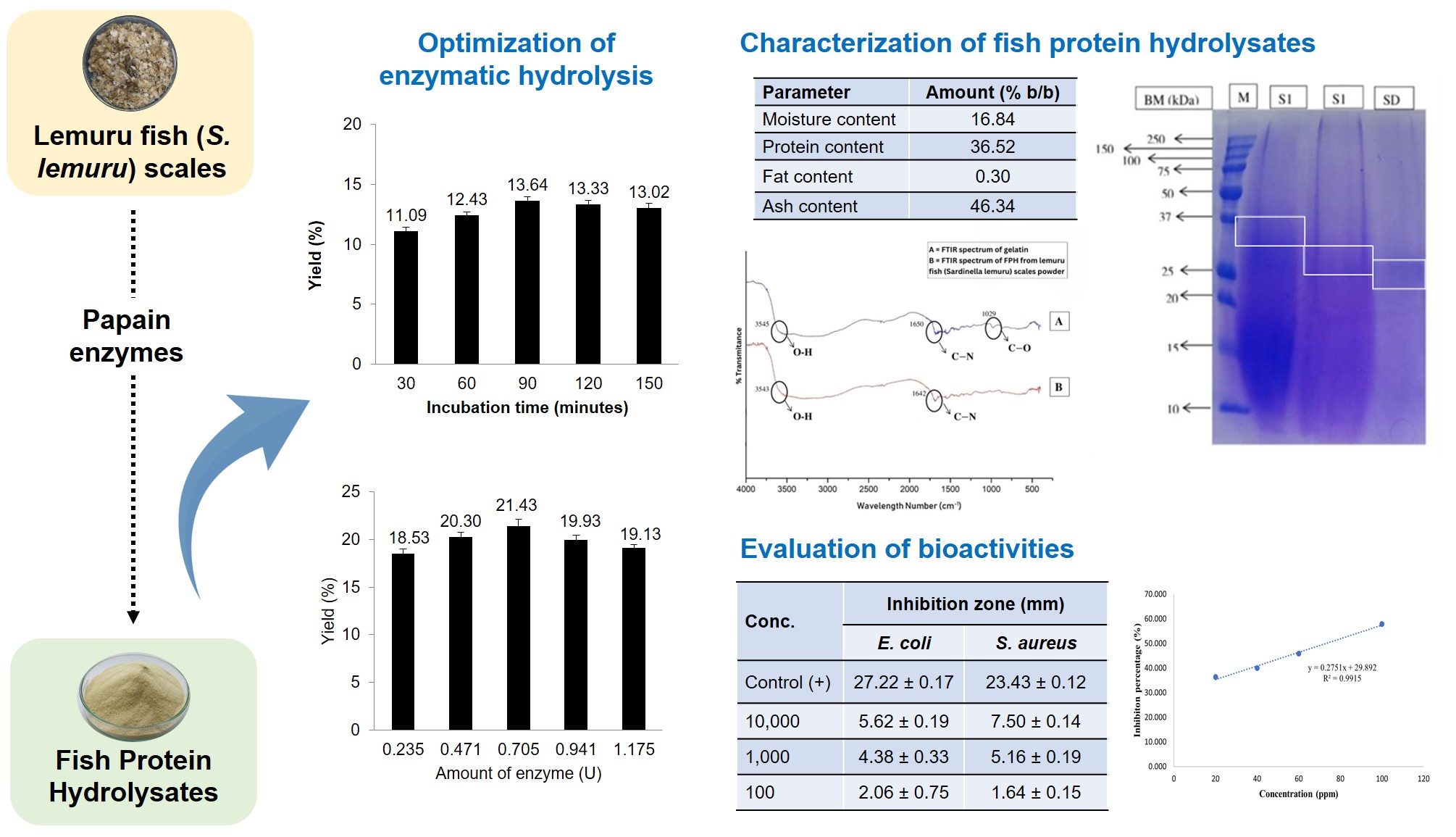
Fish protein hydrolysates (FPHs) have attracted significant interest owing to their robust nutritional composition, including glutamic acid, aspartic acid, leucine, lysine, and valine. The scales of lemuru (Sardinella lemuru) are currently underutilized. Therefore, in this research, FPHs from lemuru scales were produced by using papain through various stages including pretreatment of fish scales waste; optimization enzymatically of the FPHs production from waste scales of lemuru fish using papain includes the incubation time and the quantity of papain; characterization includes proximate analysis, FTIR, and SDS-PAGE; and determination of FPHs antibacterial and antioxidant activities. The results showed that the optimum FPHs production at 90 min incubation time with 0.705 U papain produced FPHs as much as 21.43%, with the molecular weight achieved less than 37 kDa. The proximate analysis of the prepared FPHs showed moisture, protein, fat and ash content of 16.85, 36.52, 0.298 and 46.34%, respectively. FTIR results showed that identical hydroxyl, carbonyl, and amide functional groups indicated the presence of peptide bonds. These findings suggest the complete enzymatic hydrolysis, and at the same time the presence of the functional groups supporting the bioactivity potencies of the hydrolysates which are involved in antibacterial and antioxidant activities. Interestingly, FPHs from lemuru scales with a concentration of 10,000 ppm could inhibit the growth of Escherichia coli bacteria indicating clear zone as much as 5.62 ± 0.19 mm and Staphylococcus aureus bacteria was 7.50 ± 0.14 mm. The IC50 value for inhibiting DPPH free radical oxidation was 60.441 µg/mL for the FPHs of lemuru scales powder. Thus, in conclusion, the FPHs from the lemuru scales has the potential to be developed as a raw material for food protein with antibacterial and antioxidant activities.
HIGHLIGHTS
- FPHs were successfully produced from lemuru ( lemuru) scales using papain, achieving an optimal yield (21.43%) at 90 min of incubation and 0.705 U of papain enzyme.
- Proximate analysis showed high protein content (36.52%) and the presence of key functional groups (hydroxyl, carbonyl, amide) was confirmed by FTIR, supporting the potential use of lemuru scale-derived FPHs as a functional food ingredient.
- The resulting FPHs demonstrated antibacterial activity against coli (5.62 mm inhibition zone) and S. aureus (7.50 mm), and antioxidant activity with an IC50 of 60.441 µg/mL for DPPH radical inhibition.
GRAPHICAL ABSTRACT
Downloads
References
Y Dinakarkumar, S Krishnamoorthy, G Margavelu, G Ramakrishnan and M Chandran. Production and characterization of fish protein hydrolysate: Effective utilization of trawl by-catch. Food Chemistry Advances 2022; 1, 100138.
A Honrado, M Miguel, P Ardila, JA Beltrán and JB Calanche. From waste to value: Fish protein hydrolysates as a technological and functional ingredient in human nutrition. Foods 2024; 13(19), 3120.
A Das, Y Nayak and S Dash. Fish protein hydrolysate production, treatment methods and current potential uses: A review. International Journal of Fisheries and Aquatic Studies 2021; 9(2), 195-200.
Y Hou, Z Wu, Z Dai, G Wang and G Wu. Protein hydrolysates in animal nutrition: Industrial production, bioactive peptides, and functional significance. Journal of Animal Science and Biotechnology 2017; 8, 24.
H Domínguez, B Iñarra, J Labidi, D Mendiola and C Bald. Comparison of amino acid release between enzymatic hydrolysis and acid autolysis of rainbow trout viscera. Heliyon 2024; 10(5), e27030.
JM Kim and KY Yoon. Functional properties and biological activities of perilla seed meal protein hydrolysates obtained by using different proteolytic enzymes. Food Science and Biotechnology 2020; 29(11), 1553-1562.
H Hariyati, M Mahendradatta, AB Tawali and J Langkong. Enzymatic hydrolysis of proteins from snakehead-fish (Channa striata). In: Proceedings of the 1st International Scientific Meeting on Engineering and its Vocational Education, Makassar, Indonesia. 2020, p. 12015.
R Karnila, Dewita, D Ilham and SW Sidauruk. Utilization of papain enzymes in the production of protein hydrolysates of yellow pike conger (Congresox talabon). AACL Bioflux 2020; 13(3), 1285-1291.
S Priatni, K Harimadi, E Buana, W Kosasih and R Rohmatussolihat. Production and characterization of spray-dried swamp eel (Monopterus albus) protein hydrolysate prepared by papain. Sains Malaysiana 2020; 49(3), 545-552.
I Wijayanti, Romadhon and L Rianingsih. Karakteristik hidrolisat protein ikan bandeng (Chanos chanos Forsk) dengan konsentrasi enzim bromelin yang berbeda (in Indonesian). Indonesian Journal of Fisheries Science and Technology 2016; 11(2), 129-133.
E Susanti, GA Wulansari, NA Arief and N Salim. Optimization and characterization of fish protein hydrolysate (FPH) from milkfish scales (Chanos chanos Forsskal) using papain enzyme. Journal of Bioprocessing and Biomass Technology 2023; 2(2), 55-62.
VG Tacias-Pascacio, D Castañeda-Valbuena, R Morellon-Sterling, O Tavano, Á Berenguer-Murcia, G Vela-Gutiérrez, IA Rather and R Fernandez-Lafuente. Bioactive peptides from fisheries residues: A review of use of papain in proteolysis reactions. International Journal of Biological Macromolecules 2021; 184, 415-428.
H Mahrus, A Syukur and L Zulkifli. Lemuru fish (Sardinella lemuru), rich in nutrients, has the potential as a medicine and health product: Review. AIP Conference Proceedings 2023; 2956, 040005.
RP Aditia, D Desniar and W Trilaksani. Aktivitas antioksidan dan antibakteri hidrolisat protein hasil fermentasi telur ikan cakalang (in Indonesian). Jurnal Pengolahan Hasil Perikanan Indonesia 2018; 21(1), 1-12.
D Liu, G Wei, T Li, J Hu, N Lu, JM Regenstein and P Zhou. Effects of alkaline pretreatments and acid extraction conditions on the acid-soluble collagen from grass carp (Ctenopharyngodon idella) skin. Food Chemistry 2015; 172, 836-843.
D Ulfah, GAR Thamrin and TW Natanael. Pengaruh waktu penyadapan dan umur tanaman karet terhadap produksi getah (Lateks) (in Indonesian). Jurnal Hutan Tropis 2015; 3(3), 247-252.
OH Lowry. Micromethods for the assay of enzymes. Methods in Enzymology 1957; 4, 366-381.
J Jelita, B Wirjosentono, T Tamrin and L Marpaung. Characterization of gelatin from scapula (Os scapula) from Aceh cattle. AIP Conference Proceedings 2018; 2049, 20072.
LS Nurhayati, N Yahdiyani and A Hidayatulloh. Perbandingan pengujian aktivitas antibakteri starter yogurt dengan metode difusi sumuran dan metode difusi cakram (in Indonesian). Jurnal Teknologi Hasil Peternakan 2020; 1(2), 41-46.
S Baliyan, R Mukherjee, A Priyadarshini, A Vibhuti, A Gupta, RP Pandey and CM Chang. Determination of antioxidants by DPPH radical scavenging activity and quantitative phytochemical analysis of Ficus religiosa. Molecules 2022; 27(4), 1326.
MH Pulungan, MM Kamilia and IA Dewi. Optimasi konsentrasi enzim papain dan suhu pemanasan pada pembuatan dangke dengan response surface method (RSM) (in Indonesian). Jurnal Teknologi Pertanian 2020; 21(1), 57-68.
E Salamah, T Nurhayati and IR Widadi. Pembuatan dan karakterisasi hidrolisat protein dari ikan lele dumbo (Clarias gariepinus) menggunakan enzim papain (in Indonesian). Jurnal Pengolahan Hasil Perikanan Indonesia 2012; 15(1), 9-16.
B Nurhidayah, E Soekendarsi and AE Erviani. Kandungan kolagen sisik ikan bandeng (Chanos-chanos) dan sisik ikan nila (Oreochromis niloticus) (in Indonesian). Bioma: Jurnal Biologi Makassar 2019; 4(1), 39-47.
S Maryam, N Effendi and Kasmah. Produksi dan karakterisasi gelatin dari limbah tulang ayam dengan menggunakan spektrofotometer FTIR (Fourier Transform Infra Red) (in Indonesian). Majalah Farmaseutik 2019; 15(2), 96-104.
V Niraputri, Romadhon and S Suharto. Pengaruh lama perendaman asam klorida terhadap kekuatan gel gelatin teripang hitam (Holothuria leucospilota) (in Indonesian). PENA Akuatika 2021; 20(1), 17-31.
GS Al-Saidi, A Al-Alawi, MS Rahman and N Guizani. Fourier transform infrared (FTIR) spectroscopic study of extracted gelatin from shaari (Lithrinus microdon) skin: Effects of extraction conditions. International Food Research Journal 2012; 19(3), 1167-1173.
A Baehaki, SD Lestari and AR Romadhoni. Hidrolisis protein ikan patin menggunakan enzim papain dan aktivitas antioksidan hidrolisatnya (in Indonesian). Pengolahan Hasil Perikanan Indonesia 2015; 18(3), 230-239.
I Jemil, M Jridi, R Nasri, N Ktari, RBSB Salem, M Mehiri, M Hajji and M Nasri. Functional, antioxidant and antibacterial properties of protein hydrolysates prepared from fish meat fermented by Bacillus subtilis A26. Process Biochemistry 2014; 49(6), 963-972.
SB Kedare and RP Singh. Genesis and development of DPPH method of antioxidant assay. Journal of Food Science and Technology 2011; 48(4), 412-422.
T Taslim and BW Efrianti. Uji daya larut kalsium oksalat dalam infus daun alpukat (in Indonesian). Jurnal Akademi Farmasi Prayoga 2016; 1(1), 19-28.
N Nurjanah, T Nurhayati, A Latifah and T Hidayat. Aktivitas antioksidan dan komponen bioaktif hidrolisat protein jeroan ikan kakap putih (Lates calcalifer) (in Indonesian). Indonesian Journal of Industrial Research 2021; 38(1), 70-78.
M Nurilmala, HH Hizbullah, E Karnia, E Kusumaningtyas and Y Ochiai. Characterization and antioxidant activity of collagen, gelatin, and the derived peptides from yellowfin tuna (Thunnus albacares) skin. Marine Drugs 2020; 18(2), 98.
N Azizah, Y Ochiai and M Nurilmala. Collagen peptides from Pangasius fish skin as antioxidants. In: Proceedings of the 4th EMBRIO International Symposium and the 7th International Symposium of East Asia Fisheries and Technologists Association, Bogor, Indonesia. 2019, p. 12055.
M Nemati, SR Shahosseini and P Ariaii. Review of fish protein hydrolysates: Production methods, antioxidant and antimicrobial activity and nanoencapsulation. Food Science and Biotechnology 2024; 33(8), 1789-1803.
L Liu, Y Wang, C Peng and J Wang. Optimization of the preparation of fish protein anti-obesity hydrolysates using response surface methodology. International Journal of Molecular Sciences 2013; 14(2), 3124-3139.
BSB Utomo, TD Suryanigrum and HR Harianto. Optimization of enzymatic hydrolysis of fish protein hydrolysate (FPH) processing from waste of catfish fillet production. Squalen Bulletin of Marine and Fisheries Postharvest and Biotechnology 2014; 9(3), 115-126.
JA Vázquez, I Rodríguez-Amado, CG Sotelo, N Sanz, RI Pérez-Martín and J Valcárcel. Production, characterization, and bioactivity of fish protein hydrolysates from aquaculture turbot (Scophthalmus maximus) wastes. Biomolecules 2020; 10(2), 310.
JM Joy, A Padmaprakashan, A Pradeep, PT Paul, RJ Mannuthy and S Mathew. A review on fish skin-derived gelatin: Elucidating the gelatin peptides-preparation, bioactivity, mechanistic insights, and strategies for stability improvement. Foods 2024; 13(17), 2793.
P Kittiphattanabawon, S Benjakul, W Visessanguan and F Shahidi. Comparative study on the characteristics of gelatin from the skins of brownbanded bamboo shark and blacktip shark as affected by extraction conditions. Food Hydrocolloids 2010; 24(2-3), 164-171.
TFM Moreira, OH Gonçalves, FV Leimann and RP Ribeiro. Fish protein hydrolysates: Bioactive properties, encapsulation and new technologies for enhancing peptides bioavailability. Current Pharmaceutical Design 2023; 29(11), 824-836.
X Liu, Q Hu, Y Shen, Y Wu, L Gao, X Xu and G Hao. Research progress on antioxidant peptides from fish by-products: Purification, identification, and structure-activity relationship. Metabolites 2024; 14(10), 561.
N Baco, SNH Oslan, R Shapawi, RAM Mohhtar, WNM Noordin and N Huda. Antibacterial activity of functional bioactive peptides derived from fish protein hydrolysate. In: Proceedings of the 3rd International Conference on Integrated Coastal Management and Marine Biotechnology, Bogor, Indonesia. 2021, p. 12019.
H Jenssen, P Hamill and REW Hancock. Peptide antimicrobial agents. Clinical Microbiology Reviews 2006; 19(3), 491-511.
HB Khaled, N Ktari, O Ghorbel-Bellaaj, M Jridi, I Lassoued and M Nasri. Composition, functional properties and in vitro antioxidant activity of protein hydrolysates prepared from sardinelle (Sardinella aurita) muscle. Journal of Food Science and Technology 2014; 51(4), 622-633.
S Meftah, K Meftah, M Drissi, I Radah, K Malous, A Amahrous, A Chahid, T Tamri, A Rayyad, B Darkaoul, S Hanine, O El-Hassan and L Bouyazza. Heavy metal polluted water: Effects and sustainable treatment solutions using bio-adsorbents aligned with the SDGs. Discover Sustainability 2025; 6(1), 137.
S Meftah, K Meftah, H Lamkhanter, T Mehdi, A Amahrouss, F Assadid, OE Hassan and L Bouyazza. The main types of derivatives of plant matter and agricultural waste used as bio-adsorbents for the removal of heavy metals and dyes: A review. Egyptian Journal of Chemistry 2024; 67(9), 185-207.
K Meftah, S Meftah, H lamkhanter, T Bouzid, Y Rezzak, S Touil and A Abid. Extraction and optimization of Austrocylindropuntia subulata powder as a novel green coagulant. Desalination and Water Treatment 2024; 318, 100339.
K Meftah, S Meftah, H lamkhanter, S Touil and A Abid. Study of Methylene Blue dye adsorption onto biochar derived from Austrocylindropuntia subulata plant. In: Proceedings of the 2nd Environment and Natural Resources: Challenges and Solutions, Khénifra, Morocco. 2024, p. 12006.
K Meftah, S Meftah, I Ballou, I Hamzaoui, J Fatihi, O Kharifi, H Lamkhanter, S Touil and A Abid. Storage post-harvest of Opuntia ficus-indica and its impact on the efficiency of bio-coagulants/flocculants extracted. Water and Environment Journal 2025; 39(2), 245-255.
S Meftah, K Meftah, OE Hassan and L Bouyazza. Eco-friendly adsorbents for the removal of heavy metals. Materials Internationals 2025; 7(1), 8.
K Meftah, S Meftah, H lamkhanter, I Hamzaoui, S Touil and A Abid. Green flocculant performance for wastewater treatment using cactus plant powder: A mini-review. Journal of Analytical Science and Applied Biotechnology 2023; 5(1), 29-34.
Published
How to Cite
Issue
Section
License
Copyright (c) 2025 Walailak University

This work is licensed under a Creative Commons Attribution-NonCommercial-NoDerivatives 4.0 International License.





