
Optimizing Transfersome Delivery of Single-Aged Garlic Extract: A Comparative Study of Characterization, Phytochemical Content, and Antibacterial Potency
DOI:
https://doi.org/10.48048/tis.2026.12818Keywords:
Transfersome, Single Aged Garlic, Characterization, Phytochemical Content, Antibacterial Potency, Antibacterial potency, Characterization, Phytochemical content, Single-aged garlic, TransfersomeAbstract
Skin infections remain a significant global health concern, particularly with the increasing prevalence of antibiotic-resistant pathogens. Single-aged garlic (SAG), a fermented form of Allium sativum, possesses enhanced antioxidant and antibacterial properties due to its enriched phenolic and flavonoid content. This study aimed to optimize and characterize the transfersome-based delivery system of SAG extract (T-SAG), and to evaluate its physicochemical properties, phytochemical content, antioxidant activity, and antibacterial potency. SAG was produced through controlled thermal incubation followed by microwave-assisted extraction, and subsequently formulated into transfersomes using the thin-film hydration method with phosphatidylcholine and sodium deoxycholate as an edge activator. The formulation was characterized in terms of particle size, polydispersity index (PDI), zeta potential, encapsulation efficiency, morphology, chemical compatibility, and storage stability. The optimized transfersome formulation exhibited nanosized vesicles (81.03 ± 0.47 nm) with a low PDI (0.14 ± 0.008), a zeta potential of −17.93 ± 0.31 mV, and high encapsulation efficiency (77.04 ± 6.62%). Transmission electron microscopy revealed well-defined spherical vesicles with uniform size distribution, while scanning electron microscopy confirmed smooth surface morphology and structural integrity. Fourier-transform infrared spectroscopy indicated no significant chemical interactions between SAG and lipid components, confirming successful encapsulation. Stability studies conducted over 28 days at 4 °C demonstrated minimal changes in particle size and zeta potential. Phytochemical analysis showed total phenolic and flavonoid contents of 62.19 ± 1.07 mg GAE/g and 63.15 ± 0.38 mg QE/g, respectively, accompanied by strong antioxidant activity (77.74 ± 2.88% DPPH inhibition). Antibacterial activity, evaluated using the Kirby-Bauer disk diffusion method against Escherichia coli, Staphylococcus aureus, and Pseudomonas aeruginosa, demonstrated notable inhibitory effects, particularly against E. coli (8.19 ± 1.34 mm), with chloramphenicol used as a positive control. These findings indicate that transfersome-based delivery enhances the stability and bioactivity of SAG extract, supporting its potential application as a natural topical antimicrobial formulation.
HIGHLIGHTS
- Optimized SAG transfersomes yielded uniform nanoscale vesicles.
- High encapsulation efficiency supported effective SAG loading.
- SAG phytochemicals enhanced antioxidant and antibacterial performance.
- Vesicle physicochemical stability was maintained over 28 days at 4 °C.
- SAG transfersomes exhibited significant inhibitory activity against coli.
GRAPHICAL ABSTRACT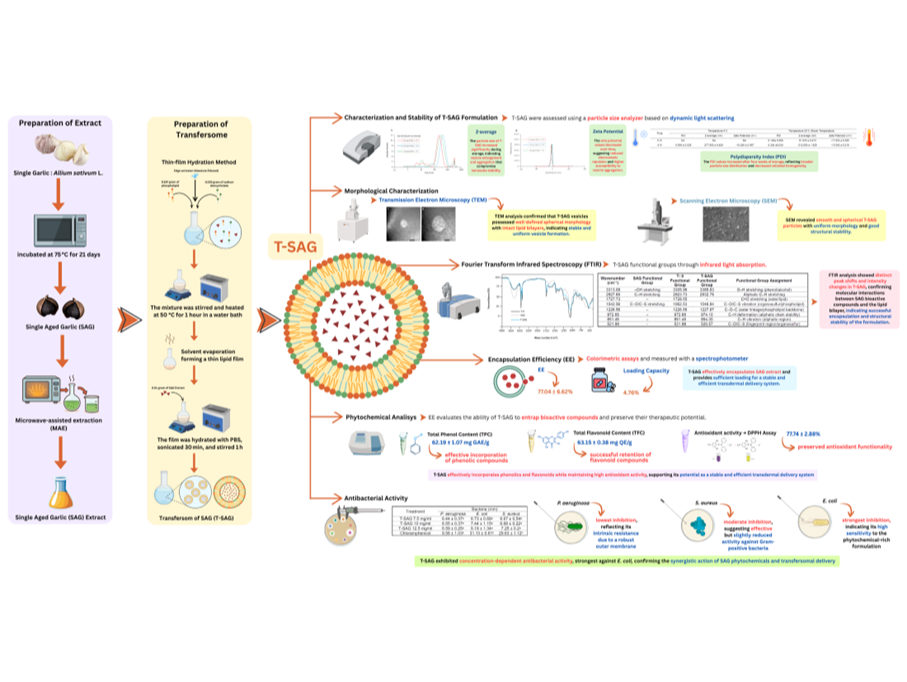
Downloads
References
V Singh, S Dharashivkar, M Gaikwad and S Shaikh. Development and evaluation of transferosomal gel using cephalexin. Research Square 2021. https://doi.org/10.21203/rs.3.rs-940323/v1
J Zakhour, SL Sharara, JR Hindy, SF Haddad and SS Kanj. Antimicrobial treatment of Pseudomonas aeruginosa severe sepsis. Antibiotics 2022; 11(10), 1-19.
CJL Murray, KS Ikuta, F Sharara, L Swetschinski, G Robles Aguilar, A Gray, C Han, C Bisignano, P Rao, E Wool, SC Johnson, AJ Browne, MG Chipeta, F Fell, S Hackett, G Haines-Woodhouse, BH Kashef Hamadani, EAP Kumaran, B McManigal, …, M Naghavi. Global burden of bacterial antimicrobial resistance in 2019: A systematic analysis. The Lancet 2022; 399(10325), 629-655.
T Astuti, PR Novitasari, R Tjandrawinata, AE Nugroho and S Pramono. Anti-diabetic effect of andrographolide from sambiloto herbs (Andrographis paniculata (Burm.f.) Nees) through the expression of PPARγ and GLUT-4 in adipocytes. Indonesian Journal of Biotechnology 2022; 27(4), 203-211.
GMC De Macedo, S Nunes and T Barreto. Skin disorders in diabetes mellitus: An epidemiology and physiopathology review. Diabetology & Metabolic Syndrome 2016; 8(1), 1-8.
VM Musyoki, W Mutai, N Ngugi, F Otieno and MM Masika. Speciation and antifungal susceptibility of Candida isolates from diabetic foot ulcer patients in a tertiary hospital in Kenya. Pan African Medical Journal 2022; 41(1), 34.
S Rasoulpoor, S Shohaimi, N Salari, A Vaisi-Raygani, S Rasoulpoor, S Shabani, R Jalali and M Mohammadi. Candida albicans skin infection in patients with type 2 diabetes: A systematic review and meta-analysis. Journal of Diabetes & Metabolic Disorders 2021; 20(1), 665-672.
M Falcone, JJ Meier, MG Marini, R Caccialanza, JM Aguado, S Del Prato and F Menichetti. Diabetes and acute bacterial skin and skin structure infections. Diabetes Research and Clinical Practice 2021; 174, 108732.
WT Chang, JL Lim and CL Hsu. Inhibitory effect of methanolic extract of black garlic on adipogenesis in 3T3-L1 adipocytes. Chung Shan Medical Journal 2018; 29(2), 113-121.
RCMR Nassur, EVB Vilas Boas and FV Resende. Black garlic: Transformation effects, characterization and consumer purchase intention. Comunicata Scientiae 2017; 8(3), 444-451.
P Sunanta, V Kontogiorgos, T Pankasemsuk, K Jantanasakulwong, P Rachtanapun, P Seesuriyachan and SR Sommano. The nutritional value, bioactive availability and functional properties of garlic and its related products during processing. Frontiers in Nutrition 2023; 10, 1142784.
SN Handayani, LC Bawono, DP Ayu and HN Pratiwi. Isolasi senyawa polifenol black garlic dan uji toksisitasnya terhadap larva udang (Artemia salina Leach). Jurnal Ilmu Kefarmasian Indonesia 2018; 16(2), 145-149.
S Roy, F Hussain and N Mazumder. Understanding the potential of black garlic as an antibacterial agent by quantifying volume scattering function. Discover Applied Sciences 2025; 7(4), 235.
LH Muharram, FN Syaputri, W Pertiwi and RF Saputri. Antibacterial activity of black garlic extract variations in aging time on prevention of skin dysbiosis causes acne. Jurnal Sains dan Kesehatan 2022; 4(2), 181-188.
NZ Darajat, A Chaerunisaa and M Abdassah. Transfersome as topical drug delivery: formulation and characterization. Jurnal Farmasi Galenika 2023; 9(1), 41-54.
AA Miatmoko, NA Marufah, Q Nada, N Rosita, T Erawati, J Susanto, KE Purwantari, A Nurkanto, Purwati and W Soeratri. The effect of surfactant type on characteristics, skin penetration and anti-aging effectiveness of transfersomes containing amniotic mesenchymal stem cells metabolite products in UV-aging induced mice. Drug Delivery 2022; 29(1), 3443-3453.
A Leonyza and S Surini. Optimization of sodium deoxycholate-based transfersomes for percutaneous delivery of peptides and proteins. International Journal of Applied Pharmaceutics 2019; 11(5), 329-332.
MI Khan, S Yaqoob, A Madni, MF Akhtar, MF Sohail, A Saleem, N Tahir, K Khan and OS Qureshi. Development and in vitro/ex vivo evaluation of lecithin-based deformable transfersomes and transfersome-based gels for combined dermal delivery of meloxicam and dexamethasone. BioMed Research International 2022; 2022(1), 8170318.
AC Khayrani, M Fahmi, RW Nurhayati, NHA Manas and M Suhaeri. Effect of freeze-thaw cycles method to transfersome characteristics for growth protein encapsulation. International Journal of Technology 2024; 15, 267-278.
A Wongrakpanich, J Leanpolchareanchai, B Morakul, W Parichatikanond and V Teeranachaideekul. Phyllanthus emblica extract-loaded transfersomes for hair follicle targeting: Phytoconstituents, characterization, and hair growth promotion. Journal of Oleo Science 2022; 71(7), 1085-1096.
W Wang, KJ Lu, CH Yu, QL Huang and YZ Du. Nano-drug delivery systems in wound treatment and skin regeneration. Journal of Nanobiotechnology 2019; 17(1), 82.
KS Avadhani, J Manikkath, M Tiwari, M Chandrasekhar, A Godavarthi, SM Vidya, RC Hariharapura, G Kalthur, N Udupa and S Mutalik. Skin delivery of epigallocatechin-3-gallate (EGCG) and hyaluronic acid loaded nano-transfersomes for antioxidant and anti-aging effects in UV radiation induced skin damage. Drug Delivery 2017; 24(1), 61-74.
HB Hmad, N Sellami, HB Jemaa and MM Lasram. Therapeutic and biological properties of white garlic and black garlic extracts (Allium sativum L.): A comparative analysis. Journal of Medicinal Food 2025; 28(8), 768-775.
MA Harun, S Buraena, EA Wello, HH Idrus and ASF Arsal. Antibacterial potency of black garlic extract from Allium sativum on Escherichia coli. Green Medical Journal 2021; 3(3), 124-131.
T Jiang, T Wang, T Li, Y Ma, S Shen, B He and R Mo. Enhanced transdermal drug delivery by transfersome-embedded oligopeptide hydrogel for topical chemotherapy of melanoma. ACS Nano 2018; 12(10), 9693-9701.
M Danaei, M Dehghankhold, S Ataei, FH Davarani, R Javanmard, A Dokhani, S Khorasani and MR Mozafari. Impact of particle size and polydispersity index on the clinical applications of lipidic nanocarrier systems. Pharmaceutics 2018; 10(2), 57.
I Iskandarsyah, AD Rahmi and DM Pangesti. Comparison of the characteristics of transfersomes and protransfersomes containing azelaic acid. Journal of Young Pharmacists 2018; 10(2), s11-s15.
U Varia, D Joshi, M Jadeja, H Katariya, K Detholia and V Soni. Development and evaluation of ultradeformable vesicles loaded transdermal film of boswellic acid. Future Journal of Pharmaceutical Sciences 2022; 8(1), 39.
SR Lestari, A Ghofur, SI Maslikah, Sunaryono, AN Rahma, DN Aisyah, IN Mufidah, ND Rifqi, N Prastita, DS Miasih and AR El Baroroh. Profiling of single garlic extract microencapsulation: Characterization, antioxidant activity, and release kinetic. Journal of Tropical Biodiversity and Biotechnology 2023; 8(3), jtbb79072.
SR Lestari, A Gofur, Hartatiek, Y Annisa, DN Ramadhani, AN Rahma, DN Aisyah, IN Mufidah and ND Rifqi. Characterization and in-vitro study of micro-encapsulation chitosan alginate of single-bulb garlic extract. Pharmaceutical Nanotechnology 2024; 12(2), 155-164.
D Praseptiangga, HL Zahara, PI Widjanarko, IM Joni and C Panatarani. Preparation and FTIR spectroscopic studies of SiO2-ZnO nanoparticles suspension for the development of carrageenan-based bio-nanocomposite film. AIP Conference Proceedings 2020; 2219(1), 100005.
M Tagrida, T Prodpran, B Zhang, RE Aluko and S Benjakul. Liposomes loaded with betel leaf (Piper betle L.) ethanolic extract prepared by thin film hydration and ethanol injection methods: characteristics and antioxidant activities. Journal of Food Biochemistry 2021; 45(12), e14012.
N Hadidi, M Saffari and M Faizi. Optimized transferosomal bovine lactoferrin (BLF) as a promising novel non-invasive topical treatment for genital warts caused by human papiluma virus (HPV). Iranian Journal of Pharmaceutical Research 2018; 17(SI 2), 12-23.
NNA Dewi and IW Mustika. Nutrition content and antioxidant activity of black garlic. International Journal of Health Sciences 2018; 2(1), 11-20.
Y Wasihun, HA Habteweld and KD Ayenew. Antibacterial activity and phytochemical components of leaf extract of Calpurnia aurea. Scientific Reports 2023; 13(1), 9767.
A Nasr, A Gardouh and M Ghorab. Novel solid self-nanoemulsifying drug delivery system (S-SNEDDS) for oral delivery of olmesartan medoxomil: Design, formulation, pharmacokinetic and bioavailability evaluation. Pharmaceutics 2016; 8(3), 20.
M Ghazwani, MH Alqarni, U Hani and A Alam. QbD-optimized, phospholipid-based elastic nanovesicles for the effective delivery of 6-gingerol: A promising topical option for pain-related disorders. International Journal of Molecular Sciences 2023; 24(12), 9983.
H Natsheh and E Touitou. Phospholipid vesicles for dermal/transdermal and nasal administration of active molecules: The effect of surfactants and alcohols on the fluidity of their lipid bilayers and penetration enhancement properties. Molecules 2020; 25(13), 2959.
BR Shah, C Zhang, Y Li and B Li. Bioaccessibility and antioxidant activity of curcumin after encapsulated by nano and Pickering emulsion based on chitosan-tripolyphosphate nanoparticles. Food Research International 2016; 89, 399-407.
A Altan, HB Yuce, Ő Karataş, MM Taşkan, F Gevrek, S Çolak and N Akbulut. Free and liposome form of gallic acid improves calvarial bone wound healing in Wistar rats. Asian Pacific Journal of Tropical Biomedicine 2020; 10(4), 156-163.
I Khan, R Needham, S Yousaf, C Houacine, Y Islam, R Bnyan, SK Sadozai, MA Elrayess and A Elhissi. Impact of phospholipids, surfactants and cholesterol selection on the performance of transfersomes vesicles using medical nebulizers for pulmonary drug delivery. Journal of Drug Delivery Science and Technology 2021; 66, 102822.
AN Rahma, DN Aisyah, Y Annisa, A Gofur, SI Maslikah and SR Lestari. Characterization and hemocompatibility assay of microencapsulation chitosan-alginate single garlic extract-loaded (MCA-SGE). BIO Web of Conferences 2024; 117, 01011.
DS Miasih, Y Annisa, SR Lestari, H Susanto and S Sunaryono. Novel self-nanoemulsifying drug delivery system of single bulb garlic: stability, toxicity, and antiinflammation in 3T3-L1 cells. Science and Technology Indonesia 2022; 7(4), 417-426.
U Sundralingam, S Muniyandy, AK Radhakrishnan and UD Palanisamy. Ratite oils for local transdermal therapy of 4-OH tamoxifen: Development, characterization, and ex vivo evaluation. Journal of Liposome Research 2021; 31(3), 217-229.
MK Amin and JS Boateng. Enhancing stability and mucoadhesive properties of chitosan nanoparticles by surface modification with sodium alginate and polyethylene glycol for potential oral mucosa vaccine delivery. Marine Drugs 2022; 20(3), 156.
V Popovici, L Bucur, CE Gîrd, D Rambu, SI Calcan, EI Cucolea, T Costache, M Ungureanu-Iuga, M Oroian, S Mironeasa, V Schröder, EA Ozon, D Lupuliasa, A Caraiane and V Badea. Antioxidant, cytotoxic, and rheological properties of canola oil extract of Usnea barbata (L.) Weber ex F.H. Wigg from Călimani Mountains, Romania. Plants 2022; 11(7), 854.
D Lombardo and MA Kiselev. Methods of liposomes preparation: Formation and control factors of versatile nanocarriers for biomedical and nanomedicine application. Pharmaceutics 2022; 14(3), 543.
MC Tanzi, S Farè and G Candiani. Techniques of analysis. In: MC Tanzi, S Farè and G Candiani (Eds.). Foundations of biomaterials engineering. Academic Press, New York, 2019, p. 393-469.
A Wongrakpanich, J Leanpolchareanchai, B Morakul, W Parichatikanond and V Teeranachaideekul. Phyllanthus emblica extract-loaded transfersomes for hair follicle targeting: Phytoconstituents, characterization, and hair growth promotion. Journal of Oleo Science 2022; 71(7), 1085-1096.
MJ Masarudin, SM Cutts, BJ Evison, DR Phillips and PJ Pigram. Factors determining the stability, size distribution, and cellular accumulation of small, monodisperse chitosan nanoparticles as candidate vectors for anticancer drug delivery: Application to the passive encapsulation of [14C]-doxorubicin. Nanotechnology, Science and Applications 2015; 8, 67-80.
R Squittieri, L Baldino and E Reverchon. Production of antioxidant transfersomes by a supercritical CO2 assisted process for transdermal delivery applications. Nanomaterials 2023; 13(12), 1812.
V Singh, S Dharashivkar, M Gaikwad and S Shaikh. Development and evaluation of transferosomal gel using cephalexin. Research Square 2021. https://doi.org/10.21203/rs.3.rs-940323/v1
MA Siregar, JA Santri, D Aksani, A Maas and M Nurudin. Analysis of FTIR spectroscopic data to observe hydrophilic and hydrophobic levels of peat in hemic and sapric maturity. IOP Conference Series: Earth and Environmental Science 2022; 1025(1), 012026.
BJ Divya, B Suman, M Venkataswamy and K Thyagaraju. A study on phytochemicals, functional groups and mineral composition of Allium sativum (garlic) cloves. International Journal of Current Pharmaceutical Research 2017; 9(3), 42-45.
NA Ramli, N Ali, S Hamzah and NI Yatim. Physicochemical characteristics of liposome encapsulation of stingless bees’ propolis. Heliyon 2021; 7(4), e06649.
M Mecozzi and E Sturchio. Computer assisted examination of infrared and near infrared spectra to assess structural and molecular changes in biological samples exposed to pollutants: A case of study. Journal of Imaging 2022; 3(1), 11.
A Motawea, SN Maria, DN Maria, MM Jablonski and MM Ibrahim. Genistein transfersome-embedded topical delivery system for skin melanoma treatment: In vitro and ex vivo evaluations. Drug Delivery 2024; 31(1), 2372277.
MA Hashim, X Huang, LA Nadtochii, DA Baranenko, MS Boulkrane and TM El-Messery. Encapsulation of bioactive compounds extracted from date palm seeds (Phoenix dactylifera L.) and their use in functional food. Frontiers in Nutrition 2022; 9, 1051050.
MT Luiz, L Abriata, JCR de Castro, JR Rocha, C de Tognon, JM Marchetti, G de Oliveira, CP de Sousa and CLM de Castro. Docetaxel-loaded folate-modified TPGS-transfersomes for glioblastoma multiforme treatment. Materials Science and Engineering: C 2021; 124, 112033.
HH Harmita, I Iskandarsyah and SF Afifah. Effect of transfersome formulation on the stability and antioxidant activity of N-acetylcysteine in anti-aging cream. International Journal of Applied Pharmaceutics 2020; 12(1), 156-162.
S Potisuwan, N Apichatwatana and S Rujivipat. Improved skin permeation of transferosomes containing Eulophia macrobulbon extract. Colloids and Surfaces B: Biointerfaces 2023; 229, 113474.
PS Wu, YS Li, YC Kuo, SJJ Tsai and CC Lin. Preparation and evaluation of novel transfersomes combined with the natural antioxidant resveratrol. Molecules 2019; 24(3), 600.
T Ahmed and CK Wang. Black garlic and its bioactive compounds on human health diseases: A review. Molecules 2021; 26(16), 5028.
J Rohmah. Antioxidant activities using DPPH, FIC, FRAP, and ABTS methods from ethanolic extract of lempuyang gajah rhizome (Zingiber zerumbet (L.) Roscoe ex Sm.). Jurnal Kimia Riset 2022; 7(2), 152-166.
GS Prihanti, F Isnaini, R Yudistia, A Faradilla and M Rahman. Effect of black garlic extract on blood glucose, lipid profile, and SGPT-SGOT of wistar rats diabetes mellitus model. Majalah Kedokteran Bandung 2019; 51(2), 82-87.
EOJ La, KR Pandi and NK Esati. Aktivitas antibakteri fraksi ekstrak black garlic terhadap bakteri Propionibacterium acnes dengan metode difusi cakram. Health Science and Pharmaceutical Journal 2022; 6(3), 87-96.
E Lemma, Z Yusuf, M Desta, S Seyida, M Idris, S Mengistu and J Teneshu. Physicochemical properties and biological activities of Garlic (Allium sativum L.) bulb and leek (Allium ampeloprasum L. var. Porrum) leaf oil extracts. The Scientific World Journal 2022; 2022, 6573754.
J Borlinghaus, F Albrecht, MCH Gruhlke, ID Nwachukwu and AJ Slusarenko. Allicin: Chemistry and biological properties. Molecules 2014; 19(8), 12591-12618.
WA Cahayani, C Tanuwijaya, LX Chi and Y Mulyastuti. Antibacterial activity of garlic (Allium sativum) extract and molecular docking studies of allicin. AIP Conference Proceedings 2019; 2108(1), 020045.
N Fitriana, AA Ainayya, FA Pamasyah, MA Anam and SR Lestari. The effectiveness comparison of single bulb garlic extract for antibacterial agent P. aeruginosa. IOP Conference Series: Earth and Environmental Science 2019; 276(1), 012028.
B Coşkun, M Ayhan, S Ulusoy and R Guner. Bacterial profile and antimicrobial resistance patterns of diabetic foot infections in a major research hospital of Turkey. Antibiotics 2024; 13(7), 599.
M Khalid, M Amayreh, S Sanduka, Z Salah, F Al-Rimawi, GM Al-Mazaideh, AA Alanezi, F Wedian, F Alasmari and MH Faris Shalayel. Assessment of antioxidant, antimicrobial, and anticancer activities of Sisymbrium officinale plant extract. Heliyon 2022; 8(9), e10477.
A Gofur, I Wulandari, MF Athoillah, A Witjoro and SR Lestari. Single clove garlic (Allium sativum) essential oil as an inhibitor of Staphylococcus aureus bacteria. Biosaintifika: Journal of Biology & Biology Education 2019; 11(1), 77-83.
OO Olatunde, S Benjakul, K Vongkamjan and T Amnuaikit. Influence of stabilising agents on the properties of liposomal encapsulated ethanolic coconut husk extract. International Journal of Food Science & Technology 2020; 55(2), 702-711.
Published
How to Cite
Issue
Section
License
Copyright (c) 2026 Walailak University

This work is licensed under a Creative Commons Attribution-NonCommercial-NoDerivatives 4.0 International License.





