
The Nitric Oxide Inducing Activity of Aquilaria Subintegra Tea Extract and Its Microencapsulated Form in Human Vascular Endothelial Cells
DOI:
https://doi.org/10.48048/tis.2026.11325Keywords:
Aquilaria subintegra, Human umbilical vein endothelial cells, Endothelial nitric oxide synthase, Nitric oxideAbstract
Aquilaria subintegra leaves are rich in polyphenols and flavonoids with antioxidant properties. Aquilaria spp. leaf tea is gaining attention for its health benefits; however, its effects on cardiovascular health remain underexplored. This study examined the effects of A. subintegra tea extract (AS extract) and microencapsulation on nitric oxide (NO) production in human umbilical vein endothelial cells (HUV-EC-C). Dried leaves were extracted using hot water, freeze-dried, and tested for cytotoxicity (MTT assay), NO production (Griess assay), and expression of endothelial nitric oxide synthase (eNOS and phospho-eNOS) (western blot). The extract was microencapsulated in maltodextrin-DE10 and freeze-dried. The results showed that a 30-minute extraction yielded the highest phenolic and flavonoid contents. AS extracts (10 - 100 µg/mL) were non-toxic and significantly enhanced NO production at 40, 80 and 100 µg/mL (p < 0.05). AS extract (80 and 100 µg/mL) increased eNOS expression and phosphorylation at Ser-1177 within 15 min. Microencapsulation at a 20:1 extract-to-coating ratio had > 80% encapsulation efficiency and induced NO production 1.8 times higher than the control. These findings elucidate the mechanisms underlying the vascular endothelial promotion of A. subintegra tea extract through NO synthesis. This suggests that A. subintegra tea extract and its microencapsulated form effectively promote NO synthesis, supporting its potential as a functional ingredient for cardiovascular health.
HIGHLIGHTS
- Aquilaria subintegra tea extract (AS extract) significantly stimulated nitric oxide (NO) production in endothelial cells with increased eNOS expression and phosphorylation at Ser-1177, suggesting potential vascular health benefits.
- Microencapsulation using maltodextrin DE-10 retained over 80% of the bioactive compounds and its NO-inducing activity in endothelial cells, ensuring stability and bioavailability.
- These findings support the development of subintegra tea as a functional ingredient for vascular health and provide a scientific basis for its nutraceutical and therapeutic applications.
GRAPHICAL ABSTRACT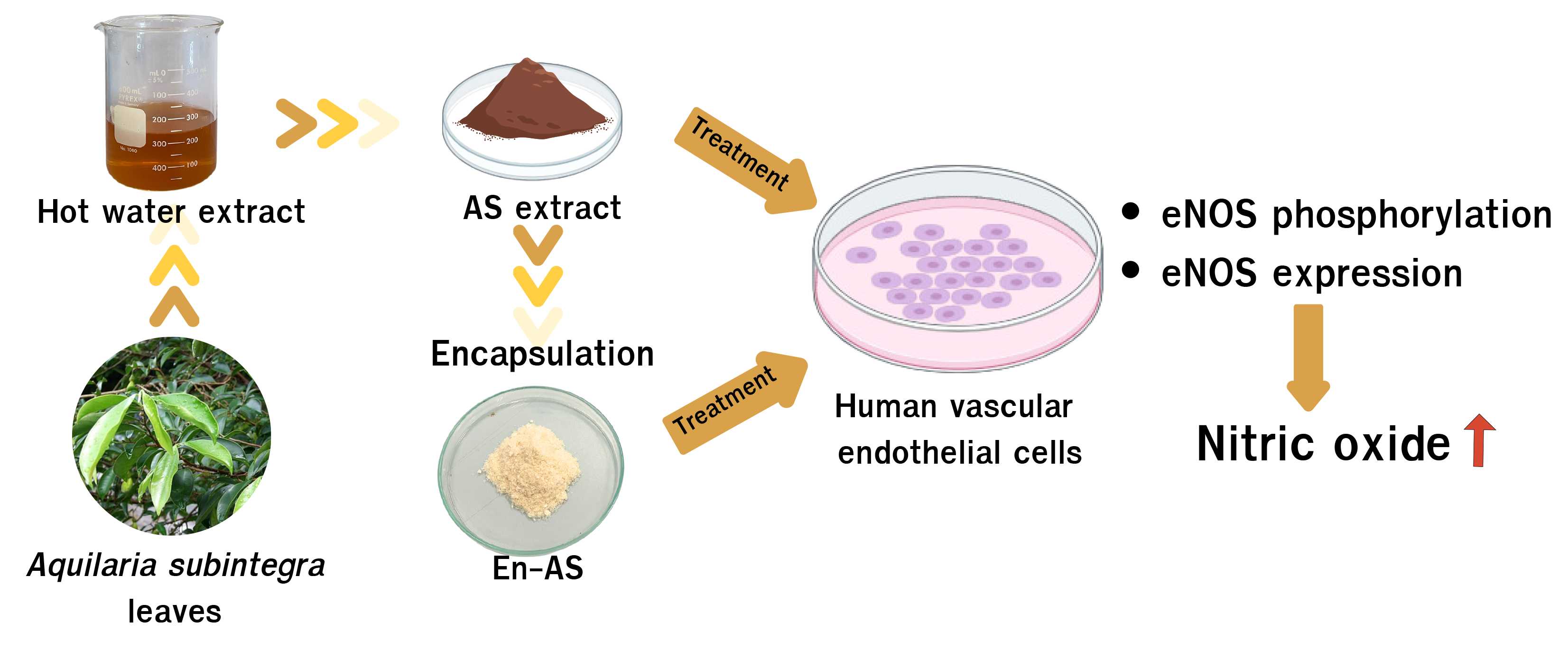
Downloads
References
JB Park, K Kario and JG Wang. Systolic hypertension: An increasing clinical challenge in Asia. Hypertension Research 2015; 38(4), 227-236.
W Srivanichakorn, IF Godsland, H Thomson, S Misra, P Phisalprapa, P Charatcharoenwitthaya, P Pramyothin, C Washirasaksiri, C Snehalatha, A Ramachandran, KGMM Alberti, DG Johnston and NS Oliver. Fasting plasma glucose and variation in cardiometabolic risk factors in people with high-risk HbA1c-defined prediabetes: A cross-sectional multiethnic study. Diabetes Research and Clinical Practice 2017; 134, 183-190.
J Davignon and P Ganz. Role of endothelial dysfunction in atherosclerosis. Circulation 2004; 109(S1), III27- III32.
S Karbach, P Wenzel, A Waisman, T Munzel and A Daiber. eNOS uncoupling in cardiovascular diseases - the role of oxidative stress and inflammation. Current Pharmaceutical Design 2014; 20(22), 3579-3594.
J Duarte, V Francisco and F Perez-Vizcaino. Modulation of nitric oxide by flavonoids. Food & Function 2014; 5(8), 1653-1668.
CA Schmitt and VM Dirsch. Modulation of endothelial nitric oxide by plant-derived products. Nitric Oxide 2009; 21(2), 77-91.
YZHY Hashim, PG Kerr, P Abbas and HM Salleh. Aquilaria spp. (agarwood) as a source of health beneficial compounds: A review of traditional use, phytochemistry, and pharmacology. Journal of Ethnopharmacology 2016; 189, 331-360.
W Thitikornpong, C Palanuvej and N Ruangrungsi. DNA barcoding for authentication of the endangered plants in genus Aquilaria. Thai Journal of Pharmaceutical Sciences 2018; 42(4), 214-220.
B Wungsintaweekul, K Umehara and H Noguchi. Chemical constituents of herbal tea, Krishna tea (Aquilaria subintegra; Thymelaeaceae), and its DPPH-free radical scavenging activity. In: Proceedings of the 9th Walailak Research National Conference, Walailak University, Nakhon Si Thammarat, Thailand. 2017.
H Bahrani, J Mohamad, MJ Payda and HA Rothan. Isolation and characterization of acetylcholinesterase inhibitors from Aquilaria subintegra for the treatment of Alzheimer’s disease (AD). Current Alzheimer Research 2014, 11(2), 206-214.
P Abbas, YZHY Hashim and A Amid. Cytokinetic study of uninfected agarwood branch ethanolic extract on breast cancer cells. Asia-Pacific Journal of Molecular Biology and Biotechnology 2017; 25(1), 91-97.
A Issuriya, C Sontimuang, S Sanpinit, S Chusri, T Kaewmanee and S Limsuwan. Aquilaria subintegra herbal tea leaves: 28-day repeated-dose oral sub-acute toxicity in Wistar rats. Journal of Complementary Medicine Research 2021; 12(4), 291.
C Aguilar-Garcia, G Gavino, M Baragaño-Mosqueda, P Hevia and VC Gavino. Correlation of tocopherol, tocotrienol, γ-oryzanol, and total polyphenol content in rice bran with different antioxidant capacity assays. Food Chemistry 2007; 102(4), 1228-1232.
F Zaidi, B Voirin, M Jay and MR Viricel. Free flavonoid aglycones from leaves of Mentha pulegium and Mentha suaveolens (Labiatae). Phytochemistry 1998; 48(6), 991-994.
S Saikia, NK Mahnot and CL Mahanta. Optimization of phenolic extraction from Averrhoa carambola pomace by response surface methodology and its microencapsulation by spray and freeze drying. Food Chemistry 2015; 171(1), 144-152.
S Zainal, M Musa, J Idris and KK Hamid. Effect of substrate concentration and reaction time of Aquilaria subintegra leaves extract on inhibition of pancreatic lipase. IOP Conference Series Materials Science and Engineering 2018; 358(1), 012039.
S Tripathy and PP Srivastav. Encapsulation of Centella asiatica leaf extract in liposome: Study on structural stability, degradation kinetics and fate of bioactive compounds during storage. Food Chemistry Advances 2023; 2, 100202.
R Srimoon and S Niyomwan. Effect of brewing temperature, time and method of tea infusion on phenolic compounds, tannins, flavonoids and antioxidant activity in Ventilago denticulata Willd. herbal tea. Journal of Science and Technology Mahasarakham University 2023; 42(3), 97-108.
G Galati and PJ O’Brien. Potential toxicity of flavonoids and other dietary phenolics: Significance for their chemopreventive and anticancer properties. Free Radical Biology and Medicine 2004; 37(3), 287-303.
L Martínez-Fernández, Z Pons, M Margalef, A Arola-Arnal and B Muguerza. Regulation of vascular endothelial genes by dietary flavonoids: Structure-expression relationship studies and the role of the transcription factor KLF-2. The Journal of Nutritional Biochemistry 2015; 26(3), 277-284.
BJ Michell, JE Griffiths, KI Mitchelhill, I Rodriguez-Crespo, T Tiganis, S Bozinovski, PRD Montellano, BE Kemp and RB Pearson. The Akt kinase signals directly to endothelial nitric oxide synthase. Current Biology 1999; 9(15), 845-848.
T Przygodzki, A Sokal and M Bryszewska. Calcium ionophore A23187 action on cardiac myocytes is accompanied by enhanced production of reactive oxygen species. Biochimica et Biophysica Acta - Molecular Basis of Disease 2005; 1740(3), 481-488.
ED Motley, K Eguchi, MM Patterson, PD Palmer, H Suzuki and S Eguchi. Mechanism of endothelial nitric oxide synthase phosphorylation and activation by thrombin. Hypertension 2007; 49(3), 577-583.
D Fulton, JP Gratton, TJ McCabe, J Fontana, Y Fujio, K Walsh, TF Franke, A Papapetropoulos and WC Sessa. Regulation of endothelium-derived nitric oxide production by the protein kinase Akt. Nature 1999; 399(6736), 597-601.
H Si, RP Wyeth and D Liu. The flavonoid luteolin induces nitric oxide production and arterial relaxation. European Journal of Nutrition 2014; 53(1), 269-275.
E Anter, SR Thomas, E Schulz, OM Shapira, JA Vita and JF Keaney. Activation of endothelial nitric-oxide synthase by the p38 MAPK in response to black tea polyphenols. Journal of Biological Chemistry 2004; 279(45), 46637-46643.
M Lorenz, S Wessler, E Follmann, W Michaelis, T Düsterhöft, G Baumann, K Stangl and V Stangl. A constituent of green tea, epigallocatechin-3-gallate, activates endothelial nitric oxide synthase by a phosphatidylinositol-3-OH-kinase-, cAMP-dependent protein kinase-, and Akt-dependent pathway and leads to endothelial-dependent vasorelaxation. Journal of Biological Chemistry 2004; 279(7), 6190-6195.
T Wallerath, G Deckert, T Ternes, H Anderson, H Li, K Witte and U Förstermann. Resveratrol, a polyphenolic phytoalexin present in red wine, enhances expression and activity of endothelial nitric oxide synthase. Circulation 2002; 106(13), 1652-1658.
G Reineccius. Controlled release of flavor in food products. In: A Taylor and J Hort (Eds.). Modifying flavour in food. Woodhead Publishing, Cambridge, UK, 2007, p. 169-184.
DJ McClements. Encapsulation, protection, and delivery of bioactive proteins and peptides using nanoparticle and microparticle systems: A review. Advances in Colloid and Interface Science 2018; 253(8), 1-22.
RVDB Fernandes, SV Borges and DA Botrel. Gum arabic/starch/maltodextrin/inulin as wall materials on the microencapsulation of rosemary essential oil. Carbohydrate Polymers 2014; 101, 524-532.
M Ahmed, MS Akter, JC Lee and JB Eun. Encapsulation by spray drying of bioactive components, physicochemical and morphological properties from purple sweet potato. LWT-Food Science and Technology 2010; 43(9), 1307-1312.
R Muangrat, K Ravichai and W Jirarattanarangsri. Encapsulation of polyphenols from fermented wastewater of Miang processing by freeze drying using a maltodextrin/gum Arabic mixture as coating material. Journal of Food Processing and Preservation 2019; 43(4), e13908.
B Cilek, A Luca, V Hasirci, S Sahin and G Sumnu. Microencapsulation of phenolic compounds extracted from sour cherry pomace: effect of formulation, ultrasonication time and core to coating ratio. European Food Research and Technology 2012; 235, 587-596.
Published
How to Cite
Issue
Section
License
Copyright (c) 2025 Walailak University

This work is licensed under a Creative Commons Attribution-NonCommercial-NoDerivatives 4.0 International License.





