
Adsorption Mechanism of Heavy Metals Using Activated Carbon Derived from Hydrilla Verticillata
DOI:
https://doi.org/10.48048/tis.2025.8732Keywords:
Activated carbon, Hydrilla Verticillata, Heavy metal adsorption, Water pollution, Surface morphology, Adsorption mechanism, Sustainable adsorbent, Activated carbon, Hydrilla verticillata, Heavy metal adsorption, Water pollution, Surface morphology, Adsorption mechanism, Sustainable adsorbentAbstract
This research investigates the adsorption mechanism of heavy metals (Cu, Pb, Fe and Zn) using activated carbon derived from Hydrilla verticillata, addressing the critical issue of water pollution caused by heavy metals, which pose significant environmental and health risks due to their persistence and toxicity. The study outlines the preparation process of the activated carbon, which involves washing, drying, carbonization, chemical activation and hydrothermal treatment. Characterization through SEM, EDX, XRD and FTIR analyses confirms the presence of functional groups and an amorphous structure conducive to adsorption. Adsorption tests reveal that H. verticillata-derived activated carbon shows high removal efficiency, especially for lead (Pb), with optimal adsorption capacities achieved within 120 min. The adsorption performance is attributed to a combination of physical adsorption, due to the microporous structure and large surface area, and chemical adsorption, facilitated by functional groups on the carbon surface. This study demonstrates that H. verticillata-derived activated carbon is a viable, cost-effective and environmentally friendly alternative to traditional adsorbents for heavy metal removal from water, with potential applications in sustainable water treatment solutions.
HIGHLIGHTS
- Activated carbon derived from the invasive aquatic plant verticillata shows significant potential for heavy metal adsorption in water treatment applications.
- Hydrothermally treated activated carbon exhibits enhanced surface morphology, larger surface area and better pore characteristics compared to untreated samples, contributing to its high adsorption capacity.
- The study demonstrates that verticillata-derived activated carbon effectively adsorbs Cu, Pb, Fe and Zn, with adsorption efficiencies improving with increased contact time.
- The adsorption mechanism involves both physical and chemical interactions, with hydroxyl and carbonyl functional groups playing a crucial role in binding heavy metal ions through complexation and coordination.
GRAPHICAL ABSTRACT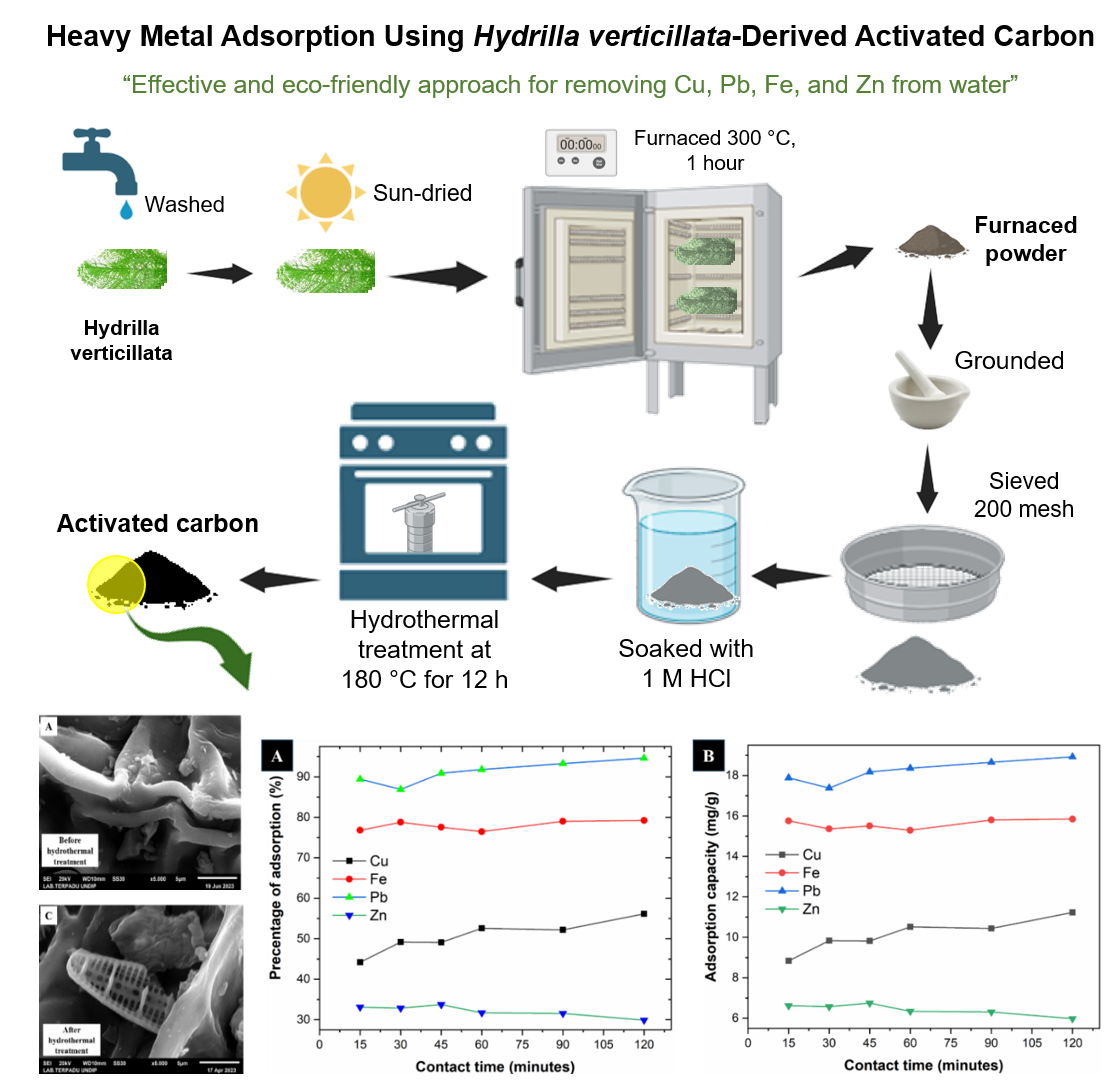
Downloads
References
H Xu, Y Jia, Z Sun, J Su, QS Liu, Q Zhou and G Jiang. Environmental pollution, a hidden culprit for health issues. Eco-Environment & Health 2022; 1(1), 31-45.
A Alengebawy, ST Abdelkhalek, SR Qureshi and MQ Wang. Heavy metals and pesticides toxicity in agricultural soil and plants: Ecological risks and human health implications. Toxics 2021; 9(3), 42.
MM Uddin, MCM Zakeel, JS Zavahir, FMMT Marikar and I Jahan. Heavy metal accumulation in rice and aquatic plants used as human food: A general review. Toxics 2021; 9(12), 360.
Z Wang, P Luo, X Zha, C Xu, S Kang, M Zhou, D Nover and Y Wang. Overview assessment of risk evaluation and treatment technologies for heavy metal pollution of water and soil. Journal of Cleaner Production 2022; 379(2), 134043.
N Akhtar, MI Syakir Ishak, SA Bhawani and K Umar. Various natural and anthropogenic factors responsible for water quality degradation: A review. Water 2021; 13(19), 2660.
J Shi, W Huang, H Han and C Xu. Pollution control of wastewater from the coal chemical industry in China: Environmental management policy and technical standards. Renewable and Sustainable Energy Reviews 2021; 143, 110883.
DA Ayejoto and JC Egbueri. Human health risk assessment of nitrate and heavy metals in urban groundwater in Southeast Nigeria. Ecological Frontiers 2024; 44(1), 60-72.
S Madhav, A Ahamad, AK Singh, J Kushawaha, JS Chauhan, S Sharma and P Singh. Water pollutants: Sources and impact on the environment and human health. In: D Pooja, P Kumar, P Singh and S Patil (Eds.). Sensors in water pollutants monitoring: Role of material. Springer, Singapore, 2020, p. 43-62.
A Taylor, JS Tsuji, MR Garry, ME McArdle, WL Goodfellow, WJ Adams and CA Menzie. Critical review of exposure and effects: Implications for setting regulatory health criteria for ingested copper. Environmental Management 2020; 65(1), 131-159.
H Schoofs, J Schmit and L Rink. Zinc toxicity: Understanding the limits. Molecules 2024; 29(13), 3130.
C Zhao, L Ge, L Mai, X Li, S Chen, Q Li, S Li, L Yao, Y Wang and C Xu. Review on coal-based activated carbon: Preparation, modification, application, regeneration, and perspectives. Energy & Fuels 2023; 37(16), 11622-11642.
M Wiśniewska and P Nowicki. Peat-based activated carbons as adsorbents for simultaneous separation of organic molecules from mixed solution of poly (acrylic acid) polymer and sodium dodecyl sulfate surfactant. Colloids and Surfaces A: Physicochemical and Engineering Aspects 2020; 585, 124179.
H Jiao, X Guo, F Shu, Q Zhang, W Wu, Y Jin and B Jiang. Structure-property-function relationships of wood-based activated carbon in energy and environment materials. Separation and Purification Technology 2024; 353, 128607.
N Hossain, MA Bhuiyan, BK Pramanik, S Nizamuddin and G Griffin. Waste materials for wastewater treatment and waste adsorbents for biofuel and cement supplement applications: A critical review. Journal of Cleaner Production 2020; 255, 120261.
G Ramalingam, AK Priya, L Gnanasekaran, S Rajendran and TKA Hoang. Biomass and waste derived silica, activated carbon and ammonia-based materials for energy-related applications - a review. Fuel 2024; 355, 129490.
MA Tony. Low-cost adsorbents for environmental pollution control: A concise systematic review from the prospective of principles, mechanism and their applications. Journal of Dispersion Science and Technology 2022; 43(11), 1612-1633.
N Kumar. Hydroponics and environmental bioremediation: Wastewater treatment. Springer Nature, Cham, Switzerland, 2024.
A Kali, A Amar, I Loulidi, M Jabri, C Hadey, H Lgaz, AA Alrashdi and F Boukhlifi. Characterization and adsorption capacity of four low-cost adsorbents based on coconut, almond, walnut, and peanut shells for copper removal. Biomass Conversion and Biorefinery 2024; 14(3), 3655-3666.
E Sembiring, D Bonardo, K Sembiring and Z Sitorus. Analyze the strength of ceramics made from clay, Sinabung volcanic ash and sea water in the term of the structure. Journal of Physics: Conference Series 2021; 2019, 012066.
NA Awang, WNW Salleh, F Aziz, N Yusof and AF Ismail. A review on preparation, surface enhancement and adsorption mechanism of biochar‐supported nano zero‐valent iron adsorbent for hazardous heavy metals. Journal of Chemical Technology & Biotechnology 2023; 98(1), 22-44.
B Wang, J Lan, C Bo, B Gong and J Ou. Adsorption of heavy metal onto biomass-derived activated carbon. RSC Advances 2023; 13(7), 4275-4302.
D Bonardo, N Darsono, S Humaidi, A Imaduddin and NS Silalahi. Effect of calcination frequency on the thermoelectric properties of Ti doped CuCrO2 by solid state method. Journal of Metals, Materials and Minerals 2023; 33(4), 1785.
F Zhi, W Zhou, J Chen, Y Meng, X Hou, J Qu, Y Zhao and Q Hu. Adsorption properties of active biochar: Overlooked role of the structure of biomass. Bioresource Technology 2023; 387, 129695.
R Shahrokhi-Shahraki, C Benally, MG El-Din and J Park. High efficiency removal of heavy metals using tire-derived activated carbon vs commercial activated carbon: Insights into the adsorption mechanisms. Chemosphere 2021; 264, 128455.
Z Raji, A Karim, A Karam and S Khalloufi. Adsorption of heavy metals: Mechanisms, kinetics, and applications of various adsorbents in wastewater remediation - a review. Waste 2023; 1(3), 775-805.
NS Razali, AS Abdulhameed, AH Jawad, ZA ALOthman, TA Yousef, OK Al-Duaij and NS Alsaiari. High-surface-area-activated carbon derived from mango peels and seeds wastes via microwave-induced ZnCl2 activation for adsorption of methylene blue dye molecules: Statistical optimization and mechanism. Molecules 2022; 27(20), 6947.
RA Ningrum, S Humaidi, S Sihotang, D Bonardo and Estananto. Synthesis and material characterization of calcium carbonate (CaCO3) from the waste of chicken eggshells. Journal of Physics: Conference Series 2022; 2193(1), 012009.
EG Söğüt and M Gülcan. Adsorption: Basics, properties, and classification. In: C Verma, J Aslam and ME Khan (Eds.). Adsorption through advanced nanoscale materials. Elsevier, Amsterdam, Netherlands, 2023, p. 3-21.
M Raninga, A Mudgal, VK Patel, J Patel and MK Sinha. Modification of activated carbon-based adsorbent for removal of industrial dyes and heavy metals: A review. Materials Today: Proceedings 2023; 77, 286-294.
Y Fei and YH Hu. Design, synthesis, and performance of adsorbents for heavy metal removal from wastewater: A review. Journal of Materials Chemistry A 2022; 10(3), 1047-1085.
ED Ligneris, LF Dumée and L Kong. Nanofibers for heavy metal ion adsorption: Correlating surface properties to adsorption performance, and strategies for ion selectivity and recovery. Environmental Nanotechnology, Monitoring & Management 2020; 13, 100297.
Z Zhang, T Wang, H Zhang, Y Liu and B Xing. Adsorption of Pb (II) and Cd (II) by magnetic activated carbon and its mechanism. Science of the Total Environment 2021; 757, 143910.
X Liu, X Xu, X Dong and J Park. Competitive adsorption of heavy metal ions from aqueous solutions onto activated carbon and agricultural waste materials. Polish Journal of Environmental Studies 2020; 29(1), 749-761.
M Sultana, MH Rownok, M Sabrin, MH Rahaman and SMN Alam. A review on experimental chemically modified activated carbon to enhance dye and heavy metals adsorption. Cleaner Engineering and Technology 2022; 6, 100382.
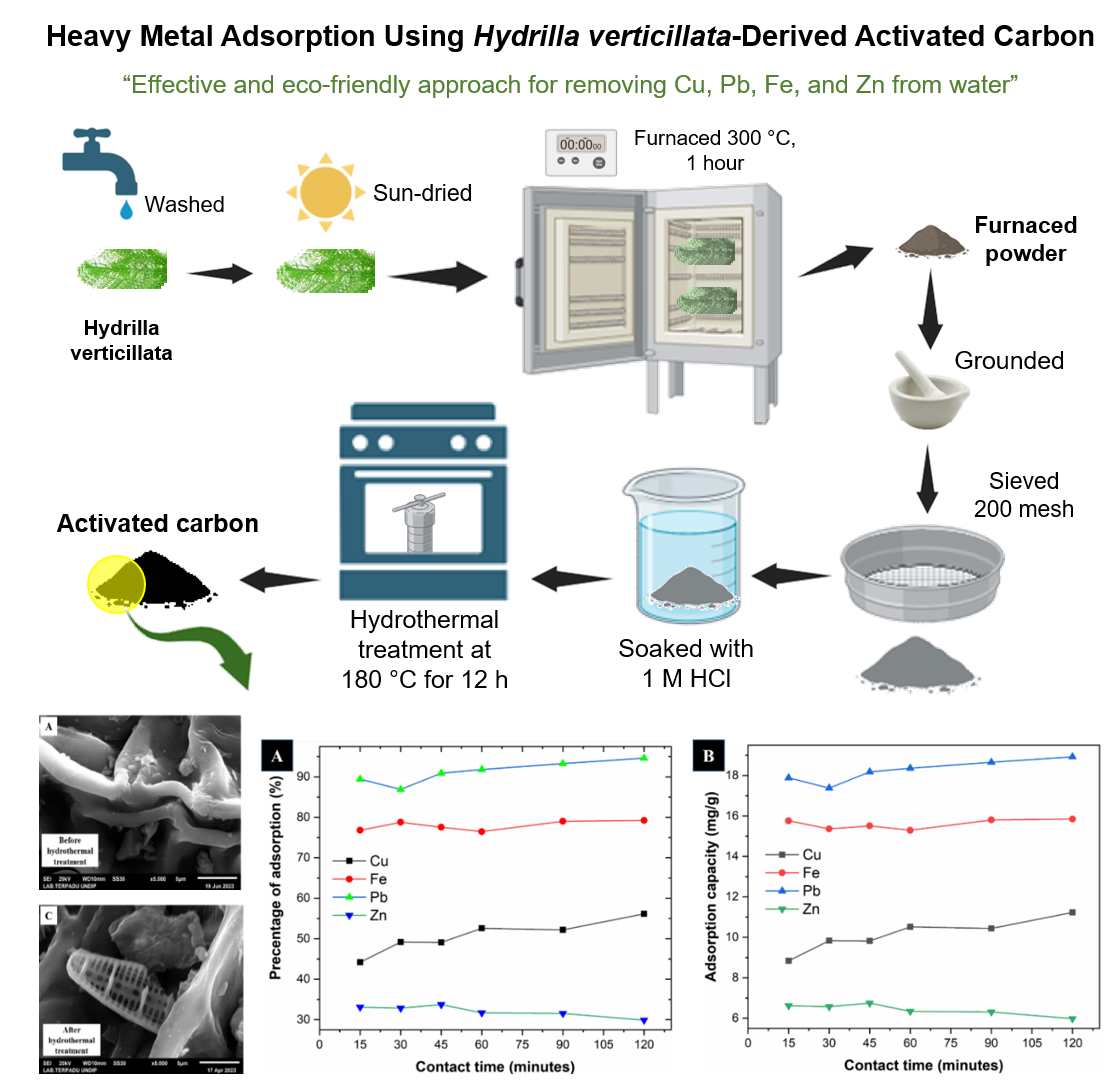
Downloads
Published
How to Cite
Issue
Section
License
Copyright (c) 2024 Walailak University

This work is licensed under a Creative Commons Attribution-NonCommercial-NoDerivatives 4.0 International License.





